
Part One — “What Grandma Put in the Bottles”
The chapel went silent before I even understood what Emma had said.
My four-year-old daughter stood beside the pastor, shaking so badly that the little black shoes I had fastened onto her feet that morning were tapping against the floor.
“Pastor,” she cried, “do I have to tell everyone what Grandma put in the babies’ bottles?”
My mother-in-law’s face changed instantly.
Until that moment, Margaret had been furious.
Now she looked terrified.
Trevor released my arm.
“What did you say, Emma?”
The pastor lifted a hand.
“Trevor, don’t question her.”
That sentence probably protected my daughter more than any of us understood at the time.
Emma pointed toward Margaret.
“I saw Grandma with the bottles.”
Margaret’s voice shot across the chapel.
“She doesn’t know what she’s talking about!”
Emma flinched.
I moved toward my daughter, but the pastor stepped between Margaret and us.
“Emma, sweetheart, you don’t have to tell us anything else right now.”
Margaret pushed forward.
“This is insane. She’s four.”
Then Emma said:
“She told me not to tell Mommy.”
That was when Trevor looked at his mother differently.
Not as the grieving grandmother he had defended five minutes earlier.
As someone he suddenly did not recognize.
Margaret must have seen it.
“Trevor, don’t you dare.”
He stared at her.
“What did you give them?”
The pastor stopped him too.
“No. We call the police.”
Margaret began shouting.
She accused me of coaching Emma.
Said grief had made everyone irrational.
Said I had always hated her.
Then, in the middle of all that noise, she screamed something that nobody in the chapel ever forgot.
“They were ruining everything!”
Silence.
Margaret seemed to hear her own words one second too late.
Trevor’s face went white.
“What?”
She shook her head.
“I didn’t mean—”
“You said they were ruining everything.”
She turned toward me.
Her expression twisted.
“You had three children under five. Trevor was exhausted. You were useless half the time. The house was chaos.”
I remember staring at her and thinking:
My sons are ten feet away in coffins, and she is still trying to win an argument.
Then she said:
“Someone had to fix things.”
The pastor told an usher to lock the exterior doors until police arrived.
Margaret tried to leave anyway.
Two relatives blocked her without touching her.
I knelt beside Emma.
“You’re not in trouble.”
She was crying now.
“I had cookies.”
“What?”
“Grandma gave me cookies so I wouldn’t come in the kitchen.”
I wanted to ask a hundred questions.
I asked none.
An officer arrived within minutes, then another.
The funeral stopped being a funeral.
It became a crime scene, a child-safety response, and the worst day of my life all over again.
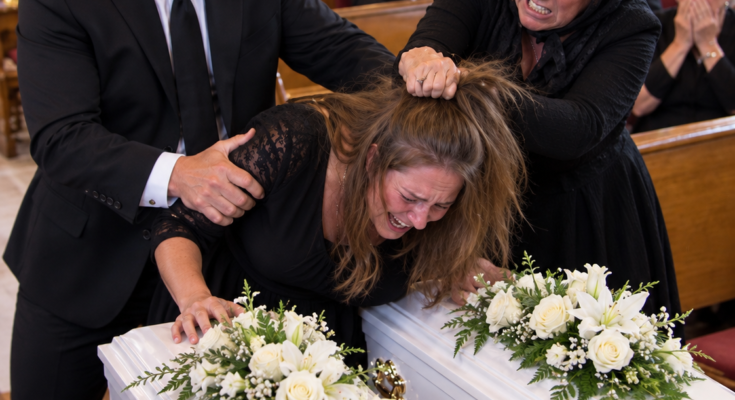
An officer photographed the swelling near my temple where Margaret had slammed my head against the coffin.
Another took initial statements from the adults who had witnessed the assault and Margaret’s outburst.
When an officer approached Emma, he crouched but did not start interrogating her.
He asked only enough to make sure she was safe.
Later, trained child-interview specialists would speak with her properly.
That mattered.
Emma was not evidence first.
She was a four-year-old who had just buried her brothers.
Police asked one question that made my stomach turn.
“Where did the twins die?”
“At home.”
“Were the bottles from that night preserved?”
I looked at Trevor.
He looked back at me.
After the boys died, investigators had already collected several items because two infants dying unexpectedly on the same night required examination.
At the time, preliminary findings had not given us a clear answer.
We had been told additional toxicology and pathology results could take time.
Margaret had spent those weeks insisting there was nothing to investigate.
“Sometimes God decides,” she kept saying.
I had hated that sentence.
Now I understood why she might have wanted us to accept it.
Trevor sank into a pew.
“My mother was there that night.”
I turned toward him.
“What?”
His eyes filled.
“You were asleep upstairs. I went to the pharmacy because Noah had a fever.”
Our twins were Noah and Benjamin.
Eight months old.
Trevor continued.
“Mom came over. She said she’d stay with them while I ran out.”
I stared at him.
“You never told me she was alone with them.”
“I didn’t think it mattered.”
The police officer heard him.
Now it mattered enormously.
━━━━━━━━━━━━━━━━━━━━
Part Two — The Night We Had Never Reconstructed
The investigation took weeks.
Not one dramatic confession in a chapel.
Not one frightened child’s memory.
Weeks.
Emma was interviewed by trained professionals.
Her account remained simple.
Grandma had been in the kitchen.
Two bottles were on the counter.
Margaret poured something from a small container into them.
Emma asked what it was.
Margaret told her it was “medicine to make the babies settle down.”
Then she gave Emma cookies and told her to watch television.
Emma remembered Margaret saying on the phone:
“They’ll finally be quiet.”
That statement alone did not prove murder.
The physical evidence mattered.
Toxicology testing eventually identified a sedating substance in both boys’ systems that had not been prescribed to either child.
Residue consistent with the same substance was found in one preserved bottle.
Investigators found that Margaret had access to medication containing that substance.
Phone records placed her in our house during the critical time.
Messages recovered from her phone showed something even uglier.
Weeks before the twins died, she had complained repeatedly to relatives about how the babies had “destroyed Trevor’s life.”
One message read:
He was happier before all these children.
Another:
She can’t handle them, and he won’t admit it.
Nothing in those messages alone proved what happened.
Together with the forensic evidence and Emma’s independently obtained statement, they became part of a much larger case.
Trevor stopped defending his mother.
But that did not repair what he had done to me at the funeral.
He had watched his mother insult me beside our children’s coffins.
Then when she assaulted me, his first instinct had been to grab me and order me to leave.
I could not unknow that.
When he apologized, I told him:
“You only stopped protecting her when you became afraid she had hurt the boys. You were willing to let her hurt me.”
He cried.
I did too.
Understanding him was not the same as forgiving him.
━━━━━━━━━━━━━━━━━━━━
Part Three — Emma Was Never Responsible for Solving It
Margaret was charged after investigators completed enough of their work for prosecutors to move forward.
The case lasted much longer than people expected.
There were hearings.
Experts.
Defense challenges to toxicology.
Arguments about whether Emma’s memories were reliable.
Questions about handling of evidence.
That was difficult to endure, but necessary.
A terrible accusation does not become true merely because people desperately want an explanation.
Eventually, the prosecution established that Margaret had intentionally added a substance to the twins’ bottles in an attempt to make them sleep for an extended period.
The boys never woke.
She insisted she had not intended to kill them.
She claimed she only wanted them quiet because Trevor was exhausted and I was, in her words, “incapable of controlling the house.”
That distinction mattered legally.
It did not matter much to me as their mother.
Noah and Benjamin were eight months old.
They did not need to be controlled.
They needed adults to keep them safe.
Margaret had convinced herself that she understood what her son needed better than everyone else.
Including her son.
Including me.
Including doctors.
Including the babies whose bodies she decided she had the right to alter because their crying inconvenienced her.
The court eventually imposed serious consequences based on the charges that could be proven.
I do not remember the exact words the judge used.
I remember Margaret turning around before she was taken away.
For one awful second, I thought she might look at me.
She looked at Trevor instead.
“You know I did everything for you.”
Trevor’s face collapsed.
“No, Mom.”
His voice was barely audible.
“You did everything to keep me yours.”
That was the first time I understood the deeper shape of their relationship.
Margaret had spent Trevor’s entire life interpreting control as devotion.
She chose his friends.
Criticized girlfriends.
Inserted herself into finances.
After we married, every boundary became evidence that I was “taking her son away.”
When Emma was born, she competed with me over feeding, naps, even what Emma called her.
When the twins arrived, something in her became more intense.
Trevor was overwhelmed.
So was I.
We had three children under five.
Our home was noisy.
Laundry multiplied faster than we could fold it.
Some nights Trevor and I communicated mostly through exhausted nods.
Margaret saw all of that and decided the problem wasn’t that young parents needed support.
The problem, in her mind, was the babies.
That knowledge almost destroyed Trevor.
He started therapy.
So did I.
We also put Emma in age-appropriate trauma therapy.
The first thing her therapist helped us understand was that Emma could not be allowed to believe she had “caught” Grandma or “saved” us.
Adults around her kept saying things like:
“You were so brave.”
“You told the truth.”
“You helped the police.”
Those statements were well meant.
But her therapist warned us to be careful.
A four-year-old should not grow up believing the responsibility for stopping adult violence belonged to her.
So when Emma finally asked:
“Did Grandma go away because I told?”
I sat beside her on the floor.
“No.”
“But I told the pastor.”
“Yes.”
“And then police came.”
“Yes.”
She looked confused.
I took her hands.
“Grandma went away because of choices Grandma made. You told something you remembered. Then adults investigated.”
“Was I bad because I didn’t tell before?”
That question shattered me.
“No.”
I pulled her into my arms.
“You did nothing wrong.”
“Not even eating the cookies?”
I cried into her hair.
“Especially not eating the cookies.”
For a long time, she thought the cookies were part of the crime.
In a four-year-old’s mind, she had accepted a treat and then something terrible happened.
It took months before she could eat that kind of cookie again without asking whether it was safe.
That is what people forget about child witnesses.
They don’t remember events like adults do.
They build strange little bridges between details.
Cookies.
A kitchen light.
A phone ringing.
Grandma’s cardigan.
Things adults would dismiss can become the center of a child’s fear.
Trevor and I did not stay together.
That surprised our families.
They assumed tragedy should either permanently bind us or that Margaret’s crime was so enormous nothing else mattered.
But our marriage had been damaged before we knew what Margaret had done.
For years, Trevor had repeatedly asked me to tolerate his mother’s cruelty because confronting her was exhausting.
“She doesn’t mean it.”
“That’s just Mom.”
“Can you let it go this once?”
Every “this once” became the architecture of our marriage.
At our sons’ funeral, when she assaulted me, Trevor’s reflex was to protect the system he understood.
His mother created the conflict.
I was expected to leave.
Later, he understood.
Deeply.
Painfully.
But understanding came after something inside me had changed permanently.
We separated eight months after the trial began.
There was no bitter custody war.
Trevor loved Emma.
Emma loved him.
I never wanted her to lose another parent because our marriage had failed.
We learned to co-parent.
Slowly.
Sometimes awkwardly.
Trevor became much better at hearing the word no without interpreting it as abandonment.
Years later, he apologized to me again.
We were sitting in the parking lot after Emma’s middle-school concert.
“I’ve apologized for the funeral a thousand times.”
“I know.”
“But I don’t think I understood it until recently.”
I looked at him.
He said:
“When Mom hit you, I wasn’t thinking about what was right. I was thinking about getting the person who usually gave in to give in again.”
That was exactly it.
I had always been easier to move than Margaret.
So he moved me.
Until he couldn’t anymore.
I accepted that apology.
It did not make me regret leaving.
Emma is sixteen now.
She remembers almost nothing about the funeral.
I’m grateful.
She remembers Noah and Benjamin through photographs and the stories we tell.
Noah loved being bounced.
Benjamin made a strange squeaking sound before he laughed.
They both hated peas.
They both calmed down when Trevor sang badly.
Those are the memories I wanted their sister to inherit.
Not bottles.
Not toxicology reports.
Not a grandmother screaming in a chapel.
On their birthday every year, Emma and I bring two small blue flowers to the cemetery.
Trevor joins us when he can.
We do not talk about Margaret there.
She has already occupied enough space beside our sons.
Last year, Emma asked me something while we stood near their graves.
“Mom?”
“Yeah?”
“Do you think they would’ve liked me?”
I smiled.
“You would have bossed them around constantly.”
She laughed.
“No, seriously.”
“I am serious.”
Then I put my arm around her.
“They would have adored you.”
She looked down at the flowers.
“I used to think they died because I didn’t tell you what Grandma did.”
My chest tightened.
“Do you still think that?”
“No.”
Then she said something that told me years of therapy, careful language, and ordinary love had done their work.
“I was four. Adults were supposed to know.”
“Yes.”
She nodded.
“Grandma was supposed to know.”
That was the truth.
The worst moment of my life was not when Emma spoke at the funeral.
It wasn’t even when we learned what Margaret had done.
It was realizing how many adults had spent years normalizing behavior because challenging Margaret was inconvenient.
I had done it.
Trevor had done it.
Relatives had done it.
We told ourselves her cruelty was personality.
Her possessiveness was love.
Her control was concern.
And eventually, the person everyone kept appeasing convinced herself there was no boundary she wasn’t entitled to cross.
People sometimes tell this story as though my four-year-old daughter stood up at a funeral and solved a murder.
She didn’t.
She was a frightened child who said something she remembered.
Adults finally listened.
Professionals investigated.
Evidence established what happened.
And the person responsible faced consequences.
Emma’s job was never to save her brothers.
She was their sister.
That was all she ever should have had to be.
And if there is one thing I wish I could go back and whisper to the woman I was beside those two small coffins, it would be this:
Protecting the peace is not the same as protecting your family.
Sometimes the safest thing you can do is finally let the truth make noise.