
Part One — The Letter in My Mother’s Pocket
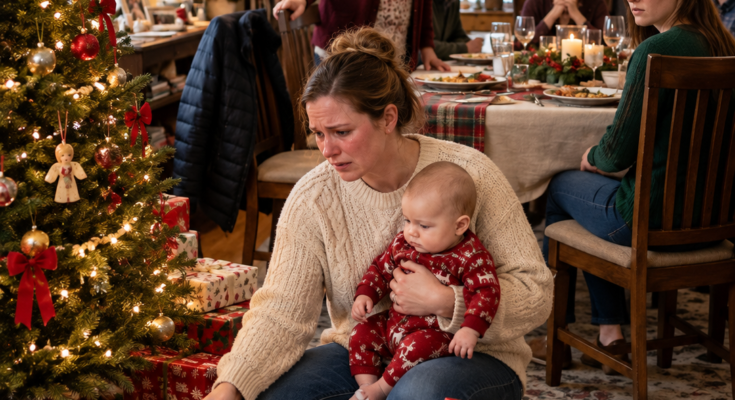
My daughter’s presents were the smallest pile beneath my mother’s tree, tucked so low the pine needles almost swallowed the ribbon.
A soft book from my sister.
A little stuffed bunny from my aunt.
Two uneven boxes I had wrapped after midnight in my apartment, after my eight-month-old daughter, Lucy, finally fell asleep and the only sound left was the dryer thumping through the wall.
I had carried her into that dining room wanting one quiet Christmas.
The table looked exactly the way Mom liked Christmas to look.
Polished glasses.
Turkey beneath the chandelier.
Cranberry sauce in the good bowl.
Cinnamon candles making the house smell warmer than it felt.
Lucy sat against my chest in her red Christmas onesie, staring at the tree lights as though someone had hung stars indoors just for her.
Then Mom put down her fork.
“She looks… off.”
The entire table seemed to hesitate.
I looked at her.
“What?”
“Are you sure that baby is even healthy?”
My cousin stopped chewing.
My aunt stared down at her plate.
My sister Jenna’s husband folded his napkin once, then again.
Even the children at the folding table became quiet.
Lucy didn’t understand the insult.
She only felt my body go still.
I waited for Mom’s familiar little laugh—the one she used whenever cruelty came out too clearly and she needed everyone to pretend it had been humor.
It didn’t come.
Instead she lifted her wineglass.
“I’m just saying what everyone is thinking. Some babies are not… normal.”
“Mom,” Jenna whispered. “Stop.”
But Mom wore that careful expression she had perfected over decades.
Concern.
Always concern.
My clothes were never flattering enough because she was “concerned.”
My job was disappointing because she “wanted more for me.”
After my divorce, my apartment was too small because she was “worried about my standards.”
The way I fed Lucy was wrong.
I held her too much.
I responded too quickly when she cried.
I was making her dependent.
Mom never called any of that criticism.
She called it helping.
For years, I called my silence keeping the peace.
Then Lucy’s fist tightened in my sweater.
She trusted me with her entire little body.
And suddenly I understood something embarrassingly simple.
Peace should not cost a child her dignity.
I stood.
The chair scraped loudly across the floor.
Everyone looked at me.
I tucked Lucy against my side, grabbed the diaper bag, and walked toward the Christmas tree.
I picked up her presents one by one.
The book.
The bunny.
The two crooked boxes.
“What are you doing?” Mom asked.
Her voice had changed.
Only slightly.
But enough.
Fear.
Not fear of losing me.
Fear of losing control of the scene.
I zipped the diaper bag.
“Don’t be dramatic,” she said. “I didn’t mean it like that.”
I turned.
“This is her last Christmas here.”
For once, Mom had no immediate answer.
Her eyes moved around the table, searching for someone to tell me I was too sensitive.
Nobody did.
My aunt looked down.
My uncle suddenly became fascinated by his coffee.
Jenna stared directly at our mother.
I reached the hallway table.
Christmas cards sat in a basket beside a tiny American flag in a blue ceramic vase.
Lucy rested her warm cheek against my neck.
My hand was shaking when I grabbed the doorknob.
Then Jenna spoke.
Quietly.
Too quietly.
“Mom… you didn’t tell her about the letter, did you?”
The whole house seemed to stop breathing.
I turned.
“What letter?”
Mom’s face lost its color.
Not embarrassed pale.
Caught pale.
Jenna covered her mouth.
Mom looked at her, then at me.
One hand slowly moved toward the pocket of her cardigan.
“Mom.”
She stopped.
“Take your hand out of your pocket.”
Nothing.
Jenna whispered:
“Please just give it to her.”
Mom pulled out a folded envelope.
My name was written across the front.
CLAIRE
But it wasn’t my mother’s handwriting.
I knew those blocky capital letters immediately.
My father’s.
Dad had died eleven months earlier.
I had been five months pregnant with Lucy.
I stared at the envelope.
“Where did you get that?”
Mom’s fingers tightened around it.
“Claire, Christmas is not the time.”
“You’ve had a letter from my dead father in your pocket and Christmas isn’t the time?”
Jenna stood.
“I thought she gave it to you.”
I looked at her.
“What are you talking about?”
Jenna’s eyes filled.
“Dad wrote it before he went into hospice. I was there when he gave it to Mom.”
My stomach dropped.
“He told her to give it to you after the baby was born.”
I looked at my mother.
Lucy shifted against my shoulder.
“You’ve had this for eight months?”
Mom finally held it out.
“I was going to give it to you when you were in a better place emotionally.”
That sentence told me more than she intended.
Even Dad’s words had apparently required her approval before I was mature enough to receive them.
I took the envelope.
Then sat on the bottom stair because my knees had stopped cooperating.
Dad’s handwriting filled three pages.
The first line read:
Claire, if you’re reading this, then I didn’t get to meet my granddaughter. That may be the hardest part of leaving.
I stopped.
Lucy grabbed the edge of the paper.
I kissed her fingers and kept reading.
Dad wrote about becoming a grandfather.
About regretting that he would never hold her.
About hoping she inherited my laugh instead of his knees.
Then the letter changed.
There is something I should have told you while I was well enough to say it properly.
My chest tightened.
I spent too much of your childhood asking you to understand your mother.
I looked up.
Mom was standing completely still.
I read on.
When she criticized your clothes, I said she wanted the best for you. When she embarrassed you in front of relatives, I said she was blunt. When she made you cry and then accused you of being sensitive, I told you not to ruin the evening.
Tears blurred the page.
Dad had never been cruel to me.
That was almost what made the letter harder.
He had been kind.
And quiet.
I thought keeping the family peaceful made me a good husband and father. Too often, it only made you the person required to absorb whatever everyone else didn’t want to confront.
Jenna was crying now too.
Mom said:
“Your father was sick when he wrote that.”
I kept reading.
You are going to have a daughter soon. I hope your mother becomes the grandmother I know she is capable of being. But if she ever starts teaching that little girl the same lesson we taught you—that love requires accepting humiliation—please do what I did not do often enough. Protect the child first. Let the adult be uncomfortable.
My breath caught.
He had written it before Lucy was born.
Before he knew her face.
Before the red Christmas onesie.
Before that dinner table.
Dad wasn’t predicting the future.
He knew the past.
That was enough.
At the bottom, beneath his signature, he had added one final line.
Keeping the peace is only noble when everyone is allowed to have some.
I folded the letter carefully.
Mom said:
“You cannot possibly think your father wanted you to walk out of Christmas.”
I looked at her.
“No.”
Her shoulders relaxed.
Then I stood.
“I think he wanted me to stop pretending walking out is worse than what makes you leave.”
And I opened the door.
━━━━━━━━━━━━━━━━━━━━
Part Two — Why She Hid It
Mom called before I had even gotten Lucy strapped into her car seat.
I didn’t answer.
She texted instead.
You are twisting your father’s words because you’re emotional.
Then:
I said one thing about Lucy’s health. Any responsible grandmother would notice when something looks wrong.
That part mattered enough that I called Lucy’s pediatrician after Christmas.
Not because I believed my mother.
Because genuine medical concerns should be handled medically, not turned into insults over turkey.
Lucy’s doctor had no new concerns about her development.
But even if she had, it would not have justified what happened at that table.
A child’s medical condition would never make “not normal” an acceptable family punch line.
Jenna came to my apartment two days later.
She brought the bunny we accidentally left behind.
“I’m sorry.”
“For what?”
“For knowing about the letter.”
“You thought she gave it to me.”
“At first.”
I looked at her.
“And later?”
Jenna stared at her hands.
“I asked in September. Mom said you were too overwhelmed after the divorce and the baby. She said Dad’s letter would just make you angry.”
“And you accepted that?”
Her eyes filled.
“Yes.”
I nodded.
That hurt.
But at least she didn’t hide behind an excuse.
“I should’ve called you,” she said. “I did the same thing Dad wrote about. I let Mom decide what everyone else could handle because contradicting her was harder.”
That was the first apology I received that actually helped.
Mom’s took much longer.
For three months, she insisted I was withholding Lucy to punish her.
I wasn’t.
I had simply stopped offering my daughter as the price of family harmony.
My boundary was simple.
No comments about Lucy’s body, face, intelligence, health, weight, development, or temperament as entertainment.
If Mom ever had a legitimate concern, she could tell me privately and respectfully.
No undermining me as Lucy’s mother.
No posting photographs without asking.
No access to Lucy while speaking badly about me in front of her.
Mom called those rules “controlling.”
I said:
“You’re allowed to dislike them.”
That was new for me.
I did not argue until she approved.
━━━━━━━━━━━━━━━━━━━━
Part Three — The Christmas We Built Ourselves
Lucy’s next Christmas was held in my apartment.
The one Mom had repeatedly called too small.
We fit twelve people into it.
Barely.
Jenna brought folding chairs.
My aunt brought too much food.
My uncle discovered my cheap little coffee maker apparently offended him on a spiritual level and arrived with a better one.
Lucy was twenty months old and more interested in wrapping paper than presents.
The tree leaned slightly to the left.
Half the lights stopped working after dinner.
It was one of the best Christmases I had ever had.
Mom was not there.
That wasn’t revenge.
She simply had not reached the point where I trusted her to participate without turning the holiday into a test of whether I had “forgiven enough.”
She mailed Lucy a gift.
A wooden puzzle.
No guilt note.
No message addressed through my daughter.
That was the first good sign.
Then, in February, Mom called.
“I want to apologize.”
I waited.
She started poorly.
“I’m sorry if what I said sounded cruel.”
I almost ended the call.
Then she stopped herself.
“No.”
There was a long pause.
“That’s not an apology.”
I said nothing.
She tried again.
“I said something cruel about Lucy in front of the whole family.”
“Yes.”
“I knew it would embarrass you.”
That surprised me.
“You knew?”
“I was angry.”
“About what?”
Mom breathed out slowly.
“That you weren’t asking me for help anymore.”
I sat down.
After my divorce, Mom had become intensely involved in my life.
She helped with errands.
Bought baby supplies.
Came to appointments.
At first I appreciated it.
Then every favor became evidence that I couldn’t manage without her.
So I had gradually stopped asking.
Mom noticed.
“I felt you pulling away,” she said. “Then you came to Christmas looking happy.”
I almost laughed.
“That made you angry?”
“It made me feel unnecessary.”
There it was.
Not concern about Lucy.
Not health.
Fear.
Mom continued.
“I wanted to remind you that you still needed my judgment.”
The honesty was ugly.
But it was honesty.
Then she spoke about the letter.
“I hid it because your father wrote things about me I did not want you reading.”
“Obviously.”
“I told myself I was protecting you.”
“You were protecting yourself.”
“Yes.”
That was the first time in my life I heard my mother accept a correction without defending herself.
She began seeing a counselor.
I did not require that.
She chose it.
Eventually she told me her own mother had been much worse.
Appearance had been everything.
Weight.
Grades.
Manners.
How the family looked to outsiders.
Mom had grown up believing criticism was a form of maintenance.
“You correct people you love before the world gets a chance to,” she said.
I understood how she learned it.
I did not pretend that made passing it down acceptable.
Context can explain a pattern.
It does not obligate the next generation to continue it.
Mom saw Lucy again when Lucy was nearly two.
We met at a park.
Jenna came too.
Mom did not rush toward her.
She crouched a few feet away and said:
“Hi, Lucy.”
Lucy hid behind my leg.
Mom smiled.
“That’s okay.”
No:
Come give Grandma a kiss.
No:
She doesn’t remember me because you kept her away.
Just patience.
Ten minutes later, Lucy handed her a pinecone.
Mom treated it like a diamond.
Trust came back in moments like that.
Small enough nobody would put them in a movie.
Mom asking before posting a picture.
Mom accepting when I said a visit needed to end.
Mom saying, “She’s shy today,” then correcting herself:
“No, she’s just deciding whether she wants to come over.”
Mom learning that children do not owe adults physical affection.
Mom learning that neither did I.
She never again spent Christmas as the unquestioned center of the family.
Sometimes we went to her house.
Sometimes mine.
Sometimes Jenna hosted.
The holiday stopped belonging to one person’s rules.
Dad’s letter lives in a wooden box in my bedroom now.
When Lucy turned four, she found a photograph of him holding my pregnant belly.
“Who’s that?”
“Your grandpa.”
“Where is he?”
“He died before you were born.”
She studied the picture.
“Did he know me?”
I thought about the letter.
“Yes.”
That confused her.
“But I wasn’t born.”
“He knew about you.”
She accepted that.
Then asked whether Grandpa liked dinosaurs.
Four-year-olds are excellent at refusing to let adults turn sentimentality into a long performance.
When Lucy is older, I may give her Dad’s letter.
Not because I want her to inherit my conflict with her grandmother.
She has her own relationship with Mom now.
I want her to know something else.
Patterns can be inherited without being permanent.
My father saw one clearly near the end of his life.
He regretted the part he played in maintaining it.
My sister recognized hers.
Eventually, Mom recognized hers too.
And I finally recognized mine.
For years, I thought being a good daughter meant absorbing the uncomfortable moment so everyone else could enjoy dinner.
Smile.
Change the subject.
Don’t ruin Christmas.
Don’t embarrass your mother.
Don’t make people choose sides.
Then one sentence about an eight-month-old baby finally made the cost visible.
Lucy will never remember that Christmas.
I’m glad.
She will not remember being called “not normal.”
She won’t remember me packing her little bunny beneath the tree or carrying her into the cold while my hands shook.
But I remember.
And every Christmas since, when I see her opening gifts, I think about those two crooked boxes tucked beneath my mother’s tree.
I thought I was taking presents away from Christmas that afternoon.
I wasn’t.
I was taking my daughter away from a lesson I had spent my whole life learning:
That keeping an adult comfortable matters more than protecting yourself.
Dad had spent years wishing he’d challenged that lesson sooner.
I finally did.
Not by screaming.
Not by humiliating my mother back.
I picked up my baby.
I picked up her gifts.
And I left.
Sometimes ending a family pattern doesn’t look dramatic.
Sometimes it looks like a mother with a diaper bag in one hand and a doorknob in the other, finally understanding that the person most angry about your boundary is often the person who benefited most from you never having one.