At my husband’s funeral, his mother stood beside his polished mahogany casket and proudly announced to a packed chapel that I had ruined him, stolen from him, and that he was better off dead. She fully expected me to break down in humiliated tears. She had absolutely no idea that my eight-year-old son was about to stand up, hold his dead father’s cell phone high in the air, and ask if she wanted the entire room to hear the explosive recording his dad had made about her.
Part One — The Recording Daniel Left Behind
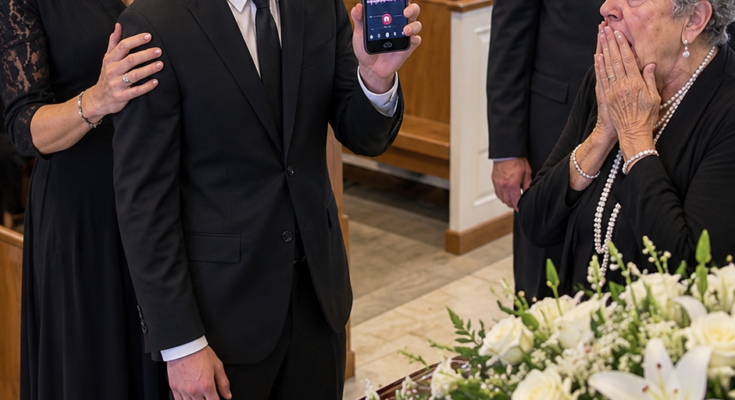
Vivian’s pearls gleamed beneath the chapel lights as she faced the mourners.
“Better he’s gone now than forced to live with the embarrassment she brought him,” she declared.
My husband, Daniel, lay six feet away in a polished mahogany casket wearing the navy tie I had chosen for our anniversary dinner three weeks earlier.
I sat in the front pew with our eight-year-old son, Noah.
I had buried my husband in the morning.
Apparently, by afternoon, I was expected to defend myself at his funeral.
Vivian dabbed dry eyes with a lace handkerchief.
“She came into this family with nothing. Daniel gave her a home, a respected name, a beautiful life. And she repaid him with secret debts and financial disgrace.”
Behind her stood Daniel’s older brother, Grant.
Arms crossed.
Expression solemn.
The same Grant who had asked me about Daniel’s life insurance before the funeral home had even collected Daniel’s body.
Vivian stepped closer.
“You should be grateful we’re even allowing you to sit with the family.”
Nobody defended me.
I didn’t answer.
During the six days since Daniel’s car accident, Vivian had told anyone willing to listen that I had forged Daniel’s signature on business loans, hidden hundreds of thousands of dollars, and almost destroyed Bellmore Manufacturing—the company Daniel’s father had founded.
None of it was true.
But I had stopped trying to argue with rumors.
Daniel used to tell me:
“Never interrupt someone while they’re busy exposing themselves.”
So I let Vivian speak.
“My son spent his last months cleaning up her financial mess,” she continued. “Now Grant and I will protect what remains of Daniel’s legacy.”
There it was.
Not grief.
Ownership.
Vivian believed Daniel’s company shares, our home, and the insurance proceeds would somehow become hers to control once she convinced everyone I was dishonest.
What she didn’t know was that seven days before his death, Daniel had discovered something.
And recorded it.
Beside me, Noah moved.
At first I thought he wanted my hand.
Then I saw the black phone between his palms.
Daniel’s phone.
Police had returned it with his wallet and wedding ring.
I had locked it in my bedroom drawer because I couldn’t bear to hear his voice.
Noah must have found the spare key.
“Noah,” I whispered.
He stood.
Every head in the chapel turned.
Vivian frowned.
“Sit down, sweetheart. The adults are speaking.”
Noah’s hands shook.
“Grandma, do you want me to play the recording Dad made about you last week?”
Every trace of color disappeared from Vivian’s face.
Grant uncrossed his arms.
“What recording?” he demanded.
Noah looked at the screen.
I stood immediately and put one hand over the phone.
“No.”
He stared at me.
“But Mom—”
“This isn’t your job.”
His eyes filled.
“She’s lying about you.”
“I know.”
“Dad said—”
“I know.”
I took the phone gently.
“You don’t have to defend me at your father’s funeral.”
The chapel was completely silent.
Then Vivian snapped:
“Give me that phone.”
That was the moment everything changed.
Not because of what she said.
Because of how quickly she said it.
Grant moved toward us too.
“I’m executor of Daniel’s business affairs. That phone may contain company information.”
I put it into my purse.
“You’re not touching it.”
Vivian’s voice sharpened.
“You have no idea what’s on there.”
I looked directly at her.
“Apparently you do.”
She said nothing.
The funeral director stepped between us before things escalated.
I took Noah into the small family room behind the chapel.
He was crying.
“I heard Dad talking on it.”
“When?”
“Before his trip.”
That was how he knew.
Daniel had apparently recorded something, then listened to part of it again in his home office. Noah had heard his grandmother’s name through the door.
“Did you listen to all of it?”
He shook his head.
“Just Dad saying Grandma couldn’t keep doing it.”
I hugged him.
Then I did the thing grief had prevented me from doing for six days.
I unlocked Daniel’s phone.
There were three audio files in a folder labeled:
FOR ELENA — IF I DON’T GET THIS FIXED FIRST.
My name.
My hands went numb.
The first recording began with Daniel’s voice.
Tired.
Angry.
Alive.
“Mom, I know the signatures aren’t Elena’s.”
A woman answered.
Vivian.
“Keep your voice down.”
Then Grant.
“You’re misunderstanding the restructuring.”
Daniel again:
“No. I’ve compared the loan documents. Someone used Elena’s information to guarantee debt she never approved.”
I sat down.
Noah leaned against me.
I stopped the recording.
Not because I didn’t want to know.
Because my eight-year-old did not need to hear the rest.
I handed him to my sister, who had followed us inside.
“Take him home.”
Then I put on headphones.
And listened alone.
Daniel had discovered that loans associated with the family business had been created using documents that appeared to contain my authorization.
Vivian and Grant had apparently been trying to keep Bellmore Manufacturing afloat after years of poor decisions Daniel didn’t fully know about.
My supposed guarantees made it appear that part of our marital assets stood behind some of the debt.
When Daniel confronted them, they told him the company would collapse if he exposed what happened.
Then Vivian said the sentence that explained the past week.
“If this becomes public, Elena takes the blame. She married into this family. People already think she spends too much. Nobody will question it.”
Daniel’s answer came immediately.
“I will.”
The recording ended twelve minutes later.
The second file was Daniel alone.
“Elena, if you’re hearing this, something prevented me from telling you myself. I’m sorry. I should have told you the moment I became suspicious.”
I began crying.
Not dramatically.
Just silently, with his voice in my ears.
“Do not sign anything from my mother or Grant. Do not let anyone tell you protecting the company is the same as protecting our family. I’ve sent copies of the records to Marcus Levin.”
Marcus Levin.
A forensic accountant Daniel had known for years.
Then:
“And please keep Noah out of this. None of this belongs on his shoulders.”
I covered my mouth.
My dead husband had given me instructions.
And the first one concerning our son was exactly what I had just done.
Don’t make the child carry it.
I left the chapel without confronting Vivian.
She believed silence meant fear.
For the next forty-eight hours, I let her keep believing it.
━━━━━━━━━━━━━━━━━━━━
Part Two — What the Numbers Said
Monday morning, I met Marcus Levin and my own attorney.
Daniel had given Marcus copies of loan documents, company emails, bank records, and the original versions of several forms carrying my supposed signature.
We did not take an audio recording and declare the case solved.
We preserved the phone properly.
My attorney arranged for relevant evidence to be reviewed and, where appropriate, referred to the institutions and authorities responsible for investigating the suspected fraud.
The recording provided context.
The documents provided something stronger.
Dates.
Transfers.
Metadata.
Signature inconsistencies.
Emails between Grant and a finance employee.
One message from Grant read:
Once Elena is on the guarantee, the bank stops asking questions.
Another from Vivian:
Daniel doesn’t need to know until renewal. He’ll only complicate things.
Daniel had discovered the problem shortly before he died.
His accident was exactly that—an accident.
No murder plot.
No secret conspiracy.
Just terrible timing.
Vivian had interpreted his death as opportunity.
She began blaming me before I could discover what Daniel had found.
She assumed the dead could no longer contradict her.
She forgot Daniel had spent his final week making sure he could.
━━━━━━━━━━━━━━━━━━━━
Part Three — The Thing Noah Was Allowed to Remember
The investigation took months.
That frustrated people who heard the funeral story later.
They expected Vivian to be arrested beside the casket while everyone applauded.
Real consequences are rarely that theatrical.
Banks reviewed loans.
Lawyers untangled company ownership.
A forensic accountant reconstructed transactions.
Investigators determined which documents could be authenticated and who had participated in what.
Some rumors Vivian spread about the company having financial trouble were actually true.
Bellmore Manufacturing had been struggling.
That did not make forged authorization acceptable.
Grant had hidden losses.
Vivian had helped conceal them.
And both had convinced themselves that using my name was temporary because, once business improved, nobody would ever need to know.
Business did not improve.
The lies multiplied.
Daniel found them.
Then he died before he could finish dealing with them.
The disputed obligations tied to my forged authorization were challenged.
The company went through a painful restructuring.
Some assets were sold.
Grant lost his management authority.
There were civil consequences and further legal proceedings over the conduct that investigators could actually prove.
I did not become the surprise owner of a billion-dollar empire.
The truth was less glamorous.
Daniel’s estate retained value, but far less than Vivian had imagined while standing beside his casket talking about his “legacy.”
The life insurance belonged according to the actual policy designation.
Our home remained subject to the ordinary estate and marital-property process.
No funeral speech changed any of that.
Vivian blamed me anyway.
Her first message after the investigation became serious said:
You destroyed what Daniel’s father built.
I replied once.
I didn’t sign those documents.
Nothing more.
Months later, she asked to see Noah.
I struggled with that.
He loved his grandmother.
She had also tried to turn him against his mother at his father’s funeral.
So I did not decide based on anger.
I spoke with his therapist.
My attorney.
Most importantly, I listened to Noah.
“I want to see Grandma,” he said.
“Okay.”
“But I don’t want her talking about you.”
“That’s fair.”
Their early visits were supervised.
Vivian hated that.
But for once, what she wanted was not the deciding factor.
The first visit lasted forty-five minutes.
When Vivian started saying:
“Your mother doesn’t understand everything your father—”
Noah interrupted her.
“Grandma, we said no talking about Mom.”
I almost stood up.
The therapist supervising the visit gently reinforced him.
Vivian stopped.
That was the first time I saw Noah set a boundary with an adult without believing he had to rescue anyone.
It mattered more than anything that happened in court.
As he grew older, I told him more.
Not all at once.
At eight, he knew Grandma and Uncle Grant had made serious financial mistakes and Dad discovered them.
At twelve, he learned documents had been created using my name without permission.
At sixteen, he asked to hear the recording.
I hesitated.
Then I let him hear the portions appropriate for him.
When Daniel’s voice said:
Please keep Noah out of this. None of this belongs on his shoulders,
my son stopped the audio.
He sat silently.
Then said:
“I almost played it at the funeral.”
“I know.”
“Would that have been bad?”
I thought about it.
“Not bad.”
I took his hand.
“But it would’ve made an eight-year-old responsible for exposing adults.”
He nodded.
“I thought I was protecting you.”
“You were eight.”
“I know.”
“That wasn’t your job.”
He looked away.
“Dad protected you.”
“Yes.”
Then I corrected myself.
“Dad gave me evidence. Other people helped me use it. And I protected myself too.”
That distinction mattered.
Daniel had not left behind a magical recording that saved his helpless wife.
He had left information.
I still had to act on it.
I still had to sit through meetings where people questioned my signature.
Still had to hand over private financial records.
Still had to watch the company bearing Daniel’s family name shrink under debts I hadn’t created.
Still had to raise a grieving boy while grieving the man who should have been beside me.
That was not revenge.
It was cleanup.
Years later, Vivian and I reached something resembling peace.
Not closeness.
She never fully became the woman I once thought she was.
But age has a way of exhausting certain performances.
One afternoon, when Noah was seventeen, she asked to speak to me privately.
“I hated you,” she said.
“I know.”
“I thought if Daniel married you, eventually you would control everything.”
“I didn’t want everything.”
“I know that now.”
She looked at her hands.
“His father built that company from nothing. After he died, I started believing keeping it alive justified almost anything.”
I waited.
“When Grant said we could move debt around temporarily, I let myself believe it.”
“And my signature?”
Her eyes filled.
“I knew.”
There it was.
No excuse.
No misunderstanding.
“I knew you hadn’t agreed.”
I nodded.
“I’m sorry.”
I accepted the apology.
I did not rewrite history because she finally told the truth.
Forgiveness isn’t an eraser.
Daniel has been gone eleven years now.
Noah is nineteen.
The old phone no longer works, but I had the recordings preserved properly years ago.
I almost never listen to them.
There is one exception.
Not the confrontation with Vivian.
Not the financial details.
The final thirty seconds of Daniel’s message to me.
After explaining where he had sent the records, his voice changed.
Softer.
“Elena, if you’re angry that I didn’t tell you sooner, you should be. I thought I could fix it before I frightened you. That was arrogant. You deserved the truth before I had a solution.”
Then there was a pause.
“Tell Noah I love him. And don’t let anybody turn him into evidence. Let him be eight.”
That was the part I kept.
At Daniel’s funeral, Vivian wanted me humiliated.
She expected me to collapse while an entire room accepted her version of my marriage.
And for one terrible moment, my little boy believed the way to save his mother was to stand up and expose his grandmother in front of everyone.
I am grateful he tried.
I am even more grateful I stopped him.
Because Daniel’s last act of protection was not destroying his mother from beyond the grave.
It was leaving enough truth behind that I would not have to use my child as a weapon to be believed.
People sometimes ask why I didn’t play the recording in the chapel myself.
The answer is simple.
Daniel was dead.
Noah had just lost his father.
And the truth did not become more true because two hundred people heard it beside a casket.
So I let Vivian finish making her speech.
Then I took my husband’s phone, my son’s hand, and the truth home with me.
The funeral belonged to grief.
The evidence could wait until Monday.