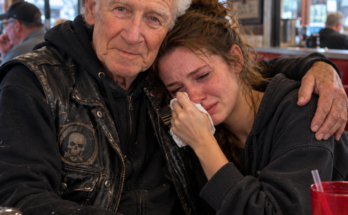
My 78-year-old father recoiled in terror the moment I reached for the buttons of his heavy winter coat.
Part One — What Was Under the Coat
Inside a house heated to seventy-four degrees, he grabbed both my wrists with trembling hands.
“Elena, please,” he whispered. “Don’t take it off. If Julian finds out you saw…”
His voice broke.
I locked the bathroom door.
Turned the shower on full blast to drown out our voices.
Then I carefully removed his coat.
What I found underneath made my blood run cold.
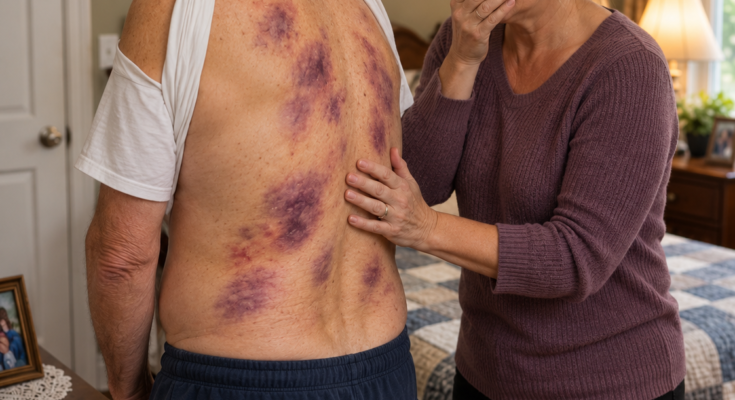
Dark purple bruises covered his ribs. Raw friction burns circled both wrists. His body was so thin I could count every rib beneath his skin.
My brother and his wife had spent months starving, beating, and terrorizing our father while draining his estate.
They had convinced a frightened old man that nobody was coming to save him.
But they had forgotten one crucial detail.
They had no idea who I actually worked for.
I had driven six hours through relentless rain to surprise Dad for his seventy-eighth birthday. The second I stepped across the threshold of my childhood home, every instinct in my body told me something was terribly wrong.
It was two o’clock in the afternoon, yet every heavy curtain in the living room had been pulled shut. The air smelled sharply of cheap lemon bleach, as though someone had tried to cover something sour underneath.
And standing in the doorway, physically blocking my path, was my brother Julian’s wife, Chloe.
One hand rested against the frame. Sunlight caught the thick diamond tennis bracelet around her wrist.
I had never seen it before.
“Elena.”
Chloe smiled, but her eyes remained cold.
“You really should have called before driving all this way. Your father’s mind has been slipping badly lately. Strangers and surprises make him agitated.”
Strangers.
Apparently that now included his own daughter.
Before I could respond, a shadow moved at the end of the hallway.
Dad shuffled into the foyer.
Four months.
That was all it had been since I had last seen him.
Yet he looked like a different man.
He had lost at least thirty pounds. His cheekbones protruded sharply beneath pale skin. And despite the warm house, Dad was swallowed inside a thick wool coat buttoned all the way to his chin.
Then his faded blue eyes found mine.
They filled with tears.
But he didn’t come toward me.
He didn’t hug me.
He simply stood frozen, hands buried inside his coat pockets, as though even affection required permission.
Twenty minutes later, Julian came home and immediately launched into what sounded like a speech he had rehearsed.
The medical appointments.
The expensive prescriptions.
The groceries.
The emotional burden.
The terrible sacrifice of caring for a declining parent.
Then he slid a notarized folder across the dining table.
A durable power of attorney.
It granted him broad authority over Dad’s finances.
Behind him, Chloe folded her arms.
“We’ve been carrying the heavy load every single day while you disappeared into your big-city career, Elena. So don’t waltz in once a season pretending to be the devoted daughter.”
I said nothing.
I looked at Chloe’s bracelet.
Then at Julian.
And smiled.
“You’re completely right.”
Both of them relaxed.
“You two must be exhausted. Why don’t you have some wine tonight and let me help Dad get washed up and ready for bed?”
They exchanged a glance.
Relief.
They thought I believed them.
Exactly ten minutes later, Dad and I were upstairs.
And now he was standing half dressed in front of me while I stared at the evidence written across his body.
“Dad…”
Tears rolled down his face.
“Julian ties me to the iron bedpost at night whenever I ask what happened to my savings.”
Something inside me went completely still.
“And last Tuesday,” he whispered, “when I wouldn’t sign the transfer papers…”
His voice cracked.
“Chloe hit my ribs with my cane until I picked up the pen.”
I had to press one hand against the sink.
Then the rest came out.
Three months of horror.
They had not taken him to a doctor.
They had sold his lake cabin.
Liquidated retirement accounts.
Restricted his food until he became weak enough to obey.
Taken his phone.
Forced him to sign documents he did not understand.
Changed his will.
Three weeks earlier, he had hidden in a closet and tried to call me.
Julian found him.
Dragged him out.
Smashed the phone.
Dad collapsed against me.
“They said you were too busy to care.”
I wrapped both arms around him.
His body felt frighteningly light.
“They said if I told you, you’d believe Julian.”
I held him tighter.
“No.”
For several seconds, I allowed myself to be his daughter.
Then I became what twenty-seven years of work had trained me to become.
“Elena?”
I looked at him.
“Dad, I need to ask you some questions.”
His expression changed.
“Am I in trouble?”
That nearly shattered me.
“No. Never.”
I took his hands carefully, avoiding the raw skin around his wrists.
“Do you want to leave this house tonight?”
His answer came instantly.
“Yes.”
“Do you want Julian controlling your money?”
“No.”
“Do you want him making decisions for you?”
“No.”
“Do you feel safe telling the truth to a doctor and the police if I stay beside you?”
He began shaking again.
Then nodded.
“Yes.”
That was enough.
Because my “big-city career” was not corporate law, as Julian apparently believed.
I worked for the state attorney general’s financial crimes division.
For the previous eleven years, I had specialized in cases involving financial exploitation of older adults.
I knew exactly what a suspicious power of attorney looked like.
I knew how abusers isolated people.
How they manufactured “decline.”
How they turned caregiving expenses into personal purchases.
How sudden property transfers, new wills, depleted brokerage accounts, and unexplained jewelry could fit together.
And most importantly, I knew the biggest mistake families made.
They confronted the suspected abuser before the victim was safe.
I wasn’t going to make that mistake.
I did not storm downstairs.
I did not announce my job.
I did not threaten Julian.
Instead, I photographed Dad’s injuries with his permission.
Not for social media.
Not for revenge.
For evidence.
I photographed the wrist marks beside a ruler from Dad’s shaving kit.
The bruising.
His visible weight loss.
Then I helped him dress in a loose shirt instead of the coat.
“Can you walk downstairs?”
“If Julian doesn’t know.”
“He won’t.”
I opened my phone.
I did not call anyone from my own office.
This was my father.
I had a conflict.
So I called the local emergency number and gave the dispatcher the facts as plainly as I could.
Seventy-eight-year-old man.
Visible injuries.
Possible starvation.
Possible restraint.
Alleged assault.
Possible financial exploitation.
Suspected perpetrators currently downstairs.
Then I gave the address.
The dispatcher told me officers and medical personnel were being sent.
Dad’s hand clamped around mine.
“They’ll hear them.”
“I know.”
“What if Julian gets angry?”
“Then Julian can be angry in front of witnesses.”
For the first time, something changed in Dad’s face.
Not confidence.
Not yet.
But the smallest beginning of relief.
Downstairs, a wineglass clinked.
Chloe laughed.
Then Julian called up the stairs.
“Elena? Everything okay?”
I looked at my father.
He looked back at me.
And for the first time that afternoon, he answered before I could.
“No.”
Silence downstairs.
Then footsteps.
Fast ones.
Julian reached the bathroom door and tried the handle.
Locked.
“Elena?”
I stepped between Dad and the door.
“Stay where you are, Julian.”
“What the hell are you doing?”
“Waiting.”
“For what?”
The doorbell rang.
Then came a hard knock.
“Police.”
Julian stopped moving.
That was the moment his confidence disappeared.
━━━━━━━━━━━━━━━━━━━━
Part Two — A Power of Attorney Is Not Ownership
The next two hours were chaotic.
But not cinematic.
Nobody was dragged away in handcuffs because I made an impressive speech.
Dad was taken by ambulance to the hospital.
I rode with him.
At the emergency department, medical staff documented dehydration, significant weight loss, bruising in different stages of healing, and injuries consistent with restraint. A social worker interviewed Dad away from Julian and Chloe.
I stayed only because Dad asked me to.
A detective came later.
So did an adult-protective-services worker.
Dad repeated what he had told me.
Slowly.
Painfully.
Twice he stopped and asked whether he had caused all this by signing.
Both times he was told no.
That mattered.
People who are frightened long enough begin to treat coerced compliance as participation.
Meanwhile, Julian called me seventeen times.
I answered none of them.
At 10:43 p.m., he sent:
You are destroying this family over Dad being confused.
I saved the message.
Then another arrived.
You don’t understand anything about what we’ve sacrificed.
Saved.
Then Chloe:
He gave us permission to manage everything.
Saved.
I did not argue through text.
My work had taught me that people often say useful things when nobody interrupts them.
The financial side took longer.
A power of attorney can grant broad authority.
It does not make the agent the owner’s replacement.
It does not authorize theft.
It does not make coercion lawful.
And it does not erase questions about capacity, undue influence, self-dealing, or abuse.
The next morning, with Dad medically stable and clear about what he wanted, an attorney experienced in elder law met us at the hospital.
Not me.
An independent attorney for Dad.
That distinction mattered.
With proper legal advice, Dad revoked Julian’s authority.
Banks and financial institutions were notified through the appropriate channels. Accounts connected to suspicious transfers were flagged for review. Records were preserved.
Nobody promised Dad that every dollar would come back.
That isn’t how real life works.
But now the money had a trail.
The lake cabin had a trail.
The brokerage liquidations had a trail.
And Chloe’s bracelet?
That had a receipt.
Or, as we discovered later, Dad’s credit card did.
Twenty-eight thousand dollars.
Purchased six weeks earlier.
Julian had categorized it in his homemade accounting file as:
Caregiving expense — household support.
Even the investigator reviewing the records stared at that one for several seconds.
I wanted to laugh.
I didn’t.
Because beneath the absurdity was something ugly.
Julian had not merely convinced himself he deserved compensation.
He had begun treating Dad’s entire life as reimbursement.
At the hospital, Dad asked me:
“Will they go to prison?”
“I don’t know.”
That was the truth.
“Do you want them to?”
His eyes filled.
“They’re still my children.”
I took his hand.
“Julian is.”
He nodded.
“I don’t know what I want.”
“You don’t have to know today.”
That might have been the most important thing I said to him.
For months, Julian and Chloe had forced immediate answers out of him.
Sign now.
Agree now.
Obey now.
I wanted Dad to learn that safety meant he could take time again.
━━━━━━━━━━━━━━━━━━━━
Part Three — The Man They Called Senile
Dad came home with me.
At first, only temporarily.
My apartment was too small, and the six-hour distance complicated everything, so after several weeks we found a furnished rental near his doctors and attorney.
He chose the bedroom himself.
That detail sounds ridiculous.
It wasn’t.
For three months, almost every choice had been made for him.
What to eat.
When to sleep.
Whether the curtains opened.
Who he could call.
The first night in the rental, I asked what he wanted for dinner.
He stared at the menu for nearly five minutes.
Then started crying.
“I don’t know.”
I sat beside him.
“That’s okay.”
“I used to know.”
“You will again.”
We ordered soup and a turkey sandwich because those were the first things he could tolerate comfortably.
He ate half.
Then apologized.
“For what?”
“For wasting food.”
“Dad.”
His eyes dropped.
“Chloe said food was expensive.”
That sentence made me angrier than the jewelry.
I had to leave the room for a moment.
Not because Dad needed me calm all the time.
But because my rage belonged somewhere else.
The criminal investigation continued.
So did the civil side.
The new will was challenged.
Property records were reviewed.
The cabin sale was examined closely.
Dad’s physicians documented that there was no prior diagnosis supporting the sweeping claims Julian and Chloe had made about severe cognitive decline.
Dad was older.
He occasionally forgot names.
He repeated stories.
He needed more time with complicated paperwork.
None of that meant he lacked the ability to know what he owned, whom he trusted, or whether someone was hurting him.
That distinction became central.
Julian’s attorney initially argued that Dad had voluntarily transferred assets because Julian and Chloe had become his primary caregivers.
Then the bank records arrived.
There were restaurants Dad had never visited.
Designer purchases.
A luxury vacation charged while Dad was supposedly too medically fragile to be left alone.
Cash withdrawals.
Transfers into an account controlled by Julian.
The pattern was difficult to explain as caregiving.
The physical evidence was harder.
So were Dad’s statements.
Eventually charges were filed.
Not because I worked for the attorney general.
In fact, I formally stayed away from any official role touching the matter once my family connection became known.
I provided information as a daughter and witness.
Other investigators handled the case.
That was important to me.
I did not want Julian punished because his sister knew the system.
I wanted the system to look at what he had done.
Chloe called me once before their attorneys instructed everyone to stop direct contact.
Her voice was shaking.
“You always hated me.”
“No.”
“Don’t lie.”
“I didn’t know you well enough to hate you.”
“You’re enjoying this.”
I almost answered angrily.
Then I thought of Dad asking permission to eat half a sandwich.
“No.”
My voice became quiet.
“I’m enjoying that he’s safe.”
She had no response.
Then she said, “You have no idea what it was like caring for him every day.”
“Maybe not.”
“He complained constantly. He questioned every purchase. He accused us of taking his money.”
I closed my eyes.
“He was right.”
Silence.
Then Chloe hung up.
The legal process lasted more than a year.
Some transactions were reversed.
Some assets were recovered through settlement and court action.
The lake cabin was complicated because innocent third parties had become involved. Dad chose eventually not to pursue every possible remedy once his lawyer explained the cost and uncertainty.
That hurt him.
He had loved that cabin.
Arthur—our grandfather—had helped him build the dock when Julian and I were children.
Dad had taught us both to fish there.
He kept saying:
“I thought I’d die owning that place.”
Grief came in strange forms.
Losing money angered him.
Losing the cabin broke his heart.
One afternoon, I drove him north.
Not to the cabin.
We had no right to appear unannounced at someone else’s property.
Instead, we stopped at the public lake access a few miles away.
Dad sat on a bench.
For a while, neither of us spoke.
Then he said:
“I used to think leaving something to your children was love.”
I looked at him.
“It can be.”
“I kept thinking the more I left you two, the safer you’d be.”
He stared across the water.
“Maybe I should’ve spent more of it.”
I smiled.
“That is the first sensible thing you’ve said all year.”
He laughed.
A real laugh.
It startled both of us.
So we began spending some.
Not recklessly.
Dad would have had a medical emergency if I suggested recklessness.
He bought a better recliner.
Replaced his old hearing aids.
Took my daughter—his granddaughter—to a baseball game.
Ordered dessert without checking the price first.
One Saturday, he bought a ridiculous red fishing boat.
Tiny.
Used.
Absolutely unnecessary.
When I asked what possessed him, he said:
“Your brother already bought a diamond bracelet with my money. I figured I deserved a boat.”
I laughed so hard I had to sit down.
Healing did not happen in one direction.
Dad still woke from nightmares.
For months, he could not tolerate having his bedroom door closed.
He hid crackers in drawers.
The first time I found them, I almost cried.
Instead, I bought a basket and placed it beside his bed.
Crackers.
Granola bars.
Bottled water.
Nothing hidden.
Nothing rationed.
One night he asked:
“Are you angry with me?”
“For what?”
“For not calling sooner.”
My chest tightened.
“You tried.”
“I should’ve fought harder.”
“No.”
“Elena—”
“No.”
I moved my chair closer.
“You were injured, underfed, isolated, and frightened. Survival isn’t a character test.”
His eyes filled.
Then he asked the question I had been expecting for months.
“Why didn’t you notice?”
That one I couldn’t answer cleanly.
Because I was busy.
Because Julian always said everything was fine.
Because Dad sounded tired on the phone and I accepted “I’m okay.”
Because four months can disappear very quickly when work is consuming your life.
“I should’ve called more.”
Dad shook his head.
“I’m not blaming you.”
“I know.”
“But you are.”
“Yes.”
He reached across and took my hand.
“Then stop.”
I laughed sadly.
“That’s rich coming from you.”
He smiled.
“Maybe we’re both learning.”
Julian eventually pleaded guilty to several charges connected to financial exploitation and assault rather than taking every allegation to trial. Chloe’s case was resolved separately.
I attended sentencing.
Dad did too.
He insisted.
When given the opportunity to speak, he stood slowly with his cane.
The same kind of cane Chloe had once used to hurt him.
For days, I worried he would ask the court for maximum punishment.
Or no punishment.
Either choice would have been his.
Instead he looked at Julian and said:
“You kept telling me I was senile.”
Julian stared at the floor.
“You told me nobody would believe an old man.”
Dad’s voice trembled.
“But I remembered everything.”
That was all.
He sat down.
No grand speech.
No curse.
No declaration that Julian was no longer his son.
Just:
I remembered everything.
Later, outside the courthouse, Dad cried against my shoulder.
“I still love him.”
“I know.”
“Does that make me stupid?”
“No.”
“After what he did?”
“You can love someone and still be unsafe with them.”
Dad nodded slowly.
That became another lesson we both had to learn.
Love did not require access.
Forgiveness, if it ever came, would not require forgetting.
And being family did not erase consequences.
Dad lived another six years.
He never moved back into the old house.
He sold it.
His choice.
The curtains, he said, bothered him.
With part of the money, he bought a small condo with enormous windows.
The first thing he did every morning was open every blind.
Even in winter.
Even when the sun hit the television screen and made it impossible to see.
“Dad, you’re getting glare.”
“I like glare.”
“Of course you do.”
He died at eighty-four.
Peacefully.
No winter coat.
No locked curtains.
No one deciding how much he could eat.
I was beside him.
So was my daughter.
A week before he died, he gave me a folder.
I almost laughed.
Our family apparently communicated best through paperwork.
Inside was his final estate plan.
Simple.
Transparent.
Most of what remained would be divided among grandchildren and a local organization that helped older adults experiencing abuse and financial exploitation.
There was a letter for me.
Elena,
For a long time I thought the day you came to the house was the day you saved me.
I stopped reading.
Then continued.
It wasn’t.
The ambulance crew helped. The nurses helped. The social worker helped. The police helped. The lawyers helped. You did one thing first.
You believed me.
My hands began shaking.
An old man can survive being poor. He can survive losing a cabin. He can even survive discovering that someone he loves is capable of terrible things.
What I don’t think I could have survived much longer was believing nobody would believe me.
At the bottom he had written:
Thank you for looking under the coat.
I still have that letter.
And sometimes, when people hear what I did for a living, they assume that was what saved Dad.
It helped.
I knew what documents mattered.
I knew which calls to make.
I knew enough not to announce myself downstairs and turn the whole thing into a confrontation.
But my job was not the crucial detail Julian and Chloe had overlooked.
They were wrong about something much simpler.
They thought distance meant indifference.
They thought fear had made Dad unbelievable.
They thought age had made him powerless.
And they thought because they controlled his money, his phone, his food, and the locks on his doors, they controlled the truth too.
They didn’t.
That afternoon, I walked into my childhood home as a daughter who thought she was surprising her father for his birthday.
I walked upstairs believing I was helping an old man take off a winter coat.
And when I saw what was underneath, I understood something I have never forgotten.
Abuse survives by making its victim believe the locked door is stronger than their voice.
Sometimes the first way you break that lock is not with authority.
It is with four words:
I believe you. Tell me.