
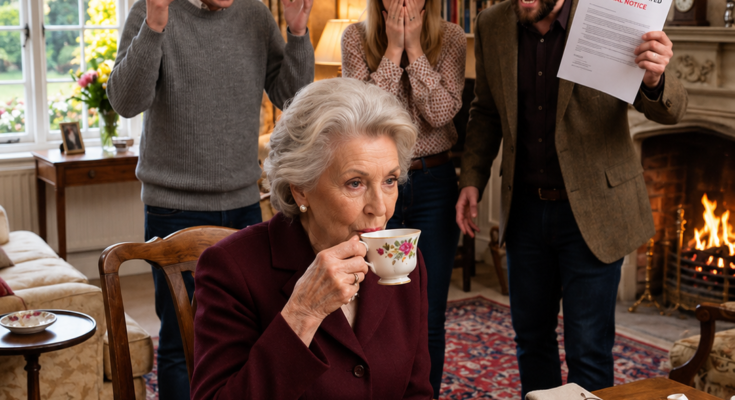
Part One — The Third Person in the Driveway
“Mom, the plans changed,” Wesley texted at 6:18 p.m.
The second message came before I could even push myself up from the kitchen chair.
You weren’t invited. My wife doesn’t want you there.
The navy dress still held the marks of my palms where I had smoothed it down. Rain tapped against the kitchen window in small, restless beats. The tea kettle clicked once on the stove, empty and cooling, and the room smelled like lemon polish, old wood, and tea that had gone bitter.
Arthur’s photograph watched from the mantel.
I had set out the pearl earrings he bought me for our fiftieth anniversary. Beside them sat the townhouse brochure Wesley had mailed back in March—white trim, staged lamps, smiling couples, and promises printed on thick expensive paper.
“For you too, Mom,” Wesley had said.
I believed him because mothers are trained to hear love even when it is only convenience wearing a son’s voice.
The clock read 6:20.
I read the words again until they stopped looking like an accident.
You weren’t invited.
Serena had not shouted.
Serena never shouted.
Her cruelty arrived through polished doors, folded napkins, and sentences soft enough to deny later.
“Your mother makes things awkward,” she had once said, smiling over a fourteen-dollar coffee I paid for. “She means well, but still.”
I laughed then.
A small, practiced laugh.
The kind women use when they are trying not to become a problem.
My hand found the back of the chair. I pulled it out, sat down, and opened the old drawer in my mother’s desk.
The folder was labeled WESLEY.
Inside were years of quiet rescues.
Tuition checks. Insurance drafts. Mortgage help. Country club fees. Emergency transfers that somehow happened every month. A $2,800 preschool payment for my granddaughter. A $6,400 repair bill Serena had called “temporary.”
At 6:47, my granddaughter texted.
Grandma, are you coming?
I stared at her message until my eyes burned.
Children rarely know which adults are building walls around them.
I wrote:
Not tonight, sweetheart. I love you.
Then I picked up the landline.
I did not call Wesley.
I did not call Serena.
I did not beg for a seat at a table I had been helping to pay for.
I called the bank.
The woman on the emergency line verified my identity, then asked which authorizations I wanted stopped.
“All of them connected to Wesley Hale.”
There was a small pause.
Then keys began clicking.
That was the sound of a mother remembering she was still a person.
At 7:03, I sent my son one sentence.
Then you and your wife can start paying your own way.
I turned off my phone and removed the pearls.
By 8:11 the next morning, I was sitting across from Lydia at First National. She had known our family for twenty-two years. She approved Arthur’s first retirement account and sent flowers when he died.
She did not pity me.
That helped.
“Are you sure, Mrs. Hale?”
“I am.”
Eight pages printed.
Mortgage drafts. Insurance. Utilities. Club dues. Tuition. Subscriptions. A business line Wesley had never mentioned.
One hundred seventy-four active recurring charges, transfers, and payment authorizations were tied in one way or another to accounts or cards I controlled.
It had not happened through one grand act of theft.
That would have been easier to understand.
It happened through years of me saying yes.
Could you cover this until March?
Yes.
Could we put the insurance on your card and reimburse you?
Yes.
The preschool gives a discount if we pay the year upfront.
Yes.
We’re tight this month.
Yes.
Some reimbursements came.
Most eventually stopped.
The temporary things simply became ordinary.
“It never happens all at once,” Lydia said quietly.
“No.”
Aphorisms are cheap until they cost you something.
Then they become receipts.
I signed the final form.
When I returned home, I made tea in the good cup.
Not the chipped one.
Not the one I used because I felt nicer things should be saved for guests.
At 11:26, the first declined charge hit.
Then another.
Then my driveway filled with the sound of tires on wet gravel.
Serena stepped from the passenger side first, cream coat spotless, mouth tight.
Wesley followed, phone in his hand, his face pale.
But the third person made me set down my teacup.
My fourteen-year-old granddaughter, Lily, climbed from the back seat wearing her school sweatshirt.
Her eyes were swollen.
She wasn’t angry.
She looked frightened.
Before Wesley reached the porch, Lily ran ahead of him.
“Grandma?”
I opened the door.
She didn’t hug me.
She just stood there.
“Dad said you canceled my school.”
My eyes moved to Wesley.
“What?”
“And Mom said you don’t want to help us anymore because you don’t want us in your family.”
Serena’s face changed.
“Lily, that’s not what I—”
I held up my hand.
“No.”
Everyone stopped.
I looked at my granddaughter.
“I need you to hear me before the adults start talking.”
She nodded.
“Nothing that happened last night was because of you. Your school is not punishment. Your health insurance is not punishment. You do not have to earn your grandmother by taking anyone’s side.”
Her mouth trembled.
“Are you mad at me?”
That question nearly broke me.
I pulled her into my arms.
“No, sweetheart.”
She hugged me hard.
Then I looked over her shoulder at my son.
“Why would she even think that?”
Wesley looked embarrassed.
Serena answered.
“Because when you start canceling everything without warning, there are consequences.”
I felt Lily stiffen against me.
“Enough.”
I stepped aside.
“Lily, go into the kitchen. There are cinnamon rolls.”
“I’m not hungry.”
“Then sit with them until they develop a personality.”
That got half a smile.
When she disappeared into the kitchen, I closed the door behind her.
Wesley began immediately.
“Mom, you cannot just shut everything off.”
“I can stop paying bills that belong to you.”
“You canceled the mortgage draft.”
“Yes.”
“The homeowners insurance.”
“Yes.”
“My business payment.”
“I didn’t even know I was making your business payment.”
He stopped.
Serena stepped forward.
“Do you realize what you’ve done?”
I looked at her.
“Yes.”
“You’ve weaponized money because your feelings were hurt over a dinner.”
There it was.
The sentence she had prepared in the car.
I surprised her by nodding.
“Some of this started because my feelings were hurt.”
Wesley stared at me.
I continued.
“But that doesn’t make the rest untrue.”
Serena folded her arms.
“We never forced you to pay anything.”
“No.”
That answer seemed to unsettle her.
I looked at Wesley.
“You asked. I said yes. Then you asked again. I said yes again. Eventually neither of us even bothered pretending the answer might be no.”
“Then why are you acting like we’ve stolen from you?”
“I’m not.”
I walked to the desk and brought out the folder.
“You did not steal ninety-three thousand six hundred dollars from me last year.”
Wesley looked at the papers.
“I gave it to you.”
Silence.
“That is the part I have to take responsibility for.”
Serena’s expression shifted.
I continued.
“I kept rescuing you because I liked being necessary.”
Wesley looked up.
“I told myself I was helping my son. Sometimes I was. Other times I was paying your bills because being useful was the easiest way to make sure there was still a place for me.”
“Mom—”
“No. Let me finish.”
I had waited fifteen years.
I could wait another thirty seconds.
“When your father died, you called every evening for three months. Then your life got busy. Mine got quiet. Somewhere along the way, every financial emergency became a reason for you to come back through my door.”
My voice shook then.
Not from weakness.
From finally saying something I had hidden from myself.
“And I mistook being needed for being included.”
Wesley lowered his eyes.
Serena did not.
“So this is revenge.”
“No.”
I looked directly at her.
“Revenge would be letting your daughter lose her school because I’m angry with her parents. I won’t do that. I’ll contact the school myself. I will cover the semester already promised, directly to them. I will keep the education account Arthur and I created for Lily under the terms we established.”
I placed the folder on the table.
“But I’m done paying for this marriage, this townhouse, your club, your streaming services, your business, your cars, your dinners, and whatever else the two of you decided became my responsibility because I kept saying yes.”
Wesley whispered, “You can’t expect us to rearrange our entire lives overnight.”
I looked at him.
“You rearranged mine by text at 6:18.”
That hurt him.
Good.
Not because I wanted pain.
Because sometimes a sentence has to land before anything can change.
Then Lily called from the kitchen.
“Grandma?”
I opened the door immediately.
She stood beside my good teacup.
“Can I stay here tonight?”
Serena began, “Lily—”
I looked at Wesley.
“Her choice.”
For once, he understood.
He nodded.
Lily stayed.
Her parents left without solving anything.
That was the first healthy thing any of us did.
We allowed one problem to remain unsolved overnight.
━━━━━━━━━━━━━━━━━━━━
Part Two — What I Had Actually Been Paying For
The next week was ugly.
Wesley called.
Serena emailed.
There were spreadsheets, accusations, apologies that turned into arguments, and one voicemail from my son that began, “I’m sorry about dinner,” and ended with, “but you really left us in a terrible position.”
I listened twice.
Then deleted it.
Lydia helped me sort legitimate authorizations from charges I no longer recognized. Anything I had not actually approved was reviewed properly with the bank. Everything else was simpler.
I had agreed to pay.
Now I was withdrawing that agreement going forward.
The annual total stunned even me.
$93,600 in the previous twelve months.
More than my first house had cost.
When I showed the figure to my attorney, he asked one question.
“Do you want to punish them, or do you want to stop supporting them?”
“The second.”
“Good. Then keep those two things separate.”
That advice saved me from becoming cruel simply because I had finally stopped being compliant.
I paid nothing toward Wesley’s adult lifestyle after that.
But Lily’s existing school commitment continued directly through the school. Her medical expenses remained covered through a separate grandchild account Arthur and I had established years earlier. Wesley and Serena could not use it for mortgages, vacations, or anything else.
Lily was not collateral.
That mattered to me.
Then came the hardest realization.
Wesley had become dependent on my money partly because I trained him to expect it.
Arthur had seen the pattern sooner.
I found one of his old notebooks while looking through tax papers.
On a page from eight years earlier, he had written:
Wes asked again. Helen said yes before he finished asking. Need to talk to her about helping without carrying.
I sat on the bedroom floor with the notebook in my lap.
Arthur had tried.
I remembered the argument.
“He’s our son,” I had told him.
“He’s forty-one,” Arthur answered.
I accused him of being hard.
He accused me of confusing love with rescue.
We both went to bed angry.
I had forgotten the argument.
Arthur apparently had not.
At the bottom of the page he had added one line:
If we solve every consequence, how will he ever know what he can survive?
I closed the notebook.
Then I cried.
Not because Arthur had been right.
Because he was gone, and I could finally hear something he had tried to tell me while he was alive.
━━━━━━━━━━━━━━━━━━━━
Part Three — The Dinner I Didn’t Pay For
The first thing Wesley and Serena lost was the country club.
I knew because Wesley called to tell me.
I almost laughed.
I did not.
The second car went next.
Then the housekeeper stopped coming twice a week.
They canceled three subscriptions I didn’t know existed and one meal-delivery service whose monthly cost made me question whether the food came with a private chef and a small violin orchestra.
The townhouse was harder.
Wesley could afford it.
Just not while also living the way they had been living.
That distinction became important.
For years, every expense had been treated as fixed except the money coming from me.
Once my money disappeared, suddenly everything became negotiable.
Serena returned to full-time consulting work.
Wesley closed the struggling side business whose line payment had been coming from my account and focused on the job that actually paid him.
They refinanced nothing with my signature.
Asked for no rescue.
For several months, Wesley barely spoke to me.
I missed him.
That surprised people.
A friend said, “After the way he treated you?”
Especially after.
Boundaries don’t switch off love.
They reveal whether love can survive without subsidy.
Lily still came.
Every other Saturday at first.
Then whenever she wanted.
She and I baked.
She did homework at my kitchen table.
Sometimes she complained about her parents.
I never joined in.
That was difficult.
Very difficult.
One afternoon she said, “Mom says you embarrassed them.”
“I probably did.”
“She says you wanted them to fail.”
“No.”
“Dad says you changed.”
“That part is true.”
She looked at me.
“Are you still mad?”
“Yes.”
Children deserve honest answers that do not recruit them.
I continued.
“But your parents love you. And my disagreement with them is adult business. You never have to carry messages between us.”
She nodded.
Then stole the icing off my cupcake.
Life continued.
Six months passed before Wesley showed up alone.
No phone call.
No Serena.
Just my son standing on the porch in the rain.
He looked older.
Not dramatically.
Just in the way people do after a year forces them to meet themselves.
“You busy?”
“Yes.”
His face fell.
I opened the door.
“But come in.”
I made tea.
Two good cups.
That detail mattered to me.
For years, I had served guests from the good china while drinking from the chipped cup myself.
I didn’t do that anymore.
Wesley sat at the kitchen table.
For several minutes, he stared at his hands.
Then he said, “I thought you were trying to control us.”
“I was, sometimes.”
He looked up.
That wasn’t the answer he expected.
“I didn’t use money deliberately to control you. But I used helping as a way to stay necessary.”
He nodded slowly.
“I used needing you as a way to avoid growing up.”
That was also unexpected.
Neither of us spoke.
Then he said, “I’m sorry about the dinner.”
I waited.
Not because I wanted him to suffer.
Because I had learned not to finish apologies for other people.
“You were invited originally,” he continued. “Serena and I argued that afternoon.”
“About me?”
“Yes.”
“What did she say?”
“That every time we saw you, money was in the room even if nobody mentioned it.”
I looked at him.
“Was she wrong?”
He hesitated.
“No.”
That hurt.
But perhaps not for the reason he expected.
Because I realized Serena had sometimes felt indebted in ways I had never allowed myself to see.
Wesley continued.
“She said she wanted one dinner that wasn’t paid for by you, organized around you, or followed by some conversation about what we needed.”
“So her solution was to uninvite me.”
“Yes.”
“And yours was to send the text.”
“Yes.”
“Why didn’t you tell her no?”
He looked down.
“Because it was easier to hurt you than argue with my wife.”
There it was.
The actual wound.
Not the townhouse.
Not ninety-three thousand dollars.
Not dinner.
I nodded.
“Thank you for finally saying it correctly.”
His eyes filled.
“I’m ashamed of that.”
“You should be.”
He looked at me.
I let the sentence sit.
Then added, “Shame is useful for about ten minutes. After that, do something better.”
He smiled through tears.
“That sounds like Dad.”
“It is Dad.”
I told him about the notebook.
He cried then.
Not loudly.
Wesley had always cried like Arthur—head lowered, one hand over his eyes as though grief was a private malfunction he could repair if given a minute.
“I miss him.”
“So do I.”
“I think after he died, I started asking you for more.”
“You did.”
“Why did you keep saying yes?”
I took a long breath.
“Because every time you needed me, I got to feel like I hadn’t lost my whole family.”
He reached across the table.
For the first time in years, my son held my hand without asking me for anything.
That was when I knew something had actually changed.
Not fixed.
Changed.
Serena took longer.
She did not arrive with flowers.
I would not have trusted flowers.
She called one afternoon and asked if she could meet me for coffee.
“You’re buying,” I said.
There was silence.
Then she laughed.
“Fair.”
We met at the same café where she once told me I made things awkward.
She ordered her fourteen-dollar coffee.
I ordered plain tea.
When the check came, she picked it up before I could.
That amused me more than I let her see.
Serena apologized.
Not perfectly.
She still believed my financial help had created an unhealthy power dynamic.
She was right.
She also admitted she had been happy to benefit from that dynamic when it made their life easier.
That mattered more.
“I resented you for paying,” she said, “while depending on you to keep paying.”
“That’s a difficult combination.”
“Yes.”
“I resented being treated like a bank while behaving like one.”
She looked at me.
“Also difficult.”
We did not become close that afternoon.
But we stopped pretending only one person had contributed to the mess.
A year after the dinner I wasn’t invited to, Wesley texted me.
Dinner. Saturday. 7 p.m. You are actually invited. Serena says I need to specify that.
I smiled.
Then another message came.
Also, before you ask: we’re paying.
I wore the navy dress.
The same one.
I nearly put on Arthur’s pearls, then changed my mind.
Not because of sadness.
Because Lily had given me a ridiculous silver necklace shaped like a little teacup for my birthday.
I wore that instead.
When I arrived, Wesley opened the door himself.
“Mom.”
“Son.”
Serena was in the kitchen.
Lily ran toward me.
The table looked different.
No catered food.
No expensive wine.
Wesley had burned one side of the roast.
The potatoes were slightly undercooked.
I ate everything.
Halfway through dinner, Lily asked, “Grandma, why are you smiling?”
“No reason.”
“You’re staring at Dad.”
Wesley looked nervous.
“I don’t like where this is going.”
I laughed.
“I was just thinking this might be the cheapest dinner you’ve ever given me.”
Serena nearly spit out her water.
Even Wesley laughed.
That was good.
Not because the past disappeared.
Because eventually you have to know whether you can laugh in the same room as something that once hurt you.
The relationship rebuilt slowly after that.
Wesley never regained access to my accounts.
He never asked.
That was part of the repair.
I changed my estate plan too.
Not to punish him.
To make things clear.
My grandchildren’s education funds remained protected.
A portion would go to Wesley eventually.
Another portion went to causes Arthur and I had supported for years.
And a large amount remained for me.
At seventy-seven, I had been behaving as though my own life was the temporary part.
It wasn’t.
I took a train trip through Canada with my sister.
Replaced the furnace before it became an emergency.
Hired someone to repaint the kitchen the pale green I had always wanted.
And I used the good cups.
All of them.
One afternoon Lily opened my cabinet and said, “Grandma, where’s that ugly chipped mug you always used?”
“I threw it out.”
“You loved that mug.”
“No. I was accustomed to it.”
She shrugged.
Teenagers understand some truths instantly that adults spend decades avoiding.
I am eighty now.
Wesley and I are better.
Not because I resumed paying for his life.
Because I stopped.
The money had hidden too much.
His dependence.
My loneliness.
Serena’s resentment.
Our family’s strange habit of treating my generosity as proof I belonged while treating my presence as optional.
The night that changed everything began with a text:
You weren’t invited.
For months, I thought that sentence was the cruelest thing my son had ever said to me.
Now I see it differently.
It was cruel.
But it was also clarifying.
I had spent fifteen years paying bills that were never mine because some frightened part of me believed helping guaranteed a chair at the table.
It didn’t.
Money can pay the mortgage on a house you are not welcome inside.
It can cover dinner at a table where nobody saved you a seat.
It can make people dependent on you without making them close to you.
The morning after I canceled those 174 payments, I thought I was finally teaching my son a lesson.
I wasn’t.
The first person who needed the lesson was me.
I did not have to finance my place in my own family.
I did not have to make myself useful enough to deserve an invitation.
And I did not have to drink from the chipped cup while saving the good one for people who remembered me only when something was due.
These days, when Wesley comes over, I make tea for both of us.
Two good cups.
No invoices on the table.
No transfer requests waiting on my phone.
Just my son and me.
Sometimes love becomes much easier to recognize after you stop paying for everything around it.