
The Roofer Everyone Called Dishonest Kept Patching a Widow’s Leaking Roof for Free—Then Demolition Day Revealed What He Was Really Doing
Part One — The Roof Dean Refused to Replace
“You’re just going to patch it again?”
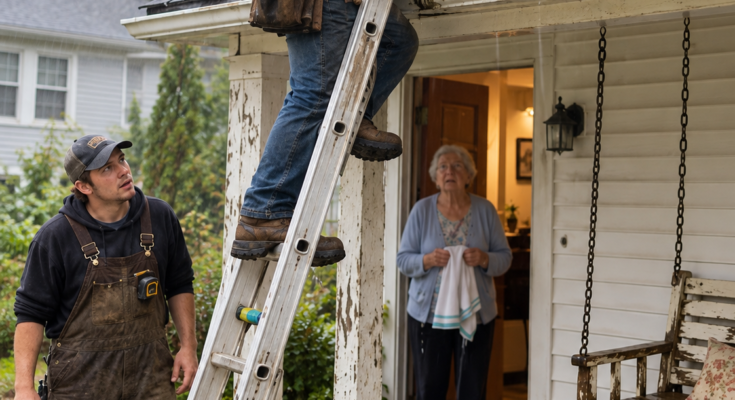
The young apprentice stood at the bottom of the ladder, rain dripping from the bill of his cap, staring up at Dean Hollister.
Dean didn’t answer right away.
At fifty-eight, his knees hurt every time he climbed a roof. His hands were scarred from three decades of shingles, sheet metal, and splintered decking. And the little roofing company he had once built from nothing was barely alive.
Bankruptcy had taken most of his equipment.
Divorce had taken the house.
Pride had taken whatever was left.
But there he was on a cold Tuesday morning, kneeling over the leaking porch roof of eighty-one-year-old Margaret Bell, replacing three cracked shingles he had already repaired twice that year.
His apprentice, Cody, shook his head.
“She needs a new roof, Dean.”
“I know.”
“Then why don’t you tell her?”
Dean pressed another nail into place.
“Because she doesn’t need one.”
Cody looked up at the sagging porch.
Rainwater was dripping into a bucket below.
“Looks like she does.”
Dean climbed down without answering.
Margaret opened the front door before his boots touched the ground. She was tiny, with silver hair pinned behind her ears and an old blue sweater buttoned crooked near the top.
“How much do I owe you this time?” she asked.
Dean wiped his hands on his jeans.
“Nothing.”
Her mouth tightened.
“Dean Hollister, I don’t take charity.”
“And I don’t charge for ten-minute jobs.”
“It took you an hour.”
“Then I’m getting slow.”
She almost smiled.
Almost.
The truth was, half the town had already started talking about Dean.
Margaret had mentioned at the diner that her roofer kept patching the same leak instead of replacing the porch roof.
That was all it took.
Small towns don’t need newspapers when they have coffee counters.
By Friday, people were saying Dean was keeping the widow trapped in endless repairs.
By the next week, someone told Cody that Dean was probably planning to squeeze money out of her little by little.
That one hurt.
Dean heard about it at the hardware store.
A man he had known twenty years looked at him across the lumber aisle and said, “You ought to do right by that lady.”
Dean stared at him.
Then nodded.
“You’re right.”
He paid for a bundle of shingles and left.
Years earlier, Dean probably would have defended himself.
He would have explained every detail until nobody could question his honesty.
But bankruptcy changes a man.
So does divorce.
So does discovering that people who praised you when your trucks were new stop returning your calls when those trucks get repossessed.
Dean had learned something painful.
Sometimes your reputation arrives before the truth does.
So he kept quiet.
Whenever Margaret called about another drip, Dean came back.
He sealed flashing.
Replaced shingles.
Cleaned gutters.
Reinforced a weak section above the porch.
And never handed her a bill.
Finally, Cody couldn’t stand it anymore.
One afternoon, after they finished another repair, he followed Dean to the truck.
“You’re teaching me this business,” Cody said. “So teach me.”
Dean opened the driver’s door.
“Teach you what?”
“Why you won’t replace her roof.”
Dean looked toward Margaret’s house.
The little white place had faded shutters, a crooked mailbox, and a porch swing hanging from chains worn smooth with age.
Then he sighed.
He reached behind the seat and pulled out a manila folder.
Inside were maps.
Letters.
Property notices.
And a photograph of a small yellow house seven miles away.
Cody read the first page.
His expression changed.
“The highway?”
Dean nodded.
The state had approved an expansion through Margaret’s road.
Her house was one of several scheduled to be purchased and demolished.
She had known for months.
But she had told almost nobody.
“She’s got maybe five months left here,” Dean said.
Cody looked back toward the roof.
“So if she pays for a new one…”
“She’ll spend almost everything she has left on a house that’s coming down anyway.”
Cody was quiet.
Dean tapped the photograph of the yellow house.
“This one’s smaller. Good furnace. Solid roof. Grocery store nearby. Bedroom downstairs so she won’t have to climb steps.”
“You found it?”
“I’ve been helping her look.”
Cody stared at him.
“You’ve been doing all this while people are calling you a crook?”
Dean shrugged.
“People can call me whatever they want.”
“Why not tell them?”
“Because Margaret asked me not to tell anyone about the highway until she was ready.”
He slid the folder back behind the seat.
“Her husband built that porch with his father in 1968. Her kids grew up here. She buried him six years ago.”
Dean looked toward the old porch swing.
“She isn’t just losing a house.”
That evening, Cody didn’t say much.
Neither did Dean.
A month later, Margaret signed the papers on the yellow house.
Dean found a retired electrician to check the wiring.
A plumber volunteered a Saturday.
Cody painted the porch railing.
Nobody charged Margaret much of anything.
And still, most of the town knew none of it.
They only knew the roofer who kept refusing to replace a widow’s roof.
Then demolition week arrived.
Margaret spent her final morning in the old house sitting on the porch swing.
Dean found her there alone.
The rooms behind her were empty.
Boxes had already been moved.
Pictures were gone from the walls.
Only pale rectangles remained where family photographs had hung for decades.
Margaret rested her hand on the wooden swing.
“My husband made this,” she said.
Dean nodded.
“You told me.”
“He wasn’t much of a carpenter.”
“I can tell.”
She laughed through her tears.
“He’d haunt you for saying that.”
Dean smiled.
Margaret looked down the road toward the survey flags marking the future highway.
“I thought I’d be ready.”
“Nobody’s ready to leave forty-eight years behind.”
She ran her fingers over the worn armrest.
“My babies were rocked on this swing.”
Dean said nothing.
“My husband proposed to me twice.”
“Twice?”
“I said no the first time.”
“Smart woman.”
She laughed again.
Then cried harder.
Dean stood beside her for a long time.
He had spent thirty years repairing structures.
Roofs.
Flashing.
Decking.
Gutters.
He understood how to replace broken things.
But there was no replacement for forty-eight years in one house.
So he did not try to tell Margaret the new place would be better.
He did not say she should be grateful.
He simply sat beside her until she was ready to stand.
━━━━━━━━━━━━━━━━━━━━
Part Two — What Dean Had Been Saving
Two days later, the demolition equipment arrived.
Neighbors stepped outside.
Some stood quietly beside mailboxes, watching homes that had held generations prepare to disappear.
Then Dean’s roofing truck turned onto the road.
Someone muttered, “What’s he doing here now?”
But Dean’s crew didn’t bring shingles.
They brought tools.
Cody climbed onto Margaret’s old porch and began unhooking the chains from the ceiling.
Dean carefully lifted one end of the weathered wooden swing.
Together, they carried it down the steps.
Then Dean stopped.
“Wait.”
He went back beneath the porch.
Cody followed.
Attached to one of the old beams was a small rectangular piece of wood, barely visible beneath decades of paint.
Carved into it were names.
MARGARET + THOMAS — 1968
Beneath that:
ELLIE — 1971
DAVID — 1974
Tiny pencil marks followed.
Children’s heights.
Dates.
One crooked star.
Cody looked at Dean.
“The machine’s going to take all this.”
“I know.”
Dean carefully removed the board.
Then another.
The piece of porch trim where Margaret’s husband had marked the grandchildren.
The old brass hook beside the door where Thomas hung his work jacket.
Nothing valuable.
Everything valuable.
Dean loaded them beside the swing.
An hour later, Margaret stood on the porch of her new yellow house.
Fresh paint covered the railing.
A pot of red geraniums sat beside the steps.
And beneath the porch roof hung the same old swing her husband had built nearly sixty years earlier.
Dean had sanded the roughest edges but left every scratch.
He replaced the rusted chains but kept the old hooks.
On the underside, where nobody would see unless they looked closely, two sets of initials remained carved into the wood.
Margaret touched them.
Then covered her mouth.
Cody turned away.
Dean stood near the steps with his hands in his pockets.
Margaret sat.
The swing creaked exactly the way it always had.
She looked up at Dean.
“You saved it.”
Dean shook his head.
“No, ma’am.”
He glanced toward the little house behind her.
“We just moved it forward.”
Then Cody carried over one more piece.
The height board.
Margaret’s face changed again.
“Oh.”
She traced one of the pencil lines with her finger.
“That’s Ellie.”
Another.
“David.”
Then a smaller one.
“My grandson.”
She looked at Dean.
“You took this too?”
Dean shrugged.
“Figured the highway didn’t need it.”
Margaret cried.
Not loudly.
She simply stood there with one hand over her mouth while forty-eight years of family history leaned against the new porch.
Dean gave her the old brass coat hook too.
That was when she finally hugged him.
Dean froze.
Cody later said he’d never seen his boss look more uncomfortable in his life.
“You can let go now, Mrs. Bell.”
“No.”
“All right.”
She held him another ten seconds.
By the end of the week, the truth had traveled through town.
The same people who had criticized Dean now told everyone what he had done.
Some apologized.
Some didn’t.
A few acted as though they had always known there had to be an explanation.
Dean found that part especially entertaining.
The man from the hardware store approached him while he was loading underlayment.
“I owe you an apology.”
Dean kept loading.
“Okay.”
“I said something I shouldn’t have.”
“You did.”
The man waited.
Dean finally looked at him.
“You want me to make this easier for you?”
The man almost smiled.
“No.”
“Good.”
Then Dean added, “Next time, ask before deciding.”
The man nodded.
“Fair.”
The hardware store owner quietly extended Dean better terms on materials.
A contractor called with three roofing jobs.
Two homeowners who had heard the rumors called to apologize and ask for estimates.
Dean accepted the work.
He did not pretend the sudden change in public opinion didn’t help him.
It did.
His company had been close to disappearing.
But he also refused to turn Margaret’s story into advertising.
When someone suggested posting photographs of the swing online with the company logo, Dean said no.
“That’s her porch.”
“What does that mean?”
“It means it isn’t content.”
That became another lesson Cody remembered.
Not every good thing had to become proof that you were good.
━━━━━━━━━━━━━━━━━━━━
Part Three — The Things Worth Carrying Forward
Dean’s business recovered slowly.
Not dramatically.
There was no millionaire arriving with a giant contract.
No television crew.
No miraculous check.
He still drove the same old truck.
Still rented a small apartment above a dentist’s office.
Still woke up some mornings and needed five minutes before his left knee agreed to bend.
But the phone rang more often.
Bills stopped arriving faster than money.
Cody eventually moved from apprentice to crew lead.
And Dean did something he had not done since the bankruptcy.
He hired another employee.
Then another.
The little company began looking alive again.
Margaret settled into the yellow house more slowly.
For the first month, she kept telling Dean where things “used to be.”
“My bedroom used to face east.”
“The old kitchen had another drawer.”
“Thomas planted roses outside that window.”
Dean listened.
He never answered with, “But this place is better.”
Because better wasn’t the point.
The new house had a safer bathroom.
A better furnace.
No stairs to her bedroom.
A roof that would probably outlive Dean.
But grief does not compare square footage.
Margaret had lost a place where her entire adult life had happened.
She needed time to stop measuring every new wall against an old one.
The porch swing helped.
Every evening she sat there.
Eventually, neighbors began stopping.
A young mother from two houses down brought her toddler.
Margaret started keeping animal crackers near the door.
An older widower named Frank walked past every morning.
At first they waved.
Then he sat down.
Six months later, Margaret told Dean, “Frank stayed for coffee.”
Dean raised an eyebrow.
“Scandalous.”
“Don’t start.”
“I said nothing.”
“Your face did.”
She swatted his arm.
That was when Dean realized the yellow house was becoming something other than the place Margaret had been forced to move into.
It was becoming hers.
One afternoon, nearly a year after demolition, Margaret called Dean.
“My roof is leaking.”
Dean closed his eyes.
“That’s impossible.”
“Are you accusing an old woman of lying?”
“Yes.”
There was silence.
Then Margaret started laughing.
“I wanted to see if you’d come.”
“You could invite me for coffee like a normal person.”
“You’d say you’re busy.”
“I am busy.”
“Exactly.”
He went anyway.
The roof was fine.
Margaret had pie waiting.
Cody came too.
They sat on the porch swing.
The same swing.
The new chains squeaked slightly now.
Dean said he’d oil them.
Margaret forbade it.
“Thomas’s squeaked.”
“So?”
“So this one should.”
“You realize that’s terrible maintenance philosophy?”
“I learned from a roofer who patched the same porch six times.”
Cody nearly choked on his coffee.
Dean pointed at him.
“Don’t encourage her.”
Years passed.
Cody eventually bought part of the business.
Dean resisted for nearly a year.
“You don’t want this headache.”
“I already have the headache. I work for you.”
Eventually Dean agreed.
They renamed nothing.
No dramatic rebranding.
The same old sign stayed on the truck:
HOLLISTER ROOFING & REPAIR
Underneath, Cody added one small line:
Repair what matters. Replace what doesn’t.
Dean pretended to hate it.
He did not remove it.
Margaret lived in the yellow house until she was eighty-nine.
Near the end, her daughter Ellie moved in to help.
Dean visited when he could.
His knees were worse by then.
Climbing roofs had become something he supervised more than performed.
One autumn afternoon, Margaret asked him to sit beside her on the swing.
He did.
For a while they watched leaves move across the yard.
Then Margaret said, “You know I heard what people said about you.”
Dean looked at her.
“Back then.”
“I assumed.”
“I wanted to tell them.”
“Why didn’t you?”
“You told me not to talk about the highway.”
“I didn’t mean you had to let people call you dishonest.”
Dean shrugged.
“You were losing your house. I figured my reputation could survive five months.”
Margaret looked at him.
“Did it?”
“Eventually.”
She was quiet.
Then she said, “I’m sorry.”
“For what?”
“That it cost you.”
Dean considered that.
Then he shook his head.
“Didn’t cost as much as a new roof would’ve cost you.”
Margaret laughed.
Then her expression softened.
“You know what Thomas would’ve liked about you?”
“Nothing. You told me he’d haunt me.”
“He would’ve liked that you didn’t make a big production out of helping.”
Dean looked toward the yard.
“That makes two of us.”
Margaret died that winter.
Her daughter called Dean before the funeral.
“I need to ask you something about the swing.”
Dean already knew.
Margaret had left instructions.
The yellow house would eventually be sold.
The swing was not to stay.
At first Dean assumed Ellie wanted it.
She didn’t.
“Mom said it belongs with you.”
Dean went silent.
“She wrote something.”
At the funeral, Ellie handed him an envelope.
Inside was a note.
Margaret’s handwriting had become shaky.
Dean—
Thomas built the swing.
You saved it.
I wore it out twice.
Seems fair you get stuck with it now.
Dean laughed.
Then kept reading.
People thought you were doing too little because all they could see were patches.
I knew better.
You weren’t saving my roof.
You were saving my money for the life I had to live after that roof was gone.
Dean stopped.
The last lines were shorter.
Thank you for understanding that losing a house and losing a home are not always the same thing.
You helped me carry the home forward.
—Margaret
Dean read the note twice.
Then handed it to Cody because his eyes had become useless.
A month later, the porch swing hung outside the roofing shop.
By then Dean and Cody had rented a small building with an office, warehouse, and covered front porch.
The old swing fit perfectly.
They mounted the height board from Margaret’s original house on the wall beside it.
Not as decoration for customers.
As history.
Dean kept the old brass coat hook too.
His jacket hung from it every winter.
One morning, a young homeowner came into the office furious.
Another roofing company had told him his entire roof needed replacing.
Cody inspected it.
Then came back.
“You need flashing repaired around the chimney and maybe twenty shingles.”
The man looked suspicious.
“That’s it?”
“That’s it.”
“The other company quoted eighteen thousand dollars.”
Cody pointed toward the swing outside.
“We don’t replace things just because replacement pays better.”
Dean heard that from the back room.
He smiled.
Later, he asked Cody, “Where’d you learn that?”
Cody pretended to think.
“Some dishonest roofer.”
Dean threw a pencil at him.
Years later, when Dean finally retired, Cody became the owner.
Dean gave him one instruction.
“Don’t become sentimental.”
Cody looked toward the porch swing.
“Says the man who transported an eighty-year-old porch swing through three addresses.”
“That was structural preservation.”
“Of course.”
Dean retired at sixty-nine.
He bought a small place outside town.
Nothing impressive.
Two bedrooms.
A little workshop.
Good roof.
Cody had inspected it twice.
On Dean’s last official day, the crew gathered for pizza.
Several former employees came.
Margaret’s daughter Ellie came too.
So did neighbors and customers.
The hardware-store owner brought beer and announced that he had finally decided Dean was “probably honest.”
Dean told him it had taken long enough.
Near sunset, Cody stood beside the swing and said something Dean never forgot.
“When I was nineteen, I thought roofing was about putting the best roof possible on every house.”
Dean listened.
“You taught me that’s not true.”
Several people looked confused.
Cody continued.
“The best job isn’t always the biggest job. Sometimes the best roof is the one you don’t sell somebody.”
Dean looked away.
He hated speeches.
Cody knew that.
Which was probably why he kept going.
“And you taught me something else. If somebody trusts you with the part of their life they aren’t ready to explain to everyone else, you protect that too.”
Dean’s eyes watered.
He blamed pollen.
Nobody believed him.
That night, before leaving the shop, Dean sat alone on Margaret’s swing.
It creaked.
He could still see the scratches.
The carved initials.
Places where generations of hands had worn the wood smooth.
Once, the swing had belonged to Thomas and Margaret.
Then to their children.
Then grandchildren.
Then a yellow house.
Then a roofing shop.
Nothing about it was where it started.
Yet somehow it was still itself.
Dean ran one hand along the armrest.
For years, people had talked about how he saved Margaret’s swing.
That wasn’t how he remembered it.
Margaret had been forced to lose almost everything familiar at once.
He simply noticed one thing that didn’t have to be lost.
Maybe that was what repair work had always been at its best.
Not making things new.
Knowing what could still be saved.
Dean stood.
Turned off the shop lights.
Then paused at the door.
Behind him, the old swing moved slightly in the evening breeze.
People once thought he kept patching Margaret Bell’s roof because he was dishonest.
The truth was simpler.
Dean knew the roof had an expiration date.
Margaret’s memories did not.
So he spent months protecting her money for what came next and, when the bulldozers finally arrived, carried forward the piece of home that mattered most.
A roof is supposed to protect what is underneath it.
Dean had understood before anyone else that sometimes the thing worth protecting isn’t the house at all.