Part One — The Five Seconds Gloria Never Skipped
“I put that boy at his own driveway.”
Gloria Benton said it again, her hands trembling around a paper cup of coffee nobody had touched.
“I watched his sneakers hit the gravel. I watched him turn toward his house.”
Across the table, the school administrator lowered his eyes.
The nine-year-old boy had been missing for nearly six hours.
And Gloria was the last adult anyone could prove had seen him.
For thirty-four years, Gloria had driven a school bus through the back roads of rural Arkansas. She knew which children fell asleep against the windows. She knew whose grandparents waited at the mailbox, which muddy roads flooded first, which dogs chased tires, and which children needed a little extra time getting down the steps.
She carried spare gloves in winter because somebody always forgot theirs. She kept crackers in her purse for children who insisted they weren’t hungry while staring too long at somebody else’s snack.
In thirty-four years, Gloria had never lost a child.
Not once.
Until that Tuesday.
By sunset, deputies had filled the missing boy’s neighborhood. Volunteers walked ditches with flashlights. His mother stood crying on the porch while his father paced the yard demanding answers.
Then somebody said the sentence Gloria would hear over and over for the next three days.
“The bus driver must have dropped him at the wrong stop.”
Gloria shook her head.
“No, sir.”
The boy’s father stepped closer.
“You’re sixty-six years old. Maybe you got confused.”
That hurt more than she wanted anyone to know.
Gloria had spent most of her life being trusted with other people’s children.
Now one terrible afternoon had turned every gray hair on her head into evidence against her.
The district checked the bus camera.
Nothing.
The main recording system had malfunctioned earlier that afternoon.
By the next morning, Gloria was suspended while the investigation continued.
The yellow bus she had driven for years pulled away from the transportation yard without her.
A substitute sat behind the wheel.
Gloria stood at her kitchen window and watched children pass her house on their way to school.
For the first time in decades, she wasn’t part of their morning.
Then the whispers began.
At the grocery store, two women stopped talking when Gloria entered the aisle.
At the gas station, a man who had waved to her every weekday for fifteen years suddenly became fascinated by the numbers on the pump.
Someone wrote online that older drivers needed to know when to retire.
Another person said Gloria had probably been “slipping for a while.”
She read that one twice.
Then closed the computer.
Her daughter, Denise, found her that evening sitting at the kitchen table wearing her old navy bus-driver jacket.
“You don’t have to wear that anymore, Mom.”
Gloria looked down at it.
“I know.”
But she didn’t take it off.
The boy was still missing.
And Gloria didn’t care nearly as much about her reputation as everyone thought she did.
She cared that somewhere there was a nine-year-old child who should have been home eating dinner.
“I keep going through it,” she told Denise. “Every stop. Every turn.”
She closed her eyes.
“He got off at 4:17.”
“You’re sure?”
Gloria opened her eyes.
“I’m not guessing.”
She could still see him.
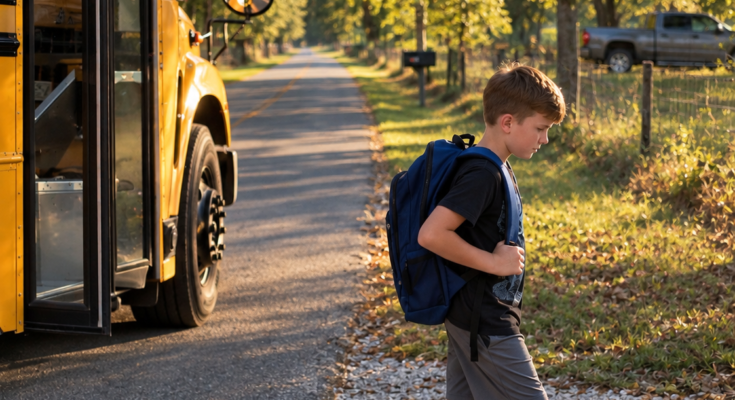
Blue backpack.
Red shoelaces.
One strap hanging lower than the other.
He jumped down from the last step, turned around, and called, “See you tomorrow, Miss Gloria.”
She had smiled and said, “Watch the mud by that ditch.”
Then she waited.
That was something younger drivers occasionally teased her about.
Gloria never pulled away the instant a child stepped off.
She watched until they were clear of the road.
“Those extra five seconds matter,” she always said.
Nobody laughed about that anymore.
By the second night, search crews were checking barns, tree lines, ponds, sheds, and abandoned buildings.
Gloria drove to the staging area even though she had been told she didn’t need to come.
A deputy met her outside.
“Mrs. Benton, you should go home.”
“I can help.”
“You’ve already given your statement.”
“I know these roads.”
“So do we.”
She understood what he was really saying.
Go home.
Stay out of the way.
So Gloria sat in her car for twenty minutes and watched volunteers leave with flashlights.
Then she drove home.
She barely slept.
The next morning, somebody had left a handwritten note in her mailbox.
WE KNOW YOU WOULD NEVER HURT A CHILD.
No signature.
Gloria folded it carefully and put it inside her jacket pocket.
It was the first kindness she’d received in two days.
Then, shortly before noon, a district mechanic named Raymond Cole climbed onto Gloria’s bus.
Raymond had known her for twenty-two years. Every December, she gave him homemade banana bread and told him, “You keep my brakes working, I keep you fed.”
Everybody had already checked the camera.
Raymond checked again.
The main unit was dead.
But while tracing an old wiring harness behind the dashboard, he found a cable that wasn’t connected to the system everyone had been examining.
He followed it.
Behind a faded plastic panel sat a small secondary dashcam.
It had been installed years earlier after a minor traffic complaint and forgotten when the district upgraded the main cameras.
Raymond pulled its memory card.
Most files were corrupted.
One was not.
Eleven seconds.
That was all.
He watched once.
Then again.
Then called the school administrator.
Then the sheriff’s office.
Then Gloria.
She was home when the phone rang.
“Gloria,” Raymond said, “I need you to come down here.”
She arrived still wearing the navy jacket.
Nobody spoke much as they gathered around a small monitor in the transportation office.
Raymond pressed play.
Trees.
Gravel road.
Late-afternoon sun.
The bus slowed.
Stopped.
The door opened.
Then the missing boy stepped down.
Blue backpack.
Red shoelaces.
One strap lower than the other.
Gloria covered her mouth.
“There.”
The boy walked safely toward his driveway.
Exactly where Gloria said he had.
For the first time in three days, nobody questioned her memory.
Then Raymond said, “Wait.”
He moved the footage back several frames.
At the edge of the image, partly hidden between two trees, something appeared.
The front end of a pickup truck.
Driver’s side visible.
Just enough.
Gloria leaned closer.
Her face changed.
“I know that truck.”
The room went still.
It belonged to Dean Mercer, a local man who knew the boy’s family.
And for three days, Dean had been one of the loudest people blaming Gloria.
He had stood outside the school telling reporters she should be fired.
He called her careless.
Said parents deserved “someone younger and more responsible” behind the wheel.
But at 4:17 that afternoon, Dean’s truck had been near the boy’s driveway.
And nobody remembered him mentioning that.
━━━━━━━━━━━━━━━━━━━━
Part Two — Eleven Seconds
Deputies found Dean before lunch.
His explanation changed twice.
First he said he had been driving through the area.
Then he said he had stopped nearby to check something on the truck.
When investigators asked why he had never mentioned seeing the school bus or the child, he became defensive.
That was enough to change the direction of the search.
Gloria was not told every detail.
She did not need to be.
Hours later, sheriff’s vehicles headed toward an isolated hunting property several miles outside town.
By evening, the missing boy was found alive.
Cold.
Frightened.
But safe.
The investigation afterward was handled carefully, especially for the child’s sake.
Gloria never asked for details she did not need to know.
One fact was enough.
She had put him at his driveway.
She had waited.
She had watched.
She had told the truth.
That evening, the school administrator called.
“Gloria, I owe you an apology.”
She said nothing.
“We lifted the suspension.”
Still nothing.
“You can take as much time as you need.”
“When does my route leave?”
There was a pause.
“Six twelve.”
“I’ll be there at five forty-five.”
“Gloria, you don’t have to—”
“Yes,” she said. “I do.”
Then she hung up.
━━━━━━━━━━━━━━━━━━━━
Part Three — Until They Were Safe
At 5:43 the following morning, Gloria walked into the transportation yard.
Raymond was already there.
He handed her a cup of coffee.
“You’re early.”
“So are you.”
“I don’t trust you around my buses.”
“They’re my buses.”
Raymond smiled.
“That sounds more like you.”
Her route sheet rested beside the driver’s seat. The little plastic keychain her granddaughter had given her years earlier swung from the ignition.
Gloria sat down.
Put both hands on the steering wheel.
And breathed.
For three days, she had imagined this moment.
She thought she might feel triumphant.
She didn’t.
She felt tired.
And sad.
Because being proven right did not erase what happened to the boy.
It did not erase three days of strangers deciding she had become incompetent because she was old.
It did not erase the father telling her she might be confused.
Truth repaired facts faster than it repaired wounds.
At the first stop, three parents stood with their children.
Normally, one parent waited.
That morning there were three.
They waved.
At the second stop, five adults stood near the road.
Someone clapped when the bus arrived.
Gloria gripped the wheel tighter.
By the time she reached the county road, almost every family on her route was outside.
Some waved.
Some applauded.
One father removed his cap and held it against his chest.
Gloria pretended to be very interested in her mirrors.
Then she reached the boy’s driveway.
His mother stood beside him.
Gloria stopped the bus.
Opened the door.
For several seconds, the boy didn’t move.
Then his mother squeezed his shoulder.
He climbed the steps.
Gloria looked at him.
He looked at her.
Neither knew what to say.
Then the boy threw both arms around her.
“I knew you didn’t forget me.”
Gloria cried.
Right there behind the wheel.
She hugged him carefully.
“Not a chance, sweetheart.”
Behind him, his mother began crying too.
Before Gloria closed the door, the woman stepped closer.
“Gloria?”
“Yes?”
“I’m sorry.”
Gloria looked at her.
There are apologies that repair misunderstandings.
And there are apologies that can only acknowledge a wound that still needs time.
Gloria nodded.
Then said quietly, “Just make sure you believe him when he tells you something important.”
The mother covered her mouth.
Gloria closed the door.
The boy sat near the front that morning.
Normally, he preferred the back.
Gloria did not mention it.
She simply drove.
At school, children began getting off.
One.
Two.
Three.
Gloria counted every head.
Then she drove the afternoon route.
At each stop, she did exactly what she had always done.
Brake.
Check mirror.
Open door.
Watch the child step down.
Wait.
Five seconds.
Sometimes seven.
Sometimes ten.
Until she knew they were clear.
The district offered Gloria a public apology at the next board meeting.
She attended because Denise insisted.
The superintendent spoke first.
“We failed Mrs. Benton when we allowed uncertainty to become assumption.”
Gloria appreciated that wording.
Because that was exactly what had happened.
Nobody had evidence she made a mistake.
They simply had an older woman and a missing child.
Fear filled the gap.
When Gloria’s turn came to speak, she carried no notes.
“I don’t expect people not to ask questions,” she said. “A child was missing. Questions needed asking.”
The room was silent.
“But asking questions and choosing an answer before you have evidence aren’t the same thing.”
Several people lowered their eyes.
“I’ve driven children for thirty-four years. Maybe someday I’ll forget a stop. Maybe someday I’ll be too old to do this safely. If that day comes, I hope somebody honest tells me.”
She paused.
“But don’t decide that day has arrived just because my hair is gray.”
The room stayed quiet for one second longer.
Then everyone stood.
Gloria hated standing ovations.
She had told the superintendent this beforehand.
Apparently nobody listened.
Afterward, the boy’s father approached her.
Gloria saw him coming and briefly considered finding the nearest exit.
He stopped several feet away.
“I was wrong.”
“Yes.”
He seemed surprised she didn’t soften it.
“I said things about you I shouldn’t have.”
“Yes.”
“I was scared.”
“I know.”
He looked down.
“That doesn’t excuse it.”
“No.”
Then he said, “You watched him get off.”
Gloria’s expression changed.
“Every day.”
“He told us that. Said you always waited until he reached the yard.”
Gloria swallowed.
The father wiped his eyes.
“I should’ve listened when you said the same thing.”
That one mattered.
She nodded.
“I hope none of us ever need eleven seconds of video to believe somebody who has spent thirty-four years showing us who she is.”
The father nodded.
“Me too.”
Gloria continued driving for another two years.
Not because she had something to prove.
That was important to her.
She did not stay simply so nobody could say Dean had chased her away.
She stayed because she still liked the mornings.
The sunrise over the fields.
The little ones climbing aboard half asleep.
The middle-school boys pretending they were too old to say good morning while still saying it.
The kindergarten girl who brought Gloria a dandelion every Friday.
Then, at sixty-eight, Gloria decided she was done.
On her terms.
Her final route happened on a warm May afternoon.
No scandal.
No emergency.
No cameras.
Just thirty-one children climbing aboard.
They knew it was her last day.
That made them unusually loud.
Someone had decorated the bus with paper signs.
THANK YOU MISS GLORIA
34+ YEARS
BEST DRIVER
Gloria corrected that one.
“Best is subjective.”
The children ignored her.
At the last stop, the same boy who had once gone missing was now eleven.
He waited until everyone else had gotten off.
Then he stood beside her seat.
“You really retiring?”
“That’s the rumor.”
“Who’s going to drive us?”
“Somebody younger.”
He smiled.
“Are you mad about that?”
Gloria laughed.
“No, sweetheart.”
He looked toward the windshield.
Then asked, “Are they going to wait like you?”
That question almost undid her.
“I told them to.”
He nodded seriously.
“Good.”
Then he stepped off.
Gloria watched him walk up the driveway.
He reached the yard.
Turned.
Waved.
Gloria waved back.
Only then did she close the door.
A week after retirement, Raymond stopped by with a small package.
Inside was a digital frame.
“What is this?”
“Press the button.”
She did.
The screen showed the old eleven-second clip.
Gloria frowned.
“I’ve seen this enough.”
“Keep watching.”
After the footage ended, another video began.
The boy was standing beside his mother.
“Hi, Miss Gloria.”
Gloria sat down.
Then another child appeared.
Then another.
Raymond had collected short recordings from families along her route.
Some children thanked her for crackers.
One remembered the spare gloves.
Another remembered the day Gloria waited ten minutes because her mother was late reaching the stop.
A high-school senior said, “You drove me from kindergarten through eighth grade and never once left until you saw me get inside Grandma’s gate.”
Then the missing boy appeared again.
He looked directly into the camera.
“You always waited until we were safe.”
Gloria covered her face.
Raymond stood awkwardly beside the table.
“I thought you should know what people actually remembered.”
For days after the disappearance, Gloria had believed the town would remember only one question:
Did she lose that boy?
But that wasn’t what lasted.
Years of quiet actions had lasted.
The gloves.
The crackers.
The careful stops.
The extra seconds.
People later called those eleven seconds of forgotten footage a miracle.
Gloria never did.
A miracle would have been keeping that boy from being taken at all.
The footage was evidence.
Nothing more.
What mattered was everything that happened before the camera ever turned on.
For thirty-four years, Gloria Benton had performed thousands of tiny acts that nobody thought to record.
She watched.
She remembered.
She waited.
And when the worst afternoon of her career came, she knew exactly what she had seen because she had spent a lifetime paying attention.
The camera did not prove Gloria suddenly became trustworthy.
It only forced everyone else to notice that she already was.