Part One — The File Nobody Had Really Read
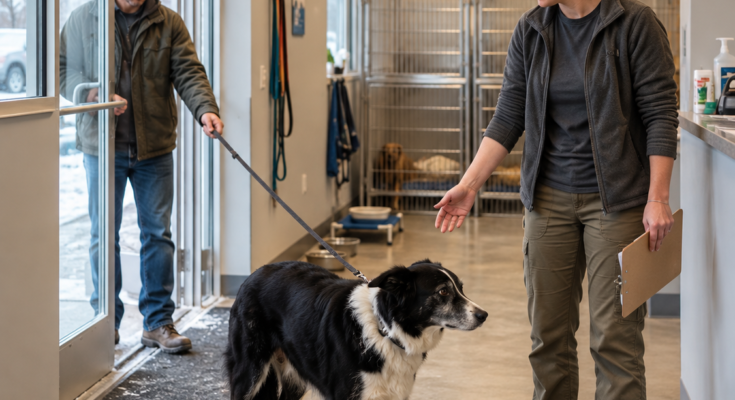
When Luna returned through our shelter doors less than twenty-four hours after finally leaving them, she looked at me once and then turned her face toward the wall. I work at an animal shelter, and I had watched that eight-year-old Border Collie wait eleven months for someone to choose her.
She had arrived on a Tuesday morning with the man who had been her owner. He kept repeating, “They don’t allow dogs,” while filling out the surrender paperwork because he was moving somewhere she couldn’t go. Luna sat beside his leg and kept looking up at him. When he handed me her leash and walked toward the exit, Luna followed. I had to hold her back. She pulled harder when the door opened, whined once as he stepped outside, and stared after him.
He never turned around.
After that, Luna learned the shelter through absence. A vehicle entered the parking lot—she stood. The front door opened—she watched. A man’s voice reached the kennel hallway—her ears lifted. But nobody came back for her.
Spring became summer. Summer leaned toward fall. Puppies left within hours. Younger dogs went home. Families stopped at Luna’s kennel, saw her age, and kept walking. “She’s eight?” they would ask. “Any younger Border Collies?” Eventually Luna began lying down before those families had even left.
Then, after eleven months, a mother, father, and teenage daughter stopped at her kennel.
And they stayed.
The girl’s name was Mia. She sat on the concrete floor for almost twenty minutes without trying to touch Luna. Eventually Luna walked over on her own and placed her chin on Mia’s knee. In the exercise yard, Mia threw a tennis ball. Luna chased it slowly the first time, faster the second, and by the fourth throw her tail was wagging without hesitation.
Possibility.
That was what returned to her face.
The family completed the paperwork. I clipped a new leash to Luna’s collar, and Mia crouched beside her, kissed her forehead, and whispered, “We’re taking you home.”
I watched their car leave and smiled so hard my face hurt.
That evening, I told my coworker Denise, “Luna finally got out.”
At 9:03 the following morning, the phone rang.
It was Mia’s mother.
She was crying.
“She was up all night.”
My stomach dropped.
“She cries whenever we leave the room. She scratches at the doors. She wouldn’t let my husband go upstairs without her. Nobody slept.”
“Give her time.”
“We can’t.”
“One night isn’t time.”
“I know. I’m sorry.”
Forty minutes later, their car entered our parking lot.
Luna was sitting in the back seat.
She recognized the shelter before the car had even stopped.
I walked outside as the family opened the rear door. Mia stood nearby crying. Her mother held the leash and apologized over and over. Her father looked embarrassed and exhausted.
Then Luna stepped out.
She didn’t pull toward them.
She didn’t try to climb back into the car.
She simply walked beside me.
That was worse.
When we reached her old kennel, Luna entered without being asked. I crouched beside her.
“Luna.”
She looked at me once.
Then turned toward the concrete wall.
I stayed there wondering how you explain to a dog that one frightened night did not mean she had failed.
Then Denise stopped behind me.
“Don’t put her back up for adoption like nothing happened.”
I turned.
“What do you mean?”
She held out her hand.
“Give me the file.”
I passed it through the kennel gate.
Denise sat on the floor and started reading every page, not just the adoption summary. Intake sheet. Veterinary notes. Behavioral observations. Volunteer logs. Old phone messages.
After about ten minutes, she stopped.
“Here.”
She handed me a page from Luna’s original surrender interview.
There was a section I had never noticed because it had been scanned sideways and buried beneath medical records.
How does the animal behave when left alone?
The former owner had written:
She hasn’t really been alone in years. My wife died three years ago. Luna followed her everywhere when she was sick, then started following me. If I shut a door, she waits outside it. Please don’t put her with someone who expects her to be alone all day right away. She panics when people disappear.
I read it twice.
Then found another note.
A kennel attendant had written during Luna’s first week:
Vocal/distressed after closing. Scratched kennel door until staff member sat in aisle. Settled once she could see someone.
Another note three months later:
Moved temporarily for cleaning. Extreme distress when familiar staff exited.
Another:
Possible separation-related anxiety. Recommend gradual transition to home setting.
None of that had made it onto Luna’s public profile.
Her adoption card simply said:
Calm senior Border Collie. House-trained. Good with older children. Prefers quiet home.
I felt sick.
Mia’s family had not been told they were taking home a dog who might interpret a closed bedroom door as abandonment.
We had handed them a leash, congratulated them, and expected eleven months of shelter life to disappear at their front door.
Denise closed the file.
“She didn’t fail the adoption.”
I looked at Luna facing the wall.
“No.”
“We did.”
That afternoon, I called Mia’s mother.
I expected anger.
Instead she started crying again.
“I thought she hated our house.”
“She didn’t hate your house.”
“Then why was she trying to get out?”
“Because every person Luna has depended on has disappeared.”
There was silence.
Then another voice came onto the phone.
Mia.
“Can I come see her?”
Her mother whispered something in the background.
I said, “Yes.”
Twenty minutes later, Mia was sitting outside Luna’s kennel.
She didn’t call her.
Didn’t reach through the bars.
Just sat.
For almost five minutes, Luna continued facing the wall.
Then one ear moved.
She turned her head.
Saw Mia.
And stood.
Mia started crying before Luna reached the gate.
“I’m sorry,” she whispered.
Luna pressed her nose through the bars.
Mia put her forehead against them.
Her mother stood behind us with both hands over her mouth.
Then Mia asked me something I wasn’t prepared for.
“Can we try again?”
Her father looked at her.
“Mia…”
“Not today. Not like yesterday.”
She wiped her face.
“Can somebody teach us how to do it right?”
━━━━━━━━━━━━━━━━━━━━
Part Two — We Stopped Calling It a Return
We did not send Luna home again that day.
Instead, we changed the plan.
Our veterinarian ruled out pain or other medical problems that could be worsening her distress, and we contacted a behavior professional who worked with separation-related issues. Luna went temporarily into foster care with Denise, who lived five minutes from the shelter and had two quiet older dogs.
For the first week, Mia visited every afternoon.
No dramatic reunions.
She sat with Luna.
Walked her.
Fed her dinner.
Then left for ten minutes.
The next day, fifteen.
Luna still watched the door, but somebody remained with her.
Gradually, she learned a new pattern:
People left.
And people came back.
Mia’s parents returned too. They learned that Luna needed routine, predictable departures, and a transition measured in weeks rather than one exhausting night. Nobody promised it would be perfect.
Six weeks later, Luna spent one afternoon at their house.
Then an evening.
Then one night.
At 7:12 the next morning, Mia sent me a photograph.
Luna was asleep on the rug outside her bedroom.
The message underneath said:
She cried once when Dad went upstairs. Then he came back. She believed him this time.
I saved that photograph.
━━━━━━━━━━━━━━━━━━━━
Part Three — The Dog Who Finally Stopped Watching the Door
Luna went home permanently three weeks later.
I refused to call it a second adoption.
The first one had never really ended.
It had simply needed more help than any of us understood.
When Mia arrived to take her home, she brought the same tennis ball from their first meeting. Luna saw her in the lobby and pulled the leash so hard I nearly lost my grip.
That time, when they walked through the front doors, Luna did not look back at me.
I was grateful.
For the next several weeks, Mia sent updates.
Day 3: Slept through the night.
Day 8: Stole Dad’s sock. Apparently rehabilitation is complete.
Day 16: Mom went to the mailbox alone. Luna waited by the window but didn’t cry.
Then one month passed.
Two.
Six.
Luna still had difficult moments. Thunderstorms made her clingy. Suitcases frightened her. If somebody left unexpectedly, she sometimes paced.
But the family stopped treating fear like misbehavior.
That changed everything.
Mia’s father installed a cheap camera in the living room so they could monitor Luna during carefully planned absences. At first she stood at the door almost the entire time. Eventually she began lying on the couch.
The first day she fell asleep while the house was empty for twenty minutes, Mia sent me the video like her dog had won an Olympic medal.
Honestly, it felt almost that important.
The shelter changed too.
We reviewed every long-term animal’s file from the beginning.
Not the summaries.
Everything.
We discovered details that had been compressed into vague phrases because staff changed, software changed, and people became busy.
Needs patience.
What did that actually mean?
Prefers company.
How much?
Shy at first.
Under what circumstances?
We stopped using simple labels when they hid useful information.
For dogs who had spent months or years in kennels, we began offering transition plans, foster-to-adopt periods, scheduled follow-ups, and more realistic conversations about the first seventy-two hours.
Not every adoption survived.
Some homes genuinely were wrong.
But fewer people left believing that a frightened dog had shown her “real personality” on the first night.
Mia started volunteering the following summer.
The first time she arrived wearing our shelter T-shirt, I laughed.
“What?”
“You know you’re supposed to be escaping this place with Luna, not coming back.”
She shrugged.
“Luna has separation anxiety. Apparently I have shelter anxiety.”
She became good with the difficult dogs.
Not because she had magical instincts.
Because she could wait.
She sat outside kennels without staring.
She understood that a dog hiding in the back wasn’t rejecting her.
Sometimes the animals everybody else called aloof were simply terrified of hoping.
Luna became ten.
Then eleven.
Her black fur turned more silver around the face. She stopped chasing tennis balls quite as hard but still carried one whenever she was excited.
On her eleventh birthday, Mia brought her to visit.
The moment Luna entered the shelter, I worried.
Would she remember?
She did.
Her body stiffened.
Her eyes went toward the kennel hallway.
Then Luna looked back at Mia.
Mia knelt.
“We’re not leaving you.”
Luna stared at her for a second.
Then continued walking.
That small movement nearly made me cry.
The building still meant something.
It just didn’t mean everything anymore.
A year later, Mia left for college.
That created the next challenge.
The girl Luna had attached herself to most strongly was leaving.
Mia spent months preparing her. Her parents became more involved in feeding and walks. Mia started sleeping away from home occasionally. Her mother took over the evening routine.
When move-in day came, Luna watched suitcases travel through the front door.
According to Mia’s mother, she began trembling.
Mia almost canceled leaving.
Her mother told her no.
“You can’t build your entire life around making sure Luna never sees anybody go.”
That sentence ended up mattering to all of them.
Mia sat on the floor with Luna for a long time.
Then she left.
Luna waited by the door.
For forty minutes.
Then Mia’s father called her into the kitchen.
Luna followed.
She ate dinner.
That night she slept outside the parents’ bedroom instead of Mia’s empty one.
Mia came home two weeks later.
Luna nearly knocked her down.
Then something wonderful happened.
After twenty minutes of celebration, Luna wandered away and went to sleep.
She had learned the thing we should have helped her learn long before.
Leaving was not always forever.
Luna lived until she was thirteen.
Near the end, arthritis made walking difficult. Her hearing faded. She slept more.
Mia was home from college during Luna’s final week.
The family knew they were getting close to a decision. Their veterinarian came to the house one afternoon when Luna stopped eating and could no longer comfortably stand.
Mia called me afterward.
I had not worked at the shelter for almost a year by then.
“I thought you’d want to know.”
I sat down.
“Was she comfortable?”
“Yes.”
“Were you with her?”
“All of us.”
Her voice broke.
“She was on her bed in the living room. Dad was holding her paw.”
For a moment neither of us spoke.
Then Mia said, “Do you remember when we brought her back?”
“Yes.”
“I hate thinking about it.”
“I don’t.”
She sounded surprised.
“Why?”
“Because you came back too.”
Silence.
“You were sixteen years old. Your family made the wrong decision after one terrible night. Then you asked how to do better.”
Mia started crying.
“So she knew we loved her?”
I thought about the dog who once turned her face toward a shelter wall.
Then I thought about the photograph I had kept all those years—Luna sleeping outside Mia’s bedroom because somebody had left and actually returned.
“Yes.”
“I think she knew.”
Several weeks later, Mia visited the shelter.
She was carrying Luna’s old tennis ball.
She asked if we could keep it.
We put it in a shadow box beside the adoption office.
Underneath it, we added a small card:
LUNA
11 months waiting.
1 night returned.
4 years home.
Then, after some debate, we added one more line:
Fear is not failure.
I still think about the morning Luna came back.
For a long time, I remembered the way she entered her old kennel and turned toward the wall.
I thought I was watching a dog understand rejection.
Maybe I was.
But I was also watching the moment our shelter finally understood something we should have known already.
We celebrated adoption as if walking through the front door were the finish line.
For some animals, it is only the beginning.
A dog can be safe and still terrified.
Loved and still waiting for abandonment.
Home and still unsure whether home will exist tomorrow.
Luna did not need a family that would never make a mistake.
She needed one willing to learn after making one.
Years later, Mia told me she sometimes thought about the first night. Luna scratching at doors. Crying whenever somebody disappeared upstairs. Everyone exhausted and panicking.
“We thought she was telling us she didn’t want us.”
I told her, “No.”
Luna had been saying something much simpler.
Please don’t disappear too.
It took time before she understood the answer.
But eventually, every closed door opened again.
Every person who left returned.
And after eleven months of watching strangers walk away from her kennel, Luna finally learned she could fall asleep without keeping one eye on the door.