
Part 1: The Discovery
My name is Oscar Blake. I’m seventy-two years old, and before retiring, I spent four decades working as a corporate auditor. Numbers were my world. Missing funds. Unusual transfers. Accounts that refused to balance. Over the years, I learned that financial records often reveal the truth long before people are willing to admit it.
I just never expected the most disturbing financial mystery of my life to involve my own family.
Ten years earlier, my wife Diane died after a long illness. Her treatment consumed most of our savings. After she passed, I sold the home where we had raised Jared, settled the remaining bills, and used what was left to help our son finish college and keep his struggling software startup alive. Jared turned that chance into extraordinary success. His company grew. Then it grew again. Before long, my son was a millionaire.
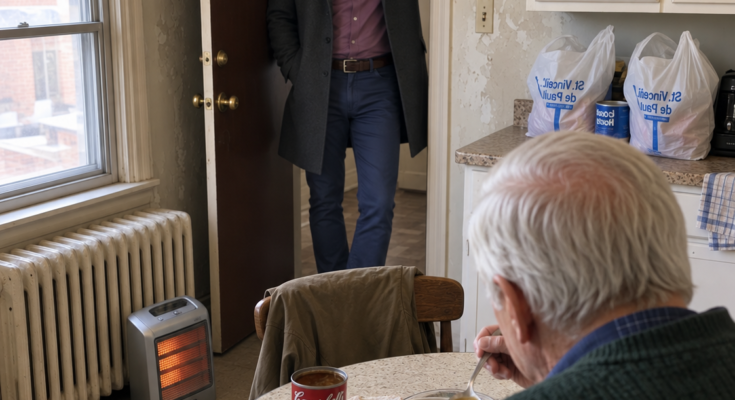
I couldn’t have been prouder. And because I was proud of him, I never wanted him feeling responsible for me. That was how I ended up spending three years inside a drafty Chicago apartment with peeling walls, an unreliable radiator, and a small space heater beside the kitchen table.
Twice a week, I walked six blocks to a nearby church pantry. Canned soup. Bread. Powdered milk. Nothing fancy. Just enough to keep going. Whenever Jared called, he assured me that he had created a family trust to make sure I was comfortable. “Lauren handles everything,” he would say. “You don’t need to worry about money.” I assumed the funds were sitting somewhere for future expenses. I never asked questions.
Then Father’s Day arrived. Jared appeared unexpectedly, wearing an expensive coat that looked completely out of place in my worn apartment. The second he stepped inside, his expression changed. He looked at the peeling paint. Then the space heater. Then the soup on my table. “Dad,” he asked slowly, “where’s the senior residence?”
I frowned. “What senior residence?”
His face tightened. “Lauren told me she moved you into a place downtown months ago.”
“I’ve lived here for three years.”
Jared stared at me. Then he asked the question that changed everything. “Dad, are you happy with the $8,000 Lauren sends you every month?”
The only sound in the room was the radiator clicking in the corner. “Jared,” I said carefully, “I have never received $8,000 from anyone.” His face drained of color. “The church pantry has been helping me survive.”
He immediately reached for his phone. Before he could make a call, the apartment door opened. Lauren stepped inside wearing a white wool coat and carrying an expensive leather handbag. She saw Jared. Then she saw me. For the briefest moment, something flickered across her expression. Surprise. Maybe fear. Then it disappeared.
“Oh, Jared,” she said softly. “I didn’t want you to discover this like this.” He turned toward her. “Discover what?”
Lauren began explaining. She claimed she had deposited the money every month. She said I had become increasingly confused. According to her, she had arranged a comfortable senior residence for me downtown, but I had somehow left and returned to my old apartment without telling anyone. I stood beside my kitchen table listening to her calmly describe a life I had never lived.
Jared looked from her to me. “Dad, is any of this true?” Before I could answer, his phone buzzed. He checked the screen and frowned. “Business emergency. Give me five minutes.” He stepped into the hallway and closed the door.
The moment he was gone, Lauren’s expression changed. She walked toward me. “When Jared comes back,” she whispered, “don’t make this harder than it has to be.” I said nothing. Then she told me something far more important. Paperwork had already been prepared. If I appeared mentally incapable of managing myself, decisions involving my finances, medical treatment, and living arrangements could be transferred to someone else. To her.
That was the moment forty years of instinct came rushing back. I didn’t confront her. I didn’t accuse her. I simply listened. When Jared returned, I deliberately allowed my shoulders to slump. Then I stared past him with a confused expression. “Will Diane be home for dinner?” My son froze. Diane had been dead for ten years. Lauren gently placed a hand on his shoulder. But as Jared turned away from me, she looked over his back and gave me the smallest satisfied smile. She thought she had won.
Twenty minutes later, they left. The second their footsteps disappeared down the hallway, I straightened. I pushed the cold soup away. Then I opened a clean notebook. At the top of the first page, I wrote one number. **$8,000.**
The following morning, I went directly to my bank. The branch manager, Beverly, had known me for years. “I need a complete review of every transaction connected to my family trust.” She pulled up the account. And there it was. On the first day of every month, exactly $8,000 arrived from Jared’s trust. January. February. March. Month after month. My son hadn’t lied. He really had been sending the money.
Then Beverly scrolled farther down. Directly beneath each $8,000 deposit was another transaction. **$7,800 transferred out.** Again. And again. And again. Every single month. Only $200 remained behind. I leaned toward the monitor. “Can you trace the destination?” Beverly started typing. A few seconds later, her fingers stopped moving. She stared at the screen. Then she slowly looked at me. “Mr. Blake,” she said quietly, “I think you need to see who authorized these transfers.”
She turned the monitor in my direction. I read the name. And suddenly I understood exactly why Lauren had spent so much effort convincing my son that I was losing my mind. Because the transfers weren’t random. They had been set up using legal authority supposedly granted by me. And the person listed as controlling my money was someone I had never authorized at all. **Lauren.**
—
Part 2: The Evidence
Beverly printed every statement. Every transfer. Every signature card. Every authorization form. She put them in a manila folder and slid it across the desk.
“Mr. Blake,” she said quietly, “this is serious. The signature on these authorization forms doesn’t match the signature on your original account documents.”
I opened the folder and studied the pages. Forty years of auditing had taught me to spot forgeries. The loops were wrong. The spacing was off. The pressure was inconsistent. Someone had practiced my signature and gotten close, but not close enough.
“Can you certify these as forgeries?” I asked.
“I can certify that they don’t match your known signature,” Beverly said. “You’ll need a forensic document examiner for a formal opinion.”
I nodded. “I’ll get one.”
I called my attorney, a woman named Patricia Okonkwo who had handled my affairs since Diane died. She listened without interrupting. When I finished, she was quiet for a long moment.
“Oscar,” she said, “this is elder financial abuse. It’s a felony. And if she’s planning to have you declared incompetent, we need to move fast.”
“What do you recommend?”
“First, we get a forensic document examiner. Second, we file a petition to freeze the trust and revoke any power of attorney she claims to have. Third, we hire a private investigator to find out exactly what she’s been doing with the money.”
“And Jared?”
Patricia paused. “Your son may be a victim too. Or he may be complicit. We need to find out before we tell him anything.”
I agreed. Over the next week, I worked quietly. The forensic examiner confirmed the signatures were forged. The private investigator traced the $7,800 monthly transfers to a private account in Lauren’s name. From there, the money had been moved into a series of shell companies. Some had been used to pay for luxury vacations. Some had been invested in real estate. Some had simply disappeared.
But the most disturbing discovery was the paperwork Lauren had prepared. A petition for guardianship. A medical evaluation form. A list of doctors who had been paid to declare me incompetent. She had been planning this for months. Maybe years.
I sat in my apartment that night, staring at the folder. The radiator clicked. The space heater hummed. The soup can sat unopened on the counter.
I thought about Diane. I thought about the life we had built. I thought about the son we had raised. And I thought about the woman who had tried to take everything from me.
I didn’t feel anger. I felt something colder. Something calculated. Something that had been dormant for years but was now fully awake.
I picked up my phone and called Patricia. “It’s time,” I said. “Let’s do this.”
—
Part 3: The Reckoning
Patricia filed the petition on a Monday morning. By Tuesday afternoon, Lauren’s accounts were frozen. By Wednesday, she was sitting in a conference room across from me, her expensive lawyer beside her, her face a mask of controlled fury.
“This is outrageous,” her lawyer said. “My client has done nothing wrong. She has been managing Mr. Blake’s affairs with his full consent.”
Patricia slid a folder across the table. “These are the forged authorization forms. These are the bank records showing $7,800 transferred out of Mr. Blake’s trust every month for three years. That’s $280,800. And this is the petition for guardianship you filed, claiming Mr. Blake is mentally incompetent.”
Lauren’s lawyer glanced at the documents. His face tightened.
“Where did you get these?” Lauren demanded.
“I’m an auditor,” I said quietly. “I’ve spent forty years finding missing money. Did you really think you could hide it from me?”
She stared at me. For the first time, I saw fear in her eyes.
Jared was in the hallway. He had been waiting outside, confused and worried. Patricia had asked him to come. She wanted him to hear the truth from me.
I walked out and sat beside him. He looked at me. “Dad, what’s going on?”
I handed him the folder. He opened it slowly. He read the first page. Then the second. Then the third. His face went pale. Then red. Then pale again.
“She told me she was sending you the money,” he whispered. “She showed me the statements. She said you were confused. She said you didn’t know what you were doing.”
“She lied,” I said.
He looked at me. “I believed her.”
“I know.”
“I should have checked. I should have visited. I should have—”
“Jared.” I put my hand on his shoulder. “You trusted your wife. That’s not a crime. What she did is.”
He broke down. He cried in the hallway of the law office. He cried for the years he had lost. He cried for the father he had neglected. He cried for the marriage he had just discovered was a lie.
I held him. I didn’t say anything. I just held him.
The legal proceedings were swift. Lauren was charged with elder financial abuse, forgery, and attempted guardianship fraud. Her lawyer tried to negotiate a plea deal, but the evidence was overwhelming. She was convicted and sentenced to five years in prison. She was ordered to repay every dollar she had stolen.
Jared filed for divorce. He moved back to Chicago. He bought a house near my apartment. He started visiting every week. He started calling every day. He started being my son again.
I didn’t move into a senior residence. I didn’t need one. I bought a small house with a garden. I planted tomatoes. I read books. I watched baseball. I lived my life.
But I also kept the ledger. The notebook where I had written $8,000. The folder with the forged signatures. The bank statements. The evidence.
I kept it as a reminder. A reminder that even in the darkest moments, the truth is always worth fighting for. A reminder that numbers don’t lie. A reminder that sometimes, the people we trust the most are the ones who betray us.
But also a reminder that it’s never too late to fight back. It’s never too late to reclaim what’s yours. It’s never too late to teach someone a lesson they’ll never forget.
Lauren learned that lesson. Jared learned it too. And I learned something about myself. I learned that even at seventy-two, even after everything, I still had the strength to stand up for what was right.
The ledger is still on my shelf. I look at it sometimes. And every time I do, I remember that day in my freezing apartment. The soup. The radiator. The question that changed everything.
“Dad, are you satisfied with the $8,000 Lauren sends you every month?”
No. No, I wasn’t satisfied. But I was patient. And in the end, that was enough.
The End.