
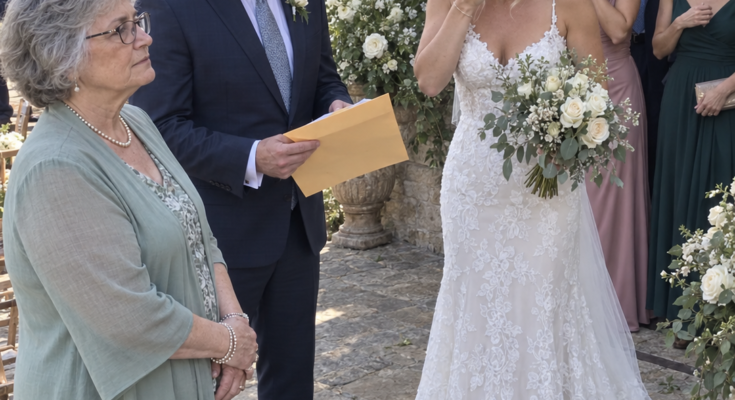
My son’s bride stopped me at the wedding entrance and said, “You were uninvited.” I calmly agreed to leave, then stepped aside and introduced the man behind me. One look at him made her drop her champagne glass before the ceremony even began.
My name is Wendy Thornton. I am sixty-seven years old, a retired fifth-grade teacher, and until three weeks before my son’s wedding, I believed I would be sitting proudly in the audience watching him marry the woman he loved.
I had already chosen what I would wear. Gray slacks. A lavender cardigan. And my mother’s pearl brooch pinned near the collar. That brooch had belonged to our family since 1951. My mother wore it on her wedding day and gave it to me shortly before she died. “It should go to the woman who loves a Thornton man enough to marry him,” she told me.
For eleven years, I kept it inside a velvet box, waiting for my son Ryan to meet that woman. I believed he had. Madison was elegant, attractive, and always perfectly composed. The first time Ryan brought her to my house, I made pot roast and watched my son smile more easily than I had seen in years.
I genuinely liked her. That detail matters. What happened later was not the result of jealousy. I was not some possessive mother searching for reasons to dislike the woman my son had chosen. I supported them. I gave them $4,000 toward the wedding venue deposit. I co-signed the mortgage on their house. Whenever Ryan struggled financially, I quietly bought groceries and never mentioned the money afterward.
I recorded those things in a leather notebook I had owned since I was twenty-six. Not because I expected repayment. Because numbers have a way of changing when families start rewriting history.
At first, the exclusions seemed small. There was a wedding-planning group chat I somehow never got invited into. My name disappeared from the list for family photographs. On the seating chart, I was placed near the kitchen doors between two business associates of Madison’s mother. Then I discovered Madison’s bridal shower had already happened. Twelve women had attended. Mothers. Aunts. Cousins. Friends. Everyone except the groom’s mother.
When I gently asked one of Madison’s cousins about it, her face turned pink. “Sharon thought it would be easier without too many opinions.” Sharon was Madison’s mother. She was a successful real-estate agent who wore expensive suits and spoke to people as though she were constantly estimating their value.
At the engagement party, Sharon raised her champagne glass and said, “Some women believe writing a check automatically makes them part of the family. It doesn’t. It simply makes them a line item.” She never looked directly at me. She did not need to. Half the room did.
I smiled and took a sip of wine. Women like Sharon prepare themselves for tears. Arguments. Public scenes. What they rarely understand is a woman who stays calm and remembers everything.
Five weeks before the wedding, Madison called while I was washing dishes. She spent nearly a minute and a half discussing the weather before her tone changed. “Wendy, I’ve thought about this carefully,” she said. “I think it would be better if you didn’t attend the wedding.”
I turned off the faucet. “Better for whom?” “For everyone. It will just be easier.” No explanation. No accusation I could challenge. Only a decision. I could hear her waiting for me to cry. Instead, I thanked her for telling me herself. Then I ended the call before she could.
That evening, I sat alone at my kitchen table and opened my notebook. Four thousand dollars toward the venue. My signature on their mortgage. Nineteen years raising the groom alone after his father died. And somehow there was no chair for me at his wedding.
I should have been furious. Instead, I remembered something I had overheard several weeks earlier at a family cookout. Madison’s cousin Todd had laughed and said, “Remember when Madison ran off and married that guy Colton?” Madison laughed much too quickly. “Vegas doesn’t count.” Then Sharon appeared beside them and immediately changed the subject.
At the time, I had simply remembered the name. Colton. That night, I turned to a blank page in my notebook and wrote two words. Find out.
I asked Ryan first. He laughed. “That happened years ago, Mom. She married some guy in Vegas for about five minutes. It was taken care of.” “Taken care of how?” “Annulled. Divorced. Whatever people do.” “Did you ever see the paperwork?” His smile weakened slightly. “Why would I need to? Madison told me it was handled.” I did not push him further.
Three days later, I called Patty Noak, one of my former students who now worked at the county recorder’s office. I gave her Madison’s full name, the approximate year, and the first name Colton. Two days later, Patty called me back. “I found the marriage record,” she said. “Clark County, Nevada. Madison Renee Cole and Colton Andrew Briggs.” My grip tightened around the phone. “And the divorce?” Patty became quiet. “I haven’t found one.”
She searched Nevada. Then our county. Then surrounding states. Eleven days later, she called again. There was no uncertainty in her voice this time. “Wendy, they’re still legally married.”
I sat at my kitchen table staring at a childhood photograph of Ryan attached to the refrigerator. In seventeen days, my son planned to stand before two hundred people and marry a woman who already had a husband.
My first instinct was to call him immediately. But I already knew exactly what would happen. Madison would cry. Sharon would take control of the conversation. The missing divorce paperwork would become some harmless misunderstanding. And I would become the bitter mother trying to destroy my son’s wedding because I had been removed from the guest list. Paperwork could be dismissed. A living husband could not.
One public business search was enough to locate Colton Briggs. He owned a small contracting company forty-one miles outside town. I drove there without calling ahead. He was standing beside a partially built porch when I introduced myself and explained that my son was preparing to marry Madison Cole. His expression changed immediately. “We were supposed to annul that marriage years ago,” he said. “She told me her mother took care of it.” “She didn’t.”
He looked toward his truck, his jaw tightening. Then he told me Sharon herself had contacted him after he and Madison separated. She said filing formal paperwork would be an unnecessary expense and promised everything would be handled privately. Nothing ever was.
“Will you come with me?” I asked. Colton stared down at the gravel for a long moment. Then he nodded. “Someone should have told the truth a long time ago.”
Four days before the wedding, Sharon called to make absolutely certain I understood I was not permitted anywhere on the vineyard property. “Not the ceremony,” she said. “Not even the parking lot. A clean break is kinder.” “You’ve made yourself perfectly clear,” I replied. She sounded satisfied. She had no idea she had just confirmed the exact location and timing I needed.
On the morning of the wedding, I pressed my gray slacks and put on the lavender cardigan Ryan had given me for Christmas. Then I opened the velvet box. For years, I had imagined pinning my mother’s pearl brooch onto Madison’s wedding dress. Instead, I fastened it to my own cardigan.
At two-thirty that afternoon, I drove forty-one miles to pick up Colton. He climbed into the passenger seat wearing a borrowed blue tie and carrying a certified copy of the marriage record inside a manila envelope. Neither of us spoke very much during the drive.
Cedar Hollow Vineyard was already crowded with luxury vehicles, white floral arrangements, string music, and elegantly dressed guests drinking champagne beneath the autumn trees. I parked at the far end of the gravel lot. Then Colton and I walked toward the enormous oak entrance doors.
Madison saw me from across the lawn. Her smile disappeared instantly. She gathered the skirt of her ivory gown and hurried toward me so quickly that several guests turned to watch. She reached the entrance before I did and planted herself directly in front of the doors.
“What are you doing here?” she demanded. “You were uninvited.” The conversations around us slowly faded. A photographer lowered his camera.
I did not argue. I did not beg. I simply smiled. “You’re right,” I said. “I was uninvited. So I’m leaving.” Relief immediately crossed her face. “But before I go,” I continued, “there’s someone you should meet.”
I stepped aside. The man wearing the crooked blue tie moved into the afternoon light, the certified marriage record hanging loosely from one hand. Madison stared at him. For one second, she appeared confused. Then recognition hit. The color vanished from her face so quickly that the bridesmaid standing beside her instinctively reached for her arm.
Colton looked directly into Madison’s eyes. Then he quietly said her name. The champagne glass slipped from her fingers. It struck the stone and shattered. And Madison whispered one word.
“Colton.”
The name she had spent nine years making sure my son never heard.
—
Part 1: The Uninvitation
My name is Wendy Thornton. I am sixty-seven years old, a retired fifth-grade teacher, and until three weeks before my son’s wedding, I believed I would be sitting proudly in the audience watching him marry the woman he loved.
I had already chosen what I would wear. Gray slacks. A lavender cardigan. And my mother’s pearl brooch pinned near the collar. That brooch had belonged to our family since 1951. My mother wore it on her wedding day and gave it to me shortly before she died. “It should go to the woman who loves a Thornton man enough to marry him,” she told me.
For eleven years, I kept it inside a velvet box, waiting for my son Ryan to meet that woman. I believed he had. Madison was elegant, attractive, and always perfectly composed. The first time Ryan brought her to my house, I made pot roast and watched my son smile more easily than I had seen in years.
I genuinely liked her. That detail matters. What happened later was not the result of jealousy. I was not some possessive mother searching for reasons to dislike the woman my son had chosen. I supported them. I gave them $4,000 toward the wedding venue deposit. I co-signed the mortgage on their house. Whenever Ryan struggled financially, I quietly bought groceries and never mentioned the money afterward.
I recorded those things in a leather notebook I had owned since I was twenty-six. Not because I expected repayment. Because numbers have a way of changing when families start rewriting history.
At first, the exclusions seemed small. There was a wedding-planning group chat I somehow never got invited into. My name disappeared from the list for family photographs. On the seating chart, I was placed near the kitchen doors between two business associates of Madison’s mother. Then I discovered Madison’s bridal shower had already happened. Twelve women had attended. Mothers. Aunts. Cousins. Friends. Everyone except the groom’s mother.
When I gently asked one of Madison’s cousins about it, her face turned pink. “Sharon thought it would be easier without too many opinions.” Sharon was Madison’s mother. She was a successful real-estate agent who wore expensive suits and spoke to people as though she were constantly estimating their value.
At the engagement party, Sharon raised her champagne glass and said, “Some women believe writing a check automatically makes them part of the family. It doesn’t. It simply makes them a line item.” She never looked directly at me. She did not need to. Half the room did.
I smiled and took a sip of wine. Women like Sharon prepare themselves for tears. Arguments. Public scenes. What they rarely understand is a woman who stays calm and remembers everything.
Five weeks before the wedding, Madison called while I was washing dishes. She spent nearly a minute and a half discussing the weather before her tone changed. “Wendy, I’ve thought about this carefully,” she said. “I think it would be better if you didn’t attend the wedding.”
I turned off the faucet. “Better for whom?” “For everyone. It will just be easier.” No explanation. No accusation I could challenge. Only a decision. I could hear her waiting for me to cry. Instead, I thanked her for telling me herself. Then I ended the call before she could.
That evening, I sat alone at my kitchen table and opened my notebook. Four thousand dollars toward the venue. My signature on their mortgage. Nineteen years raising the groom alone after his father died. And somehow there was no chair for me at his wedding.
I should have been furious. Instead, I remembered something I had overheard several weeks earlier at a family cookout. Madison’s cousin Todd had laughed and said, “Remember when Madison ran off and married that guy Colton?” Madison laughed much too quickly. “Vegas doesn’t count.” Then Sharon appeared beside them and immediately changed the subject.
At the time, I had simply remembered the name. Colton. That night, I turned to a blank page in my notebook and wrote two words. Find out.
What would you do if you discovered your son’s fiancée was hiding a secret that could destroy him? The truth is about to come out. Keep reading to find out what happens next. 👇
—
Part 2: The Search
I asked Ryan first. He laughed. “That happened years ago, Mom. She married some guy in Vegas for about five minutes. It was taken care of.” “Taken care of how?” “Annulled. Divorced. Whatever people do.” “Did you ever see the paperwork?” His smile weakened slightly. “Why would I need to? Madison told me it was handled.” I did not push him further.
Three days later, I called Patty Noak, one of my former students who now worked at the county recorder’s office. I gave her Madison’s full name, the approximate year, and the first name Colton. Two days later, Patty called me back. “I found the marriage record,” she said. “Clark County, Nevada. Madison Renee Cole and Colton Andrew Briggs.” My grip tightened around the phone. “And the divorce?” Patty became quiet. “I haven’t found one.”
She searched Nevada. Then our county. Then surrounding states. Eleven days later, she called again. There was no uncertainty in her voice this time. “Wendy, they’re still legally married.”
I sat at my kitchen table staring at a childhood photograph of Ryan attached to the refrigerator. In seventeen days, my son planned to stand before two hundred people and marry a woman who already had a husband.
My first instinct was to call him immediately. But I already knew exactly what would happen. Madison would cry. Sharon would take control of the conversation. The missing divorce paperwork would become some harmless misunderstanding. And I would become the bitter mother trying to destroy my son’s wedding because I had been removed from the guest list. Paperwork could be dismissed. A living husband could not.
One public business search was enough to locate Colton Briggs. He owned a small contracting company forty-one miles outside town. I drove there without calling ahead. He was standing beside a partially built porch when I introduced myself and explained that my son was preparing to marry Madison Cole. His expression changed immediately. “We were supposed to annul that marriage years ago,” he said. “She told me her mother took care of it.” “She didn’t.”
He looked toward his truck, his jaw tightening. Then he told me Sharon herself had contacted him after he and Madison separated. She said filing formal paperwork would be an unnecessary expense and promised everything would be handled privately. Nothing ever was.
“Will you come with me?” I asked. Colton stared down at the gravel for a long moment. Then he nodded. “Someone should have told the truth a long time ago.”
What happened next would change everything. Keep reading to find out what happens next. 👇
—
Part 3: The Reckoning
Four days before the wedding, Sharon called to make absolutely certain I understood I was not permitted anywhere on the vineyard property. “Not the ceremony,” she said. “Not even the parking lot. A clean break is kinder.” “You’ve made yourself perfectly clear,” I replied. She sounded satisfied. She had no idea she had just confirmed the exact location and timing I needed.
On the morning of the wedding, I pressed my gray slacks and put on the lavender cardigan Ryan had given me for Christmas. Then I opened the velvet box. For years, I had imagined pinning my mother’s pearl brooch onto Madison’s wedding dress. Instead, I fastened it to my own cardigan.
At two-thirty that afternoon, I drove forty-one miles to pick up Colton. He climbed into the passenger seat wearing a borrowed blue tie and carrying a certified copy of the marriage record inside a manila envelope. Neither of us spoke very much during the drive.
Cedar Hollow Vineyard was already crowded with luxury vehicles, white floral arrangements, string music, and elegantly dressed guests drinking champagne beneath the autumn trees. I parked at the far end of the gravel lot. Then Colton and I walked toward the enormous oak entrance doors.
Madison saw me from across the lawn. Her smile disappeared instantly. She gathered the skirt of her ivory gown and hurried toward me so quickly that several guests turned to watch. She reached the entrance before I did and planted herself directly in front of the doors.
“What are you doing here?” she demanded. “You were uninvited.” The conversations around us slowly faded. A photographer lowered his camera.
I did not argue. I did not beg. I simply smiled. “You’re right,” I said. “I was uninvited. So I’m leaving.” Relief immediately crossed her face. “But before I go,” I continued, “there’s someone you should meet.”
I stepped aside. The man wearing the crooked blue tie moved into the afternoon light, the certified marriage record hanging loosely from one hand. Madison stared at him. For one second, she appeared confused. Then recognition hit. The color vanished from her face so quickly that the bridesmaid standing beside her instinctively reached for her arm.
Colton looked directly into Madison’s eyes. Then he quietly said her name. The champagne glass slipped from her fingers. It struck the stone and shattered. And Madison whispered one word.
“Colton.”
The name she had spent nine years making sure my son never heard.
Ryan appeared in the doorway. He was wearing his tuxedo, his face flushed with confusion. “What’s going on? Madison, who is this?”
Madison couldn’t speak. She was frozen. Her mother, Sharon, rushed forward. “This is a misunderstanding. This man is nobody. Security—”
Colton spoke quietly but clearly. “I’m her husband.”
The words landed like a thunderclap. Ryan’s face went pale. “What?”
“We got married in Las Vegas nine years ago. We never divorced. She told me her mother would handle the paperwork. She didn’t.”
Ryan looked at Madison. “Is this true?”
Madison started crying. “It’s not what you think. I was going to tell you. I was going to fix it.”
“When? After the wedding? After we were already illegally married?”
Sharon stepped between them. “Ryan, calm down. This is a private matter. We can discuss it inside.”
“No,” Ryan said. “We’re going to discuss it right here. In front of everyone.”
He turned to me. “Mom, did you know?”
“I found out three weeks ago. I tried to tell you, but I knew you wouldn’t believe me. So I found Colton. And I brought him here.”
Ryan looked at me for a long moment. Then he nodded. “Thank you.”
He turned back to Madison. “The wedding is off.”
Madison screamed. She begged. She cried. She threw her bouquet on the ground. Sharon tried to salvage the situation, but it was too late. The guests had heard everything. The whispers had started. The truth was out.
Ryan walked me to my car. “I’m sorry,” he said. “For everything. For not believing you. For letting her push you away.”
“You have nothing to apologize for,” I said. “You were in love. Love makes people blind.”
“I should have seen it.”
“You see it now. That’s what matters.”
He hugged me. Then he walked back toward the venue to deal with the chaos. I drove Colton home. He didn’t say much. Neither did I.
The wedding was canceled. Madison and her family left town. The gossip followed them. Sharon lost clients. Madison lost friends. The truth had done what the truth always does. It set us free.
Ryan took some time to heal. He moved back home for a few months. We talked. We grieved. We started to rebuild.
He met someone new two years later. Her name was Emily. She was kind, honest, and exactly what he needed. They got married in a small ceremony in my backyard. I wore my lavender cardigan and my mother’s pearl brooch. This time, I was sitting in the front row.
Emily hugged me at the reception. “Thank you,” she said. “For raising a good man.”
“No,” I said. “Thank you for loving him.”
I kept my mother’s brooch in its velvet box after the wedding. But this time, I didn’t lock it away. I wore it on special occasions. I wore it to Ryan and Emily’s anniversary parties. I wore it when their first child was born. I wore it when they bought their first house.
The brooch had belonged to my mother. Then to me. One day, it would belong to Emily. And then to her daughter. A legacy passed down through generations. A reminder that love is not about money. It’s about truth. It’s about family. It’s about showing up when it matters most.
I showed up at my son’s wedding entrance. Not to cause a scene. Not to get revenge. But to protect him from a lie that would have destroyed him. And in doing so, I saved him. I saved our family. And I honored my mother’s memory.
That is what mothers do. We protect. We fight. We show up. And sometimes, we have to make a scene to do it.
The End.