Part 1: The Promise
The cold in Montana doesn’t just sit on your skin. It settles inside your bones, heavy and quiet, until you forget what warm feels like.
That was fine by me. Ever since the night state troopers pulled up my driveway three years ago to tell me my sixteen-year-old son, Toby, wasn’t coming home, I preferred the cold. It kept me awake. It gave me something to fight against.
I filled the empty space in my life with work. As a country vet covering three counties, there was always a calf struggling in a muddy pasture, a ranch dog tangled in barbed wire, or an old barn cat slowing down. Animals don’t ask you how you’re holding up. They just need you to fix what’s broken.
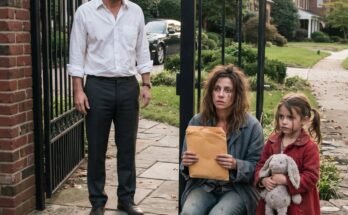
It was a Tuesday morning in January, with three feet of snow packed outside the clinic, when the bell above the door jangled. A man walked in carrying a small mutt wrapped in an old flannel shirt. Behind him was a little girl, no older than seven, wearing a winter coat that was two sizes too big and held together at the zipper with a safety pin.
The man’s hands were stained with motor oil, his knuckles raw and split from the wind. He looked at the floor, struggling to find his voice. “Dr. Donnelly,” he said softly, his breath still fogging in the drafty reception area. “She got hit by a truck down on the county road. I don’t… I don’t have much. But my daughter, she hasn’t stopped crying.”
I gently took the dog and laid her on the stainless steel table. Her leg was broken badly, and she was in shock, but her heart was beating strong. I looked at the little girl. She had her small hands buried in her dad’s coat, her eyes red, silently pleading with me to fix her whole world.
I saw Toby’s face in that little girl. I saw that absolute, fragile trust children have that the grown-ups in the room will make everything okay.
The father reached into his pocket and pulled out a worn envelope. He laid two crumpled twenty-dollar bills and some quarters on the counter. “This is all I have until my next paycheck at the lumber yard,” he whispered, refusing to look me in the eye. “I can pay you ten dollars a week. I promise you I will. Please don’t put her down.”
My chest tightened. I slid the money back across the counter toward him. “Keep it,” I said, my voice firmer than I felt. “Surgery starts in ten minutes. Go down to the diner, get your girl a hot chocolate, and come back in two hours.”
He stared at me, his lip trembling slightly under his mustache. “I can’t take charity, ma’am.”
“It’s not charity,” I said, bending down to meet the little girl’s eyes. “It’s a promise. But you have to promise me you’ll take good care of her when she goes home.”
The girl nodded furiously, wiping her nose on her sleeve. Her dad just swallowed hard, took her hand, and walked out without another word.
I did the surgery alone. I fixed the leg, set the pin, and kept the dog overnight. When they picked her up the next day, the father tried to hand me a signed paper promising payment. I tore it up and threw it in the trash right in front of him. “Just go home,” I told him. “And tell nobody about this.”
I didn’t think about it again. Life went on. The winds blew, the snow melted, and the endless rotation of sick and hurt animals kept my days full and my mind distracted.
What would you do if a simple act of kindness came back to you in ways you never imagined? The answer will warm your heart. Keep reading to find out what happens next. 👇
I know you’re curious to see what happens next, so please be patient and continue reading in the comments below. Thank you for understanding the inconvenience. Please leave a “YES” below and give us a Like to get the full story. 👇to part 2.
—
Part 2: The Anniversary
Months passed. Spring turned into summer, summer into fall, and eventually, the heavy gloom of October returned.
October 14th was the day Toby died. Every year on that day, I locked the clinic doors, turned off my phone, and sat alone in the quiet house, letting the grief wash over me until the sun came up the next morning. It was my private routine of mourning.
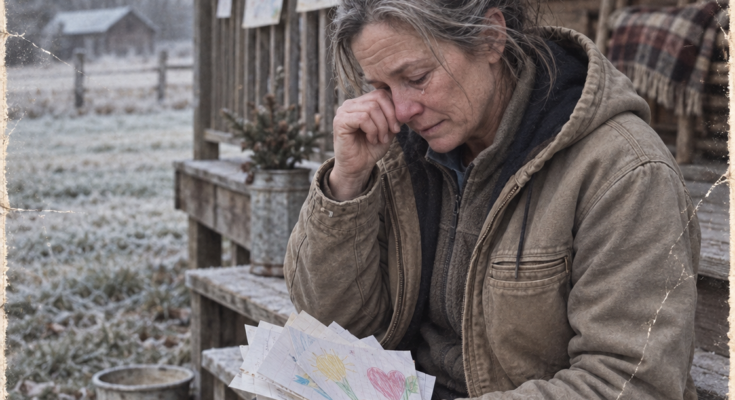
On the third anniversary, I woke up early. The frost was thick on the grass, turning the yard into a blanket of silver. I made a cup of coffee and stepped out onto the porch, bracing myself for the pain of the day.
When I looked down, I froze.
Covering the porch steps, taped to the railing, and tucked under small rocks on the gravel driveway were dozens of handwritten notes. There were cards, pieces of torn notebook paper, and crayon drawings pinned to the wooden posts.
I set my mug down, my heart pounding in my chest, and walked down the steps.
I picked up the first note. It was written in unsteady handwriting on lined paper: *”Dr. Claire, Marcus down at the lumber yard told us what you did for his girl’s dog last winter. He said you wouldn’t take his money. You saved my old blue-heeler three years ago when I couldn’t pay the full bill, and you never brought it up again. That dog was all I had left after my wife passed. God bless you.”*
I picked up another one. It was a child’s drawing of a cat with giant, uneven ears: *”Thank you for fixing Barnaby. My daddy said you are an angel who walks on two legs.”*
I opened a card with a local flower shop logo on the front: *”Dear Claire, We know what day it is today. We know about Toby. You have spent three years taking care of everyone else’s family when yours was broken. We just wanted you to know that none of us forgot. You held this town together when we had nothing left to give.”*
There were over fifty notes.
What would you do if your entire community showed up for you on your darkest day? The answer will restore your faith in humanity. Keep reading to find out what happens next. 👇
I know you’re curious to see what happens next, so please be patient and continue reading in the comments below. Thank you for understanding the inconvenience. Please leave a “YES” below and give us a Like to get the full story. 👇to part 3.
—
Part 3: The Reckoning
Fifty stories from farmers, truck drivers, single mothers, and retirees across three counties. Some were from people I remembered; others were from folks whose pets I had treated years ago without ever realizing how much it meant to them.
The young father hadn’t kept my secret. He had quietly shared it at the lumber yard, at the diner, and at the local hardware store. And when the town learned that the anniversary of my son’s passing was coming up, they didn’t bring flowers to a grave.
They brought their gratitude to my doorstep.
I sat down on the cold wooden porch step, holding a handful of crumpled papers against my chest, and I cried.
For three years, I believed that when I lost my son, my life became an empty, quiet room that nothing could ever fill again. I thought I was just passing the time, working myself to exhaustion so I wouldn’t have to feel the silence.
But sitting there in the crisp morning air, surrounded by the faint scrawls of crayon and ink, I realized something.
We can’t always save the things we love the most. We can’t stop the storm from coming, and we can’t bring back what the wind carries away. But we can leave a light on for someone else. We can fix what’s broken. We can show up. We can love.
I read every single note. Some made me laugh. Some made me cry harder. One was from a woman whose cat I had treated for free when she was going through a divorce. One was from a teenage boy whose dog had been hit by a car—the same kind of accident that had taken Toby. One was from an elderly man who had no family left, just a small terrier named Peanut who had been his only companion for twelve years.
*”You saved Peanut’s life,”* he wrote. *”And in doing so, you saved mine. I was ready to give up. But you treated him like he mattered. You treated me like I mattered. I don’t know how to thank you for that.”*
I sat on that porch for hours, reading and rereading every note. The sun climbed higher in the sky. The frost melted. The world woke up around me.
And for the first time in three years, I felt something other than grief. I felt gratitude. Not for the notes themselves—though they were beautiful—but for the reminder that my life had meaning. That my work mattered. That the kindness I had shown, often without thinking, had rippled out into the world in ways I would never fully know.
The young father came by later that day. He was alone this time. His daughter was in school. He stood at the bottom of the porch steps, hat in his hands, looking nervous.
“Dr. Donnelly,” he said. “I know you told me not to tell anyone. But I couldn’t help it. After what you did for us… I had to tell people. I had to let them know what kind of person you are.”
I walked down the steps and stood in front of him. “You didn’t have to do that.”
“Yes, I did,” he said. “You saved my daughter’s dog. You saved her heart. She was so scared. She thought she was going to lose the only friend she had. And you… you just fixed it. You didn’t ask for anything. You didn’t make us feel like charity cases. You just… helped.”
He paused, his voice cracking. “My daughter still talks about you. She wants to be a vet now. She wants to help animals the way you helped hers.”
I felt tears prick my eyes. “She does?”
He nodded. “She’s only seven. But she’s determined. She’s already reading books about animals. She’s already practicing on her stuffed toys. And it’s because of you.”
I didn’t know what to say. So I just hugged him. He hugged me back.
That evening, I called my sister. She lived three states away, and we hadn’t talked much since Toby died. I had pushed everyone away. I had convinced myself that I didn’t need anyone. That I could carry the grief alone.
But I couldn’t. And I didn’t have to.
“Claire?” she said, surprised. “Is everything okay?”
“Yeah,” I said. “Everything’s okay. I just… I wanted to hear your voice.”
We talked for two hours. About Toby. About our parents. About the little things we used to laugh about when we were kids. It felt good. It felt like coming home.
The next morning, I opened the clinic as usual. The bell above the door jangled. A rancher walked in with a sick calf. A woman brought in a cat that had swallowed a hair tie. A teenager came in with a dog that had stepped on a piece of glass.
I treated them all. I didn’t think about the notes. I didn’t think about the grief. I just did what I had always done. I helped.
But something was different. I wasn’t just going through the motions. I wasn’t just filling the empty space. I was present. I was grateful. I was alive.
Months passed. The notes stayed on my porch until the wind and rain finally took them. But I kept them all. I put them in a box and stored them in the closet. And every year, on October 14th, I take them out and read them again.
I read them to remember. To remember that I am not alone. To remember that kindness matters. To remember that even in the darkest moments, there is light.
I still miss Toby. I will always miss Toby. But I no longer feel like my life is an empty room. It’s full of animals and people and stories and love. It’s full of the notes that a small town wrote to remind me that I matter.
The young father was right. I did help his daughter’s dog. But his daughter—and her father, and the whole town—helped me too. They helped me remember that life is worth living. They helped me remember that I am worth loving. They helped me remember that even when the storm comes, the sun will rise again.
We can’t always save the things we love. But we can leave a light on for someone else. And sometimes, when we least expect it, that light comes back to us.
The End. ❤️