Part One: The Note
“Is that about me?”
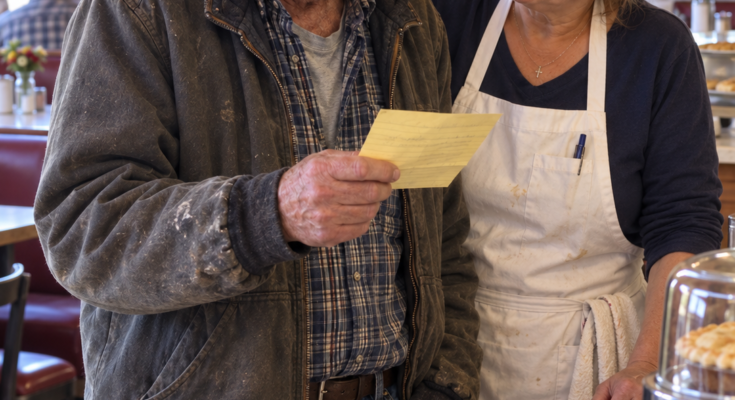
Dennis Vail stood beside the register with two dollars pinched between his fingers. Across the counter, the diner owner held a slip of yellow paper she had just pulled from the suggestion box.
He had only caught the first line.
*The man by the window keeps asking people about their day.*
Dennis looked toward his booth. His jacket was folded neatly on the seat, and the sugar packets stood in tidy rows.
“I didn’t realize I was bothering anybody,” he said.
Marlene glanced down at the paper again. “Dennis—”
“No, that’s all right.” He laid the money on the counter. “You don’t have to explain.”
I was standing behind him, waiting to pay for scrambled eggs. I watched him reach for his jacket, and I recognized the way he moved.
My father used to move like that when he thought he had overstayed his welcome. Quietly. Carefully. Trying to leave less trouble behind than he had brought in.
Dennis was sixty. Until four months earlier, he had worked at the mill outside our Nebraska town for thirty-one years.
He had trained men who were now grandfathers. He knew which loading door stuck in cold weather and which machine made a different sound before something went wrong.
Then, one Thursday, he came home before lunch carrying his thermos and a grocery sack.
His department had been eliminated.
There was paperwork, a brief meeting, and a man he barely knew telling him how much his years of service were appreciated.
The next morning, Dennis woke at 4:40.
He still did.
His wife, Carol, worked mornings at the county office. Their daughter lived three hours away with a husband, two children, and the kind of schedule that made every phone call begin with, “I’ve only got a minute, Dad.”
Nobody had abandoned him.
Everybody simply had somewhere to be.
Dennis started coming to the diner because sitting in his kitchen until noon made the walls feel closer together.
He ordered one coffee. Marlene refilled it, and he stayed in the window booth until eleven, when he wiped away the little brown ring beneath his cup and left before anybody needed the table for lunch.
Sometimes he straightened the sugar packets. Sometimes he folded an uneven stack of napkins.
And he asked people about their day.
“Your boy get that truck running?”
“How’d your mother like her new place?”
“You get much rain out your way?”
He wasn’t especially talkative. He just remembered things.
If somebody mentioned a sick dog on Tuesday, he asked about it Friday. If a waitress had an exam coming up, he wished her luck and waited until her next shift to hear how it went.
I knew this because I came in most mornings myself.
What I didn’t know was that Dennis usually went home without telling anybody a single thing about his own life.
That morning, beside the register, he got one arm into his jacket before Marlene came around the counter.
“Hold on,” she said.
He kept looking at the floor. “I know I sit too long. I’ll find somewhere else.”
“Would you please read the whole thing?”
She held out the paper.
He didn’t take it immediately.
Then he slipped his glasses from his shirt pocket and read the line he had already seen. Marlene turned the note over.
There were three more sentences on the back.
*Then nobody asks about his.*
*Please save the seat beside him for me tomorrow.*
*I’d like to hear the answer.*
Dennis stood still enough that the refrigerator humming behind the counter suddenly seemed loud.
He read it again.
“Who wrote this?”
“No name,” Marlene said. “But I’ve got a pretty good guess.”
Dennis rubbed one thumb along the edge of the paper.
“Oh,” he said.
That was all he managed.
Marlene put a hand on his shoulder, briefly, the way you touch somebody when you know a longer kindness might undo them.
“Same time tomorrow?”
He nodded.
Then he asked if he could keep the note.
—
Part Two: The Answer
The next morning, Dennis arrived ten minutes early.
I was in my usual spot near the register when Marlene approached his booth with the coffeepot.
“Two coffees today,” he told her.
She set down the second cup without asking anything.
At eight fifteen, a woman named Ruth came through the door. She was a regular, seventy-something, with a blue coat and a purse she always carried tucked under her arm.
She stopped beside Dennis.
“Is this seat taken?”
“I believe it’s yours.”
She sat down across from him and unbuttoned her coat. For a moment, they both looked at the two cups.
Then Dennis asked, “What made you write that?”
Ruth rested her hands on the table.
“Do you remember asking me how my Thursday went? A few weeks back?”
He shook his head apologetically.
“I said it was a long one. You told me to sit down while I waited for my order.”
Dennis nodded slowly.
“I’d been clearing out my husband’s side of the closet,” she said. “He’s been gone eight months. I got as far as his work shirts, and then I had to get out of the house.”
Dennis stopped reaching for his coffee.
“You didn’t know any of that,” she continued. “You asked whether I’d always lived around here. Somehow I ended up telling you about the little house we rented when we first got married.”
“The furnace you had to kick.”
Ruth smiled.
“You do remember.”
“Your husband put a slipper beside it so he wouldn’t hurt his foot.”
“That’s right.”
She looked down for a moment, smiling at something neither of us could see.
“I hadn’t laughed about him in a while,” she said. “Every conversation had been about how I was managing. For ten minutes, you let me remember having a good life with him.”
Dennis swallowed.
“Well,” he said, “sounds like he was quite a fellow.”
“He was.”
Ruth picked up her cup, then set it down again.
“So. How was your Thursday?”
Dennis gave the little shrug I’d seen him give a hundred times.
“Can’t complain.”
“I’ve got time,” she said.
He looked toward the window. A pickup rolled past with fence posts rattling in the bed.
Finally, Dennis turned back.
“I still wake up before the alarm,” he said. “Don’t even set it anymore.”
Ruth waited.
“I get dressed so Carol won’t feel bad leaving me in my pajamas. Then I walk around the house trying to find something that needs doing.”
His fingers rested beside the sugar holder.
“Yesterday I tightened a cabinet handle that wasn’t loose.”
Ruth didn’t tell him to enjoy retirement. She didn’t suggest a hobby or remind him that other people had it worse.
“That must be a hard way to start the morning,” she said.
Dennis nodded.
—
Part Three: The Table
And then he kept talking.
I finished my breakfast before they finished their coffee. When I passed the window outside, Ruth was saying something, and Dennis was listening with both hands wrapped around his cup.
The sugar packets were crooked.
He had left them alone.
They still meet there. Some mornings they talk about their families. Some mornings it’s the weather, or a recipe that didn’t turn out, or a day that felt longer than it should have.
The mill job didn’t come back. Some mornings are still difficult.
But now, when Dennis leaves the house, somebody is expecting him.
I think about that whenever I catch myself giving a familiar person a hurried hello and walking on.
It takes so little to assume somebody is doing fine. Dennis had been clean-shaven, polite, and interested in everyone around him. We had mistaken his kindness for proof that he didn’t need any.
All it took was one woman willing to ask another question—and stay for the answer.
The people who ask how everyone is doing need someone to wait for their answer, too.
—