Part One: The Bat
I was ready to beat a scarred, terrifying stray dog with a baseball bat to protect my daughter, until I saw what the dog was actually guarding her from.
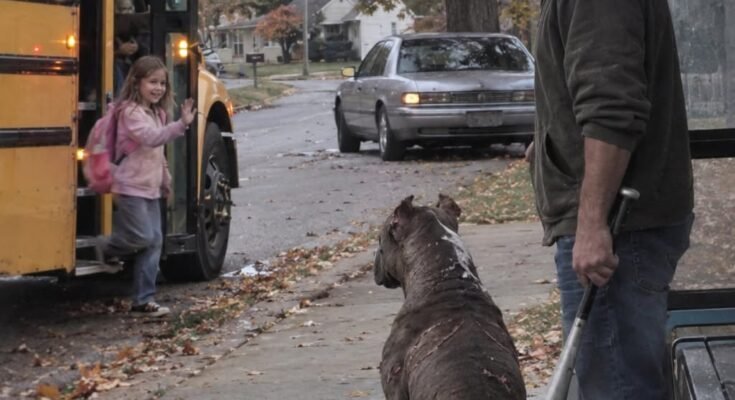
I gripped the aluminum bat so hard my knuckles turned white, my eyes locked on the massive, battle-scarred pit bull sitting near the bus stop. “Get away from here!” I screamed, raising the weapon. The beast didn’t even flinch. It didn’t look at me, didn’t growl, and didn’t retreat.
Instead, the dog’s torn ears twitched, and its eyes remained fixed on something behind me. “Put the bat down, you fool,” a raspy voice called out. I spun around to see Mr. Miller, the retired military K9 handler from the end of the block. He was leaning heavily on his wooden cane, glaring at me.
“That animal is stalking my eight-year-old daughter!” I yelled, pointing the bat at the massive dog. “My little girl says it waits for her every single day. I’m not letting it near her.”
Mr. Miller shook his head slowly. He limped down his driveway and stopped beside me. “You aren’t looking at the whole picture,” he said quietly. “Look at the dog’s posture. Tail stiff, ears forward, body low. He’s not hunting. He’s holding a defensive perimeter.”
I stared at the old man, completely confused. “Perimeter against what?”
Mr. Miller raised his cane and pointed past the dog, past the bus stop, toward the cross street.
“Against that.”
Fifty yards away, parked perfectly in the shadow of a large oak tree, was a generic silver sedan.
The car’s windows were tinted pitch black. Its engine was idling smoothly, sending a faint puff of exhaust into the crisp autumn air. It looked entirely ordinary, yet completely out of place in our quiet suburban neighborhood. There was absolutely no reason for a car to be idling there.
Mr. Miller pulled a worn leather notebook from his jacket. “I’ve been watching this play out for three weeks,” he said, his voice grim. “That car pulls up exactly at 2:45 PM every weekday. It parks in different spots—sometimes by the community center, sometimes behind those hedges. But it always has a clear line of sight to where your daughter gets off the bus.”
I felt the blood drain from my face. My stomach twisted into tight, painful knots. “And the dog?” I whispered, my voice suddenly failing me.
“The dog showed up around the same time,” Mr. Miller explained. “He’s a stray. Been abused, clearly. But every day, when that silver car parks, this dog arrives two minutes later. He places himself exactly in the middle.”
I looked back at the battle-scarred animal. It was true. The dog was positioned directly on an invisible line connecting the idling sedan to the patch of sidewalk where my daughter would soon stand. He wasn’t watching the bus stop. He was daring the car to move.
“I called the local authorities,” Mr. Miller continued, flipping a page in his notebook. “They said a legally parked car isn’t a crime. They said to call back if someone approaches a child. But this dog… he knows. He knows what that man is waiting for.”
I dropped the baseball bat. It clattered loudly against the asphalt, but the dog didn’t even blink. He remained perfectly still, a massive statue of muscle and scars, keeping his eyes locked on the silver sedan.
A deep, heavy rumble echoed down the street.
The bright yellow school bus rounded the corner, its air brakes hissing loudly as it slowed to a halt. Flashing red lights activated, and the stop sign swung out. My heart hammered wildly against my ribs.
The folding doors hissed open. A few older neighborhood kids piled out and scattered in different directions.
Then, my eight-year-old daughter stepped down onto the pavement.
She adjusted her pink backpack. She looked over at the terrifying, scarred stray dog and gave him a gentle, familiar little wave.
At that exact second, the silver sedan’s engine roared.
The car pulled out of the shadows and began rolling straight toward my daughter—and then the passenger-side window started to slide down.
—
Part Two: The Charge
I couldn’t move. I couldn’t breathe. My legs were concrete, my voice trapped somewhere in my throat.
The dog moved first.
He stepped forward, directly into the sedan’s path. His lips pulled back, revealing a row of teeth that had survived years on the street. A low growl rolled out of him, deep and steady.
The car kept rolling.
The window kept sliding down.
And then a man’s face appeared in the gap. He was middle-aged, wearing a plain gray hoodie. His eyes were fixed on my daughter.
“Lily!” I finally screamed. “Run to the house!”
She turned toward me, confused.
The dog lunged.
He didn’t bite the car. He didn’t attack the man. He simply threw his entire body against the front passenger door with a force that rocked the sedan sideways. The metal dented inward. The window shattered.
The man inside panicked. He slammed on the accelerator and swerved around the dog, tires screeching against the pavement. The car fishtailed, clipped the curb, and sped down the cross street without looking back.
I ran. I scooped Lily into my arms and held her so tight she squeaked.
“Dad, you’re hurting me.”
“I’m sorry. I’m sorry. Are you okay?”
She nodded, her eyes wide.
“The dog scared the bad car away,” she said.
I looked over my shoulder.
The dog was still standing in the middle of the street. His body was trembling. Blood dripped from a cut on his shoulder where the shattered window had caught him.
He looked at Lily. Then at me.
Then he collapsed.
—
Part Three: The Name
We rushed him to the emergency vet.
The doctor said he was dehydrated, malnourished, and covered in scars from years of abuse. He had a fractured rib from the impact with the car. But he was alive.
We named him Scout.
The police found the silver sedan two days later. The man inside had a record. He’d been watching school bus stops across three counties for months. He was arrested and charged with attempted kidnapping.
Scout came home with us a week later.
He slept at the foot of Lily’s bed every night. He walked her to the bus stop every morning. He waited for her every afternoon.
He never let her out of his sight.
The vet said he was probably eight or nine years old. He’d lived a hard life. He’d been hurt by people who were supposed to care for him.
But he never stopped protecting.
Not once.
Lily asked me why Scout chose her.
I thought about it for a long time.
“I don’t know,” I said. “Maybe he saw something in you that reminded him of himself. Maybe he just knew you needed him.”
She hugged Scout around the neck.
“I’m glad he did,” she whispered.
Me too.
That was two years ago.
Scout is older now. Grayer. Slower. But every afternoon at 2:45, he walks to the bus stop. He waits. He watches.
He still holds the perimeter.
And he still sleeps at the foot of Lily’s bed.
Some heroes don’t wear capes.
Some heroes have scars, missing teeth, and a limp.
Some heroes are strays who decide, all on their own, that someone is worth protecting.
Scout chose us.
And we chose him back.
—