Part 1: The Last Truck
The last truck arrived on a Thursday in October 1999, and before the driver stepped out, Tessa knew something was wrong. He sat behind the windshield with both hands resting on the wheel, looking at her gate as though he had come to tell her someone had died.
“This is all of it, Tessa,” he said when he finally climbed down. “They’re closing the shop tomorrow.”
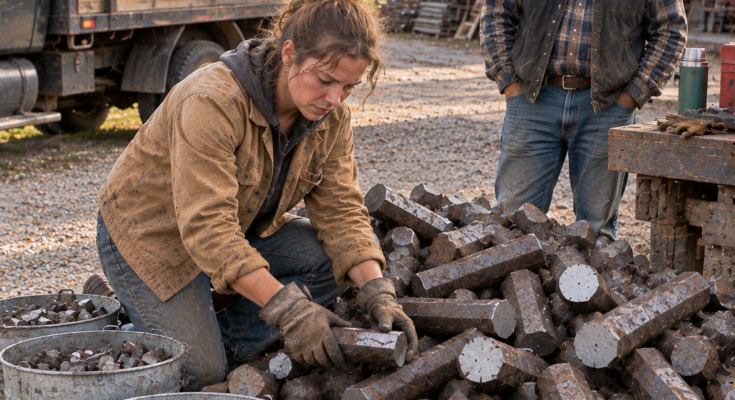
Behind him lay forty-one pieces of steel, bright at the cut ends and streaked with oil from machines that would soon belong to somebody else. For twelve years, trucks from Brenner Precision had brought their unwanted bar stock to her farm, and for twelve years, people had mistaken those deliveries for evidence that she was failing.
Tessa was forty-three that autumn, wearing the canvas coat her father had bought her before his hands began to shake. In the left pocket were his adjustable pliers; in the right was a notebook containing numbers the men at the farm supply counter would never have believed.
The driver, Caleb Rusk, pulled his cap lower and apologized again. Tessa told him he had nothing to apologize for, but her voice sounded steadier than she felt.
What frightened her was not the steel already sitting on his truck. It was the empty road that would follow it, the winter orders waiting on her workbench, and the possibility that everyone who had told her to sell had merely been early.
Twelve years before, a different driver had stopped at that same gate and asked whether she wanted a load of cutoffs. She had said yes before he finished explaining that nobody at the machine shop considered them worth sorting.
That first October morning in 1987, Tessa was thirty-one and two years into learning how quiet a house becomes after the last person who understands you is gone. Her father, Orson Vale, had left her sixty-one acres outside Auburn, Indiana, a tired pickup, two old machines, and $11,200.
He had also left her a reputation she had never asked for. Around that stretch of DeKalb County, she was Orson’s daughter, the girl who could weld a hinge and fix a mower, but apparently not the woman who could decide what to do with her own land.
People rarely said that last part directly. They asked whether she had considered something easier, whether the taxes were getting heavy, whether it felt lonely keeping all that property by herself.
The most persistent was Warren Pike, who owned the implement dealership east of town. He spoke to her with the patient expression men use when they believe kindness means explaining your limitations slowly.
“Your father made it work because he knew everybody,” Warren told her that summer. “There’s no shame in realizing you can’t carry the same load.”
Tessa had been buying a replacement belt, and she remembered folding the receipt until the paper went soft. She wanted to ask who had finished her father’s jobs during the last eighteen months of his life, but grief had made her economical with arguments.
Instead, she took the belt home and installed it. That evening, she paid the electric bill, sharpened a drill, and cried over a cup of coffee that had gone cold beside the kitchen sink.
Her father had started with hogs, then moved into repair and fabrication when raising them stopped paying. He built their two-bay shop in 1971 and filled it with equipment other men had already decided was finished.
The Bridgeport mill came from an estate auction in 1974 for $840. The South Bend lathe was older, already standing in the building when her grandfather bought the property in 1958.
Dad identified that lathe by serial number in his will. The lawyer read the numbers aloud while Tessa sat with her hands clasped so tightly that her nails left crescents in her palms.
She understood why he had done it. He wanted there to be no confusion about whether the machine was an asset to liquidate or something he meant for her to keep.
When she was nine, she watched him empty rusty bolts onto a workbench and asked why he bothered with things people threw away. He held up one bolt, brushed its threads clean, and showed her that it matched the broken fastener from a neighbor’s cultivator.
“Somebody threw away a problem,” he told her. “We might be holding somebody else’s answer.”
By seventeen, Tessa could run the mill, square a face, and recognize the sound of a tool beginning to chatter. Dad taught her to measure twice, but she taught herself to write everything down because memory became less impressive whenever an invoice depended on it.
Her notebooks recorded dimensions, material grades when known, purchase costs, and selling prices. Eventually, another column appeared: parts customers needed but could not get quickly.
That column was why she wanted the cutoffs. She had been watching farmers pay dearly for simple replacement pins, then wait days for pieces that any competent machinist with the correct stock and specifications could make.
She was not foolish enough to believe every steel bar was interchangeable. Unknown pieces went into a separate rack, and anything involving demanding loads or heat treatment required material identification and specifications she could stand behind.
But plenty of ordinary linkage pins and spacers fell within the work she already knew. What kept small orders expensive was setup time, wasted material, and the nuisance of stopping profitable jobs to make four little parts.
She had time nobody valued and short steel nobody wanted. For the first time since Dad’s funeral, those two facts looked less like disadvantages than the beginning of a plan.
The first driver was a broad-shouldered man named Floyd Mercer. His daughter kept horses on the next road, and he had noticed her scrap bins while passing the farm after work.
Brenner Precision had usable bar ends left from production runs, but sorting them for individual resale cost more than the shop could recover. Floyd asked his foreman whether he could drop a few loads with someone who would actually use them.
Forty-seven pieces came off his truck that morning. Tessa stacked them by size while he watched, then offered him eggs from her laying hens because gratitude felt awkward without something to put in his hands.
“You really think there’s something here?” he asked. Tessa held up a length of round stock and told him there were several things, depending on who came through the door.
By supper, the bars stood in labeled buckets along the shop wall. For the first time in months, she ate without calculating which bill could wait until Friday.
That winter, she worked on a small family of replacement pins for common farm implements. She built drilling fixtures from offcuts, timed each operation, and learned that repeating one setup forty times was a different business from making forty unrelated repairs.
She planned to charge $4.75 for a standard pin and more for work requiring additional measurement or machining. The raw stock was free, but electricity, tooling, packaging, maintenance, and her own hours still belonged in the arithmetic.
At night, she sometimes caught herself turning toward Dad’s stool to ask whether a finish looked right. The stool remained empty, and she had to become the person who answered.
By March 1988, she had 480 finished pins in labeled containers and enough doubt to fill the rest of the building. She loaded samples into a cardboard box and drove to a farmers’ equipment meeting, where Warren Pike saw her unfold her little table near the door.
He looked at the samples, then at her handwritten sign, and smiled without warmth. “Tessa, you can’t build a future out of what another business sweeps off the floor.”
She straightened the price sheet and felt every sleepless night settle into something hard inside her. “Then it’s fortunate,” she said, “that these never touched the floor.”
—
Part 2: The Turning Point
Warren Pike’s laugh followed Tessa out of the meeting hall. But by the time she reached her truck, three farmers had already written down their names and the parts they needed. One wanted pins for a hay elevator. Another needed spacers for an old plow. A third asked if she could make a replacement shaft for a feed auger that had been discontinued in 1979.
Tessa said yes to all of them. Then she went home and worked through the night.
The first orders were small—forty dollars here, seventy-five there. But the pins worked. The spacers fit. The shaft held. And when farmers asked where she had learned to do that kind of work, she gave the same answer every time: “My father taught me.”
Word spread slowly. Then faster. By the end of 1988, Tessa had made 4,000 pins and more than a hundred custom parts. She bought a second lathe at an auction. She hired a neighbor’s son to help with deliveries. She started keeping a second notebook just for orders she couldn’t fill fast enough.
In 1992, Brenner Precision offered her a contract. They wanted her to supply pins for their own equipment line. The foreman who called her admitted that Warren Pike had recommended her—not out of kindness, but because he had finally realized she was the only one who could deliver on time.
Tessa accepted the contract. Then she expanded the shop. Then she hired two full-time machinists. Then she bought the Bridgeport mill her father had always wanted.
By 1999, the year the last truck arrived, Tessa’s pin line was worth $210,000 a year. She had built it from scrap. She had built it from stubbornness. She had built it from the belief that nothing was truly worthless if you knew how to use it.
Caleb Rusk, the driver who had brought the last load, stood beside her as she looked at the forty-one pieces of steel. “What are you going to do now?” he asked.
Tessa smiled. “I’m going to buy the rest of Brenner’s stock. And then I’m going to hire you.”
What happened next would change the town forever. Keep reading to find out what happens next. 👇
—
Part 3: The Legacy
Tessa bought Brenner Precision’s remaining stock at auction for $8,400. She also bought their old CNC lathe, their tooling cabinets, and their customer list. It took her three months to sort everything, but when she was done, she had enough material to keep her pin line running for five years.
She hired Caleb full-time. She hired two more machinists. She converted one of her father’s old barns into a second workshop. And she started teaching night classes at the community college, showing young people how to turn scrap into something useful.
Warren Pike came to see her on a Tuesday morning in 2003. He stood in her shop doorway, hat in his hands, looking older than she remembered.
“I was wrong,” he said. “You built something real.”
Tessa nodded. “I know.”
He asked if she would consider selling him a share of the business. She told him no. He asked if she would at least let him buy her a cup of coffee. She said yes.
They sat at the diner on Main Street, and Warren told her about his own struggles. His dealership was failing. The big-box stores were taking his customers. He didn’t know what to do.
Tessa listened. Then she offered him a job. Not as a partner. As a salesman. He could sell her pins to the farmers he had known for forty years.
Warren stared at her. “You’re serious?”
“I’m always serious,” she said. “But I’m also fair. You were wrong about me. That doesn’t mean you’re wrong about everything.”
He took the job. And he turned out to be good at it. He knew every farmer in three counties. He knew their equipment. He knew their problems. And he knew how to sell a solution.
By 2010, Tessa’s pin line was worth more than $500,000 a year. She had ten employees. She had a waiting list. She had a reputation as the best small-parts machinist in northern Indiana.
But the thing she was most proud of was the wall in her shop. It was covered with photographs of every person she had ever helped—farmers, mechanics, young machinists, and neighbors who had once told her to sell the farm.
At the center of the wall was a photograph of her father, Orson, standing beside the old South Bend lathe. He was holding a bolt in one hand and smiling. Underneath the photo, Tessa had written the words he had taught her: *“Somebody threw away a problem. We might be holding somebody else’s answer.”*
Tessa never married. She never had children. But she had something better. She had a legacy. She had a shop full of people who respected her. She had a community that relied on her. And she had the knowledge that she had built something from nothing—not because she was lucky, but because she refused to give up.
On her sixty-fifth birthday, the town threw her a party. The mayor gave a speech. The local newspaper wrote an article. And Warren Pike, now retired, stood up and told the crowd the story of the first time he had seen her at the farmers’ meeting.
“I laughed at her,” he said. “I told her she couldn’t build a future out of scrap. I was wrong. She built a future out of scrap. And then she built a future for all of us.”
Tessa accepted the applause. Then she walked to the podium and said the only thing that mattered.
“My father taught me that nothing is worthless if you know how to use it. That includes steel. That includes people. And that includes dreams.”
She looked at the crowd. Then she smiled.
“I was never alone,” she said. “I had his voice in my head. And I had all of you.”
The pin line is still running today. It’s owned by a young woman named Maya, who apprenticed under Tessa for six years. The shop still uses the old South Bend lathe. The notebooks are still on the shelf. And the sign above the door still reads: *Vale Precision — We Make What Others Throw Away.*
Because some things are worth keeping. And some people are worth believing in.
The End.