
Part 1: The Invitation
Denise Carter was standing at her kitchen counter when she opened the cream-colored invitation for the third time.
At the bottom, beneath the elegant lettering, was the price of the banquet ticket.
$85.
Denise stared at that number longer than she wanted to admit.
Then she folded the invitation carefully and slipped it back into the envelope.
“I can’t spend eighty-five dollars on dinner,” she whispered to her empty kitchen.
Not now.
At 57, Denise had spent nearly two decades working in the cafeteria of a middle school in a small Tennessee town.
She wore white sneakers because her feet hurt by noon, kept peppermints in her apron pocket, and knew which children hated green beans before they ever reached the serving line.
Lately, she had also learned more about hospital parking garages, insurance statements, and treatment bills than she had ever wanted to know.
Breast cancer had turned every extra dollar into a decision.
Gas or groceries.
Prescription copay or electric bill.
A new pair of work shoes or another month with the old ones.
The banquet wasn’t even a difficult decision.
It was a luxury.
But Denise desperately wanted to go.
The guest of honor was Daniel Reeves, a former student who had just been named Tennessee’s Teacher of the Year.
Denise remembered Daniel.
At least she thought she did.
There had been thousands of children over the years.
Thousands of trays.
Thousands of milk cartons, chicken sandwiches, mashed potatoes, and rushed little conversations beneath the cafeteria noise.
Daniel had been a skinny seventh-grader with serious brown eyes and a backpack that always looked too heavy.
Now he was 34 and teaching history in another Tennessee town.
When Denise saw his photograph in the local newspaper, she smiled so hard that one of her coworkers asked what was wrong with her.
“Nothing,” Denise said. “One of our kids made good.”
That was how cafeteria workers talked about former students.
Our kids.
Even when those kids became doctors, mechanics, parents, soldiers, nurses, plumbers, or teachers themselves.
For one small stretch of their lives, they had stood in front of Denise holding a plastic tray.
That counted for something.
So Denise did what she could afford.
She bought a simple congratulations card from the drugstore.
At her kitchen table that evening, she wrote:
*”Daniel, I don’t know if you remember me, but I remember that serious little face coming through my lunch line. I am proud of the man and teacher you became. Keep seeing the children who need somebody to notice them. Congratulations. —Miss Denise from the cafeteria.”*
She mailed it the next morning.
Then she put the banquet invitation in a drawer.
Life went on.
Denise worked.
She went to appointments.
She came home tired.
She sometimes fell asleep in her recliner before the evening news was over.
And when banquet night arrived, she heated a bowl of canned soup and decided she would look for pictures online later.
At 5:42 p.m., someone knocked on her front door.
Denise assumed it was a neighbor.
Instead, when she opened the door, a young man in a dark suit stood on her porch.
“Ms. Carter?”
“Yes?”
“My name’s Ethan. Daniel Reeves asked me to pick you up.”
Denise blinked.
“Pick me up for what?”
Ethan smiled.
“The banquet.”
Denise actually laughed.
“Oh, honey. There’s been some mistake. I don’t have a ticket.”
“Yes, ma’am. You do.”
He held out an envelope.
Inside was a banquet ticket.
Across the top, someone had written in blue ink:
**Your seat has been waiting for you.**
Denise covered her mouth.
For several seconds, she couldn’t speak.
“I can’t go like this,” she finally said, looking down at her old house clothes.
Ethan glanced at his watch.
“Daniel said you’d say that. He also said I was supposed to tell you we have plenty of time.”
Twenty-five minutes later, Denise came back outside wearing the navy dress she saved for funerals, weddings, and important Sundays.
She had done her makeup lightly.
A small scarf covered the thinning hair around her temples.
Before locking the door, she checked twice to make sure her purse contained the congratulations program she planned to keep.
The banquet hall was brighter and fancier than anywhere Denise usually went.
Crystal glasses.
White tablecloths.
Flowers on every table.
Hundreds of people dressed in suits and dresses.
Denise immediately felt out of place.
Then she heard someone shout:
“Miss Denise!”
Daniel crossed the room so quickly that several people turned to look.
The award-winning teacher wrapped both arms around the cafeteria worker who had once stood behind a stainless-steel serving counter.
“You came,” he said.
“You didn’t exactly give me much choice.”
Daniel laughed, but his eyes were wet.
He led her to the front.
Her seat was beside his mother.
His mother took Denise’s hands the moment she sat down.
“I’ve wanted to meet you for years,” she said.
Denise frowned.
“Me?”
Daniel’s mother nodded.
“You.”
Dinner passed in a blur.
Then came the speeches.
When Daniel’s name was announced, the room rose in applause.
Denise clapped harder than anyone.
Daniel reached the podium, thanked his family, his colleagues, his students, and the teachers who had encouraged him.
Then he stopped.
“There is one other teacher here tonight,” he said, “although she has never stood in front of a classroom.”
Denise looked around.
Daniel looked directly at her.
“She taught me something I have tried to carry into every classroom I’ve entered.”
Denise froze.
Daniel took a breath.
“When I was thirteen, my dad lost his job. For several months, things were bad at home.”
His voice softened.
“We didn’t call it poverty. My parents called it ‘getting through a rough patch.’ But kids know when the refrigerator is empty.”
The room became completely quiet.
Daniel continued.
“I started skipping breakfast so my younger sister could eat more.”
Denise’s eyes filled.
“At school, I tried to act normal. And every day, I’d go through the cafeteria line hoping nobody could tell how hungry I was.”
He pointed gently toward Denise.
“But she could tell.”
Denise shook her head as if she already knew what he was going to say and wanted to deny it.
“She never embarrassed me,” Daniel said. “Never asked questions in front of my friends. Never made me feel poor.”
He smiled.
“She’d just look at my tray and say, ‘Well, Daniel, somebody put an extra sandwich here. Better take care of that for me.'”
A few people laughed softly.
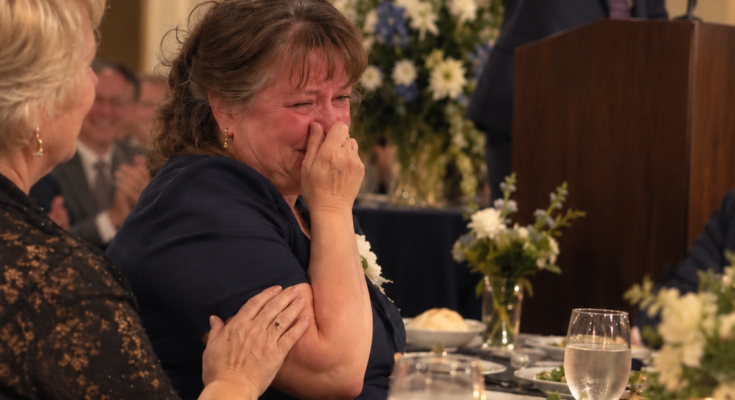
Denise started crying.
Daniel did too.
“Sometimes it was fruit. Sometimes an extra carton of milk. Once, on a Friday, she handed me a little paper bag and said the kitchen had leftovers that would only go to waste.”
Daniel paused.
“There were three sandwiches inside.”
Denise pressed a napkin to her eyes.
“I barely remember that,” she whispered.
Daniel heard her.
He nodded from the podium.
“I know you don’t.”
Then he said the sentence that broke something open in the room.
“But I do.”
Daniel looked out at hundreds of educators.
“That is why I became a teacher.”
Denise stared at him.
“I wanted to become the kind of adult who notices.”
His mother reached over and squeezed Denise’s hand.
Daniel continued.
“We talk a lot about changing children’s lives with big programs, big speeches, and big achievements. Those things matter.”
“But sometimes a child’s life changes because one grown-up sees that his tray is a little too empty.”
Denise’s shoulders began shaking.
She had spent years believing she was simply doing her job.
Serving food.
Wiping counters.
Remembering allergies.
Sneaking peppermints to nervous sixth-graders on their first day.
Making sure the shy child didn’t sit alone when she could help it.
She had never imagined that any of those moments survived beyond the cafeteria doors.
After the ceremony, people came over to meet her.
Teachers thanked her.
Parents hugged her.
One elderly principal told her, “We need more people like you in schools.”
Denise shook her head.
“No, sir,” she said. “I’m nothing special.”
Daniel heard her.
“Yes, you are.”
She looked at him.
Daniel smiled the same shy smile she suddenly remembered from seventh grade.
“You fed a hungry kid without making him ashamed of being hungry.”
For once, Denise had no answer.
On the ride home, she held the award program against her chest.
Her house was dark when the car pulled into the driveway.
The porch light flickered, just as it had for years.
Everything looked exactly the same.
The unpaid bills were still on the counter.
Her treatment schedule was still stuck to the refrigerator.
Tomorrow would still bring the same worries.
But Denise Carter went to bed knowing something she had not known that morning.
We rarely get to see where our kindness goes.
The lunch we pay for.
The chair we pull out.
The child we encourage.
The neighbor we check on.
The tired stranger we treat gently.
Most of the time, those moments disappear from our lives almost immediately.
But they may not disappear from theirs.
—
Part 2: The Years Between
Denise didn’t sleep that night.
She lay in bed, staring at the ceiling, replaying Daniel’s words over and over in her mind.
*”You fed a hungry kid without making him ashamed of being hungry.”*
She had done that. She knew she had. But she couldn’t remember the specifics. She couldn’t remember the exact days, the exact sandwiches, the exact moments.
But Daniel remembered.
He remembered everything.
And that knowledge—that her small, unnoticed kindnesses had lived on in someone else’s heart—changed something inside her.
The next morning, she went to work.
The cafeteria was the same as it always was. The same stainless-steel counters. The same plastic trays. The same smell of chicken nuggets and green beans and chocolate milk.
But Denise saw it differently now.
She saw the children in line. The ones who smiled. The ones who didn’t. The ones who looked down at their shoes. The ones who looked up at her with tired eyes.
She saw them all.
And she made a decision.
She was going to keep noticing.
—
The years passed.
Denise continued working at the middle school. She continued serving lunches. She continued slipping extra sandwiches to the kids who needed them.
But she also started doing more.
She started a food pantry in the school. It was small—just a few shelves in the corner of the cafeteria. But it was enough.
She started a mentorship program. She paired older students with younger ones. She taught them how to support each other.
She started a clothing closet. She collected donated coats and shoes and backpacks. She made sure no child ever had to go without.
The school named her “Volunteer of the Year” three times.
She accepted the awards. She smiled. She said thank you.
But she never forgot Daniel’s words.
*”You taught me something I have tried to carry into every classroom I’ve entered.”*
She had taught him. But he had taught her too.
He had taught her that kindness matters.
That small things matter.
That the moments we think are forgotten are actually remembered.
—
Part 3: The Legacy
Twenty years passed.
Denise retired from the cafeteria at the age of 77. Her body couldn’t take it anymore. The cancer had come back twice, and she had fought it both times. She was tired. She was weak. But she was still here.
The school threw her a retirement party.
Hundreds of people came. Former students. Current students. Teachers. Parents. Administrators.
And Daniel Reeves.
He was 54 now. His hair was graying. He had children of his own. He had been named National Teacher of the Year twice.
He stood at the podium and told the story again.
About the skinny seventh-grader. About the empty refrigerator. About the extra sandwich.
But this time, he added something else.
“Miss Denise didn’t just feed me,” he said. “She taught me. She taught me that kindness isn’t about grand gestures. It’s about small ones. It’s about noticing. It’s about doing what you can with what you have.”
He looked at her.
“She had nothing. She was struggling herself. She had cancer. She had bills. She had pain. But she still gave me lunch. She still gave me dignity. She still gave me hope.”
Denise was crying.
“So I want to say thank you. Not just for the sandwiches. For everything.”
He stepped away from the podium and walked to her table.
He knelt down beside her.
“I named my daughter after you,” he said.
Denise’s eyes widened.
“What?”
“My daughter. Her name is Denise. She’s twelve. She wants to be a teacher. She wants to be like you.”
Denise couldn’t speak.
Daniel took her hand.
“You changed my life, Miss Denise. And now you’re changing hers. And someday, she’ll change someone else’s. And on and on and on.”
He smiled.
“Your kindness is still rippling out into the world. And it will never stop.”
—
Denise Carter died three years later.
She was 80 years old. She died peacefully, surrounded by family and friends.
Her funeral was held at the middle school. In the cafeteria. Where she had spent so many years.
Hundreds of people came.
Daniel Reeves spoke.
“I owe my life to this woman,” he said. “Not just my career. My life. Because without her, I wouldn’t have had the strength to keep going. I wouldn’t have believed that I mattered.”
He paused.
“She was just a cafeteria worker. That’s what she would have said. But she was so much more. She was a teacher. She was a healer. She was a hero.”
He looked out at the crowd.
“There are people in this room who never met her. But you’re here because of her. Because she changed your teacher. Your friend. Your parent. Your child.”
He smiled.
“Her kindness is still rippling. And it always will.”
—
Denise left behind a small box.
In it were letters from former students. Hundreds of them. All thanking her for small things she had done.
An extra scoop of mashed potatoes.
A smile on a bad day.
A hand on a shoulder.
A peppermint before a test.
A lunch that didn’t go to waste.
She had kept every single one.
And at the bottom of the box, wrapped in tissue paper, was a banquet ticket.
An $85 ticket.
From twenty years ago.
Daniel had kept it. He had saved it. He had given it back to her on her 80th birthday.
On the back, he had written:
*”Your seat has been waiting for you. Always.”*
—
The End