
Part 1: The Office
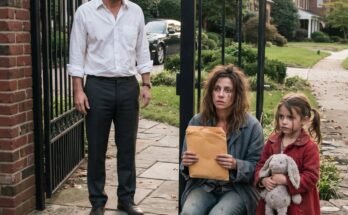
I changed the locks on prom night. My daughter was 17. She’d lied about where she’d been for months.
“Don’t bother coming back,” I told her through the door. Her clothes went into three garbage bags on the porch. The neighbors, the Floreses, took her in. I told myself she’d come crawling back. She never did. That was 2009.
I eat Thanksgiving alone now. Her mother left me the year after.
Last week I saw a flyer at the library. The flyer read: “Attorney Rachel Flores. Free legal clinic for single mothers.” My daughter. She’d taken their name. The article said she turned down a $190,000 firm to open it. I drove down, sat in the lot an hour, then walked in. She set down her pen.
“Dad.”
Her voice was calm. Flat. She didn’t look surprised to see me.
“I saw the flyer,” I said.
“I figured you would.”
She gestured to the chair across from her desk. I sat down.
“You look well,” I said.
“I am.”
“Your mother—”
“She’s fine. She lives in Florida now. We talk.”
I nodded. I didn’t know what else to say.
“Why are you here, Dad?” she asked.
I looked at the floor.
“I don’t know. I saw your name. I wanted to see you. I wanted to say I’m sorry.”
She didn’t respond for a long moment.
“Seventeen years,” she said.
“I know.”
“You told me not to come back.”
“I know.”
“You made me homeless. The Floreses took me in because I had nowhere else to go. I graduated high school living in their spare room. I went to college on scholarships because you wouldn’t help me. I built my entire life because I had nothing. And now, seventeen years later, you walk in here and say you’re sorry.”
I couldn’t look at her.
“I was wrong,” I said. “I was a terrible father. I was angry. I was proud. I didn’t know how to let go of my pride long enough to see what I was doing to you.”
“Did you ever think about me?” she asked.
“Every day.”
“Then why didn’t you come find me?”
I finally looked at her.
“Because I was ashamed. I thought you were better off without me. I thought you were happier. I thought I would ruin everything if I showed up.”
She shook her head.
“I was seventeen, Dad. I was a kid. I made mistakes. I lied. I was scared. And instead of talking to me, you threw me out.”
“I know.”
“I spent years angry at you. Years. And then I stopped being angry. I just stopped caring.”
I felt my heart crack.
“That’s the worst part,” she said. “I stopped caring. You became a stranger. Someone I used to know. Someone who used to matter.”
—
Part 2: The Apology
I didn’t know what to say.
For seventeen years, I had imagined this moment. I had rehearsed apologies in my head. I had planned speeches. I had convinced myself that if I ever saw her again, I would know exactly what to say.
But sitting across from her, in this small office with its secondhand furniture and its wall of thank-you letters from women she had helped, I realized I had nothing.
No words could undo what I had done.
No apology could bring back the years I had stolen from her.
No explanation could justify throwing my own daughter out of my house on prom night.
“I don’t expect you to forgive me,” I said. “I don’t deserve it. But I need you to know that I have spent every day of the last seventeen years regretting what I did.”
She looked at me. Her eyes were hard. But there was something else there too. Something softer. Something that looked almost like curiosity.
“Why now?” she asked. “Why did you come now?”
I thought about it.
“Because I’m dying.”
She didn’t flinch.
“Cancer. Stage four. They gave me six months.”
She was quiet for a long time.
“I’m sorry,” she said finally. And she meant it.
“I don’t want your pity. I just wanted to see you. I wanted to tell you I was wrong. I wanted to tell you I love you. Even if you don’t love me back.”
She looked down at her desk.
“I don’t know what I feel,” she said. “I don’t know if I love you. I don’t know if I hate you. I don’t know if I feel anything at all.”
“That’s okay.”
“It’s not okay. I should feel something. You’re my father. You’re dying. I should—”
She stopped.
She covered her face with her hands.
And then she started to cry.
—
Part 3: The Healing
I didn’t reach for her.
I wanted to. Every instinct screamed at me to stand up, walk around the desk, and hold my daughter. But I knew better. I knew that she needed to come to me. I knew that I had lost the right to comfort her.
So I sat there, my hands folded in my lap, and waited.
She cried for a long time.
When she finally looked up, her face was red, her eyes were swollen, and she looked exhausted.
“I hated you for so long,” she whispered. “I hated you for what you did. I hated you for making me feel like I didn’t matter. I hated you for making me believe I was worthless.”
“I know.”
“But then I met the Floreses. And they showed me what family was supposed to look like. They didn’t have much. They didn’t have money or a big house. But they had love. They had kindness. They had patience.”
She wiped her eyes.
“They took me in when I had nothing. They fed me. They clothed me. They helped me graduate. They helped me apply for college. They helped me become who I am.”
“I’m grateful to them,” I said. “I’m grateful someone was there for you when I wasn’t.”
She nodded.
“I stopped hating you a long time ago. But I didn’t stop missing you. And I didn’t stop wondering why I wasn’t enough.”
“You were always enough. I was the one who wasn’t.”
She looked at me.
“You’re not the man I remember.”
“I’m not the man I remember either.”
She almost smiled.
—
We talked for two hours.
She told me about her life. About law school. About the clinic. About the women she helped. She told me about her husband—a teacher—and her two children. She told me about her mother, who had moved to Florida to start over, and how they had rebuilt their relationship after the divorce.
I told her about my life. About the years of loneliness. About the guilt that had eaten me alive. About the cancer diagnosis and the realization that I couldn’t die without trying to make things right.
When I finally stood up to leave, she walked me to the door.
“Will you come back?” she asked.
“If you want me to.”
She was quiet for a moment.
“I don’t know if I want you to. But I know I don’t want you to disappear again.”
I nodded.
“I won’t.”
—
I visited her every week after that.
At first, it was awkward. We didn’t know how to talk to each other. We didn’t know what to say. But slowly, we found our rhythm.
I met her children. They were shy at first, but they warmed up to me. Her son, Michael, had her laugh. Her daughter, Sarah, had her stubbornness.
I met the Floreses. They were kind, generous people who welcomed me into their home despite knowing what I had done. They told me stories about Rachel’s childhood. They showed me photographs I had never seen. They filled in the gaps that my absence had left.
I met her husband. He was quiet, thoughtful, and protective. He watched me carefully during our first meeting, but after a few visits, he loosened up. He told me he forgave me. Not for me. For her. So she could move on.
—
I died eight months later.
I didn’t die alone.
I died surrounded by my daughter, my son-in-law, and my grandchildren. I died holding Rachel’s hand. I died with her voice in my ears, telling me she loved me.
I died with a smile on my face.
Because I had finally done something right.
—
Rachel spoke at my funeral.
She stood at the podium, wearing a black dress, her hands folded in front of her.
“My father was not a good man,” she said. “He made mistakes. He hurt me. He threw me away like I was nothing.”
She paused.
“But he was also a broken man. A proud man. A man who didn’t know how to love.”
She looked at the crowd.
“Seventeen years ago, he closed a door in my face. And I thought I would never see him again.”
She smiled.
“But he opened it. And he walked through. He apologized. He listened. He changed.”
She wiped her eyes.
“He was not a good man. But he became one. And that is the greatest gift he could have given me.”
—
I don’t know if there’s an afterlife.
But I like to think there is.
I like to think that Emily was waiting for me when I arrived. I like to think she told me she was proud of me. I like to think we finally took that trip together.
I like to think that Rachel forgave me.
Not because I deserved it.
Because she was stronger than me.
Because she was better than me.
Because she was the daughter I always wanted but never knew how to love.
—
The End