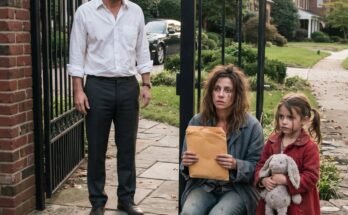
My 5-year-old granddaughter climbed into my lap at Thanksgiving. Whispered, “Grandma, why does Mommy have purple marks on her arms?” My daughter wore long sleeves. 78 degrees. I waited for the goodbye hug. Pulled the sleeve. 7 bruises. Finger-shaped.
I cornered my daughter in the kitchen. “Who?” She said, “I fell.” I said, “Those are finger marks.” Her eyes filled. “He’ll take the kids.”
I called a lawyer Monday. $400 an hour. “We need documentation for a protective order.” My granddaughter had already provided it. She’d been drawing pictures at school. Her teacher saved 14 of them over 6 months. Filed a report. The report says my son-in-law has been hitting her mother. And threatening to hurt her if she told anyone.
The drawings showed it all. A stick figure with angry eyes. A woman on the floor. A child crying in the corner. Every image documented a moment of violence my daughter had tried to hide. My granddaughter had been watching. She had been listening. She had been drawing what she saw, hoping someone would notice. And finally, someone did.
The police arrived at my son-in-law’s house the next morning. He was arrested for domestic violence and assault. My daughter and grandchildren were placed in protective custody. I held my daughter as she sobbed.
“I was so scared,” she whispered. “He said he would take them. He said no one would believe me.”
“Believe you?” I said. “I believe you. The teacher believes you. The police believe you. Those drawings are the best evidence we have.”
—
Part 2: The Trial
The trial lasted two weeks.
My son-in-law sat in the courtroom, dressed in a suit, looking like the perfect husband. His lawyer argued that my daughter was lying. That she was trying to take the children away from him. That she was unstable. He painted her as vengeful, manipulative, desperate. He tried to make the jury doubt everything she said.
But then the prosecutor called the teacher to the stand. She brought the drawings with her. 14 of them. Every one of them showing a child’s desperate attempt to communicate what she was seeing at home. There were no words in the drawings. There didn’t need to be. The images spoke for themselves.
“Is this your work?” the prosecutor asked my granddaughter.
She nodded. “Mommy cried a lot. Daddy was angry.”
The jury saw the drawings. They saw the truth. They saw a little girl who had been witnessing violence and had no other way to tell anyone. They saw a mother who had been too scared to speak up. And they saw a man who had been hiding behind a mask of respectability.
The verdict came back within hours. Guilty on all counts. My son-in-law was sentenced to 10 years in federal prison. My daughter and grandchildren were safe. The drawings were entered into evidence. They were also published in a local newspaper article about the case. The community rallied around my daughter. People sent cards, flowers, money. They called her brave.
She didn’t feel brave. She felt broken. But she was rebuilding. Slowly. One day at a time.
—
Part 3: The Healing
It’s been two years now.
My daughter has a new job. She’s strong. She’s independent. She’s finally free. She doesn’t flinch when someone raises their voice. She doesn’t check the locks five times before bed. She sleeps through the night. She smiles more. She laughs again.
My granddaughter is 7 years old now. She still draws. But now she draws happy pictures. Sunshine. Flowers. A big, loving family. She draws her mother with long sleeves, but not because she’s hiding anything. Because it’s cold outside. She draws herself smiling. She draws her grandmother. She draws the dog.
She doesn’t talk about her father anymore. She doesn’t remember him clearly. She just knows that her mother is safe now. And that’s enough.
I think about those drawings sometimes. The ones that saved my daughter’s life. I think about the little girl who sat on my lap and whispered, “Grandma, why does Mommy have purple marks on her arms?” She didn’t know she was saving her mother’s life. But she was. And I will never forget that.
I learned something from that experience. I learned that sometimes the most important evidence is the simplest. A child’s drawing. A teacher’s careful attention. A grandmother’s willingness to notice. I learned that speaking up is always the right thing to do. And I learned that love—real love—means protecting the people who need it most.
My daughter and granddaughter still live with me. We’re a family. A strong, resilient, unbreakable family. We don’t talk about the past much. We talk about the future. About school. About careers. About dreams. About all the things that are possible now that the fear is gone.
I still have one of those drawings framed in my bedroom. A little stick figure with angry eyes. A woman on the floor. A child crying in the corner. I keep it as a reminder of what we survived. And as a promise that I will never let anyone hurt my family again.
The End