
For many people in northern Europe, drinking a glass of milk as an adult seems completely ordinary.
But globally, that ability is actually unusual.
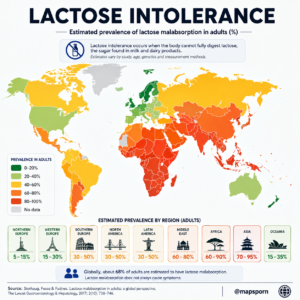
Researchers estimate that roughly 68% of the world’s population has lactose malabsorption, meaning their bodies produce insufficient lactase to completely digest the lactose found in milk. (NIDDK)
The geography is striking.
Lactose malabsorption is relatively uncommon across much of northern Europe.
It becomes more common through southern Europe and the Mediterranean.
Across large parts of Africa, East and Southeast Asia, the Middle East and parts of South America, the majority of adults are estimated to have reduced lactose digestion.
At first glance, this may look like a simple food-intolerance map.
It is actually a map of human evolution, ancient farming, migration and culture.
What Is Lactose?
Lactose is the natural sugar found in mammalian milk.
To absorb it, the small intestine produces an enzyme called lactase.
Lactase splits lactose into the simpler sugars glucose and galactose so they can be absorbed.
Human babies normally produce plenty of lactase because milk is their primary food.
But for most mammals—and historically for most humans—lactase production declines after weaning.
That is called lactase non-persistence.
When lactase levels become low, some lactose passes undigested into the colon. Gut bacteria ferment it, producing gas and drawing additional fluid into the intestine. In some people, this results in bloating, diarrhea, nausea, abdominal discomfort and other symptoms. (NIDDK)
Lactose Malabsorption Is Not the Same as Lactose Intolerance
This distinction is critical.
Someone may have lactose malabsorption but drink milk without experiencing noticeable problems.
Only when the malabsorption causes gastrointestinal symptoms is the person considered lactose intolerant. (NIDDK)
That is why I would rename the infographic:
Lactose Malabsorption Around the World
with a subtitle such as:
Estimated share of adults with reduced ability to digest lactose
That wording better matches the scientific study used as the source.
About 68% of the World’s Population Has Lactose Malabsorption
The major systematic review by Storhaug, Fosse and Fadnes combined data from 175 studies and approximately 450 population groups across 89 countries.
After adjusting for population size, the researchers estimated:
68% of people worldwide have lactose malabsorption.
The confidence interval was approximately 64–72%. (OUP Academic)
But the variation between regions was enormous.
The study estimated prevalence around 28% across western, southern and northern Europe combined, compared with roughly 70% in the Middle East. Other studies and public-health summaries similarly report especially high lactose malabsorption across much of Africa and Asia. (ResearchGate)
That makes lactose digestion one of the clearest examples of how human biology can vary geographically.
Northern Europe Is the Global Exception
The darkest green area on the map stretches across places such as:
Norway, Sweden, Denmark, Ireland and parts of Britain.
Here, large proportions of adults retain the ability to digest lactose.
This trait is known as:
lactase persistence.
Instead of lactase production falling dramatically after childhood, the enzyme remains active through adulthood.
Northern Europeans are therefore unusual compared with most humans.
The ability to drink fresh milk comfortably as an adult is not the ancestral human condition.
Lactase non-persistence is. (PubMed Central (PMC))
Why Did Northern Europeans Become Milk Drinkers?
The explanation appears to involve one of the most famous examples of gene-culture coevolution.
Thousands of years ago, people began domesticating cattle, sheep and goats.
That created access to milk.
Milk was nutritionally valuable because it supplied:
energy, protein, fat, minerals and water.
But adults who could continue producing lactase could obtain even more benefit from fresh milk.
Over generations, genetic variants allowing lactase production to persist into adulthood became increasingly common in some dairy-farming populations.
Researchers have found one of the strongest signals of recent natural selection in the human genome around the LCT lactase region in Europeans. (PubMed)
One influential model suggests lactase persistence underwent strong selection among European dairying populations beginning several thousand years ago. (PubMed Central (PMC))
Europeans Were Drinking Milk Before Most Could Digest It
Here is an especially fascinating twist.
People did not first evolve lactase persistence and then start dairy farming.
Archaeological evidence shows that Europeans were using milk thousands of years before the lactase-persistence trait became common.
A major 2022 Nature study examined dairy-fat residues preserved in prehistoric pottery from more than 550 archaeological sites and found widespread European milk use stretching back thousands of years. (PubMed)
That creates an intriguing evolutionary sequence:
Humans domesticated dairy animals.
They learned to process milk.
Then, under certain conditions, the ability to digest fresh milk in adulthood became strongly advantageous.
Culture changed the environment.
The environment changed which genetic traits were advantageous.
And genetics eventually changed populations.
Why Fermentation Changed Everything
Humans also discovered another solution that did not require genetic adaptation:
processing milk.
When milk is fermented into products such as yogurt or certain cheeses, microorganisms break down some of the lactose.
Hard cheeses can contain dramatically less lactose than fresh milk.
This allowed populations with low adult lactase activity to benefit from dairy products without necessarily drinking large quantities of fresh milk.
Even today, NIDDK notes that many lactose-intolerant people find yogurt and hard cheeses such as cheddar or Swiss easier to tolerate. (NIDDK)
This means the history of dairy is not simply:
“People who can digest milk drink dairy.”
Humans changed the food itself.
Africa Is Much More Complicated Than One Red Color
The infographic shows much of Africa with very high estimated lactose malabsorption.
At a broad continental level, that reflects the fact that lactase non-persistence is common across many African populations. (NIDDK)
But Africa contains major exceptions.
Some pastoralist populations have historically depended heavily on cattle and milk.
And remarkably, researchers have discovered different genetic variants for lactase persistence in African populations from the best-known European variant. (PubMed)
That means adult milk digestion evolved independently more than once.
This is called convergent evolution.
Different populations faced similar pressures—long traditions of dairying—and independently evolved biological solutions allowing adults to digest lactose.
That is one of the most fascinating aspects of this entire map.
East Asia Has Very High Lactose Malabsorption
Across China, Japan, Korea and much of Southeast Asia, lactase non-persistence is widespread.
Historically, dairy farming was not as central to many East Asian agricultural societies as it was in northern European pastoral economies.
Food traditions developed around:
rice,
soy,
fish,
vegetables,
grain,
and fermented foods
rather than widespread fresh-milk consumption.
As a result, there was generally less evolutionary pressure favoring adult lactase persistence.
This helps explain why dairy consumption historically remained lower in much of East Asia.
But diets can change much faster than genes.
Modernization and globalization have increased consumption of:
milk,
cheese,
ice cream
and other dairy products across many Asian countries.
That does not mean lactose malabsorption disappears.
It means people develop different ways of consuming dairy.
Lactose Intolerance Does Not Mean “No Dairy Ever”
This is perhaps the most practically important misconception.
Someone with lactose intolerance does not necessarily need to eliminate every dairy product.
NIDDK notes that tolerance varies substantially from person to person.
Research suggests many people with lactose intolerance can consume about 12 grams of lactose—the amount in roughly one cup of milk—without symptoms or with only mild symptoms, especially under suitable conditions. (NIDDK)
Some people do better with smaller portions.
Others tolerate dairy better when consumed with meals.
Yogurt and hard cheeses are often easier to tolerate.
Lactose-free milk is another option.
Lactase enzyme products can also help some people digest lactose. (NIDDK)
So lactose intolerance is not an all-or-nothing switch.
Why Symptoms Vary So Much
Two people with similar lactase levels can experience very different symptoms.
The severity depends partly on:
the amount of lactose consumed, residual lactase activity, gut bacteria, other foods eaten at the same time and individual digestive sensitivity.
NIDDK emphasizes that symptoms can range from mild to severe depending partly on how much lactose is consumed. (NIDDK)
This is another reason a map of biological malabsorption cannot tell us exactly how many people experience uncomfortable intolerance.
Lactose Intolerance Can Also Be Temporary
Most global mapping focuses on primary lactase non-persistence, the genetically influenced reduction in lactase production after infancy.
But other causes exist.
Damage to the small intestine from conditions such as celiac disease, Crohn’s disease, infections, certain treatments or surgery can temporarily reduce lactase production.
This is called secondary lactose intolerance.
If the underlying intestinal problem improves, lactose tolerance may improve too. (NIDDK)
There is also an extremely rare condition called congenital lactase deficiency, in which infants produce little or no lactase from birth.
These cases are biologically very different from the common adult pattern shown on the map.
Lactose Intolerance Is Not a Milk Allergy
This is another common confusion.
Lactose intolerance is a digestive problem.
The problem involves insufficient digestion of lactose sugar.
A milk allergy involves the immune system reacting to milk proteins.
They are completely different biological processes.
A milk allergy can sometimes produce severe or life-threatening allergic reactions, whereas lactose intolerance primarily causes gastrointestinal symptoms. (NIDDK)
So lactose-free cow’s milk may work for someone with lactose intolerance.
It is not a solution for someone with a genuine cow’s-milk protein allergy.
North America Is More Diverse Than the Map Suggests
A national average can also hide enormous variation inside a country.
The United States is a particularly good example.
NIDDK estimates that approximately 36% of people in the United States have lactose malabsorption. (NIDDK)
But prevalence differs substantially by ancestry and population history.
The U.S. contains descendants of:
Northern Europeans,
East Asians,
West Africans,
Indigenous peoples,
Latin Americans,
Middle Eastern populations
and many others.
These groups arrived with different historical frequencies of lactase persistence.
So coloring the entire United States one shade simplifies an extremely diverse population.
The same problem applies to Canada, Brazil, South Africa, Australia and many other multicultural societies.
Country Borders Are Not Biological Borders
This is perhaps the biggest weakness of any world map like this.
Genes do not suddenly change when you cross a political border.
A pastoralist community may differ significantly from neighboring farming populations inside the same country.
Northern and southern regions can differ.
Ethnic groups can differ.
Urban populations can differ from rural populations because of migration.
And modern populations are increasingly mixed.
So the map should be read as:
estimated national or regional population patterns
rather than:
biological properties possessed by every person from that country.
Why New Zealand Stands Out
New Zealand appears very low in lactose malabsorption on the infographic.
That largely reflects the ancestry composition of populations captured in some of the underlying research, particularly populations with substantial European ancestry.
But modern New Zealand is diverse, including Māori, Pacific peoples, Asian communities and many other groups.
Their biological histories of lactase persistence differ.
Again, national averages can hide enormous internal variation.
Milk Drinking Is a Cultural Habit—and an Evolutionary Experiment
The most interesting part of the map is not really lactose.
It is what it tells us about humans.
Humans changed their environment by domesticating cattle.
They created a new food source.
Some populations developed cultural techniques such as fermentation to make that food easier to digest.
Others evolved genetic traits allowing adults to drink fresh milk directly.
The result is visible thousands of years later on a global map.
Northern Europe contains unusually high lactase persistence.
Some African and Middle Eastern pastoral populations independently evolved their own lactase-persistence variants.
Much of Asia and Africa retained the ancestral pattern of declining lactase production after childhood.
One food transformed human culture.
And human culture helped transform our biology.
Is Lactase Persistence Still Evolving?
Human evolution did not stop in prehistoric times.
But the environment has changed dramatically.
Today people who cannot digest lactose easily have options that ancient humans did not.
They can buy:
lactose-free milk,
plant-based beverages,
lactase tablets,
low-lactose cheeses,
and fermented dairy products.
Modern food systems therefore reduce some of the nutritional advantage that adult lactase persistence may once have provided.
A genetic trait that could have offered a powerful survival advantage thousands of years ago may matter much less in a supermarket economy.
The Bigger Lesson Behind the Map
If roughly 68% of humanity has lactose malabsorption, then from a global perspective:
the unusual trait is not losing the ability to digest milk.
The unusual trait is keeping it into adulthood.
That flips the common Western assumption on its head.
In northern Europe and populations descended from northern Europeans, drinking fresh milk as an adult became so normal that lactose intolerance is often viewed as a disorder or exception.
Evolutionarily, it is closer to the opposite.
For most humans throughout history, lactase production declined after childhood.
Only certain populations evolved high frequencies of lactase persistence.
And the geographic pattern we see today still carries the imprint of ancient herders who began milking animals thousands of years ago.
Source & Accuracy Note
The 68% global estimate on the infographic is well supported by the 2017 systematic review and meta-analysis by Storhaug, Fosse and Fadnes. The review analyzed 175 studies representing 450 population groups in 89 countries and estimated global lactose malabsorption at 68% (95% CI 64–72%). (OUP Academic)
However, I would change the main title from “Lactose Intolerance” to “Lactose Malabsorption” because the underlying study measured reduced lactose digestion, not necessarily symptomatic intolerance. NIDDK explicitly notes that not everyone with lactose malabsorption experiences symptoms. (NIDDK)
I would also treat regional labels such as “Asia 70–95%” or “Africa 60–90%” as broad visual summaries rather than exact continental statistics because prevalence varies substantially among populations and study methods.