
Imagine arriving at a hotel after a 15-hour flight.
Your phone is nearly dead.
You unpack your charger, walk over to the wall—and discover that your plug does not fit.
The outlet has three enormous rectangular holes.
Or three round pins.
Or two angled slots.
Or a strange recessed socket that looks almost—but not quite—compatible with the charger you brought.
It is one of international travel’s most familiar frustrations:
Why does the world have so many different electrical outlets?
The answer is surprisingly historical.
Electricity spread across the world before countries had agreed on a single international standard. Different nations developed their own voltages, frequencies, safety rules and plug designs.
Once millions of homes had been wired with a particular system, changing everything became extremely expensive.
The result survives today.
Depending on the classification used, travelers encounter 15 commonly recognized household plug types, labeled A through O.
Behind those letters is a map shaped by engineering, empire, trade and more than a century of technological history.
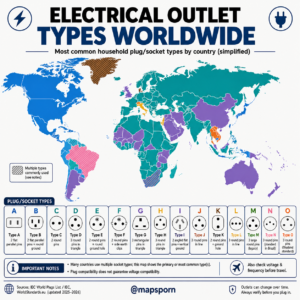
First: Plug and Socket Are Not Exactly the Same Thing
People often use the words interchangeably, but technically:
The plug is the part attached to your appliance or charger.
The socket or outlet is the receptacle in the wall.
Compatibility depends on both.
Some sockets accept more than one plug type.
For example, the simple two-round-pin Type C Europlug works with many European sockets even when the country’s grounded wall standard is technically Type E, F, J, K, L or N.
This is one reason electrical maps can become confusing.
A country may commonly accept Type C plugs while its primary grounded socket belongs to another category entirely.
Why Didn’t the World Just Choose One Plug?
The simplest explanation is timing.
Electricity became commercially important during the late 19th and early 20th centuries.
Countries were building electrical grids independently.
There was no global electrical authority telling everyone:
“Use this voltage, this frequency and this socket.”
Instead, companies and national standards organizations designed systems suited to local conditions.
Then infrastructure locked those decisions in.
Imagine replacing every:
- Wall socket
- Appliance plug
- Extension cord
- Power strip
- School outlet
- Factory connection
- Hotel socket
in an entire country.
The cost would be enormous.
Once a plug standard becomes widespread, the inconvenience of changing it can outweigh the benefit of global standardization.
That is why historical decisions made generations ago remain visible on today’s world map.
Type A: The Two Flat-Pin Plug
Type A is one of the world’s most recognizable plug designs.
It has:
Two flat parallel blades
and normally no grounding pin.
It is associated especially with:
- United States
- Canada
- Mexico
- Japan
- several Central American and Caribbean countries
The United States normally supplies households at about 120 volts and 60 Hz. Canada uses the same basic A/B system and 120 V/60 Hz. (WorldStandards)
Japan also uses Types A and B but is unusual because its nominal mains voltage is only about 100 volts.
Japan has another peculiarity:
Parts of the country operate at 50 Hz, while others use 60 Hz. (WorldStandards)
That historical division dates to the early electrification of Japan, when different regions imported generating equipment based on different frequency standards.
Type B: North America’s Grounded Plug
Type B looks similar to Type A but adds:
A third grounding pin
below the two flat blades.
It is extremely common in the United States and Canada.
Modern grounded appliances typically use Type B, while many low-power devices such as phone chargers use Type A.
The ground connection provides an additional safety path if a fault causes the metal casing of an appliance to become energized.
This illustrates an important theme in plug evolution:
Many later designs were developed partly to improve electrical safety, not simply to make plugs look different.
Type C: The Famous Europlug
Type C has:
Two round pins
and no separate ground contact.
It is one of the most widely encountered plug designs on Earth.
World Standards’ current country list describes Types A and C as the two most frequently used plug forms globally. (WorldStandards)
Type C plugs are common across much of:
- Continental Europe
- South America
- Asia
- Africa
But there is a major catch.
Many countries do not technically use Type C as their primary grounded wall-socket standard.
Instead, Type C plugs fit into sockets such as:
- Type E
- Type F
- Type J
- Type K
- Type L
- Type N
For example:
Germany uses C/F.
France uses C/E.
Spain uses C/F.
Switzerland uses C/J. (WorldStandards)
So labeling almost all of Europe simply “Type C” is convenient for travelers carrying small two-pin chargers, but electrically it hides several different national systems.
Type D: The Older Indian-Style Three-Pin System
Type D uses:
Three round pins arranged in a triangle.
It is strongly associated with India and several countries historically influenced by British electrical standards.
India commonly uses Types D and M and operates around 230 V, 50 Hz. (WorldStandards)
Type D remains familiar in South Asia and appears in varying degrees elsewhere.
The design demonstrates how colonial history helped distribute electrical standards.
Infrastructure introduced under one political system often remained long after independence.
Type E: France and Its Historical Sphere
Type E has:
Two round power pins
plus a grounding system using a male earth pin projecting from the socket.
It is strongly associated with France and appears in Belgium and several other countries influenced by French standards.
Current references list:
France — C/E
Belgium — C/E
Czechia — C/E
among others. (WorldStandards)
Many modern European plugs are designed to work with both Type E and Type F sockets, which has improved compatibility dramatically.
Type F: The Schuko System
Type F is the famous Schuko plug.
Its name comes from the German word Schutzkontakt, referring to a protective contact.
Instead of a projecting ground pin like Type E, Type F uses earthing clips along the sides.
It is widespread across countries including:
- Germany
- Spain
- Portugal
- Netherlands
- Austria
- Sweden
- Norway
- Finland
- much of Central and Eastern Europe
Germany, for example, is listed as using C/F at 230 V and 50 Hz. (WorldStandards)
Because Type C plugs fit many Type F sockets, travelers sometimes assume the entire region uses one identical outlet.
Grounded appliances reveal the differences.
Type G: Britain’s Large Three-Pin Plug
Type G is visually unmistakable.
It has:
Three rectangular pins
arranged in a triangle.
It is used in the:
- United Kingdom
- Ireland
- Cyprus
- Malta
- United Arab Emirates
- Singapore
- Hong Kong
- Kenya
- several other former British-linked territories
The UK operates at approximately 230 V, 50 Hz, and Type G is the national standard. (WorldStandards)
Why Is the British Plug So Big?
Its size reflects several safety features.
British plugs typically include:
- An earth connection
- Insulated portions of the live and neutral pins
- A fuse inside the plug
- Shuttered socket designs
The system developed largely in the postwar period when Britain rebuilt and standardized domestic electrical infrastructure.
It may be bulky compared with a Europlug, but it was designed with substantial safety protection.
Type H: Israel’s Unique Plug
Type H is associated primarily with Israel.
The modern form uses three round pins.
Israel also commonly accepts Type C plugs.
Current listings describe Israel as using C/H, with a typical supply of 230 V, 50 Hz. (WorldStandards)
This is one of several national systems that survived despite being geographically surrounded by countries using different standards.
Type I: Australia, New Zealand—and Beyond
Type I uses:
Two angled flat pins
and, on grounded versions, a third vertical earth pin.
It is strongly associated with:
- Australia
- New Zealand
Australia operates around 230 V, 50 Hz. (WorldStandards)
Variations of the Type I family are also encountered in:
- China
- Argentina
- several Pacific nations
But identical-looking plugs should not automatically be assumed to mean identical electrical conditions.
China, for example, uses A/I arrangements at about 230 V/50 Hz, while Argentina’s Type I system is also approximately 230 V/50 Hz. (WorldStandards)
Type J: Switzerland
Switzerland has its own distinctive Type J system.
It uses:
Three round pins
but the earth pin is slightly offset.
Swiss households commonly use Type J sockets while also accepting Type C Europlugs.
Switzerland’s domestic supply is around:
230 V, 50 Hz. (WorldStandards)
A common travel mistake is assuming that because Switzerland is surrounded by EU countries, every grounded European plug will fit.
A simple two-pin Europlug often does.
A large grounded Schuko plug may require an adapter depending on the socket.
Type K: Denmark
Denmark traditionally uses Type K.
It has:
Two round current-carrying pins
plus a grounding pin arrangement unique to the Danish standard.
But modern Danish electrical life is more complicated than a single letter.
The country currently uses C/F/K combinations and operates at approximately 230 V/50 Hz. (WorldStandards)
Greenland likewise commonly encounters C/F/K rather than one isolated plug type. (WorldStandards)
So the infographic’s single-color or striped depiction should be understood as a simplification.
Type L: Italy
Italy’s traditional grounded standard is Type L.
It features:
Three round pins arranged in a straight line.
There are different current-rated versions.
But contemporary Italian sockets commonly accommodate several formats.
Current references list Italy as using:
C/F/L
at approximately:
230 V, 50 Hz. (WorldStandards)
This is an example of gradual practical convergence.
Rather than forcing everyone to replace every appliance immediately, modern socket designs can support compatibility with multiple older standards.
Type M: The Large South African-Style Plug
Type M resembles Type D but is larger.
It uses:
Three large round pins
and has historically been strongly associated with southern Africa.
South Africa is currently listed as using:
C/M/N
at around 230 V, 50 Hz. (WorldStandards)
Type M remains common, particularly for older installations and certain higher-current applications.
But South Africa has been transitioning toward another standard:
Type N.
Type N: Brazil and South Africa’s Newer Standard
Type N has:
Three round pins
with the grounding pin offset slightly from the two power pins.
Brazil is its most famous user.
IEC information describes two Brazilian Type N versions:
- 10 amp
- 20 amp
The Type N socket was also designed to accept Type C plugs. Brazil is particularly unusual because both 127 V and 220 V supplies are found in different areas, while frequency is normally 60 Hz. (Suntek PC)
This means Brazil perfectly demonstrates why knowing the socket shape is not enough.
A charger may physically fit while the voltage differs from what you expected.
Fortunately, many modern electronics chargers support wide input ranges such as:
100–240 V, 50/60 Hz
but travelers must verify the label on the actual device.
South Africa and Type N
South Africa also uses Type N alongside older Type M and Type C-compatible arrangements. (WorldStandards)
The IEC originally created the underlying 16 A, 250 V design as a possible international standard, illustrating that attempts at global harmonization have existed for decades. (IEC Webstore)
But history had already locked most nations into their existing systems.
Type O: Thailand’s Newer Standard
Type O is associated with Thailand.
It has three round pins and was developed as a Thai standard.
However, Thailand is another country where real-world outlets are more complicated than the letter on a simplified map.
Current listings show:
A / B / C / O
with a nominal supply of approximately:
230 V, 50 Hz. (WorldStandards)
This means visitors may encounter sockets accepting older flat-pin plugs, Europlugs or the newer grounded Type O.
So calling Thailand simply “Type O” describes the national standard but not every socket a traveler will encounter.
Why Plug Maps Follow Old Empires
Once you recognize the patterns, world plug maps begin to look strangely familiar.
They often resemble historical political maps.
British influence
Type G appears across places with strong historical British connections.
Continental European influence
C, E and F systems appear throughout much of Europe and many countries with former French, German, Belgian or Portuguese connections.
North American influence
Types A and B dominate the United States, Canada and large portions of Central America and the Caribbean.
Australian influence
Type I appears across Australia, New Zealand and parts of the Pacific.
Electrical standards are therefore a kind of invisible historical geography.
An empire may disappear.
Its wall sockets can remain for generations.
Why Voltage Is Even More Important Than Plug Shape
Suppose you own a U.S. hair dryer designed for:
120 V
You travel to France.
France supplies approximately:
230 V.
You buy a cheap mechanical plug adapter.
Now the plug fits.
But electrically, nothing has changed.
Your 120 V appliance may receive nearly twice the voltage for which it was designed.
That can damage the appliance and create a safety hazard.
A plug adapter changes shape.
It does not necessarily change voltage.
The U.S. State Department advises travelers to check destination voltage and outlet type and notes that a converter may be needed for equipment that does not support the local voltage. (Travel State)
Why Phone Chargers Usually Travel Better
Many modern electronic chargers are designed globally.
Look at the small print on a laptop or phone power supply.
You may see:
INPUT: 100–240 V ~ 50/60 Hz
If so, the power supply can generally accept both:
North American-style 120 V systems
and
European-style 230 V systems.
You may still need a plug adapter, but not a voltage transformer.
This is one reason traveling with phones and laptops is much easier than traveling with:
- Hair dryers
- Curling irons
- Electric kettles
- Certain kitchen appliances
High-power heating appliances are particularly important to check carefully.
50 Hz vs 60 Hz
Voltage is not the only difference.
Electrical grids also use different frequencies.
Most countries use:
50 Hz
while the United States, Canada and many countries influenced by their system use:
60 Hz.
Some devices do not care.
Modern electronic power supplies frequently support both.
But frequency can matter for:
- Certain motors
- Clocks
- Older equipment
- Specialized machinery
Japan is famous for using both 50 Hz and 60 Hz, depending on the region. (WorldStandards)
So international electricity has three separate questions:
Will the plug fit?
Is the voltage correct?
Is the frequency compatible?
Why Europe Looks Standardized—but Isn’t Completely
Europe is probably the most confusing region on the infographic.
From far away, most of continental Europe appears to use essentially the same two-round-pin system.
For simple ungrounded Europlugs, that is often true.
But grounded sockets vary.
For example:
Germany — C/F
France — C/E
Switzerland — C/J
Denmark — C/F/K
Italy — C/F/L
United Kingdom — G
Ireland — G (WorldStandards)
So Europe has achieved considerable compatibility without adopting one completely identical outlet.
Brazil Is One of the World’s Most Interesting Cases
Brazil deserves special attention because it combines two kinds of electrical complexity.
Current references list:
Plug types: C/N
Voltage: 127 V or 220 V
Frequency: 60 Hz. (WorldStandards)
Voltage can vary by location.
That means merely knowing that Brazil uses Type N does not tell you everything you need to know.
IEC specifically warns that incorrect voltage can damage appliances and notes that many appliances sold domestically are dual-voltage. (Suntek PC)
For travelers, Brazil is perhaps the clearest example of the rule:
Always check voltage separately from plug type.
Some Countries Use Almost Everything
A world map becomes especially difficult in parts of Asia and Africa.
Bangladesh, for example, is listed with several plug types and widespread universal sockets.
Myanmar likewise has a mixture of A, B, C, D, E, F, G and I in current reference tables.
Cambodia is another striking example: contemporary listings describe several compatible socket arrangements, including A, B, C, F and G, with universal receptacles widespread. (WorldStandards)
This is why a clean infographic should always include the phrase:
“Most common types—simplified.”
Otherwise readers may assume national standards are much more uniform than they really are.
Why “Universal” Wall Outlets Are Not a Perfect Solution
Hotels and some homes use multi-standard receptacles designed to accept several foreign plug types.
They look convenient.
But universal sockets can introduce their own safety issues if they do not maintain strong contact, proper grounding or effective shutters for every plug design.
A certified travel adapter designed specifically for the destination is generally a more predictable solution than assuming every multi-format outlet will safely accept everything.
International compatibility is not merely a geometry problem.
Electrical contacts must carry current safely.
Could the Whole World Finally Adopt One Plug?
Technically?
Yes.
Practically?
Extremely difficult.
The IEC has pursued international standardization, and its IEC 60906-1 system was developed as a compact 16 A/250 V design that countries needing a new or replacement standard could adopt. (IEC Webstore)
But replacing established domestic infrastructure worldwide would cost enormous amounts of money.
Consider just one nation.
You would need to replace or adapt:
- Hundreds of millions of outlets
- Existing appliances
- Extension cords
- Building standards
- Industrial equipment
- Electrical codes
The benefits for international travelers would rarely justify the national cost.
So gradual compatibility is more realistic than suddenly replacing every outlet on Earth.
USB May Be Becoming the Closest Thing to a Universal Plug
Interestingly, the solution may not come from wall sockets at all.
Phones, tablets, headphones and many laptops increasingly charge through USB.
USB-C in particular is spreading across manufacturers and product categories.
You may still need a country-specific power supply to connect to the wall.
But once electricity reaches the USB port, the connector used by the device can be standardized globally.
In that sense, electronics are gradually bypassing the century-old battle between Type A, C, G, I and all the others.
The wall remains local.
The device connection becomes global.
A Simple Traveler’s Checklist
Before plugging anything in abroad, check three things:
1. Socket type
Does your plug physically fit?
2. Voltage
Does your device label support the local voltage?
3. Frequency
Does your device support 50 Hz, 60 Hz or both?
The U.S. State Department similarly advises checking destination voltage and electrical outlet type and carrying the appropriate adapter or converter when necessary. (Travel State)
And never assume that because the pins fit, the appliance is electrically compatible.
The World Map Is Really a History Map
At first, electrical outlets seem like one of the most boring objects imaginable.
Then you look at the global pattern.
Suddenly Type G tells a story about British influence.
Types E and F reveal continental European standardization.
A and B trace North American electrical history.
Type I connects Australia and parts of the Pacific.
India retains D and M.
Brazil built around Type N.
Thailand developed Type O.
South Africa is gradually transitioning between systems.
Each socket is a small piece of technological history still embedded in the walls of millions of buildings.
And that is ultimately why there are so many plug types.
The world electrified before the world standardized.
By the time everyone realized how useful one universal plug might have been, billions of incompatible sockets were already installed.
Changing them all would be much harder than simply packing an adapter.
Source & Accuracy Note
The familiar A–O naming system is a convenient international reference for household plugs and sockets, but real national use is often more complex than one letter per country. IEC TR 60083 documents nationally standardized household plug/socket systems, while current country-level references show multiple formats in many locations—for example C/F in Germany, C/E in France, C/F/L in Italy, C/N in Brazil, A/B/C/O in Thailand, and C/M/N in South Africa. (IEC Webstore)
The infographic is therefore best labeled “most common household plug/socket types by country — simplified.”