Part 1: The Fuses
I had my hand on the phone when the young man whispered, “Please don’t call the police. My kids are cold.”
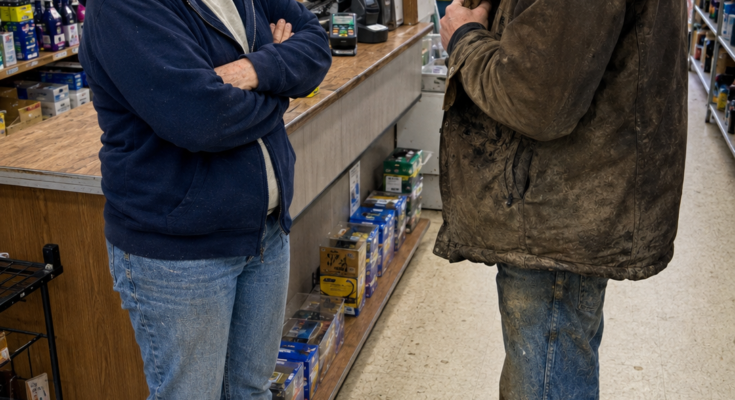
He couldn’t have been more than thirty. His work boots were muddy. His coat zipper was broken. And sticking halfway out of his pocket was a package of furnace fuses from aisle six. I knew exactly what they cost. $11.89. I also knew he hadn’t paid for them.
For forty-two years, my husband, Dale, and I had run that little hardware store in Nebraska. We sold everything from nails and snow shovels to garden hose fittings and furnace filters. Dale remembered everybody’s name and somehow knew which size bolt a man needed before the man finished explaining the problem.
After Dale died, the store got very quiet. Not literally. The bell still jingled over the front door. The old heater still rattled. Farmers still came in smelling like cold air and diesel fuel. But when you’ve spent four decades beside someone, silence isn’t the absence of sound. It’s the absence of one particular voice.
The funeral bills had come first. Then the medical bills. Then a bad spring. Then a big discount store opened forty minutes away and started advertising prices I couldn’t match. By that winter, I was sixty-five years old and working six days a week just to keep Dale’s name on the sign.
So when I saw that young man slide those fuses into his coat, something hard rose up inside me. I was tired. Tired of bills. Tired of people saying, “You really ought to sell.” Tired of watching every dollar leave faster than it came in.
I stepped around the counter and said, “Son, put those back.”
He froze. For a second, neither of us moved. Then he slowly pulled the package from his coat. “I’m sorry,” he said.
I pointed toward the register. “Come here.”
His face had gone red. He kept looking at the floor. I asked his name. “Caleb.” “Why, Caleb?” He swallowed.
That was when he told me. The electricity at the little house he rented hadn’t actually been shut off like I first thought. A furnace fuse had blown, and the replacement his landlord promised to bring hadn’t arrived. He said he had two children at home, six and eight. Their mother had left the year before. He worked at a grain facility outside town, but payday was three days away.
“I’ve got nine dollars,” he said, pulling crumpled bills from his wallet. “I can bring the rest Saturday.”
I looked at the bills in his hand. Nine dollars. Then I looked at the package. $11.89. Less than three dollars stood between that man and paying honestly. Yet embarrassment had convinced him he was out of options.
Part 2: The Deal
I wish I could tell you I immediately became some kind, understanding saint. I didn’t. Part of me was angry. My husband and I had never taken what wasn’t ours, no matter how bad things got.
But then I remembered something. Three months after Dale died, I had sat on the floor behind that same counter with a stack of bills around me and cried so hard I couldn’t read the numbers. I had been one bad week away from missing the store mortgage. Nobody knew. People saw me open the doors at seven each morning, straighten the shelves, and smile. They didn’t see me eating toast for supper because I was afraid to spend twelve dollars on groceries.
That’s the trouble with looking at people from the outside. You see what they did. You don’t always see what brought them to that moment.
I took Caleb’s nine dollars. Then I opened the register. I pulled out the money he’d handed me and put it right back in his palm. “Take the fuses.” His eyes lifted. “What?” “Take them.” He shook his head immediately. “No, ma’am. I can pay you Saturday.” “I’m not giving them to you for free.” He looked confused.
I pointed toward the loading door at the back of the store. “Truck comes Saturday morning at eight. My back isn’t what it used to be. You want those fuses, you show up and help me unload.” He stared at me. Then he nodded. Once. Hard. “I’ll be here.”
I figured there was maybe a fifty-fifty chance I’d ever see him again.
Saturday morning came. It was eighteen degrees outside. At 7:42, I saw an old pickup pull into the lot. Caleb climbed out wearing the same torn coat. He had coffee in one hand. And beside him were two sleepy children bundled in mismatched winter jackets.
“My sister couldn’t watch them,” he said. “Hope it’s okay.”
The little girl held out a paper cup. “Daddy said this one is yours.” It was gas-station coffee. Too much sugar. Best cup I’d had in months.
Caleb worked until nearly noon. He carried bags of salt, boxes of screws, paint cans, snow shovels, and enough plumbing fittings to supply half the county. When he finished, I tried to give him twenty dollars. He refused. “We’re square,” he said. Then he paused. “My kids slept warm because of you.”
Part 3: The Reckoning
I never forgot that. Caleb started coming by every few Saturdays after that. Sometimes I paid him. Sometimes he just helped. His son learned to sweep the front aisle. His daughter liked organizing the little packets of garden seeds, though she put the flowers before the vegetables because she said “pretty things should come first.” By spring, they felt less like customers and more like part of the store.
Then came the letter from the bank. I had sixty days to catch up. Business had fallen farther than I realized. I sat in Dale’s old chair in the back office and read that letter three times. For the first time, I admitted what I’d been avoiding. I might lose the store. Not because I didn’t work hard enough. Not because Dale and I had done something foolish. Sometimes the world just changes faster than an old business can.
That night, I turned the sign to CLOSED and stood alone beneath the faded photograph of Dale hanging behind the register. “I tried,” I told him. It felt like losing him twice.
A few days later, Caleb came in for work gloves. He could tell something was wrong. I told him the truth. “I may have to close.” He didn’t say much. He bought the gloves and left.
The next Saturday, I arrived at 6:45 in the morning. There were already four trucks in the parking lot. By seven, there were twelve. At seven-thirty, cars were parked along the road. I thought there must have been some accident nearby. Then I opened the front door. Caleb was standing outside with his kids. Behind him were farmers, teachers, retirees, mechanics, young couples, and people I hadn’t seen in years. Someone had made a handwritten sign: SHOP HERE TODAY. KEEP OUR STORE OPEN.
I looked at Caleb. “What did you do?” He smiled. “Put the money back.”
I didn’t understand at first. Then he told me. For the past week, he had called neighbors, posted notices at the diner, talked to people at work, and asked everyone he knew to buy whatever they needed that weekend from my store. No donations. No handouts. Just business.
“If you need a hammer next month,” he’d told people, “buy it Saturday. If you’ll need furnace filters this winter, buy them Saturday. If you believe a town ought to keep the people who’ve kept it going, show up Saturday.”
They showed up. Lord, did they show up. We sold snow shovels in April. A rancher bought enough fencing staples to last years. One retired teacher bought twelve rolls of duct tape and whispered, “I’ll figure out what to do with them later.” The local carpenter bought every box of deck screws I had. An elderly widow purchased one tiny packet of picture hooks. She pressed my hand and said, “This is all I need, Marjorie. But I wanted you to know I came.”
I cried behind the register. More than once. By closing time, my feet hurt so badly I could barely stand. The shelves looked like a storm had passed through them. And the register held enough to make the overdue payment.
The store survived. Not forever because nothing does. But it survived long enough for me to steady things, bring Caleb on part-time, and eventually turn more of the daily work over to younger hands.
That was seven years ago. Caleb is still there. His son stocks shelves after school now. His daughter, the one who believed pretty things should come first, keeps fresh flowers in a coffee can beside the register every spring.
People sometimes tell me I saved Caleb the day I caught him with those fuses. I always correct them. I didn’t save him. I simply decided that the worst thing I’d seen him do wasn’t necessarily the truest thing about him. And when my own worst day came, he returned the favor.
I’ve learned that dignity can change a person in ways punishment sometimes cannot. A little mercy doesn’t always disappear after you give it away. Sometimes it walks back through your door years later, bringing half the town with it.
Before you decide who someone is by their lowest moment, remember: the hand you choose not to close into a fist today may be the hand that holds you up tomorrow.
Now, every time I see that faded photograph of Dale hanging behind the register, I don’t feel sadness anymore. I feel gratitude. Because the store he built is still standing. The name he loved is still on the sign. And the family that came through my door because of a stolen package of fuses has become part of our story.
Caleb’s kids are grown now. His son is studying engineering. His daughter is in nursing school. They still come by on Saturdays. They still bring me coffee. And I still keep fresh flowers on the counter, just like she taught me.
That’s the thing about kindness. It doesn’t just help one person. It ripples outward, touching everyone it meets. A stolen package of fuses turned into a town that refused to let a hardware store close. A moment of grace became a legacy.
I’m grateful for that young father and his muddy boots. I’m grateful for his children and their warm smiles. And I’m grateful that I chose mercy over punishment.
Because sometimes, the best thing we can do for ourselves is to show a little kindness to someone else. You never know when they might return the favor. ❤️