Energy is the foundation of modern society.
Every country needs electricity, transportation fuels, heating, and industrial power — but the way nations produce and consume energy varies dramatically.
Some countries rely heavily on fossil fuels.
Others have built their systems around nuclear power, hydropower, or renewable energy.
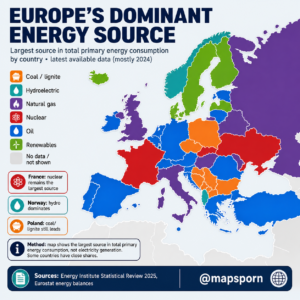
This map shows the largest source of total primary energy consumption in each European country, using the latest available data (mostly from 2024).
The result reveals a fascinating pattern:
Europe does not have one single energy system.
Instead, it is a patchwork shaped by geography, history, resources, and government policy.
What Does “Dominant Energy Source” Mean?
The map does not show the source of electricity generation alone.
Instead, it shows the largest contributor to:
Total primary energy consumption
This includes energy used for:
- Electricity production
- Heating
- Transportation
- Industry
- Buildings
A country may generate much of its electricity from one source while still relying on another source for its total energy needs.
France: Europe’s Nuclear Power Leader
France stands out clearly on the map.
Its dominant energy source is:
Nuclear power
France developed a large nuclear fleet after the 1970s energy crisis.
Today, nuclear energy remains the backbone of the country’s electricity system.
Advantages of nuclear power include:
- Low carbon emissions during operation
- Reliable large-scale electricity production
- Reduced dependence on imported fossil fuels
France’s nuclear strategy is one of the most distinctive energy choices in Europe.
Norway: The Hydroelectric Giant
Norway is one of Europe’s most unusual energy cases.
Its dominant source:
Hydroelectric power
Norway has enormous advantages:
- Mountain landscapes
- Heavy rainfall
- Thousands of lakes and rivers
These natural conditions allow Norway to generate most of its electricity from hydropower.
The country’s geography essentially acts as a giant natural battery.
Poland: Coal’s Last European Stronghold
Poland remains one of the most coal-dependent countries in Europe.
Its dominant source:
Coal and lignite
Poland historically developed around large coal reserves.
Coal has supported:
- Industrial development
- Electricity production
- Energy independence
However, Poland is also experiencing a major energy transition as Europe moves toward lower-carbon sources.
The country is investing more in:
- Renewable energy
- Nuclear power plans
- Gas infrastructure
Natural Gas Dominates Much of Eastern Europe
Several countries in Eastern Europe and surrounding regions have historically relied heavily on natural gas.
Natural gas became important because of:
- Existing pipeline networks
- Industrial demand
- Heating needs
- Historical energy relationships
Countries where gas plays a dominant role include parts of:
- Eastern Europe
- The Balkans
- Former Soviet regions
However, recent years have brought major changes because of energy security concerns and efforts to diversify supply.
Oil Remains Important in Some Countries
Oil remains a major energy source in countries where transportation demand is high.
Oil is especially important because:
- Cars and trucks still depend heavily on petroleum fuels
- Aviation relies almost entirely on liquid fuels
- Heavy transport is difficult to electrify
Even countries with strong renewable sectors still consume significant amounts of oil.
Renewable Energy Leaders
Some European countries have developed strong renewable energy systems.
Renewables are supported by:
- Wind resources
- Solar availability
- Government incentives
- Modern electricity networks
Northern and Western Europe have seen rapid growth in:
- Wind power
- Solar energy
- Biomass
Countries with favorable geography often have an advantage.
For example:
- Windy coastal regions support wind energy.
- Sunny southern regions support solar power.
- Mountainous regions support hydropower.
Geography Shapes Energy Choices
A country’s energy system is often determined by its landscape.
Mountains → Hydropower
Examples:
- Norway
- Switzerland
- Austria
Uranium investment → Nuclear
Example:
- France
Coal deposits → Coal power
Example:
- Poland
Windy coastlines → Wind energy
Examples:
- Denmark
- Northern Europe
Energy is not just a political decision.
It is also a geographic one.
Europe’s Energy Transition
Europe is currently undergoing one of the largest energy transformations in history.
Countries are trying to balance:
- Energy security
- Affordable prices
- Climate goals
- Industrial competitiveness
This transition is creating different strategies:
Some countries are expanding:
- Wind
- Solar
- Nuclear
Others are reducing dependence on:
- Coal
- Imported fossil fuels
There is no single European path.
Each country is choosing a strategy based on its own resources and history.
Why This Map Matters
Looking at energy sources reveals more than just power plants.
It explains:
- Why some countries have different energy policies
- Why energy prices vary
- Why certain regions invest in specific technologies
- How geography influences national decisions
A country’s energy system is a reflection of its land, history, and priorities.
Final Thought
Europe may share a continent, but it does not share one energy story.
From Norway’s rivers to France’s nuclear reactors and Poland’s coal fields, every country has built its energy system around different advantages and challenges.
The future of European energy will likely be a combination of:
- Renewables
- Nuclear power
- Storage technology
- Smarter energy networks
The map of Europe’s energy future is still being written.
Sources:
Energy Institute Statistical Review 2025; Eurostat energy balances.