Part 1: The Panel
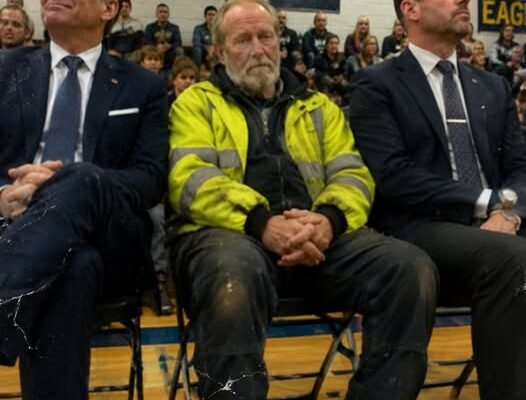
I felt completely out of place the second I walked into that middle school gymnasium. To my left sat a local bank manager wearing a crisp navy suit and a watch that probably cost more than my truck. To my right was a real estate developer who couldn’t stop checking his phone, practically vibrating with self-importance. And then there was me. Vance. Sixty-two years old, wearing my faded high-visibility jacket and a pair of scuffed work boots that had seen their fair share of Ohio winters.
The school was hosting a “Community Leaders” panel, and they had asked me to come down and represent the transportation department. I was proud to do it, but sitting up there on that stage under the bright fluorescent lights, I could feel the eyes of the parents and teachers in the audience. It was that subtle, silent judgment. The quick once-over that says, What is the bus driver doing up there with the successful people?
When the assembly started, the questions from the students were mostly directed at the men in the suits. The kids wanted to know about big money. They asked the developer how many houses he owned. They asked the banker how many millions of dollars he held in his vault. The men puffed out their chests, leaning into the microphones to talk about profit margins, college degrees, and climbing the corporate ladder. They spoke about success like it was something you could only measure in a bank account. And with every word, I could see the kids in the bleachers looking at me, then back at them, quietly learning a lesson I didn’t want them to learn.
Finally, a boy in the third row raised his hand and pointed right at me. “Why do you just drive a bus?” he asked, his voice echoing in the quiet gym. “Didn’t you want to do something important?”
A few parents chuckled nervously. The banker to my left gave me a pitiful, tight-lipped smile, clearly waiting for me to stumble.
I pulled the microphone a little closer, took a deep breath, and looked right into the bleachers.
Part 2: The Speech
“I didn’t want to just do something important,” I said, my voice steady. “I wanted to do something necessary.”
The gym went completely silent.
“Every morning, my alarm goes off at 4:00 AM,” I told them. “While most of the town is still asleep, I’m out in the freezing cold, doing a walk-around of a forty-foot metal tube. I check the air brakes, the tires, and the heaters, because I know that in two hours, I am going to be holding the most valuable things in this entire town in my hands.”
I looked over at the banker. “I don’t transport millions of dollars,” I said. “I transport your children. I navigate black ice, flooded county roads, and blinding snowstorms to make sure they get to this building safely. I am the first adult some of these kids see in the morning, and the last one they see before they go home.”
I paused, looking at a few of the faces I recognized from my Route 4 morning run. “For some kids, my bus is the only place they feel safe. My ‘good morning’ might be the only kind word they hear all day. So no, I don’t wear a suit to work. I don’t have a corner office. But I hold the lives of fifty children in my hands every single day. I’d say that’s a pretty important job.”
You could have heard a pin drop on that polished hardwood floor. The real estate developer had finally stopped checking his phone.
When the assembly ended, the kids were dismissed to their classrooms. The important men in their expensive suits shook hands, packed up their briefcases, and hurried out to their luxury cars. I stayed behind for a minute, packing up my old thermos and grabbing my jacket.
That’s when I felt a small tug on my sleeve.
I turned around and looked down. It was a little girl, maybe ten years old, clutching a battered notebook to her chest. I recognized her instantly. Her name was Maelle.
Maelle was one of my quiet ones. She always sat right behind my seat on the bus, staring out the window, never saying a word.
“Mr. Vance?” she whispered, looking nervously toward the gym doors to make sure nobody else was listening.
“Yes, Maelle? What can I do for you?”
Then her eyes filled with tears, and what she whispered next changed the meaning of everything I had just said.
Part 3: The Confession
“I want to be a bus driver when I grow up,” Maelle whispered, her voice trembling. “But my mom says I should aim higher. She says I should be like the men in suits. She says driving a bus is for people who couldn’t do anything else.”
I felt my heart crack. I knelt down so I could look her in the eyes. “Maelle, why do you want to drive a bus?”
She clutched her notebook tighter. “Because of you. Because you say good morning to me every day. Because you wait for me when I’m running late. Because you don’t laugh at me when I’m sad. Because you make me feel like I matter.”
She was crying now. “My mom works three jobs. I don’t see her much. My dad left. I don’t have anyone who sees me. Except you. You see me.”
I pulled her into a gentle hug, right there in the empty gym. “Maelle, listen to me,” I said softly. “You don’t have to be a bus driver to matter. But if that’s what you want to do, you do it. And you do it better than anyone else. Because you already know the most important part of the job. You know how to see people.”
She nodded, wiping her eyes. “Will you still be my bus driver next year?”
“I’ll be your bus driver as long as you need me,” I said.
Months passed. Maelle continued to ride my bus. She started talking more, smiling more, participating in class. She had found someone who believed in her. And that made all the difference.
At the end of the school year, Maelle brought me a drawing. It was of a yellow school bus with a man in a high-vis jacket waving from the driver’s seat. She had written across the bottom: “Thank you for seeing me.”
I hung it up in my garage. I still have it.
A few years later, Maelle graduated from high school. She sent me an invitation to her graduation. I went. I sat in the front row, wearing my cleanest jacket, and watched her walk across the stage. When she got her diploma, she looked right at me and smiled.
After the ceremony, she ran over to me and hugged me. “I did it,” she said. “I’m going to college. I’m going to be a teacher. And I’m going to see every kid the way you saw me.”
I cried. I couldn’t help it. “I always knew you would do something amazing,” I said.
She smiled. “I learned it from you.”
I kept driving my bus for another six years. I retired at sixty-eight, but I never stopped being a bus driver. It was never just a job. It was a calling. I had carried children through snowstorms, through grief, through loneliness. I had been the first face some kids saw in the morning, and the last face they saw before going home.
I was the one who saw them. And that was enough.
Maelle became a teacher at that same middle school. She asked me to come speak at her career day. I was seventy-two years old by then, but I put on my high-vis jacket and showed up. I stood in front of a new generation of kids and told them the same thing I had told Maelle all those years ago:
“You don’t need a suit to be important. You just need to show up, see people, and care about them. That’s what makes a hero.”
After my talk, Maelle came up to me. “Thank you,” she said. “For everything.”
“No,” I said. “Thank you. You reminded me why I did what I did.”
She hugged me. And I knew that I had left something behind that would last long after I was gone.
I still think about that day in the gym. The men in suits. The laughter. The question that was meant to diminish me. But I also think about Maelle. The quiet girl who saw me for who I really was. The girl who reminded me that the best kind of success isn’t measured in money.
It’s measured in the lives you touch. The people you lift. The love you give.
I never had a corner office. I never had a million dollars. But I had something better. I had the privilege of being part of a child’s story. And that, I think, is the most important job of all. ❤️