Part 1: The Collar
The old gray cat pressed his face into the shelter wall and stopped eating the same day we wrote him down as abandoned.
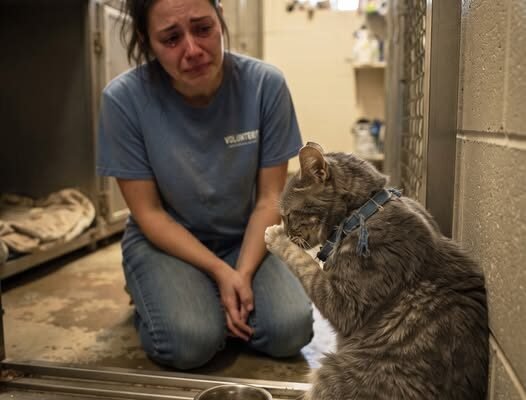
I had seen scared cats. I had seen angry cats, sick cats, and cats so wild they threw themselves against a kennel door until they bled. But this one was different. He wasn’t fighting. He wasn’t even hiding. He just curled into the back corner of the cage, covered his nose with one paw, and shut the whole world out like his heart had already left before his body got there.
We called him Winston because the intake form needed a name. Male. Senior. Gray tabby. Found in a carrier near a church parking lot. That was all we knew.
For the first two days, he refused everything. Wet food, tuna, treats, water from a bowl, water from a syringe. He didn’t hiss when I reached in. Didn’t scratch. Didn’t make a sound. He only lifted his head when the front door opened. Every single time. His ears would rise. His eyes would flash with something that looked almost painful. Then, when he realized it was not the person he was waiting for, he would fold back into himself again.
By the third morning, I was carrying that cat around in my chest. Our shelter stayed full most weeks. Too many animals, not enough homes, and never enough hours in the day. You learn how to move fast, or the sadness will drown you. Still, Winston got to me.
That morning, I opened his kennel and slid my hand under him, meaning only to check how much weight he’d lost. He felt light. Too light. His old blue collar hung loose in some places and tight in others, like somebody had adjusted it with shaking hands. When I turned it over, I noticed the stitching on the inside. It wasn’t factory stitching. It was crooked. Done by hand.
I took a small seam ripper from the desk, sat down on the floor beside his kennel, and carefully opened a few threads. A folded piece of paper slipped into my palm. I remember staring at it for a second before I opened it, because something in me already knew this was going to hurt.
The note said: My name is Walter. I am 81 years old. If you are reading this, it means my cat has been found. His name is Winston. He has slept beside me every night since my wife passed six years ago. I am going into hospice care today, and I was told I cannot bring him. I do not have children. I do not have family close by. I only have him. Please do not think he is unfriendly. He is grieving. If you can, say his name softly before you touch him. He always trusted my voice first. Please love him enough to help him forgive me. I am not leaving him because I want to. I am leaving him because I ran out of time.
Part 2: The Grief
By the time I finished reading, I was crying so hard I had to lower my head. Winston was still in the kennel doorway, watching me. I wiped my face and said, real quiet, “Hey, Winston.” His ears moved. I swallowed and tried again. “Hey, buddy. Walter wanted me to say your name soft.”
I don’t know what I expected. Maybe nothing. But Winston stood up. Slowly. Like every bone in his body ached. He stepped out of the kennel, one paw at a time, and walked directly to me. He pressed his head against my hand. Not demanding. Not desperate. Just… present.
I sat there on the cold floor, petting him, while he closed his eyes and let out a long, shaky breath. It was the first time I had heard him make any sound at all. It was the sound of grief finally finding somewhere to land.
I knew then that I couldn’t just leave him here. Winston wasn’t an abandoned cat. He was a loved cat who had lost everything. I had to find Walter. I had to see if there was any way to reunite them, even for just a moment.
I called the church parking lot where Winston had been found. I called the local hospitals. I called the hospice centers. It took three days of relentless searching, but finally, I found him. A small hospice facility on the outskirts of town had admitted a Walter Montgomery, 81 years old, with no known family.
My heart raced as I drove there. I had Winston in a carrier beside me, his nose pressed against the air holes. He seemed to know something was happening. He was alert. Watchful. Hopeful.
At the hospice, I explained the situation to the nurse. She listened, her eyes filling with tears. “He’s been asking about his cat,” she said. “Every day. He asks if anyone has found him.”
“Can I bring him in?” I asked.
She nodded. “I’ll make an exception.”
Part 3: The Reunion
The room was small and quiet. Walter was lying in a hospital bed, his skin pale, his eyes half-closed. He looked so much older than his 81 years. His hands rested on the thin blanket, motionless.
I walked in with the carrier. “Mr. Montgomery?”
His eyes opened. Slowly. He looked at me, confused at first. Then he saw the carrier. His whole body tensed. “Is that…?”
I opened the door. Winston stepped out. He didn’t hesitate. He walked straight to the bed, hopped up, and pressed himself against Walter’s chest. Then he started purring. Loudly. Desperately. Like he was trying to tell him everything he had been holding in.
Walter’s hands came up and wrapped around him. Tears streamed down his face. “Oh, Winston. Oh, my boy. I thought I lost you. I thought I’d never see you again.”
Winston pressed his face into Walter’s neck and stayed there. He didn’t move. He didn’t make a sound. He just stayed.
I stood by the door, crying quietly. The nurse came up beside me and touched my arm. “Thank you,” she whispered. “You gave him something no one else could.”
I stayed for two hours. Walter told me about his life—his wife, his work, his love for Winston. He told me about the day he had to make the impossible choice, knowing he couldn’t take his cat with him.
“I thought I was doing the right thing,” he said. “I thought he would find a new home. But he just… stopped. He stopped living.”
“He was waiting for you,” I said. “He never gave up.”
Walter looked down at Winston, who was still pressed against him, still purring. “I don’t know what I’m going to do. I can’t keep him here. They said—”
“I’ll take care of him,” I said. “I’ll make sure he’s safe. I’ll visit every day. And when you’re ready, he’ll be here for you.”
Walter looked at me, his eyes wet. “You would do that?”
“I already did,” I said. “I found you. I found him. That’s not a coincidence.”
Winston stayed with Walter until the end. Two weeks later, Walter passed away peacefully in his sleep, with Winston curled up beside him. The hospice staff called me. I picked up Winston, who was quiet but calm. He seemed to understand.
I took him home. He slept in my bed, wrapped around my pillow. He ate. He started to purr again. He was grieving, but he was healing. Because he knew someone still loved him.
I never let him go. Winston became my cat. He sat with me on the porch. He followed me from room to room. He was old and slow, but he was alive. And every night, he would press his head against my hand, the same way he had pressed against Walter’s.
I thought about Walter often. I thought about the note in the collar. I thought about the love that had been written down in those shaky words. Winston had been given a second chance. And I had been given the privilege of being part of their story.
Winston passed away a year later, at the ripe old age of eighteen. He died in my arms, peaceful and loved. I buried him in the backyard, next to a small rose bush. And I kept his collar, with the note still folded inside.
I still read it sometimes. It reminds me that love doesn’t end when someone leaves. It changes. It finds new ways to exist. It shows up in unexpected places, in unexpected ways.
Sometimes, the animals we save save us right back.
And sometimes, the best thing we can do is simply be there—for the ones who are grieving, the ones who are waiting, the ones who just need someone to say their name soft.
Winston had Walter. And Walter had Winston. And I had both of them.
That was enough. That was everything. ❤️