Part 1: The Corner Booth
My name is Elara. I’m sixty-eight years old, and for thirty-five of those years, I worked in the cafeteria of our local middle school. I spent decades wearing a hairnet, scooping mashed potatoes, and quietly slipping extra bread rolls onto the trays of kids whose jackets looked a little too thin for the Wyoming winters.
I’ve been a widow for nearly a decade. Since my husband passed, the house has been far too quiet. To break up the silence, I have a Tuesday morning routine. I drive down to the local diner on Main Street, sit in the corner booth, and order two scrambled eggs with black coffee. I don’t go for the food. I go to be around people. I go to hear the sounds of life.
My whole life, I’ve been a wallflower. My late husband was the talker. I was the listener. I never liked drawing attention to myself, and I certainly never liked causing a scene.
But that Tuesday was different.
The weather outside was brutal, even by our standards. A late-season blizzard had swept through the valley overnight. The roads were sheets of black ice, and the wind was howling so fiercely it rattled the diner’s heavy plate-glass windows. Most folks had the good sense to stay home. But the delivery trucks still had to run.
That’s when Tariq walked in. He was the driver for the regional food supplier, a kid who couldn’t have been more than nineteen years old. He was slight, shivering, and wearing a jacket that was entirely no match for a negative-ten-degree morning. His boots were packed with snow, and his face was wind-chapped and raw.
For the past twenty minutes, I had watched him through the frosty window. He was lugging fifty-pound sacks of flour and heavy crates of canned goods from his truck, sliding on the icy pavement, fighting the wind with every single step. He was working his heart out just to keep this little restaurant stocked.
When he finally brought the last invoice inside, his hands were shaking so badly he could barely hold the clipboard. He was breathing hard, wiping melting snow from his eyelashes. Because of the treacherous roads, he was about thirty minutes behind schedule.
Instead of offering the boy a cup of hot coffee or a word of thanks, the diner owner stormed out from behind the counter. He snatched the clipboard out of Tariq’s freezing hands.
“You’re late,” the owner barked loudly, making sure everyone in the dining room could hear him.
Tariq ducked his head, his voice soft and heavily accented. “I am very sorry, sir. The ice on the highway was bad. I had to drive slow so the truck would not slide.”
“I don’t pay for slow!” the owner snapped back, throwing the clipboard onto a nearby table. “I run a business. You people come over here and think you can just operate on your own time. Learn how things work in this country, or get out!”
Part 2: The Stand
Tariq didn’t argue. He didn’t raise his voice. He just stood there, absorbing the humiliation. His shoulders slumped, and he stared at his wet boots. I recognized that look. I had seen it a thousand times in the cafeteria line. It was the look of a good kid trying to maintain his dignity while someone much bigger and meaner tried to strip it away.
Something inside me snapped. Maybe it was the memory of my husband, who drove a snowplow for thirty years and knew what a frozen highway felt like. Maybe it was the decades I spent watching out for vulnerable kids. Whatever it was, my quiet days were over.
I set my heavy ceramic mug down on the table. I didn’t just set it down—I slammed it. The sharp crack echoed through the dining room, cutting off the country music playing on the jukebox. Every head turned toward my corner booth.
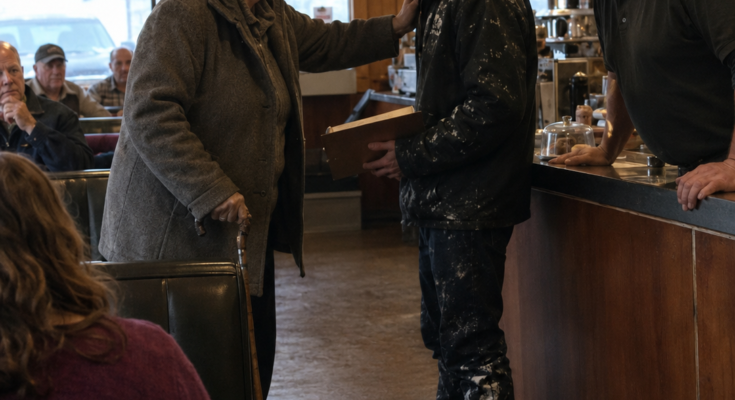
I slid out of my seat, leaning heavily on my cane, and walked straight toward the front counter. My heart was hammering against my ribs, but my voice didn’t shake. I stopped in front of the owner.
“His name is Tariq,” I said, my voice steady and clear. “And he’s been working his heart out in this weather, in the cold, just so you have food to serve in your restaurant.”
The owner stared at me. “This doesn’t concern you, lady.”
“It concerns me when I see someone being treated like they’re not a person,” I replied. “This young man is doing a job you couldn’t do yourself. He’s risking his life on icy roads to bring you supplies. And you’re yelling at him like he’s dirt.”
The diner was completely silent. Customers were frozen, forks suspended in the air. The waitress behind the counter was clutching her coffee pot like a shield.
I turned to Tariq. “You sit down, young man. I’m buying you breakfast.”
Tariq shook his head. “No, ma’am. I cannot. I have more deliveries.”
“Then you’ll have a warm meal first,” I said firmly. “That’s not negotiable.”
He looked at me, and for the first time, his eyes weren’t full of shame. They were full of gratitude. He nodded slowly and slid into a booth.
Part 3: The Ripple
The owner sputtered. “You can’t just—”
“I just did,” I said. “And here’s what’s going to happen. Tariq is going to sit right there and eat a hot meal. He’s going to warm up. And you’re going to remember that this is a country built by people who came from somewhere else. People who worked hard. People who sacrificed. People who shivered in the cold so that others could stay warm.”
I turned to the other customers. “And all of you? You’re going to watch. And maybe you’ll remember what it means to be decent.”
The owner’s face was red, but he didn’t argue. He couldn’t. Everyone in the diner was staring at him, waiting to see what he would do next. He turned and walked back into the kitchen, disappearing through the swinging doors.
I ordered Tariq a plate of eggs, bacon, and pancakes. I ordered him coffee. He ate slowly, his hands still shaking. He thanked me over and over. I told him to stop thanking me and just eat.
When he finished, he stood up. “Thank you, ma’am. I won’t forget this.”
“I know you won’t,” I said. “Now be careful on those roads.”
He left with a smile on his face and a full belly. I watched him climb into his truck and drive away, the snow swirling around his headlights.
The next Tuesday, I went back to the diner. The owner didn’t meet my eyes. But something had changed. The waitress was friendlier. The customers seemed quieter. And Tariq? He showed up again, but this time, he walked in with a smile and a wave.
“Morning, ma’am,” he said.
“Morning, Tariq,” I replied.
He delivered the food, then sat down across from me. “I told my mom about you,” he said. “She wants to meet you. She wants to thank you.”
I smiled. “You tell your mom I’m not going anywhere.”
Over the following weeks, Tariq and I became friends. He told me about his family, his dreams, his life. He was studying at the community college, working three jobs, sending money home to his parents. He was smart, ambitious, and determined.
The owner of the diner watched us from a distance. He didn’t apologize, but he also didn’t yell at anyone again. I like to think he learned something.
Tariq graduated from college two years later. He invited me to his graduation. I sat in the front row, crying with pride. When he walked across the stage, he looked at me and smiled. That was all the thanks I needed.
A few weeks after his graduation, Tariq knocked on my door. “I have something to tell you,” he said. “I got a job. A real job. I’m going to be a teacher.”
I hugged him. “You’re going to be the best teacher those kids ever had.”
“I want to be like you,” he said. “I want to be the person who sees someone in need and steps in.”
I laughed. “I’m just an old woman who eats eggs at a diner.”
“No,” he said. “You’re the person who stood up when no one else would. You’re the person who showed me what it means to be a good human being.”
I cried. I couldn’t help it.
Tariq did become a teacher. He taught at our local middle school, the same one where I had worked in the cafeteria. He slipped extra bread rolls to kids whose jackets were too thin. He smiled at the quiet ones. He remembered.
And I? I kept going to the diner every Tuesday. Tariq often joined me. We sat in that corner booth and talked about life, love, and the things that matter.
Sometimes, the people who seem like they’re just passing through end up staying forever. And sometimes, a single act of kindness can change everything.
Tariq changed my life. But I like to think I changed his too.
That’s what it means to be human. We show up for each other. We stand up for what’s right. And we never, ever give up.
The diner is still there. The corner booth is still mine. But now, when I sit there, I’m not alone. I’m surrounded by the echoes of a moment that changed everything—a moment when a quiet widow found her voice and a freezing boy found his hope.
That’s a legacy worth leaving. ❤️