Part 1: The Man Who Ran Toward Fire
Gordon Price had spent thirty years running toward fires. Barn fires. Highway wrecks. Kitchen grease fires. Lightning strikes. Brush fires that jumped fences faster than tractors could cut lines. He was a volunteer firefighter in a rural county where the firehouse had more folding chairs than paid employees and everybody knew everybody’s truck.
Gordon had missed birthdays because a siren went off. He had left Thanksgiving dinner with gravy still on his shirt. He had once spent Christmas morning helping an elderly couple save what they could from a burned-out farmhouse. People trusted him. Children waved when the red truck passed. Older folks called him “one of the good ones.”
Then, about eight months before his own house caught fire, Gordon quietly stopped answering calls. He told people his knees were giving him trouble. That was only partly true. The real reason was something he never discussed. Not with his neighbors. Not with most of the fire department. Not even with his own brother.
Years earlier, Gordon had responded to a house fire involving a child. The crew did everything they had been trained to do. They moved fast. They took risks. They went back in when common sense said stay out. But sometimes courage doesn’t change the ending. Gordon carried that call home with him.
For years, he could still function. He still climbed ladders. Still checked oxygen tanks. Still joked over bad coffee at the station. But little things began following him. The smell of burned plastic. A child crying in a grocery store. A smoke detector chirping in someone’s hallway. Sometimes he woke in the middle of the night drenched in sweat, certain he had heard someone calling from behind a door.
He started parking near exits. He stopped attending department family nights. He found excuses to avoid calls involving houses with children. Then one afternoon, after a minor garage fire, Gordon sat alone behind the station and realized he could not stop shaking. That was when he stepped away.
He told everyone he was getting old. It was easier than saying he was afraid of what his own mind might do.
Part 2: The Night He Froze
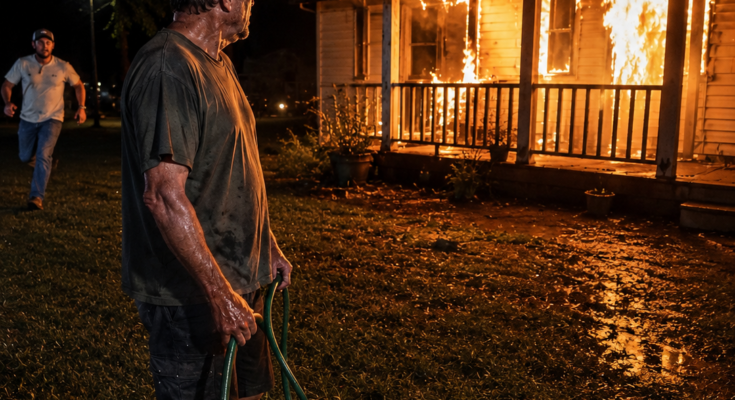
When his electrical panel sparked months later and fire crawled into the wall of his own house, Gordon’s body reacted before his mind could. He saw flames. And suddenly he wasn’t fifty-seven years old standing in his own yard. He was back at that old call. Back in the smoke. Back hearing a sound he had spent years trying to forget.
Neighbors came running. Someone pulled Gordon farther from the house. Someone else called the volunteer department. Within minutes, the road filled with flashing lights. His old crew attacked the fire while Gordon sat on the tailgate of a pickup across the road, staring at the ground.
They saved most of the house. The porch was badly damaged. A wall near the utility room had to be opened. Several of Gordon’s tools were ruined by water and smoke. But the house was still standing. Gordon barely spoke.
By the next morning, the talking had already started. Small towns can be wonderfully kind. They can also be terribly quick with whispers. “I heard Gordon just stood there.” “Thought he used to be a firefighter.” “Guess some men get scared when it’s their own stuff.” One person even used the word Gordon feared most. Coward.
Gordon heard about it at the local diner. He didn’t defend himself. He simply paid for his coffee, left most of it untouched, and went home.
Two days later, his old fire captain, Earl Bennett, walked into that same diner during lunch. Earl was the kind of man who rarely raised his voice because he never needed to. He ordered coffee, listened to the conversation at the counter for about thirty seconds, and finally set his cup down.
“You boys want to know why Gordon froze?” The room went quiet. Earl looked around. “Because he spent thirty years seeing things most of you were lucky enough never to see.”
Nobody moved. Earl didn’t give details. He didn’t have to. “He didn’t quit because he stopped caring,” he said. “He stepped away because one call stayed with him. He carried it alone because he thought that’s what strong men were supposed to do.”
Then Earl looked toward the window. “Gordon Price has gone into burning buildings for people who never even learned his middle name. If he froze one night, maybe the question isn’t why he couldn’t run into the fire.” He paused. “Maybe the question is why he ever thought he had to carry everything afterward by himself.”
Part 3: The Rescue They Never Saw Coming
By Saturday morning, six pickup trucks were parked outside Gordon’s house. Gordon opened his front door and found half the volunteer department standing in his yard. There were toolboxes. Lumber. A trailer. Coffee. And enough breakfast biscuits to feed twenty men.
“What’s all this?” Gordon asked. Earl shrugged. “Porch needs fixing.” “You boys don’t have to do that.” One of the younger firefighters laughed. “Good thing nobody asked you.”
They rebuilt the porch over three weekends. They replaced burned trim. They repaired the steps. One retired carpenter donated lumber. A hardware store owner quietly gave them materials at cost. Someone found Gordon a used workbench. Someone else replaced his ruined socket set.
But the most important thing they did had nothing to do with wood or tools. Two younger firefighters, Mason and Drew, started stopping by Gordon’s house every Tuesday afternoon. The first time, Gordon thought they wanted help repairing something. Instead Mason held up his truck keys. “Come on.” “Where?” “Counseling appointment.”
Gordon stared at him. “I can drive myself.” “I know.” “I don’t need babysitting.” “I know that too.” Gordon didn’t move. Drew leaned against the truck. “You drove us plenty of places when we were rookies.” Gordon looked down. Mason smiled. “Let us drive you somewhere.”
So Gordon went. Not because he suddenly became comfortable talking about the past. He didn’t. The first few appointments were hard. Some days he barely spoke. But he kept going. And gradually, the man who had spent his life believing rescue meant ladders, hoses, oxygen masks, and strong backs began understanding something he should have learned years earlier. Sometimes the emergency happens after the sirens stop.
Months later, Gordon returned to the volunteer station for a Saturday breakfast. He wasn’t back on active duty. Not yet. Maybe not ever. But he sat at the old folding table drinking terrible coffee, telling stories to the younger firefighters.
When the station alarm sounded, everyone stood. Gordon’s shoulders tightened for a moment. Mason noticed. He didn’t say anything. He simply touched Gordon’s shoulder on his way past. Gordon nodded. Then he watched the trucks roll out.
For the first time in a long time, he didn’t feel ashamed that he was staying behind. Because courage, Gordon finally understood, was never about being fearless. And strength was never supposed to mean suffering alone.
For thirty years, Gordon Price had helped rescue people from places they could not escape by themselves. When his turn came, his friends simply returned the favor. Some fires can’t be reached with a hose. Sometimes the bravest rescue is helping a strong person admit they need someone beside them.
That Saturday, Gordon didn’t go on the call. But he stood at the station door, watching the trucks disappear down the road, and he felt something he hadn’t felt in years: hope.
He wasn’t the same man he had been before that night. He would never be that man again. But he was a man who was learning to heal. And that was enough.
The porch was fixed. The walls were repaired. The house was standing. And so was Gordon.
Because sometimes, the people who spend their lives saving others need to be saved too. And that’s not weakness. That’s humanity. ❤️