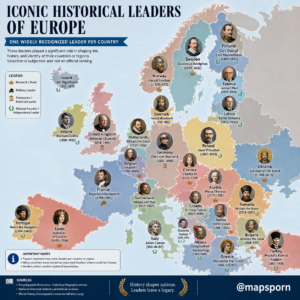
Choosing one historical leader to represent an entire European country is almost impossible.
France alone could offer Charlemagne, Louis XIV, Napoleon Bonaparte or Charles de Gaulle.
Britain could choose Elizabeth I, Queen Victoria, Winston Churchill or countless others.
Italy’s history stretches through ancient Rome, Renaissance city-states and modern unification, while countries such as Poland, Ukraine and the Balkan states have repeatedly disappeared, re-emerged or changed borders.
So this map should not be interpreted as an official ranking of Europe’s “greatest leaders.”
Instead, it selects one widely recognizable historical figure associated with each country—someone whose actions had an unusually strong effect on the country’s political development, national identity or historical memory.
Some founded states.
Some united kingdoms.
Some led independence movements.
Others defended their countries during moments when national survival appeared uncertain.
And several remain deeply controversial.
Together, however, they provide a remarkable journey through more than 2,000 years of European history.
Iceland — Jón Sigurðsson
For Iceland, the map chooses Jón Sigurðsson (1811–1879).
He never became president or king of an independent Iceland.
In fact, Iceland did not achieve full independence from Denmark until decades after his death.
Yet Sigurðsson became one of the central intellectual and political leaders of the Icelandic independence movement.
During the 19th century, he argued for greater Icelandic self-government and defended the idea that Iceland possessed its own national and historical identity separate from Denmark.
His influence became so important that his birthday, June 17, later became Iceland’s National Day.
Iceland ultimately became a sovereign republic in 1944.
Sigurðsson never witnessed it, but the political movement he helped shape made him one of the country’s most important national figures.
Ireland — Michael Collins
Ireland’s choice is Michael Collins (1890–1922).
Collins became one of the most recognizable leaders of the Irish struggle for independence from Britain.
During the Irish War of Independence, he played a major role in intelligence, organization and guerrilla warfare against British rule.
He later participated in negotiations that produced the Anglo-Irish Treaty of 1921.
The agreement created the Irish Free State but did not establish the completely independent 32-county republic sought by some revolutionaries.
That compromise divided the independence movement.
Collins supported the treaty, arguing that it provided the freedom needed to achieve more independence later.
Opponents rejected it.
The disagreement contributed to the Irish Civil War, during which Collins was killed in an ambush in August 1922.
He was only 31.
His short life remains inseparable from the creation of the modern Irish state.
United Kingdom — Winston Churchill
For the United Kingdom, the map selects Winston Churchill (1874–1965).
His reputation is overwhelmingly associated with World War II.
Churchill became prime minister in May 1940, just as Nazi Germany was overwhelming much of Western Europe.
France soon fell.
Britain faced aerial bombardment, the possibility of invasion and an uncertain future.
Churchill’s speeches and refusal to negotiate a settlement with Hitler made him a symbol of British wartime resistance.
Britain eventually emerged on the victorious Allied side in 1945.
But Churchill’s historical legacy is broader—and considerably more complicated—than his wartime leadership alone.
He was a committed defender of the British Empire, and aspects of his views and imperial policies remain heavily debated.
That makes him both one of Britain’s most celebrated historical figures and one of its most frequently reassessed.
Portugal — Henry the Navigator
Portugal’s choice is Prince Henry the Navigator (1394–1460).
Henry was not a navigator in the modern sense and did not personally make most of the famous voyages associated with his name.
His importance came from his role as a royal patron of Portuguese maritime exploration.
During the 15th century, Portuguese sailors increasingly explored the Atlantic islands and western coast of Africa.
Those expeditions contributed to improvements in navigation, mapping and knowledge of Atlantic routes.
In later generations, Portuguese explorers would reach India, Brazil and parts of Africa and Asia, creating one of the first truly global maritime empires.
Henry therefore represents the beginning of Portugal’s extraordinary Age of Exploration.
That expansion produced trade and cultural connections across continents—but also conquest, colonial domination and participation in the Atlantic slave trade.
Spain — Isabella I of Castile
Spain is represented by Isabella I of Castile (1451–1504).
Together with her husband Ferdinand II of Aragon, Isabella became one of the most consequential rulers in Spanish history.
Their marriage linked two major Iberian crowns, although Castile and Aragon remained legally distinct kingdoms.
In 1492, their forces conquered Granada, bringing the last Muslim-ruled kingdom in Iberia under Christian control.
That same year, Isabella and Ferdinand sponsored Christopher Columbus’s Atlantic voyage.
The result ultimately connected Spain with the Americas and laid the foundations for an enormous Spanish empire.
But 1492 also brought the expulsion of practicing Jews who refused conversion, while the Spanish Inquisition became associated with religious persecution.
Isabella’s reign therefore represents both Spain’s rise into a global power and some of the most contentious episodes of its history.
France — Napoleon Bonaparte
Few French leaders are more recognizable worldwide than Napoleon Bonaparte (1769–1821).
Born in Corsica, Napoleon rose through the military during the upheaval of the French Revolution.
By 1799 he had seized political power.
In 1804, he crowned himself Emperor of the French.
His armies subsequently dominated much of continental Europe.
Napoleon’s influence was not purely military.
The Napoleonic Code helped reshape legal systems in France and influenced civil law far beyond French borders.
His government reorganized administration, education and state institutions.
But his wars also caused enormous destruction and loss of life.
His invasion of Russia ended disastrously, and the coalition against him eventually defeated him.
After a brief return to power, Napoleon suffered his final defeat at Waterloo in 1815.
His legacy remains extraordinary because the political and legal consequences of his rule survived long after his empire disappeared.
Netherlands — William the Silent
The Netherlands is represented by William the Silent (1533–1584), also known as William of Orange.
William became the central political leader of the Dutch Revolt against Spanish Habsburg rule.
During the 16th century, the Netherlands formed part of the vast territories ruled by Philip II of Spain.
Religious persecution, taxation and political centralization contributed to growing resistance.
William increasingly placed himself at the center of that opposition.
The revolt eventually produced the independent Dutch Republic, although William himself was assassinated before independence was fully secured.
Historical accounts describe the federation of Holland and Zeeland under his influence as an important foundation for the wider Union of Utrecht and the emerging Dutch state.
He is therefore frequently remembered as the Father of the Fatherland in Dutch national history.
Belgium — Leopold I
For Belgium, the map chooses Leopold I (1790–1865).
Belgium became independent following the Belgian Revolution of 1830.
The new state needed a monarch.
Leopold, a German-born prince of the House of Saxe-Coburg and Gotha, accepted the Belgian throne and became the country’s first king in 1831.
His reign helped establish Belgium’s constitutional monarchy and consolidate the young state’s international position.
It is important not to confuse him with his son, Leopold II, whose personal rule over the Congo Free State later became associated with extraordinary exploitation and atrocities.
Leopold I instead represents Belgium’s first generation as an independent European country.
Germany — Otto von Bismarck
Modern Germany did not exist as a unified nation-state for most of European history.
That makes Otto von Bismarck (1815–1898) an obvious candidate for the map.
Bismarck served as prime minister of Prussia and used diplomacy, alliances and warfare to bring most German states under Prussian leadership.
Wars involving Denmark, Austria and France transformed the political map.
Following Prussia’s victory over France, the German Empire was proclaimed at Versailles in 1871.
Bismarck became its first chancellor.
His combination of practical power politics—later associated with the term Realpolitik—and careful diplomacy made him one of the dominant European statesmen of the 19th century.
Germany already possessed a shared linguistic and cultural world before Bismarck.
What he helped create was the unified German nation-state that radically altered Europe’s balance of power.
Switzerland — Niklaus von Flüe
Switzerland’s choice is unusual because Niklaus von Flüe (c. 1417–1487) was not a king, president or military conqueror.
Known as Brother Klaus, he was a hermit, mystic and mediator.
He became deeply respected in the Swiss Confederacy during the 15th century.
Tradition credits his intervention and counsel with helping prevent serious internal conflict between Swiss cantons.
His influence became so deeply woven into Swiss historical memory that he later became the country’s patron saint.
Choosing him illustrates something important about the map:
Not every nation remembers its most important figures because they conquered territory.
Some are remembered for preventing conflict.
Italy — Julius Caesar
Italy’s selection of Julius Caesar (100–44 BCE) requires an important caveat.
Caesar was not the leader of “Italy” in the modern national sense.
Modern Italy would not become a unified country until the 19th century.
Caesar was a Roman general and statesman of the Roman Republic.
Nevertheless, because Rome lies in modern Italy and Roman civilization became one of the foundational chapters of Italian history, Caesar remains an iconic figure associated with the peninsula.
He conquered Gaul, defeated his rivals in civil war and became dictator of Rome.
His concentration of political power contributed to the final crisis of the Roman Republic.
On March 15, 44 BCE—the famous Ides of March—he was assassinated by a group of senators.
His death did not restore the old republic.
Instead, another round of civil wars eventually produced the Roman Empire under his adopted heir Octavian, better known as Augustus.
Norway — Harald Fairhair
Norway is represented by Harald Fairhair, traditionally remembered as Norway’s first king and the ruler who brought much of the country under one monarchy.
He is usually placed in the late ninth and early tenth centuries.
According to later medieval traditions, Harald defeated rival rulers and gradually established authority over a large portion of Norway.
However, historians must treat the details cautiously.
Much of what is told about Harald comes from sagas written centuries after the events they describe.
His precise territory, dates and role in “uniting Norway” therefore remain debated.
Still, in Norwegian historical tradition, Harald Fairhair symbolizes the emergence of the Norwegian monarchy.
Denmark — Harald Bluetooth
Denmark’s representative is Harald Bluetooth, one of the most memorable Viking-age kings.
Harald ruled Denmark approximately from 958 until the 980s.
The famous Jelling runestone credits him with winning Denmark and Norway and converting the Danes to Christianity.
Denmark’s National Museum notes that Harald took power after the death of his father, Gorm the Old, around 958 and ruled until the late 980s.
Harald’s reign therefore marks an important stage in the consolidation and Christianization of Denmark.
Centuries later, he gained an unexpected technological legacy.
The wireless standard Bluetooth was named after him, with the idea that the technology would unite devices just as Harald was associated with uniting Denmark.
For your map, the label should preferably read “reigned c. 958–986” rather than presenting those dates as his lifespan.
Sweden — Gustavus Adolphus
Sweden is represented by Gustavus Adolphus (1594–1632).
He became king in 1611 and transformed Sweden into one of the most important military powers in Europe.
His army became famous for innovative battlefield organization and more flexible use of infantry, cavalry and artillery.
During the Thirty Years’ War, Gustavus intervened on the Protestant side and won several major victories against Catholic imperial forces.
His campaigns dramatically increased Sweden’s influence in northern Europe.
He was killed during the Battle of Lützen in 1632.
Despite his death, Sweden continued rising and became a major Baltic power during the 17th century.
Finland — Carl Gustaf Emil Mannerheim
Finland’s representative is Carl Gustaf Emil Mannerheim (1867–1951).
Few individuals were involved in as many decisive moments in modern Finnish history.
Mannerheim had served for decades in the Imperial Russian Army before Finland declared independence in 1917.
During Finland’s 1918 Civil War he commanded the White forces.
During the Winter War against the Soviet Union and later the Continuation War, he served as commander-in-chief of Finland’s armed forces.
In 1944 he became president and oversaw Finland’s difficult transition out of World War II.
Finnish historical sources describe him as the country’s best-known war hero and emphasize his role in guiding Finland from war toward peace.
His legacy is significant but not uncomplicated, particularly because Finnish history between 1918 and 1944 remains politically sensitive.
Estonia — Lennart Meri
Estonia’s choice comes from much more recent history.
Lennart Meri (1929–2006) was a writer, filmmaker, diplomat and politician who became one of the most recognizable figures of Estonia’s restored independence.
Estonia had been independent between the world wars but was incorporated into the Soviet Union in 1940.
As Soviet control weakened during the late 1980s and early 1990s, Estonia restored its independence in 1991.
Meri served as foreign minister and then became president in 1992.
His presidency became closely associated with Estonia’s effort to reconnect politically and culturally with Western Europe.
Latvia — Kārlis Ulmanis
Latvia is represented by Kārlis Ulmanis (1877–1942).
He played an important role in the creation of independent Latvia following World War I and became the country’s first prime minister.
However, his legacy is complicated.
In 1934 Ulmanis carried out a coup, dissolved parliament and established an authoritarian government.
Political parties were suppressed.
When the Soviet Union occupied Latvia in 1940, Ulmanis was removed and deported into the Soviet interior.
He eventually died in Soviet custody.
Ulmanis therefore represents both Latvia’s early independence and one of the most controversial political chapters of the interwar republic.
Poland — Józef Piłsudski
Poland’s representative is Józef Piłsudski (1867–1935).
For more than a century before 1918, Poland had been partitioned among Russia, Prussia and Austria.
Piłsudski spent much of his career pursuing the restoration of an independent Polish state.
During World War I he organized Polish military forces, and when the old European empires collapsed in 1918 he emerged as the dominant political figure of the newly restored Poland.
Historical accounts describe him as the predominant figure in the formation of the new Polish state.
His later career was more controversial.
In 1926 he led a military coup and became the dominant figure behind an increasingly authoritarian political system.
His legacy therefore combines national independence with democratic decline.
Czechia — Charles IV
Czechia is represented by Charles IV (1316–1378).
Charles was King of Bohemia and later Holy Roman Emperor.
His reign is often regarded as one of the high points of medieval Bohemian political and cultural influence.
Prague became a major imperial center.
Charles founded Charles University in 1348, one of Europe’s oldest universities.
He also sponsored construction and urban development, including projects associated with Prague Castle, the New Town and the bridge now bearing his name.
He did not rule the modern Czech Republic, of course.
But his reign became deeply connected with the historical prestige of the Czech lands.
Austria — Maria Theresa
Austria is represented by Maria Theresa (1717–1780).
She inherited the Habsburg lands in 1740 and became one of the most important European rulers of the 18th century.
Her succession immediately triggered international conflict as rival powers challenged her inheritance.
Despite those wars, she preserved most of the Habsburg monarchy.
Her government introduced important administrative, military and educational reforms that strengthened the state.
Technically, Maria Theresa was not Holy Roman Emperor herself; her husband Francis I held that title.
But she remained the dominant political figure of the Habsburg monarchy.
Her long reign helped shape the institutions that later became central to the Austrian Empire.
Slovenia — Rudolf Maister
The Slovenia label in the accompanying map should be corrected.
A historically defensible choice is General Rudolf Maister (1874–1934).
When Austria-Hungary collapsed at the end of World War I, the future border between German Austria and the emerging South Slavic state was uncertain.
Maister took military control of Maribor in November 1918 and organized Slovenian forces.
His actions helped ensure that Maribor and much of Lower Styria eventually remained on the Slovenian/Yugoslav side of the frontier.
The Slovenian government describes him as a military strategist whose actions had a crucial influence on the formation of Slovenia’s northern border.
Modern Slovenia even observes Rudolf Maister Day in his memory.
Croatia — Franjo Tuđman
Croatia’s representative is Franjo Tuđman (1922–1999).
A former Yugoslav Partisan and military officer, Tuđman later became a Croatian nationalist politician.
He founded the Croatian Democratic Union and became president as Yugoslavia began collapsing.
Under his leadership, Croatia declared independence in 1991.
The resulting war was brutal, involving Croatian, Serbian and Bosnian forces and producing displacement and atrocities across the former Yugoslavia.
Tuđman is celebrated by many Croatians as a central figure in Croatian independence.
At the same time, historians continue to debate his nationalism, wartime policies and role in the conflicts involving Bosnia and Herzegovina.
He is therefore an important example of an “iconic” leader whose historical importance does not imply universal admiration.
Romania — Michael the Brave
Romania’s representative is Michael the Brave (1558–1601).
He ruled Wallachia and, for a brief period around 1600, gained control over Moldavia and Transylvania as well.
His political union did not last.
But centuries later, Romanian nationalists interpreted his short-lived rule as an early symbol of the unity of the Romanian lands.
When modern Romania eventually unified Wallachia, Moldavia and later Transylvania through completely different historical processes, Michael became a powerful national symbol.
His position on a modern Romanian map is therefore partly retrospective.
He did not create Romania as we know it today.
But later generations saw his conquests as anticipating national unity.
Serbia — Stefan Dušan
Serbia is represented by Stefan Dušan (1308–1355).
During his reign, medieval Serbia reached the greatest territorial extent in its history.
Dušan conquered large areas of the Balkans and in 1346 proclaimed himself emperor.
His empire included significant portions of modern Serbia, North Macedonia, Albania and Greece.
He is also remembered for Dušan’s Code, a major medieval legal compilation.
His empire fragmented relatively quickly after his death.
Nevertheless, the scale of Serbia’s power during his reign made him one of the country’s most famous medieval rulers.
Bulgaria — Simeon I the Great
Bulgaria’s map representative is Simeon I the Great (864–927).
During his reign, the First Bulgarian Empire reached an extraordinary level of political, military and cultural power.
Simeon fought repeated wars with the Byzantine Empire and expanded Bulgarian influence throughout the Balkans.
His reign is also associated with a major flourishing of medieval Bulgarian literature and culture, often described as part of Bulgaria’s Golden Age.
Old Church Slavonic literary traditions expanded dramatically during this period.
For Bulgaria, Simeon represents a time when the country ranked among the most powerful states of medieval southeastern Europe.
Albania — Skanderbeg
Albania is represented by Gjergj Kastrioti Skanderbeg (1405–1468).
Skanderbeg had initially served the Ottoman Empire but rebelled in 1443.
He subsequently organized Albanian forces and resisted repeated Ottoman campaigns for more than two decades.
His ability to survive against a vastly larger empire made him famous beyond Albania.
After his death, Ottoman control over Albania eventually expanded.
But Skanderbeg’s reputation continued growing.
During the development of modern Albanian nationalism centuries later, he became the country’s supreme historical symbol of resistance and independence.
His helmet and double-headed eagle remain among the most recognizable symbols associated with Albanian national history.
Greece — Alexander the Great
Greece is represented by Alexander the Great (356–323 BCE).
Again, a modern-national caveat is essential.
Alexander was king of ancient Macedon, not king of a modern Greek state.
He was born in Pella, in a region located within present-day northern Greece.
After becoming king in 336 BCE, Alexander invaded the Persian Empire.
Within little more than a decade, his conquests stretched from Greece and Egypt through Persia and into Central and South Asia.
His campaigns laid the foundations for the Hellenistic world, in which Greek language and culture spread across an enormous region.
His legacy is therefore fundamental to Greek and wider Mediterranean history, even though attaching him neatly to a modern national map necessarily simplifies the ancient world.
Ukraine — Volodymyr the Great
Ukraine is represented by Volodymyr the Great, ruler of Kyivan Rus from the late 10th to early 11th century.
His political center was Kyiv.
His most famous decision was the Christianization of his realm, traditionally dated to 988.
That conversion had enormous consequences for the religious and cultural development of Eastern Europe.
However, Volodymyr should not be treated as a modern Ukrainian president or nationalist ruler.
Kyivan Rus existed centuries before today’s states.
Its heritage is important to the historical traditions of Ukraine, Belarus and Russia, and competing modern national narratives have frequently tried to claim it.
The map’s placement of Volodymyr over Ukraine reflects Kyiv’s central role in his realm and his importance in Ukrainian historical memory.
Turkey — Mustafa Kemal Atatürk
Turkey is represented by Mustafa Kemal Atatürk (1881–1938).
Few leaders on the map are more directly connected to the creation of the modern state they represent.
Mustafa Kemal became a prominent Ottoman military officer during World War I, particularly through his role at Gallipoli.
Following the Ottoman Empire’s defeat, Allied powers planned to partition large portions of Anatolia.
Mustafa Kemal organized the Turkish National Movement and led the War of Independence.
The Republic of Turkey was proclaimed in 1923, and he became its first president.
His government abolished the Ottoman sultanate and introduced sweeping reforms affecting:
education, law, writing, clothing, government and the relationship between religion and the state.
The Latin alphabet replaced the Ottoman Turkish Arabic-derived script.
His supporters view these reforms as the foundation of modern secular Turkey.
Critics point to authoritarian one-party government and harsh policies toward political and ethnic opposition.
Either way, his impact on modern Turkey is difficult to overstate.
What These Leaders Have in Common
The figures on this map lived in radically different worlds.
Julius Caesar lived more than two thousand years before Lennart Meri.
Alexander commanded soldiers carrying spears and shields.
Churchill led a modern industrial state fighting a mechanized world war.
Harald Bluetooth ruled during the Viking Age.
Atatürk created institutions that remain central to Turkey today.
Yet several themes repeat.
Many became national icons during moments of political transition.
Bismarck helped unify Germany.
Atatürk created the Turkish Republic.
Collins helped end most British rule in Ireland.
Piłsudski emerged as Poland regained independence.
Maister acted while the borders of post-Habsburg Europe were still being decided.
Others are remembered because their reign represented a period of unusual national power.
Simeon the Great represents medieval Bulgaria’s Golden Age.
Stefan Dušan symbolizes medieval Serbian expansion.
Gustavus Adolphus represents Sweden’s rise as a great power.
Napoleon represents France at the height of continental military dominance.
But “Iconic” Does Not Mean “Good”
This distinction is critical.
Historical importance is not the same as moral approval.
Napoleon’s wars killed enormous numbers of people.
Isabella’s reign involved religious persecution.
Piłsudski eventually undermined parliamentary democracy.
Ulmanis established authoritarian rule.
Tuđman’s legacy remains entangled with the violent breakup of Yugoslavia.
Churchill’s imperial views remain heavily debated.
Atatürk’s modernization occurred within an authoritarian political system.
Historical leaders often combined achievements that later generations admire with actions that later generations condemn.
A serious history map should make room for both.
The Borders Are Modern, but the History Isn’t
Another limitation of the map is geographic.
Modern European borders are being used to organize people who lived in completely different political worlds.
Julius Caesar never saw a country called Italy.
Alexander never ruled a modern Greek republic.
Charles IV ruled Bohemia and the Holy Roman Empire.
Maria Theresa governed the Habsburg monarchy.
Volodymyr ruled Kyivan Rus.
Michael the Brave lived centuries before modern Romania existed.
Historical maps like this therefore work best as introductions.
They show where a figure fits into the historical memory of a modern country, rather than claiming that today’s nation-states existed unchanged throughout history.
Who Would You Replace?
Perhaps the most interesting feature of this map is how easy it is to disagree with.
Should France have Napoleon—or Charles de Gaulle?
Should Britain have Churchill—or Elizabeth I?
Should Italy have Julius Caesar—or Giuseppe Garibaldi?
Should Greece have Alexander—or Pericles?
Should Germany have Bismarck—or Charlemagne, depending on how historical geography is interpreted?
Should Finland have Mannerheim—or one of the leaders of its independence movement?
There is no universally correct answer.
Every European country possesses centuries—or sometimes millennia—of history and dozens of people who could reasonably be considered defining national figures.
That is why the map should be read as a conversation starter rather than a ranking.
The real question isn’t:
“Who was Europe’s greatest leader?”
It is:
“Which single person best represents the turning point that created the country we recognize today?”
And depending on which period of history matters most to you, the answer could be completely different.
Source and Accuracy Note
The selections are subjective and use modern political borders for historical orientation. Ancient and medieval figures should not automatically be interpreted as leaders of today’s nation-states. In particular, Julius Caesar was a Roman statesman, Alexander the Great was king of Macedon, and Volodymyr the Great ruled Kyivan Rus. The Slovenia entry in the original graphic appears to contain an erroneous name; Rudolf Maister (1874–1934) is used here as the corrected representative because of his documented role in establishing Slovenian control over Maribor and shaping the country’s northern frontier.