
Italy today has a population of roughly 59 million people.
Yet around the world, the number of people who can trace at least part of their family history back to Italy may be even larger.
The Italian government has estimated that there are between 60 million and 80 million potential descendants of Italians worldwide.
They are spread across nearly every continent.
But nowhere is the Italian legacy more striking than in South America, where Italian migration transformed entire countries.
In Argentina, estimates commonly suggest that around half of the population has some Italian ancestry.
In neighboring Uruguay, the figure is more than 40%.
Brazil may have roughly 30 million people of Italian descent, although exact estimates vary.
Meanwhile, millions more people identify with Italian ancestry in the United States, Canada, Australia and throughout Western Europe.
So how did a country smaller than many of these destinations create one of the world’s largest global diasporas?
The answer begins with one of the greatest migrations in modern European history.
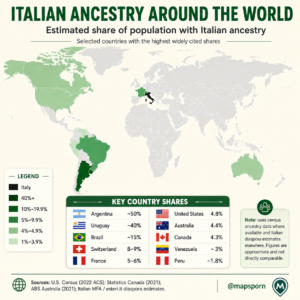
First: What Does “Italian Ancestry” Mean?
Before comparing countries, one distinction is essential.
Having Italian ancestry is not the same as:
- Being born in Italy
- Holding Italian citizenship
- Speaking Italian
- Being registered as an Italian citizen overseas
A person in Argentina, for example, might have four Italian grandparents but hold only Argentine citizenship.
An American might report both Irish and Italian ancestry.
An Australian could have one Italian grandparent and three grandparents from other backgrounds.
All may legitimately be described as having Italian ancestry, depending on the statistical definition being used.
This is why the figures on the map should be read as estimates of ancestry rather than a single standardized global census.
Different countries measure ethnicity and ancestry in completely different ways.
One of the Largest Mass Migrations in Modern History
The scale of Italian emigration is difficult to overstate.
Italy’s Ministry of Foreign Affairs describes approximately 25 million Italians emigrating between 1870 and 1970.
The biggest migration waves began during the late 19th century.
Italy had only recently become a unified country, and enormous economic differences existed between regions.
Many families faced:
- Rural poverty
- Scarcity of farmland
- Low wages
- Unemployment
- Population pressure
- Political instability
- Limited economic opportunities
Steamships and expanding global transportation networks made migration across the Atlantic increasingly possible.
Millions left.
Some traveled temporarily and later returned to Italy.
Others never came back.
They established families thousands of kilometers from the villages where they were born.
A century later, their descendants number in the tens of millions.
Argentina — Around Half the Population Has Italian Roots
If one country demonstrates the impact of Italian migration better than any other, it is Argentina.
Widely cited estimates suggest that 40–50% or more of Argentines have at least some Italian ancestry.
A recent academic study notes estimates that more than half of Argentinians identify with Italian descent.
Italy’s impact on Argentina began during the enormous migration waves of the late 19th and early 20th centuries.
A report connected with Italy’s Foreign Ministry notes that Argentina received approximately 3 million Italian immigrants between 1860 and 1970.
For a country whose population was much smaller at the time, that migration was transformative.
Why Did So Many Italians Choose Argentina?
Argentina actively encouraged European immigration during the country’s rapid expansion.
Buenos Aires became one of the principal destinations for Italian emigrants crossing the Atlantic.
Many came from regions including:
- Piedmont
- Lombardy
- Liguria
- Veneto
- Campania
- Calabria
- Sicily
Italian immigrants became laborers, farmers, tradespeople, merchants and entrepreneurs.
Their children and grandchildren became simply Argentine.
But Italian cultural influence remained unusually strong.
Italian Influence on Argentine Spanish
Perhaps nowhere is this clearer than in language.
The distinctive rhythm of Rioplatense Spanish, spoken around Buenos Aires and Montevideo, has often been linked partly to the enormous historical presence of Italian speakers.
Argentina also developed Lunfardo, a slang vocabulary historically associated with Buenos Aires and containing many words influenced by Italian dialects.
Even Argentines with little knowledge of modern Italian may therefore speak Spanish containing echoes of Italian immigration.
Italian Food Became Argentine Food
Italian cuisine was also absorbed so deeply into Argentine culture that many dishes no longer feel foreign.
Pizza is enormously popular.
Pasta is a household staple.
Milanesa reflects European culinary influence.
Gelato traditions became part of urban Argentine life.
Gnocchi even developed a particular cultural tradition: many Argentine families eat ñoquis on the 29th of each month.
The result is something more complex than simply an immigrant community preserving its cuisine.
Italian traditions became part of Argentine national culture.
Argentina Also Has a Huge Italian-Citizen Population
Argentina isn’t merely full of distant descendants.
It also has one of the largest populations of officially registered Italian citizens outside Italy.
Italy’s Foreign Ministry noted in 2023 that more than one million AIRE-registered Italian citizens lived in Argentina.
That deep connection is one reason Italy has devoted considerable attention to citizenship and consular services there.
Uruguay — More Than 40% Italian Ancestry
Uruguay may be even more surprising.
Italy’s Ministry of Foreign Affairs states that more than 40% of Uruguayans are estimated to have Italian ancestry.
Another Italian government release referred to approximately 1.5 million Italian descendants living in Uruguay.
That is extraordinary for a country with only a few million residents.
Montevideo and the Italian Connection
Most immigrants arrived in and around Montevideo.
As in Argentina, Italians integrated deeply into society rather than remaining permanently separate.
Italian surnames became commonplace.
Italian influences became visible in:
- Food
- Architecture
- Business
- Politics
- Language
- Family traditions
The Italian influence on Uruguay and Argentina is so profound partly because migration occurred while both countries were undergoing rapid demographic expansion.
Italian immigrants were not joining already enormous populations.
They helped build the modern populations themselves.
Brazil — Possibly 25–30 Million Italian Descendants
Brazil presents a different kind of scale.
The percentage of the population with Italian ancestry is often estimated around 15%, though there is no modern Brazilian census ancestry measure directly equivalent to those used in Canada or Australia.
That 15% estimate translates into roughly 25–30 million people.
One academic source describes around 30 million Brazilians—approximately 15% of the population—as Italian descendants.
The largest concentrations are found particularly in:
- São Paulo
- Rio Grande do Sul
- Santa Catarina
- Paraná
- Espírito Santo
Why São Paulo Became So Italian
Italian migration to Brazil increased dramatically during the late 19th century.
Brazilian agriculture—especially coffee plantations—needed workers following the abolition of slavery.
Large numbers of Italians arrived to work on farms.
Others later migrated into cities.
São Paulo became particularly important.
Italian immigrants and their descendants became deeply involved in the city’s industrial growth.
Neighborhoods such as Bixiga, Mooca and Brás became famous for their Italian associations.
Over generations, the Italian population mixed into Brazilian society while preserving numerous culinary, religious and cultural traditions.
Brazilian Italian Developed Its Own Language
One of the most fascinating outcomes appeared in southern Brazil.
Immigrants from Veneto and neighboring northern Italian areas developed a language variety known as Talian.
Talian combines roots in Venetian dialects with influences from Portuguese and other Italian varieties.
It survives in parts of southern Brazil today.
The existence of Talian demonstrates that the Italian diaspora did not simply transport modern standard Italian overseas.
Many emigrants left Italy before standard Italian had become the everyday language of the entire country.
They often spoke regional dialects instead.
United States — About 4.8% Report Italian Ancestry
The percentage is much smaller in the United States, but because America’s population is so large, the absolute number is enormous.
The map uses an estimate of roughly 4.8% of Americans reporting Italian ancestry, based on U.S. Census Bureau American Community Survey data.
The Census Bureau’s ancestry tables record millions of Americans identifying themselves as Italian.
The Great Italian-American Migration
Italian immigration to the United States accelerated enormously between the 1880s and the First World War.
New York became the most famous destination, but Italian communities developed across the Northeast and Midwest.
Major communities emerged in:
- New York
- New Jersey
- Pennsylvania
- Massachusetts
- Rhode Island
- Connecticut
- Illinois
- California
Many immigrants initially came from southern Italy and Sicily.
They arrived during a period when America’s industrial cities needed enormous numbers of workers.
Italian immigrants entered construction, manufacturing, transportation and small business.
Little Italys Appeared Across America
Italian neighborhoods became fixtures of cities including:
- New York
- Boston
- Philadelphia
- Chicago
- Baltimore
- San Francisco
Religious festivals, bakeries, restaurants, social clubs and churches helped communities maintain connections to their villages and regions of origin.
Over the next several generations, Italian-Americans moved increasingly into suburban areas and intermarried with other groups.
That means today’s Italian ancestry is much more geographically dispersed than old Little Italy maps suggest.
Italian-American Food Became Its Own Cuisine
One of the most recognizable outcomes was Italian-American cuisine.
Some dishes considered stereotypically “Italian” in the United States are actually products of immigrant America.
Immigrants adapted recipes to:
- Different ingredients
- Greater access to meat
- American tastes
- Commercial restaurant kitchens
The result was a distinct Italian-American culinary tradition that eventually influenced American food as a whole.
Australia — 4.4% Report Italian Ancestry
Australia provides one of the cleanest statistics on the map.
According to Australia’s 2021 Census, 1,108,364 people reported Italian ancestry, equivalent to 4.4% of the country’s population.
Importantly, only about 163,000 Australian residents were actually born in Italy.
That enormous difference shows how diaspora populations grow through generations.
Most Australians identifying with Italian ancestry were born in Australia.
Postwar Migration Transformed Italian Australia
Italian migration to Australia expanded especially after World War II.
Australia needed labor and encouraged European migration.
Italian migrants worked in:
- Construction
- Agriculture
- Manufacturing
- Small businesses
- Food production
- Hospitality
Melbourne developed an especially large Italian community.
Victoria’s 2021 Census counted approximately 384,688 people identifying Italian ancestry, or around 5.9% of the state’s population.
Italian influence on Australian café culture, food, wine and urban life became substantial.
Canada — 4.3% Report Italian Origin
Canada produces another reliable census comparison.
In the 2021 Canadian Census, 1,546,390 people reported Italian ethnic or cultural origin, equal to 4.3% of the population in private households.
Large Italian communities developed particularly in:
- Toronto
- Montreal
- Vancouver
- Hamilton
Canadian Italian migration occurred in multiple waves, but the decades following World War II were especially significant.
Thousands found work in construction, factories and small businesses.
Substantial communities eventually became established parts of Canada’s urban middle class.
Switzerland — A Long History of Italian Migration
Switzerland appears prominently on the map with an estimated Italian-background share in the high single digits.
But Switzerland illustrates why ancestry maps require caution.
Different statistics may measure:
- Italian citizenship
- Italian birthplace
- Italian language
- Italian family background
Those are not interchangeable.
What is certain is that Italian migration has had an enormous impact on Switzerland.
The two countries share a border, and Italian workers migrated north for decades to work in construction, manufacturing, hospitality and other industries.
Italian is also one of Switzerland’s official national languages.
The Swiss canton of Ticino and parts of Graubünden are historically Italian-speaking regions, meaning not every Italian-speaking Swiss person is descended from a modern Italian immigrant.
So the country’s green shading combines a complicated mixture of geography, language and migration history.
France — Generations of Italian Migration
France has another large historic Italian-descended population.
Again, a precise ancestry percentage is difficult because France does not conduct ancestry surveys in the same way as the United States, Canada or Australia.
French statistics instead often study immigrants and their direct descendants.
INSEE estimated around 805,000 France-born direct descendants of Italian immigrants in 2020—and that number does not include the many third-, fourth- or more distant-generation French people with Italian roots.
Italian migration to France was especially strong because of geographic proximity.
Large numbers settled in:
- Provence
- Nice and southeastern France
- Lyon
- Paris
- Lorraine
- Corsica and Mediterranean regions
Today many French people with Italian ancestry have completely assimilated linguistically and culturally while retaining Italian surnames or family traditions.
Venezuela — An Important Postwar Community
Venezuela developed a substantial Italian community during the 20th century, particularly after World War II.
Italian immigrants participated in the country’s period of rapid economic expansion and urban development.
Caracas and other cities attracted entrepreneurs, engineers, tradespeople and families from Italy.
The map’s roughly 3% figure should be treated as an approximate diaspora estimate rather than a census measure directly comparable with Canada or Australia.
Economic and political turmoil in Venezuela has also caused considerable migration in more recent decades, including movement among Venezuelans of Italian ancestry.
Peru — A Smaller but Historic Italian Community
Peru’s Italian-descended population represents a smaller share—shown on the map at approximately 1.8%.
Italian migration to Peru never reached the enormous scale seen in Argentina or Brazil.
Nevertheless, Italians became prominent in commerce and business, particularly in Lima and coastal cities.
Migration from Liguria was especially significant historically.
Over generations, the community became heavily integrated into Peruvian society.
Why South America Became the Heart of the Italian Diaspora
Looking at the map, one feature is impossible to miss.
South America is the world’s great concentration of Italian ancestry outside Europe.
That was not accidental.
During Italy’s great emigration period, Argentina, Brazil and Uruguay offered:
- Agricultural land
- Expanding cities
- Labor demand
- Growing economies
- Immigration programs
- Transatlantic shipping connections
At the same time, economic conditions were pushing millions out of Italy.
The timing lined up perfectly.
Chain Migration Made Communities Grow Faster
Migration also developed through networks.
One person from an Italian village might leave for Buenos Aires.
Later, a brother followed.
Then cousins.
Then neighbors.
Eventually, entire clusters of people from the same Italian province could be found in the same overseas community.
This process is known as chain migration.
Letters, money and success stories sent home encouraged still more people to leave.
Over decades, these networks produced enormous overseas populations.
Why the Map Does Not Match Italian Citizenship
There is another important distinction.
Italy has millions of citizens officially registered as living overseas through AIRE, the Registry of Italians Resident Abroad.
But the global population of Italian descendants is vastly larger.
The Italian government estimated in 2025 that 60–80 million people worldwide could potentially have Italian descent relevant to ancestry-based citizenship rules.
Most are citizens of the countries where they live.
Some cannot speak Italian.
Some have never visited Italy.
Others maintain extremely strong connections to Italian culture and relatives.
So there are really several different maps:
Italian citizens abroad
People born in Italy living abroad
People who speak Italian
People with Italian ancestry
Each map would look different.
Why These Percentages Are Difficult to Compare
This may be the most important technical detail behind the infographic.
Australia asks people to report ancestry and allows multiple responses.
Canada asks about ethnic or cultural origin.
The United States also collects self-reported ancestry data.
Brazil does not currently provide an equivalent nationwide modern ancestry measure.
France generally uses immigrant and descendant statistics rather than American-style ethnic ancestry categories.
Argentina and Uruguay’s percentages are often derived from demographic and historical estimates.
So saying:
“Argentina is 50% Italian and Australia is 4.4% Italian”
doesn’t mean those figures were measured in exactly the same way.
Argentina’s figure may include people several generations removed from migration, while Australia’s 4.4% comes from direct census self-identification.
The broad comparison is still meaningful.
But the decimals should not imply a level of precision that the global data cannot provide.
An Italian Diaspora That May Rival Italy Itself
The scale of the diaspora creates an extraordinary demographic situation.
Modern Italy contains around 59 million residents.
Yet Italian authorities estimate that 60–80 million descendants of Italian emigrants may live elsewhere around the world.
In other words, there may be as many—or more—people of Italian descent outside Italy as people living inside Italy.
They are not one homogeneous community.
An Italian-Argentine family in Buenos Aires may have a completely different experience from an Italian-American family in New Jersey.
A Brazilian with Venetian ancestry may share little culturally with a French citizen whose grandparents came from Piedmont.
But they are all connected to the same extraordinary migration story.
The Map Is Really a Map of 150 Years of Migration
At first glance, this infographic is simply a map showing percentages.
Look closer and it tells the story of millions of individual decisions.
A farmer leaving Veneto.
A Sicilian family boarding a ship for New York.
A Ligurian merchant settling in Peru.
Workers moving to Switzerland.
A family rebuilding its life in Melbourne after World War II.
Millions of journeys accumulated into communities.
Those communities had children.
Their children had children.
And within a few generations, the Italian diaspora became larger than the population of many countries.
That is why today:
Around half of Argentina may have Italian roots.
More than 40% of Uruguay has Italian ancestry according to Italian government estimates.
Roughly 15% of Brazil is widely estimated to descend from Italians.
4.8% of Americans identify with Italian ancestry according to the map’s ACS-based estimate.
4.4% of Australians reported Italian ancestry in the 2021 Census.
4.3% of Canadians reported Italian ethnic or cultural origin.
Few countries have left such a large demographic footprint so far beyond their borders.
And perhaps that is the most remarkable part of Italy’s migration story:
Italy did not only shape the population of Italy. It helped shape the populations of countries thousands of miles away.
Data Note
The map combines census ancestry figures where available with widely cited diaspora estimates elsewhere. Because countries define and measure ancestry differently, percentages should be treated as approximate and are not perfectly comparable. Australian and Canadian figures come from their 2021 censuses; U.S. figures use American Community Survey ancestry data. Estimates for countries such as Argentina, Uruguay and Brazil rely on historical and diaspora research. Italy’s Ministry of Foreign Affairs estimates that 60–80 million potential Italian descendants live worldwide.