
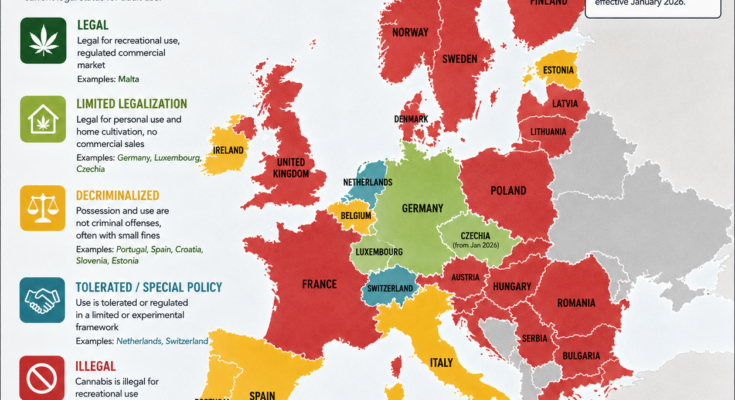
Cannabis laws in Europe are changing rapidly—but the continent is nowhere close to having one common policy.
Cross a single border and the rules surrounding the same small amount of cannabis can change dramatically.
In one country, an adult may legally grow several cannabis plants at home. In another, possession may technically remain illegal but result only in an administrative penalty. A third country may tolerate cannabis sales in certain establishments even though the underlying activity is technically prohibited.
And in many European countries, recreational cannabis remains illegal.
This is why a map of cannabis laws can look simple while the reality behind it is surprisingly complicated.
As of 2026, Malta, Germany, Luxembourg and Czechia have all introduced laws allowing some combination of limited adult possession, private consumption or home cultivation. The Netherlands continues its famous tolerance model, while Switzerland is running regulated pilot programs. At the same time, most European countries have stopped well short of creating a conventional commercial recreational cannabis market.
First: What Does “Legal” Actually Mean?
This is the most important part of understanding the map.
Words such as legalized, decriminalized, tolerated and permitted are often used interchangeably online, but they mean very different things.
Legalized
An activity is legal when legislation specifically allows it under defined conditions.
That does not necessarily mean cannabis can be bought freely from ordinary stores.
A country might legalize:
- Possession below a certain amount
- Private consumption
- Home cultivation
- Membership in nonprofit cannabis associations
while continuing to prohibit commercial recreational sales.
Decriminalized
Decriminalization generally means possession or use may still violate the law, but the offense has been removed from the criminal system or carries reduced penalties.
Someone might receive an administrative fine rather than a criminal conviction.
Tolerated
An activity can technically remain illegal while authorities follow a formal policy of not prosecuting it when certain conditions are met.
The Netherlands is Europe’s most famous example.
Illegal
Possession, cultivation or recreational use remains prohibited, although penalties can still vary enormously.
This terminology matters because the European Union Drugs Agency warns that there is no universally agreed definition of cannabis “decriminalization.” Countries frequently combine several different approaches within the same legal system.
There Is No Single European Cannabis Law
Despite the European Union’s influence over many areas of legislation, there is no harmonized EU law governing personal possession of cannabis.
Individual countries largely determine their own policies.
That is why Germany can permit limited home cultivation while neighboring Poland follows a much more restrictive approach.
EU law does establish rules dealing with illicit drug trafficking, but decisions about personal possession and use remain largely national matters.
Germany: One of Europe’s Biggest Policy Changes
Germany dramatically changed its cannabis laws in 2024.
The Cannabis Act entered into force on April 1, 2024, with additional provisions concerning cultivation associations taking effect later that year.
Adults can legally possess limited quantities of cannabis and cultivate as many as three cannabis plants for personal use.
Germany also created a system of nonprofit cultivation associations rather than introducing ordinary recreational cannabis stores.
Germany’s Federal Ministry of Health emphasized that the reform was designed around public-health protection, reducing the illegal market and strengthening protections for minors.
This is why describing Germany simply as having “legal weed” can be misleading.
Germany legalized specific forms of possession and cultivation.
It did not create the type of nationwide commercial recreational market found in places such as some U.S. states or Canada.
Luxembourg: Home Growing Became Legal in 2023
Luxembourg introduced another major European reform in July 2023.
Adults may legally cultivate up to four cannabis plants per household from seeds.
Those plants must be grown at the person’s home or usual residence and must not be visible from a public space.
Personal consumption in private is also permitted.
However, Luxembourg did not simply legalize cannabis everywhere.
Consumption in public remains prohibited, and possession, transportation or acquisition of up to three grams in public remains an offense, although the legal penalties were reduced and simplified.
Luxembourg therefore demonstrates how a country can legalize private cultivation while continuing to restrict public possession and consumption.
Czechia: A Major New Change in 2026
Czechia is one of the newest countries to significantly loosen its cannabis rules.
Changes effective January 1, 2026 allow people over 21 to possess cannabis for their own use within defined limits.
Adults over 21 may possess up to:
- 100 grams at home
- 25 grams outside the home
- Three cannabis plants for personal use
The law does not establish a conventional recreational retail market.
Instead, Czechia has essentially expanded legal personal possession and cultivation while maintaining restrictions on larger quantities and commercial activity.
The European Union Drugs Agency now lists Czechia alongside Malta, Luxembourg and Germany when discussing Europe’s emerging models of limited adult cannabis regulation.
Malta: Often Called Europe’s First, but There Is an Important Catch
Malta made international headlines in December 2021 when it became the first EU country to introduce major legal reforms for adult recreational cannabis.
But saying “weed is fully legal in Malta” is not technically accurate.
Malta’s Authority for the Responsible Use of Cannabis explicitly states:
“Malta has not legalised the use of Cannabis.”
Instead, the country has created a partially decriminalized and regulated framework.
Adults can possess up to 7 grams in public, keep up to 50 grams of dried cannabis at home, and grow up to four plants per household under specified conditions.
Adults can also join licensed Cannabis Harm Reduction Associations.
These organizations cultivate cannabis for their registered members and must operate on a nonprofit basis.
That distinction is important.
Malta has legal access routes and extensive decriminalization, but it does not operate ordinary commercial recreational cannabis stores.
Tourists also cannot simply join these associations; Malta’s regulator requires proof of Maltese residence for membership.
The Netherlands: Famous, but Cannabis Isn’t Simply “Legal”
The Netherlands may be Europe’s most surprising case.
Amsterdam’s cannabis coffeeshops are famous around the world, leading many people to assume that recreational cannabis is completely legal in the country.
Technically, it isn’t.
Under Dutch law, cultivation, supply and possession of cannabis remain offenses.
However, the sale of small amounts through qualifying coffeeshops has been officially tolerated for decades.
That means authorities generally do not prosecute approved coffeeshops for certain cannabis sales when strict conditions are followed.
The Netherlands has also begun experimenting with a regulated supply chain.
A controlled cannabis-supply experiment involving coffeeshops in selected municipalities began entering its experimental phase in 2025. The goal is to study what happens when coffeeshops receive legally regulated cannabis rather than relying on the historically tolerated but legally problematic supply system.
So the Netherlands occupies perhaps the strangest category on the European map:
Cannabis sales can be openly tolerated even though the underlying legal framework has never amounted to straightforward nationwide legalization.
Switzerland: Legal Experiments Rather Than Nationwide Legalization
Switzerland also deserves its own category.
Recreational cannabis has not been legalized nationally in the conventional sense.
Instead, Switzerland has authorized scientific pilot programs in selected locations that allow regulated distribution to approved participants.
The programs are designed to study how regulated access affects issues including consumption patterns, health and public safety.
That means someone participating in an authorized Swiss pilot can have access that would not necessarily be legal for another person elsewhere in the country.
The European Union Drugs Agency specifically identifies Switzerland’s approach as a system of pilot trials rather than nationwide recreational legalization.
Portugal: Decriminalization Is Not Legalization
Portugal may be the European country most commonly misunderstood in discussions about drug policy.
Portugal famously decriminalized personal possession and use of small quantities of drugs.
But decriminalized does not mean legal.
Cannabis did not suddenly become a legally sold recreational product.
Instead, small personal-use cases are generally handled outside the traditional criminal punishment system.
Cultivation is another matter entirely.
The European Union Drugs Agency notes that in Portugal, although personal possession offenses have been decriminalized, unauthorized cannabis cultivation remains a criminal offense.
This illustrates why coloring a country simply “legal” or “illegal” can obscure important details.
Spain Is Another Complicated Case
Spain is often listed as having decriminalized or tolerated cannabis.
Private possession and cultivation exist in a different legal environment from public possession.
For example, cultivation for personal use that is visible from a public place can result in an administrative penalty.
Cannabis social clubs have also operated in parts of Spain, but court decisions have limited the idea that clubs provide a broadly legal method of distribution.
Spain therefore cannot accurately be described as having a normal legal recreational cannabis market.
Belgium: Small Amounts Don’t Mean Full Legalization
Belgium is another example where enforcement priorities and legal status can easily become confused.
Small-scale possession and cultivation may be treated less severely under particular circumstances, but cannabis has not been broadly legalized for recreational commercial sale.
The EUDA notes, for example, that cultivation of no more than one plant can fall into a lower-level enforcement category.
That is very different from saying cannabis is simply legal.
Countries With More Restrictive Cannabis Laws
Across large parts of Europe, recreational cannabis remains prohibited.
Northern and Eastern Europe generally contain many of the continent’s more restrictive jurisdictions, although penalties vary greatly.
Countries shown in the restrictive category on maps like this often include places such as:
- Sweden
- Norway
- Finland
- Poland
- France
- Hungary
- Romania
- Bulgaria
But even within this group, there is no single policy.
The punishment for possessing a small amount can range from fines and diversion programs to potential criminal prosecution.
According to the EUDA, more than half of EU countries still have laws in which incarceration is theoretically possible for at least some minor personal-possession offenses, although actual enforcement policies may recommend alternatives.
Why Europe’s Cannabis Map Is Becoming Harder to Color
Twenty years ago, a simple “legal versus illegal” map might have been easier to understand.
Today there are many more categories.
A country may simultaneously have:
Legal home cultivation
but
Illegal commercial sales
and
Restricted public possession
while also allowing
nonprofit cannabis associations.
Another country may officially prohibit possession but routinely avoid criminal prosecution for small quantities.
Another may allow controlled cannabis sales only as part of a scientific pilot program.
The result is a patchwork rather than a simple divide.
Europe Is Moving Toward Experimentation, Not One Model
The broad trend in European cannabis policy is clear: several countries are experimenting with alternatives to traditional prohibition.
But they are doing it very differently.
Malta uses limited possession, home growing and regulated nonprofit associations.
Luxembourg permits private cultivation and consumption.
Germany allows limited possession, home cultivation and nonprofit cultivation associations.
Czechia now permits limited personal possession and home cultivation.
The Netherlands continues its tolerance system while experimenting with regulated supply.
Switzerland is conducting controlled pilot programs.
According to the EUDA’s 2026 European Drug Report, the models being developed generally emphasize limited personal cultivation, nonprofit approaches, prevention measures, monitoring and evaluation rather than unrestricted commercial sales.
Is Recreational Cannabis Commercially Legal Anywhere in Europe?
This is where many viral maps create confusion.
Europe’s reforms generally do not resemble Canada’s nationwide commercial legalization model.
Malta’s regulator explicitly describes its model as partially decriminalized and nonprofit.
Germany’s associations are non-commercial.
Luxembourg permits home cultivation but has not established ordinary recreational dispensaries.
Czechia’s new law allows limited personal possession and cultivation rather than creating cannabis stores.
The Netherlands’ famous coffeeshops remain based on a tolerance framework.
So when someone says “cannabis is legal in Europe,” the next question should always be:
Legal to do what?
Possess it?
Grow it?
Use it privately?
Buy it?
Sell it?
Join an association?
Those can have five completely different legal answers in the same country.
The Map Is Changing Quickly
Europe’s cannabis laws are now changing fast enough that maps can become outdated within a year or two.
Malta changed its system in 2021.
Luxembourg followed in 2023.
Germany’s major reform arrived in 2024.
Czechia’s latest changes took effect in 2026.
The Netherlands is conducting new regulated-supply experiments.
Other governments continue debating reforms.
The EUDA describes cannabis policy across Europe as increasingly diverse and emphasizes the importance of evaluating what happens after these new systems are introduced.
The Bottom Line
There is no single answer to the question:
“Is weed legal in Europe?”
Europe currently contains almost every possible cannabis policy model.
Some countries allow limited possession and home cultivation.
Some have decriminalized small amounts.
Some tolerate activities that technically remain illegal.
Some are conducting regulated experiments.
And many still prohibit recreational cannabis.
Perhaps the biggest surprise is that even Europe’s most liberal countries generally stop well short of creating a completely open commercial cannabis market.
So rather than dividing Europe into simply green for legal and red for illegal, the real map requires several shades in between.
And as Germany, Czechia, Malta, Luxembourg, the Netherlands and Switzerland continue testing new approaches, those colors are likely to keep changing.
Source note: This article reflects legislation and policy information available in 2026, including material from the European Union Drugs Agency, national governments and cannabis regulators. Cannabis laws can change and often contain specific age, possession, location and cultivation restrictions. Always consult the current law of the relevant jurisdiction.