
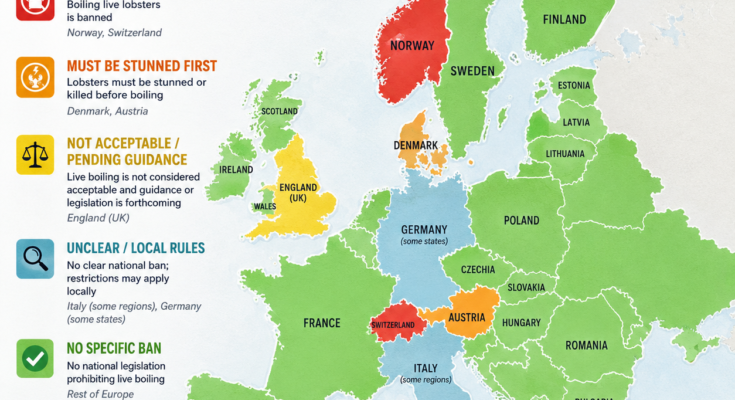
For generations, one of the most familiar ways of preparing lobster has also been one of the most controversial: placing the animal directly into boiling water while it is still alive.
Across Europe, however, there is no single rule governing the practice.
In some countries, animal-welfare rules require lobsters and other crustaceans to be stunned or killed before they enter boiling water. In others, live boiling remains permitted under national law. Elsewhere, the situation depends on guidance, regional rules, interpretation of broader animal-welfare legislation, or rules that are still developing.
That creates the unusual map above: crossing a European border can mean entering a completely different legal approach to exactly the same cooking method.
And the rules are changing as scientific understanding of crustacean sentience develops.
Why Is Boiling Lobsters Alive Controversial?
The debate centers on a basic question:
Can lobsters feel pain?
For many years, crustaceans were often treated differently from mammals, birds and fish because their nervous systems are structured differently.
Scientific opinion has shifted considerably.
A major review commissioned by the UK government and carried out by researchers at the London School of Economics examined more than 300 scientific studies involving decapod crustaceans and cephalopods.
Decapod crustaceans include animals such as:
- Lobsters
- Crabs
- Crayfish
- Prawns
- Shrimp
Researchers concluded that there was substantial scientific evidence supporting sentience in these animals and recommended that decapod crustaceans receive animal-welfare protection.
The review specifically recommended against practices such as boiling large crustaceans alive when more humane methods are available, unless effective stunning occurs first.
That evidence has increasingly influenced European animal-welfare policy.
Switzerland: Lobsters Must Be Stunned First
Switzerland has some of Europe’s clearest rules.
Swiss animal-welfare guidance requires decapod crustaceans to be stunned before they are killed, unless a killing method itself causes immediate unconsciousness without fear or pain.
For lobsters destined for cooking, electrical stunning followed by boiling is among the welfare-compliant methods described by Switzerland’s Federal Food Safety and Veterinary Office.
Swiss rules also regulate how live crustaceans are transported and stored.
The changes attracted international attention when Switzerland strengthened protections for lobsters and other crustaceans in 2018.
The important distinction is that Switzerland has not banned people from eating lobster.
Instead, the welfare requirement concerns what happens to the animal before it is cooked.
A conscious lobster should not simply be dropped directly into boiling water.
Norway: Don’t Put a Conscious Lobster Straight Into the Pot
Norway also has strong protections.
The Norwegian Animal Welfare Act explicitly covers decapods, meaning crustaceans such as lobsters and crabs fall within the scope of the country’s animal-welfare legislation.
Norway’s Food Safety Authority gives particularly clear guidance for lobsters:
Lobsters should not be killed by live boiling. They should be killed or stunned before boiling.
Similar guidance exists for crabs.
Norwegian authorities explain that placing a crab directly into boiling water is highly stressful to the animal. For restaurants, stores and other commercial businesses, crabs are expected to be stunned before boiling.
So Norway is one of the clearest examples of a country where simply dropping a conscious lobster into boiling water is not considered an acceptable method.
Austria: Stunning Is Required for Crustaceans
Austria has also incorporated special provisions for crustaceans into its animal-welfare slaughter rules.
Its regulations covering fish, frogs, crustaceans and shellfish state that crustaceans must be stunned before killing.
This puts Austria among the European countries where the traditional method of placing a fully conscious lobster directly into boiling water conflicts with animal-welfare requirements.
The Austrian example demonstrates an important distinction often lost in simplified maps.
A country may still allow boiling as the final cooking or killing step, but require the animal to be rendered unconscious beforehand.
Therefore:
“Boiling lobster is legal” and “boiling a conscious live lobster is legal” are not necessarily the same statement.
Germany Is an Interesting Exception
Germany illustrates just how complicated European regulations can be.
Germany has extensive animal-welfare legislation, yet its federal Animal Slaughter Ordinance contains a specific provision concerning crustaceans.
It states that crustaceans, snails and shellfish may be killed in strongly boiling water that completely covers them and continues boiling after they are placed in it.
The regulation also recognizes alternatives including electrical stunning or killing for crustaceans.
This is important because maps circulating online sometimes categorize Germany as having unclear rules or local restrictions.
The federal regulation itself is considerably more specific.
It is also a good example of why legal maps need frequent updates and careful definitions.
England: The Law Is Moving Toward Stronger Protection
The situation in England has changed significantly in recent years.
The UK’s Animal Welfare (Sentience) Act 2022 formally recognizes decapod crustaceans—including lobsters and crabs—as sentient animals for government policy purposes.
However, that recognition did not initially amount to an immediate nationwide ban on boiling lobsters alive.
When the change was originally announced, the UK government specifically noted that the sentience legislation itself would not directly change restaurant or fishing practices.
The position has since developed further.
In England’s animal-welfare strategy published in December 2025, the government committed to issuing guidance on methods of killing decapods and stated that the guidance would clarify that live boiling is not an acceptable killing method.
That makes England particularly important to watch.
Rather than treating the situation simply as “legal” or “illegal,” it is more accurate to say that welfare policy is moving toward explicitly rejecting live boiling.
Scotland, Wales and Northern Ireland Can Differ
Another complication is that the United Kingdom does not always operate as a single animal-welfare jurisdiction.
Rules and guidance can differ between:
- England
- Scotland
- Wales
- Northern Ireland
This means maps that color the entire UK one way can oversimplify the situation.
Anyone dealing commercially with live crustaceans should therefore consult the rules that apply in the specific UK nation where the activity takes place.
Italy: Regional and Judicial Rules Complicate the Picture
Italy is another country where a simple national color can be misleading.
Animal-welfare treatment of live crustaceans has been influenced by regional requirements and court decisions, creating a more fragmented situation than in countries such as Switzerland.
Rules concerning storage—especially keeping live lobsters on ice—and methods of killing have attracted legal challenges.
This makes Italy difficult to summarize with a simple nationwide “yes” or “no.”
The practical lesson is that restaurants and individuals need to check local requirements rather than assuming one rule applies identically across the country.
What About the Rest of Europe?
Across much of Europe, there is no specific national law explicitly stating:
“It is illegal to boil a lobster alive.”
That does not necessarily mean there are no animal-welfare responsibilities.
Different countries may regulate:
- Handling
- Storage
- Transport
- Stunning
- Commercial slaughter
- Avoidable suffering
- Restaurant practices
Some countries may also distinguish between private household preparation and commercial food businesses.
This makes a map like this useful for understanding the general trend—but not a substitute for legal advice.
The European Union Does Not Create One Simple Lobster Rule
Another common assumption is that European Union membership means every EU country must follow exactly the same rule.
That isn’t the case here.
EU Regulation 1099/2009 establishes welfare rules concerning animals at the time of killing, but the framework does not create a single detailed Europe-wide lobster-boiling rule equivalent to the national provisions found in places such as Switzerland or Austria.
Individual countries therefore retain significant room to establish additional protections.
The result is a regulatory patchwork.
Cross a border and the treatment required before cooking a lobster can change.
Why Stunning Matters
The central issue is not whether lobster can be eaten.
The controversy concerns the animal’s condition at the moment it is killed.
Researchers reviewing crustacean welfare have identified electrical stunning as one of the most promising approaches.
The objective is to make the lobster insensible before subsequent killing or cooking.
The LSE review concluded that methods such as boiling alive, gradually heating water, live dismemberment and freshwater immersion should not be used where more humane alternatives are available unless effective stunning occurs beforehand.
Swiss authorities similarly identify properly performed electrical stunning followed by boiling as a welfare-compliant method.
Does a Lobster’s Movement Prove It Feels Pain?
Not by itself.
Movement alone can be a reflex and does not automatically prove conscious suffering.
That is why scientists do not rely on one behavior when studying animal sentience.
Researchers instead consider multiple forms of evidence, including:
- Nervous-system responses
- Learning
- Motivational trade-offs
- Protective behavior
- Responses to injury
- Responses to anesthetics
- Long-term behavioral changes
The major LSE review evaluated evidence across numerous criteria rather than relying simply on whether a lobster moves when exposed to heat.
Researchers concluded that the overall body of evidence was strong enough to justify treating decapod crustaceans as sentient for animal-welfare purposes.
The Laws Reflect a Bigger Change in Animal Welfare
The lobster debate represents something much larger than seafood preparation.
Historically, animal-welfare laws focused overwhelmingly on vertebrates.
As researchers study increasingly complex behavior in invertebrates, governments are being forced to reconsider where legal protection should begin.
Lobsters, crabs and crayfish are among the most prominent examples.
The UK’s decision to recognize decapod crustaceans as sentient animals demonstrates how quickly scientific evidence can influence public policy.
Other countries may eventually revise their rules as research continues.
So, Is It Legal to Boil Lobsters Alive in Europe?
There is no single answer for Europe as a whole.
The most accurate answer is:
It depends on the country—and sometimes on the region, setting and exact method used.
Switzerland requires crustaceans to be stunned before killing.
Norway says lobsters should not be killed through live boiling and must first be killed or stunned.
Austria requires crustaceans to be stunned before killing.
Germany’s federal rules, by contrast, specifically permit crustaceans to be killed in vigorously boiling water under defined conditions.
England recognizes lobsters as sentient and has announced guidance clarifying that live boiling is not an acceptable killing method.
Other European jurisdictions have varying levels of protection, general animal-welfare laws or local rules.
Why This Map Will Keep Changing
Perhaps the most interesting thing about this map is that it is unlikely to remain unchanged forever.
Animal-welfare legislation is evolving.
Scientific research is continuing.
Government guidance is being rewritten.
And practices that were considered normal only a generation ago are increasingly being questioned.
For anyone cooking or selling live lobster, the safest approach is to check the current national and local regulations rather than relying solely on an older map.
But as a snapshot of Europe’s different attitudes toward crustacean welfare, the map reveals something fascinating:
The same lobster can receive very different legal treatment depending on which side of a European border it happens to be on.
Sources
Information in this article is based on guidance and legislation from the Norwegian Food Safety Authority, Switzerland’s Federal Food Safety and Veterinary Office, German federal legislation, Austrian federal legislation, the UK Government, and the London School of Economics review of scientific evidence concerning decapod crustacean sentience.
Laws and official guidance can change. This article is for general informational purposes and should not be treated as legal advice.