
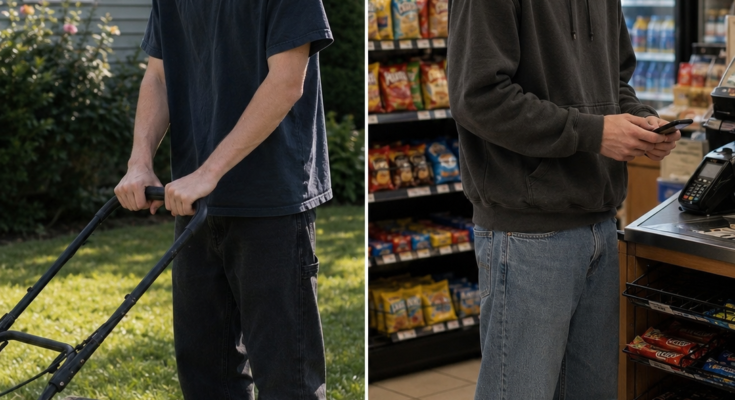
About a month after I moved into my new home, a boy who looked around fifteen knocked on my front door. Beside him was an old push mower that looked like it had survived years of hard use.
“Hi, ma’am,” he said politely. “I was wondering if you needed someone to mow your lawn this summer.”
His name was Chase. He told me he lived with his mother in a nearby trailer park and was trying to save money before school started again. There was something likable about him, so I hired him.
Chase turned out to be an excellent worker. He always arrived when he said he would. He never complained. He didn’t waste time checking his phone or rushing through the job. And when he finished, my yard looked better than I could have managed myself. Because of that, I usually gave him a little more money than we had originally agreed on.
Still, something about Chase bothered me. His face looked strangely familiar. Every week when he showed up, I found myself studying him, trying to remember where I might have seen him before. A neighbor? A local store? An old photograph? Nothing matched. Eventually, I convinced myself I was imagining things.
For several weeks, everything continued normally. Then one afternoon, my plans changed and I came home several hours earlier than usual. As soon as I stepped into the backyard, I noticed Chase’s lawn mower. It was sitting in the grass. The engine was still running. But Chase was nowhere around.
“Chase?” No answer. I walked toward the side of the house. “Chase?” Still nothing.
Then the door of my detached garage suddenly opened. Chase hurried out. I stopped walking.
“What were you doing in there?”
For a moment, he looked completely caught off guard. Then he answered quickly. “The door was already open. It was really hot, so I just went inside for a minute to cool down.”
I stared at him. His explanation didn’t make sense. I had only lived in the house for about a month. I had never used that garage. Not once. And I always kept the door locked. I knew with absolute certainty that I had not left it open that morning.
Still, I didn’t accuse him. Chase finished mowing the lawn, collected his money, and left. But the question stayed with me. How had he gotten into my garage? And what had he been doing inside?
—
Part 2: The Grocery Store
A few days later, I was walking through a grocery store when someone several aisles away caught my attention. It looked like Chase. At least, I thought it did. For a few seconds, I genuinely wasn’t sure.
Because the teenager standing across the store looked nothing like the boy who arrived at my house every week wearing faded clothes and battered sneakers. This Chase was dressed in expensive designer clothing from head to toe. His sneakers alone looked like they cost more than everything I had paid him that entire summer. He wore a nice watch. His clothes were spotless. Even his posture and confidence seemed completely different. Nothing about him looked like a teenager struggling to earn extra cash while living with his mother in a trailer park.
I nearly walked over and confronted him. Instead, curiosity took over. I stayed back and watched.
Chase finished shopping, walked outside, and crossed the parking lot. I followed from a distance. Then he approached a brand-new black SUV and climbed into the passenger seat.
At that point, I couldn’t ignore it anymore. I hurried across the parking lot and knocked on the passenger-side window. Chase turned toward me. The second he recognized my face, his eyes widened in panic.
Before he could say anything, the SUV suddenly pulled away. I stood there stunned for half a second. Then I ran back to my car, started the engine, and followed them.
Because by then, I knew one thing for certain. Chase had lied about who he was. And whatever brought him to my house every week had nothing to do with mowing my lawn.
—
Part 3: The Truth
I followed the black SUV through several turns, my hands gripping the steering wheel, my heart pounding. I had no idea what I was doing or what I would say when I caught up to them. But I couldn’t let them disappear. Not after everything I had seen.
The SUV finally pulled into the driveway of a large house in one of the wealthiest neighborhoods in town. It was the kind of house that had a gated entrance, a circular driveway, and a lawn that looked like it belonged on the cover of a magazine.
I parked down the street and watched as Chase got out of the SUV. He was joined by a man and a woman who stepped out of the house. The woman looked elegant, dressed in expensive clothes and jewelry. The man was tall and distinguished, wearing a suit even though it was Saturday. They embraced Chase like he was their son.
And that’s when it hit me. I had seen Chase’s face before—not in a store or a photograph, but in a newspaper. The family was well-known in the area. The father was a successful businessman. The mother was a philanthropist. And their son had been featured in the local paper for his volunteer work.
Chase wasn’t a poor kid from a trailer park. He was the son of one of the wealthiest families in town.
I sat in my car, trying to process what I had just seen. Why would a rich kid pretend to be poor? Why would he lie about living in a trailer park? Why would he mow lawns for pocket money when he clearly didn’t need it?
And what was he doing in my locked garage?
I decided I needed answers. The next day, I drove back to the house and knocked on the front door. A woman answered—the same woman I had seen embrace Chase. She looked at me with polite curiosity.
“Can I help you?”
“I’m looking for Chase,” I said. “He mows my lawn. I need to speak with him.”
Her smile faded slightly. “Chase? You must be mistaken. Chase doesn’t mow lawns.”
Before she could say more, Chase appeared behind her. His face went pale when he saw me.
“Mom, it’s okay,” he said quickly. “She’s my employer. I can handle this.”
He stepped outside and closed the door behind him. We stood in the driveway, facing each other.
“I think you owe me an explanation,” I said.
He sighed and ran a hand through his hair. “I know. I’m sorry. I should have told you the truth from the beginning.”
“So tell me now.”
He took a deep breath. “My name is Chase Richardson. My father owns a construction company. My mother is a philanthropist. We’re wealthy. I don’t need the money. That was never why I was mowing your lawn.”
“Then why?”
He hesitated. “Because I was looking for something.”
“What?”
“A letter,” he said. “A letter that my grandfather wrote before he died. He lived in your house. He told me he hid something there—something that would prove what kind of man my father really is.”
I stared at him. “Your grandfather lived in my house?”
“Yes. He died a few years ago. My father inherited everything, but I always suspected there was more to the story. My grandfather left me a message before he passed. He said he hid a letter in the garage. He said it would explain everything.”
“And you’ve been sneaking into my garage to find it?”
“I didn’t want to tell you the truth because I wasn’t sure if you’d believe me,” he said. “And I didn’t want my parents to find out what I was doing. My father doesn’t know about the letter. He doesn’t know I’m looking for it.”
“But you found it,” I said. “The day I caught you. You found it, didn’t you?”
He nodded slowly. “Yes. I found it. And I read it.”
“What did it say?”
He looked away. “It said that my grandfather built his business with my grandmother’s money. My father took over and pushed her out. He changed the will. He made sure she got nothing. And then he started the company with her inheritance.”
My stomach dropped. “That’s terrible.”
“It gets worse,” Chase said. “My grandmother died alone. She didn’t have anything. And my father—he never told me the truth. He let me believe she was just another family member who had passed away quietly. But she was the one who started everything. My father stole her legacy.”
“And you found proof of all this in my garage?”
“Yes. My grandfather knew he didn’t have much time, so he hid the letter there. He trusted me to find it. And I did.”
I looked at him, this teenager who had been mowing my lawn for weeks, pretending to be something he wasn’t. He wasn’t a liar. He was a truth-seeker.
“What are you going to do with the letter?” I asked.
“I don’t know yet,” he said. “I want to tell my mother. I want to expose my father. But I also don’t want to destroy my family.”
“Sometimes,” I said, “the truth is the only thing that can save a family. Even when it hurts.”
He nodded slowly. “You’re right. I need to do something. I can’t let my father get away with this.”
A few weeks later, Chase showed up at my door again. But this time, he wasn’t carrying a lawn mower. He was carrying a folder. And he wasn’t alone. His mother was with him.
“I told her everything,” Chase said. “She wants to talk to you.”
His mother stepped forward. She looked different than the first time I had seen her—less polished, more vulnerable. “Thank you for helping my son,” she said. “He told me about your conversation. I didn’t know about the letter. I didn’t know about any of it. But now I do. And I’m not going to let my husband get away with this.”
I invited them inside. We sat in my living room, the same room Chase’s grandfather had once lived in, and talked for hours. His mother told me stories about the family, about her mother-in-law, about the business. And Chase showed me the letter.
It was old and yellowed, but the words were clear. It was a confession from a dying man, written in his own hand, telling the truth about the family’s legacy.
“You need to show this to a lawyer,” I said. “You need to make this right.”
His mother nodded. “I’ve already contacted one. It’s going to be a long process, but I’m not going to stop until justice is served.”
Weeks turned into months. The case went to court. Chase’s father was forced to surrender control of the company. His mother and Chase inherited everything. And the family’s reputation was restored.
Chase didn’t stop mowing lawns. He said he liked the work, that it kept him humble. But he also made a point of telling people the truth about his family. He didn’t want anyone else to live with the same lies he had endured.
One afternoon, he showed up at my house for the last time. His lawn mower was in the back of his SUV, but he didn’t take it out.
“I came to say thank you,” he said. “If you hadn’t followed me, if you hadn’t asked the hard questions, I might never have had the courage to do what I did.”
“You had the courage all along,” I said. “You just needed someone to believe in you.”
He smiled. “Thank you for believing in me.”
And then he drove away.
I never saw Chase again after that. But I heard about him from time to time. He went to college. He started a foundation in his grandmother’s name. He became someone worth remembering.
And sometimes, when I look at my lawn, I think about the boy who came to mow it—not for the money, but for the truth.
Because sometimes, the people who seem like they’re hiding something are just looking for the courage to reveal it. And sometimes, the best thing we can do is help them find it.
The old push mower sat in my garage for years after that. I couldn’t bring myself to throw it away. It was a reminder of the boy who wasn’t who he seemed, who taught me that the truth is always worth pursuing—no matter how long it takes to find it.
And every time I look at that mower, I remember: not all heroes wear capes. Sometimes, they mow your lawn. ❤️