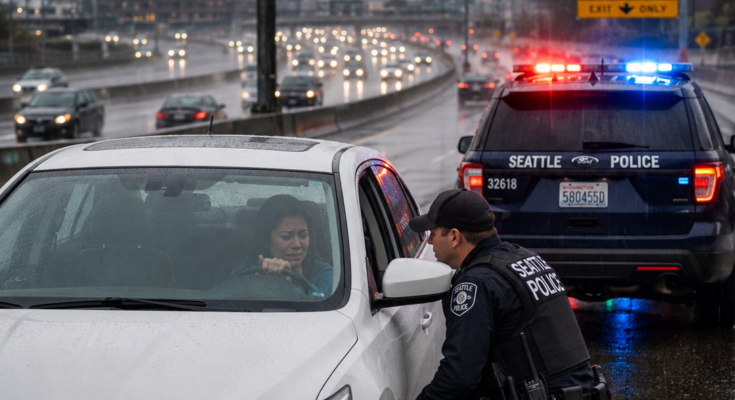
I was driving home from work along I-25 when several police vehicles surrounded my white Honda Civic. One cruiser blocked the roadway ahead. Another pulled in behind me. Red and blue emergency lights filled the interior of my car.
A command came through a loudspeaker. “Switch off the engine. Throw the keys through the window and keep both hands where we can see them.”
I followed every instruction. My keys struck the pavement outside. Cold air rushed through the open window while the officers remained behind their vehicles, treating me as though I might suddenly become dangerous.
I was twenty-nine years old. I worked as a senior data analyst. I had no criminal history, no arrests, and not even a speeding citation. But someone had convinced the police that I was a threat.
Then one of the officers recognized me and stepped into view. It was Caleb. My fiancé.
“She is my fiancée,” Officer Caleb Hayes said clearly enough for every body camera nearby to capture his words. “Let’s reduce the response while we confirm the ownership records.”
He approached my window and crouched beside the door. His eyes moved quickly across my face, my hands, and the passenger seat. Then he asked the question that told me he already suspected who was responsible.
“Emma, what did your family do?”
Caleb understood my parents. He knew how warmly they smiled in family photographs while privately punishing anyone who challenged their authority. He knew my older sister, Lauren, had always been treated like something precious, while I was treated like a financial resource whenever the family needed rescuing.
“Your license plate was flagged about ten minutes ago,” Caleb explained. “The caller reported the vehicle stolen and claimed the driver was hostile and likely to flee.”
“Who made the report?”
His jaw tightened. “Your father.”
Years earlier, Dad had co-signed the original financing documents because I was eighteen and had not yet established credit. But I had made every monthly payment. I covered the registration. The repairs. The insurance. The car was mine in every way that mattered—except on paper, where my father’s name still lingered.
I closed my eyes and took a deep breath. I had refused to give Lauren $15,000 for a “business opportunity” that I knew was a scam. Now my parents were using the police to punish me.
But what they didn’t know was that my phone had been buzzing with credit alerts all afternoon. And one of those alerts was about to change everything.
Part 2: The Credit Alert
Caleb called off the other officers and helped me out of my car. My hands were still shaking, but I wasn’t afraid anymore. I was furious.
“This isn’t the first time they’ve done something like this,” I said. “But it’s going to be the last.”
“What do you mean?”
I pulled out my phone and showed him the credit alert. A new credit card account had been opened in my name three days earlier. The balance was already $18,000. There were two other accounts I didn’t recognize, totaling over $300,000.
“They’ve been using my identity,” I whispered. “For years, probably. I don’t know how long. But I’m not the only one they’ve been stealing from.”
Caleb looked at the screen, his face darkening. “Emma, this is fraud. This is identity theft. You need to report this.”
“I will. But first, I need to know everything.”
He nodded. “I’ll pull the records. I’ll find out who made the calls, who opened the accounts, who signed the documents. But Emma, if your family is behind this, you need to be ready for what comes next.”
“I’m ready,” I said. “I’ve been ready my whole life.”
Caleb drove me to the station, where I filed a formal report. Then I went home and started digging. I pulled my credit reports, my banking records, and every financial document I could find. The picture that emerged was worse than I had imagined.
My parents had been using my Social Security number for years. They had opened credit cards, taken out loans, and even refinanced their mortgage using my identity. The total was $302,487. And the $15,000 they had asked me to give Lauren? That was just the latest demand.
They had been treating me like an ATM for over a decade. And when I finally said no, they called the police on me.
I stared at the numbers on my screen and felt something inside me break. Not my heart—that had been broken long ago. But my patience. My willingness to give them one more chance. That was gone.
Part 3: The Reckoning
The next morning, I drove to my parents’ house. Caleb offered to come with me, but I said no. This was something I had to do alone.
My mother opened the door with her usual smile. “Emma! We were so worried about you after—”
“After you called the police and reported my car stolen?” I interrupted. “After you told them I was dangerous and might try to escape?”
Her smile faltered. “I don’t know what you’re talking about.”
“Don’t lie to me. I have the police report. I have the recording of the call my father made. And I have something else.”
I pulled out a thick folder and held it up. “I have proof that you and Dad have been using my identity to open credit cards and take out loans. Over $300,000 in debt that I never authorized.”
My mother’s face went pale. She turned and called my father’s name. He appeared in the hallway, looking annoyed until he saw the folder in my hands.
“She’s lying,” he said quickly. “We never—”
“The accounts are in my name,” I said. “The Social Security number is mine. The signatures on the applications are forged. I have the documents from the credit bureaus. I have the statements. I have everything.”
My father stepped forward, his voice suddenly aggressive. “You think you can just come in here and accuse us? We raised you. We sacrificed for you. That money was for the family.”
“You didn’t sacrifice anything,” I said, my voice rising. “You stole from me. You lied to me. You used me. And when I finally said no to one of your demands, you called the police and told them I was a criminal.”
“Because you were being selfish,” my mother said, her voice dripping with entitlement. “Your sister needed that money. It was for her business. You had it. You should have given it to her.”
“I didn’t have it,” I said. “I told you that. And even if I did, it wasn’t yours to demand. It was never yours to take.”
My father pointed a finger at me. “You’re going to regret this.”
“I already regret it,” I said. “I regret trusting you. I regret giving you second chances. I regret ever thinking you might actually love me.”
I turned and walked out. But before I reached my car, I heard my mother call out from the doorway.
“What are you going to do?”
I stopped and turned back. “I’ve already done it. I filed a police report. The detective will be contacting you soon. And I’ve hired a lawyer. You’re going to have to deal with the consequences of your choices.”
Her face crumpled. “Emma, please. We’re your parents. You can’t do this to us.”
“You did this to yourselves,” I said. “I’m just the one who finally stopped taking it.”
I got in my car and drove away. I didn’t look back.
The following weeks were difficult. The police investigation confirmed everything. My parents were charged with identity theft and fraud. My sister, Lauren, was named as a co-conspirator in some of the schemes. The total amount of debt they had accumulated in my name was over $300,000.
I worked with my lawyer to clear my credit report. I disputed every charge, filed every form, and made every phone call. It took months, but eventually, the debt was removed from my name. It was transferred to my parents, where it belonged.
During that time, I didn’t speak to my family. They tried to call. They left voicemails full of apologies and accusations, sometimes both at the same time. They sent letters. They even showed up at my apartment once, begging me to drop the charges.
I didn’t answer the door. I didn’t respond to the letters. I had given them enough chances. Now it was time for them to face the consequences of their actions.
Caleb was by my side through all of it. He helped me with the paperwork, held me when I cried, and reminded me every day that I was not the one who had done something wrong.
“You’re a survivor, Emma,” he told me one night. “You’ve been surviving them your whole life. Now you get to live.”
He was right. For the first time in my life, I was free. No more demands. No more guilt. No more wondering when the next betrayal would come. I had cut the cord, and I wasn’t going to let them pull me back in.
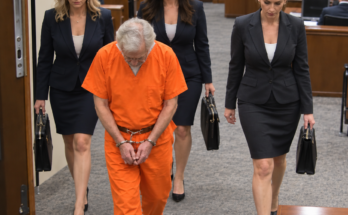
Months later, the case went to trial. My parents were convicted of multiple counts of identity theft and fraud. My sister pled guilty to lesser charges in exchange for testimony against them. The judge sentenced my father to prison time and my mother to probation.
I didn’t go to the sentencing. I didn’t need to. I had already said everything I needed to say in my victim impact statement.
“Your Honor,” I wrote, “I spent twenty-nine years being used by the people who were supposed to protect me. They took my identity, my credit, and my trust. But they could not take my future. I am building a new life now, one where I am not a resource to be exploited. I hope that one day, they will understand the damage they have done. But I am no longer waiting for that day to come.”
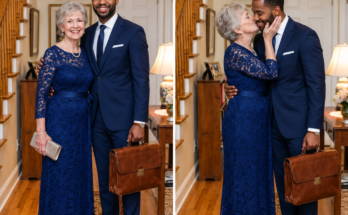
After the trial, I changed my phone number and moved to a new apartment. Caleb and I got married in a small ceremony with only our closest friends. My family was not invited. They had lost the right to be part of my life.
Now, when I look back at that night on I-25, I don’t feel anger anymore. I feel gratitude. Because those flashing lights and sirens were the wake-up call I needed. They showed me the truth about the people I trusted. And they led me to the man who would stand by me through everything.
Caleb and I are expecting our first child soon. We’ve already talked about what we’ll teach them. We’ll teach them about trust, but also about boundaries. We’ll teach them that family is not about blood—it’s about love and respect. And we’ll teach them that sometimes, the bravest thing you can do is walk away from people who don’t value you.
I’m not the same person I was before that night. I’m stronger. I’m wiser. And I will never let anyone take advantage of me again.
The $302,487 deception was the end of one chapter and the beginning of another. It was the last time my parents had power over me. And it was the first time I truly took control of my own life.
So if you’re out there, struggling with family who takes more than they give, remember this: you are not obligated to keep people in your life who hurt you. You are allowed to say no. You are allowed to walk away. And you are allowed to build something better.
That’s what I did. And I’ve never been happier. ❤️