PART 1: The Story They Rehearsed
For almost three months, everyone believed I was having a difficult pregnancy. That was the story my husband Evan and his mother Marlene repeated until even I could hear it in my sleep.
My father, Colonel Thomas Hale, called every Sunday to ask if I was eating enough protein. At first I answered every video call. Then I kept the camera pointed at the ceiling. Then I stopped answering completely, and Evan always explained for me — “She’s asleep, sir.” “Bad nausea today.”
What neither of them knew was that six weeks earlier, I’d started quietly saving things. A hidden photograph. A voicemail Evan thought he’d deleted. Prenatal summaries folded inside an old recipe book. A recording from the baby monitor Marlene never realized could upload to the cloud.
Then Dad called on a Wednesday night while Evan was in the shower. He asked me to tell him one good thing about my day, the way my late mother used to.
I cried. Just one breath that broke.
Evan’s footsteps came down the hallway. “Who told you you could call him?” he demanded, loud enough for Dad to hear on the line.
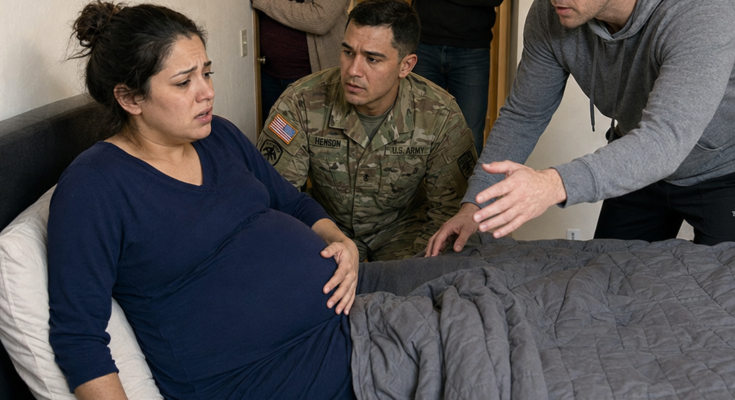
The next morning, Dad showed up at our door in his service uniform. He walked past Evan and Marlene straight to my bedroom, where I lay beneath a heavy quilt despite the warm apartment.
“Natalie,” he said softly. “Did someone hurt you?”
My sleeve had pulled back. A dark bruise showed above my pulse.
His hand moved toward the quilt.
“Dad, don’t,” I said.
Evan stepped forward. “Don’t touch her.”
Dad turned his head slowly. “Why?”
PART 2: What The Quilt Hid
Evan didn’t have an answer. He just stood frozen in the doorway while Dad, without raising his voice, without a single sudden movement, gently pulled the quilt back.
The bruises along my upper arms were impossible to explain away. So were the marks on my thigh. But it was the fading outline near the side of my stomach that changed my father’s face — the same face that had stayed steady through thirty-one years of Army service, through funerals, through my mother’s death, went completely still in a way I’d never seen before.
He didn’t shout. That frightened Evan more than yelling ever could have.
Dad stood and positioned himself between Evan and the bed. “Natalie,” he said, without looking away from my husband, “are you in immediate danger?”
“Yes,” I whispered.
Evan went pale. Marlene rushed forward with her rehearsed lines — “She doesn’t know what she’s saying,” the same tone she’d used for three months to explain away every video call I couldn’t make, every bruise I couldn’t hide, every version of me that had gone quiet.
Dad reached into his pocket and set my phone on the nightstand — the one I’d hidden two days earlier, the one I hadn’t told a single soul about.
“Where did you get that?” Evan demanded, his voice cracking.
Dad didn’t answer. He didn’t need to. Heavy footsteps were already coming up the stairs.
A Tacoma detective and an Army CID special agent appeared in the hallway behind Evan. What none of us — not Evan, not Marlene, not even me — had fully understood was that the moment Dad heard Evan’s voice cut through that Wednesday night call, he hadn’t just driven over the next morning to check on me. He’d spent that entire night making calls of his own, quietly, the way a thirty-one-year Army colonel builds a case instead of picking a fight he isn’t ready to win.
The CID agent held up a sealed evidence bag. Inside sat the old baby monitor receiver I’d thought Marlene had thrown away weeks earlier.
Marlene made a small, choking sound.
“Natalie,” the detective said gently, “we recovered the cloud account too.”
Evan stopped breathing. Because he knew exactly what that monitor had captured, in this apartment, on nights he’d assumed no one but the walls were listening.
PART 3: What The Monitor Kept
The cloud recordings, it turned out, went back nearly ten weeks — Marlene had bought the monitor secondhand for the nursery and never realized the previous owner’s account settings had quietly synced every audio capture to a server none of us in that apartment had ever checked. It had recorded far more than a sleeping baby was ever meant to hear.
It had recorded arguments. It had recorded the specific, ordinary-sounding phrases Evan used right before things turned physical — the same tone shift, almost every time, according to the detective who’d reviewed the files overnight. It had recorded Marlene’s voice too, on more than one occasion, coaching Evan afterward on what to tell my father if he ever asked, what to tell my doctor, what to tell me to say if anyone else ever asked.
I hadn’t planted that monitor to catch anything. I’d genuinely forgotten, in the fog of those months, that it was even capable of recording audio beyond the room. My father’s CID contact had found it only because I’d mentioned it, almost in passing, during the call that Evan interrupted — one detail buried in a sentence I never finished, that turned out to be enough for someone trained to listen for exactly that kind of detail.
The second evidence bag, the one the agent hadn’t opened yet in front of us, held something else entirely: medical records CID had already begun pulling that morning, cross-referencing three “accidental” ER visits over the previous four months against Evan’s duty schedule, each visit falling on days he’d been off base, each explanation — a fall, a door, a balance issue from pregnancy — matching almost word for word what Marlene had rehearsed at my bedside an hour earlier.
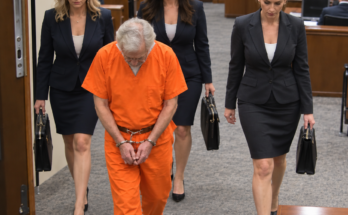
Evan was taken into custody that afternoon. The Army opened its own parallel investigation given his status as active duty, which moved with an urgency I hadn’t expected — domestic violence against a pregnant dependent isn’t something a chain of command can quietly absorb, not with CID already holding audio evidence and a documented pattern of injuries. He was formally charged within the week, facing both civilian charges through the Tacoma detective’s office and an Article 32 hearing through the Army.
Marlene was charged separately for her role in coaching false statements to medical providers, though her case moved more slowly, tangled up in questions of exactly how much she’d known versus simply chosen not to ask.
I moved into my father’s house that same week, into the guest room he’d apparently kept ready without ever telling me so, filled with the ridiculous stuffed animals he’d been mailing for months to a granddaughter he hadn’t been sure, until that Wednesday night phone call, he’d ever get the chance to actually meet safely.
My daughter, Josephine, was born seven weeks later, healthy, loud, and utterly unaware of how close things had come to a very different ending. My father was in the delivery room, the same steady, unreadable expression on his face the whole time, right up until the moment he actually held her, when it finally broke into something I hadn’t seen since before my mother died.
Evan is currently serving a sentence that will keep him well past Josephine’s early childhood. Marlene reached out once, months later, with a letter I didn’t finish reading. I’ve told my father everything I remember about those three months, slowly, in pieces, the way you’re able to when you finally trust that someone is only going to sit and listen, not touch anything until you’re ready.
Every Sunday morning now, he still calls to ask if I’m eating enough protein. I answer every time. Camera on, full face, no ceiling in sight.