PART 1: Fourteen Seconds
At 11:41 p.m., I carried my five-year-old son Owen through the doors of Summit Children’s Hospital, his body seizing against my chest, his temperature at 105.
My husband Grant arrived seconds ahead of me carrying seven-year-old Emma — the daughter of Brooke, the woman he’d been sleeping with for nearly a year. Emma had asthma, was frightened but conscious and talking.
Grant reached triage first. “She stopped breathing in the car,” he told the nurse. “Almost a full minute. Get her back now.”
That never happened.
“Owen is seizing,” I said. “Tell her the truth.”
Grant looked at our son once. Then back at the nurse. “He has a fever. He does this. She’s the emergency.”
Emma got the only open resuscitation bay. Owen waited eight agonizing minutes for a second team while he convulsed in my arms. Grant never came back — he stayed with Emma until Brooke arrived.
By morning, Dr. Patel told me Owen’s MRI showed changes from prolonged seizure activity. She couldn’t yet say what would be permanent.
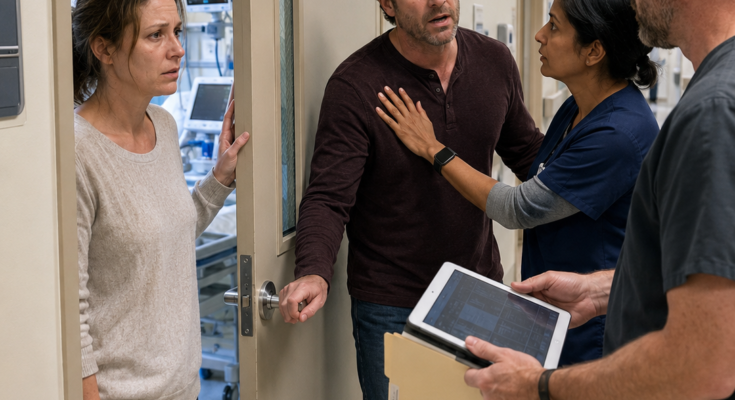
Grant vanished for nine hours. When he finally ran back to the ICU asking to see his son, Dr. Patel blocked the door.
“Then you need to answer a question about what happened before he arrived here,” she said.
A hospital safety officer named Aaron Bell stepped forward with a tablet. “At 11:37 p.m., Denver dispatch received a 911 call from Leah’s phone. Less than a minute later, a male voice canceled the ambulance.”
Grant’s face changed. “We were already close to the hospital.”
“That isn’t the part that concerns us,” Dr. Patel said.
Aaron unlocked the tablet. “The call kept recording for fourteen seconds after you thought it had disconnected.”
Grant stopped breathing.
He knew exactly what he’d said.
PART 2: What The Recording Caught
Aaron pressed play, and the corridor filled with the tinny, unmistakable sound of a call that had never actually disconnected — Grant’s voice, breathless, talking not to dispatch but to someone in the car with him.
“Brooke, listen to me. When we get there, Emma goes first. I’ll tell them she stopped breathing, they’ll take that seriously. Owen’s got a fever, he’ll be fine, they’ll see him right after. I just need five, ten minutes with Emma so nobody asks why we were both in the same car at eleven at night.”
Then Brooke’s voice, quieter, further from the phone: “What about Leah?”
“Leah will handle it. She always handles it.”
The recording ended there, fourteen seconds of my husband’s actual priorities laid out in his own voice, in front of Dr. Patel, in front of Aaron Bell, in front of me.
Nobody in that corridor said anything for a moment. Grant’s face had gone the color of the hospital walls.
“That’s not what it sounds like,” he finally managed. “I panicked. I said things I didn’t mean.”
“You said them clearly enough that dispatch flagged the call for review the moment they realized it hadn’t actually disconnected,” Aaron said. “Denver Fire forwarded it to us this morning as part of the incident file, given that a five-year-old sustained a documented delay in emergency pediatric care as a direct result of what’s on this recording.”
Dr. Patel’s voice, when she spoke next, had the same steady clinical calm she’d used delivering Owen’s MRI results to me at dawn. “Mr. Mercer, I need you to understand what those eight minutes may have cost your son. We won’t know the full extent for months, possibly longer. But you made a choice, in that car, to prioritize a child who was stable and conscious over a child who was actively seizing, and you did it to protect an affair from your wife.”
Grant looked past her toward Owen’s door, and for the first time all day, something that looked like real fear crossed his face — not fear of what he’d find in that room, I realized, but fear of what he’d already lost the right to walk into.
“I need to see my son,” he said again, quieter this time.
“You’ll need to speak with hospital security and, I expect, the Denver Police Department first,” Aaron said. “This incident is being referred for review given the nature of the 911 call and the documented delay in care.”
PART 3: What Owen Kept
I didn’t say a word during any of it. I’d spent nine hours sitting beside Owen’s bed holding two of his fingers around the IV tape, and I found, standing in that corridor listening to my husband’s own voice explain exactly how disposable our son had been to him, that I had nothing left to add. The recording had said everything I would have needed years to fully articulate myself.
Grant was escorted from the ICU by hospital security within the hour, not arrested that day, but formally barred from Owen’s floor pending the police review Aaron had mentioned. Denver PD opened an investigation into the false emergency report, since providing knowingly false information to emergency medical services to redirect care — care that resulted in a documented delay for another patient — carried real legal weight beyond the marriage he’d already destroyed.
I filed for divorce two weeks later, while Owen was still inpatient, working with a family law attorney my sister found for me since I could barely function well enough that first week to look up a phone number myself. Grant’s parental rights weren’t automatically affected, but the recording, the incident report, and Dr. Patel’s formal statement about the documented delay in care became part of a custody case that no longer resembled anything close to a fair fight.
Owen spent eleven days in the hospital. The seizure damage turned out to be, according to Dr. Patel’s cautious but genuinely relieved update three weeks later, largely reversible — some mild, likely temporary coordination issues on his left side that improved steadily with physical therapy, and no evidence of the more serious cognitive impact she’d worried about that first terrifying night. I don’t know if I’ll ever stop being grateful for how narrowly that turned out, or stop being furious about how unnecessary those eight extra minutes were.
Brooke’s involvement came out publicly during the police investigation, since her voice was on the same recording confirming she understood and went along with the plan. Whatever relationship she and Grant had built over the previous year didn’t survive an investigation that made both of their names part of a public incident report, and from what mutual acquaintances have told me since, they aren’t speaking anymore either — apparently a plan built on lying to an emergency room doesn’t hold up well once everyone involved has to explain it to a detective separately.
Grant’s custody arrangement, finalized eight months later, ended up supervised and limited, a direct consequence of the court weighing that recording alongside everything else. He still calls sometimes, still tries the same wounded, apologetic tone he used running down that ICU corridor. I let Owen decide, with his therapist’s guidance, how much of that relationship he wants as he gets older. For now, it isn’t much.
Owen turned six this spring. He still occasionally loses his grip on a pencil when he’s tired, the last visible trace of that January night, but his teacher tells me he’s reading above grade level and has strong opinions about dinosaurs that he will share with anyone willing to listen. Some evenings, when I tuck him in, he asks me why Daddy doesn’t come to his soccer games anymore, and I tell him some version of the truth small enough for a six-year-old to hold — that Daddy made a choice that hurt Owen very badly, and that choices like that have consequences, even for grown-ups.
He usually accepts that, the way kids do when the explanation is honest even if it isn’t complete. Then he asks if we can read one more chapter before lights out, and I say yes, every single time, because some nights the only thing I actually need to prove to myself is that I’m the parent who stays.