My Brother Accused Me of Stealing From Our Family Bakery—Then My Father Asked Him to Explain One Missing Receipt

My brother waited until everyone had raised their glasses before accusing me of stealing sixty thousand dollars from our father.
There were thirty-two people gathered inside Bellamy’s Bakery that night.
Employees.
Relatives.
Old customers.
Friends who remembered when my father sold his first loaves of bread from the trunk of a borrowed car.
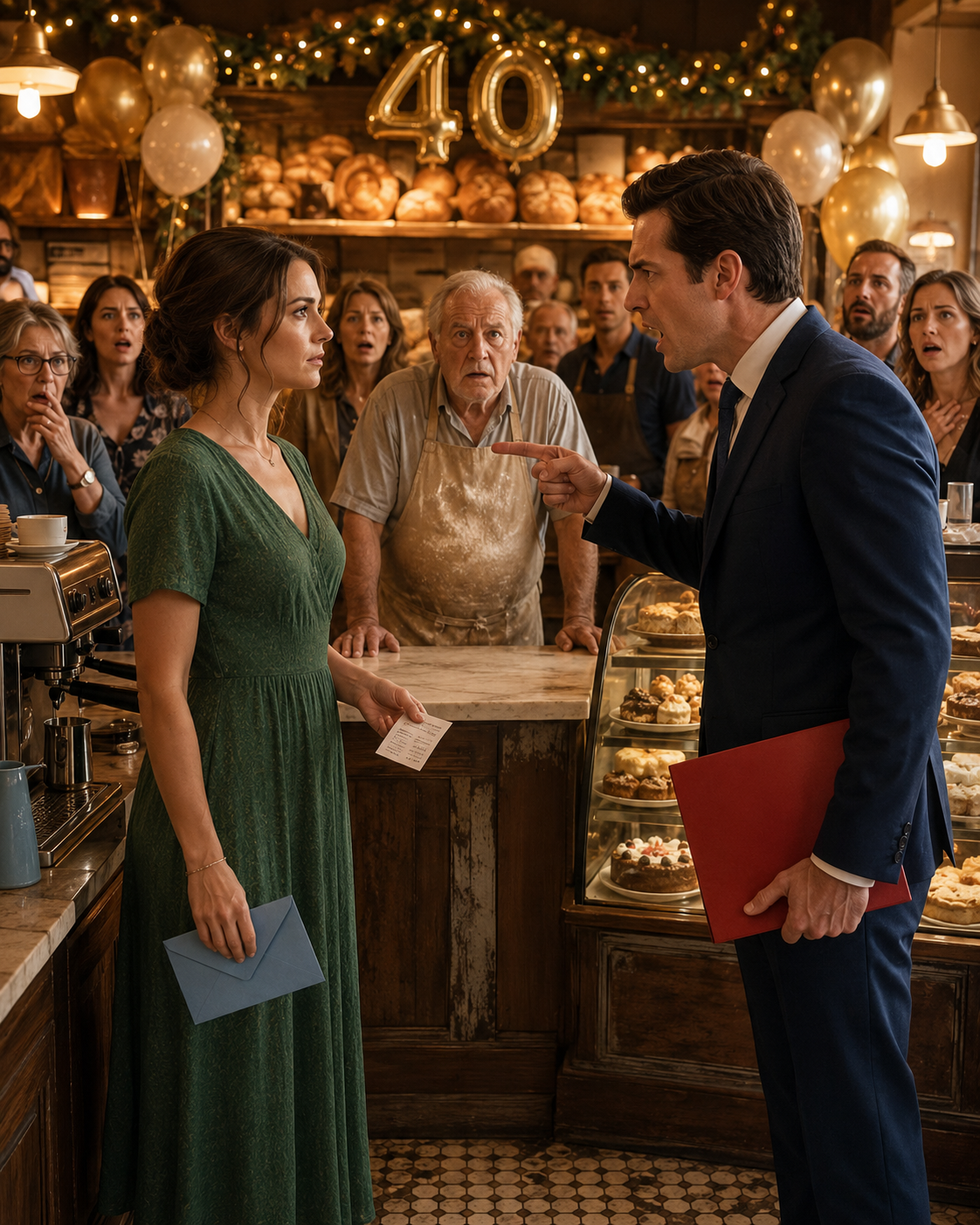
Gold paper stars hung from the ceiling, and a banner stretched across the front window.
CONGRATULATIONS ON 40 YEARS, FRANK!
My father stood behind the counter wearing the same flour-dusted apron he had worn almost every morning of my childhood.
Six months of heart problems had taken weight from his face and strength from his hands.
But when the room applauded, he smiled.
“This place raised my children,” he said. “And in many ways, all of you helped raise them too.”
My brother Daniel stood beside him in a tailored navy suit.
I stood near the coffee station in an old green dress, holding a tray of lemon pastries because one of our servers had called in sick.
That difference told everyone what they needed to know.
Daniel looked like the future owner.
I looked like the help.
The Red Folder
Daniel clinked a spoon against his glass.
“There’s something we need to discuss before Dad makes any decisions about the bakery.”
The room slowly quieted.
My father turned toward him.
“What decisions?”
Daniel reached beneath the counter and pulled out a red folder.
My stomach tightened.
“I didn’t want to do this tonight,” he said, wearing the solemn expression of someone enjoying every second. “But I can’t stay silent while our family’s livelihood is at risk.”
He opened the folder and held up several printed bank statements.
“Over the past nine months, nearly sixty thousand dollars has disappeared from the bakery’s operating account.”
A murmur moved through the room.
My aunt lowered her glass.
One of our bakers stopped halfway across the floor with a tray in his hands.
Daniel looked directly at me.
“The transfers were authorized using Clara’s employee login.”
Every face turned.
For a moment, I heard nothing except the refrigerator humming behind the counter.
My cousin whispered, “Oh my God.”
My father stared at me as though he had forgotten how to breathe.
“Clara?”
Daniel continued before I could answer.
“The money was transferred in small amounts to an account connected to her apartment address.”
He paused.
“I confronted her privately this morning. She refused to explain.”
That was a lie.
Daniel had never confronted me.
But my brother had always understood something I learned too late.
The first person to tell a story often controls it.
Everyone Was Watching
Daniel slid the bank statements toward my father.
“I think Clara planned to take as much as possible before the bakery was sold.”
My father gripped the edge of the counter.
“Sold?”
Daniel’s expression changed for only a fraction of a second.
Then he recovered.
“I mean, if that becomes necessary.”
My aunt stepped closer to me.
“Clara, tell us this isn’t true.”
I placed the tray of pastries on the coffee station.
Several employees avoided my eyes.
Others looked frightened.
They depended on the bakery for their rent, their groceries, and their children’s school clothes.
Daniel had not merely accused me of taking money.
He had accused me of stealing from all of them.
My father looked down at the papers.
Each transfer displayed my employee number.
Each authorization appeared to come from the bakery computer.
The destination account included part of my home address.
Daniel had prepared this carefully.
“Say something,” my father whispered.
I looked at my brother.
He expected me to cry.
He expected me to scream that he was lying so he could shake his head and call me unstable.
Instead, I reached into my handbag.
One Small Receipt
I removed a white receipt and placed it on top of Daniel’s red folder.
His smile disappeared.
“What is that?” my aunt asked.
I kept my eyes on him.
“It’s the one receipt Daniel hoped nobody would ever find.”
His jaw tightened.
My father picked it up.
Before he could read it, Daniel snatched it from his hand.
“This proves nothing.”
“You haven’t looked at it yet,” I said.
“I know what it is.”
Silence fell over the room.
Daniel realized his mistake immediately.
I watched the color drain from his face.
My father slowly turned toward him.
“How do you know what it is?”
Daniel folded the receipt inside his fist.
“I assumed.”
“No,” I said quietly. “You recognized it.”
He laughed, but the sound was thin.
“This is ridiculous. She steals sixty thousand dollars, and now she’s trying to distract everyone with a meaningless scrap of paper.”
“It isn’t meaningless.”
I pointed toward his hand.
“It came from a storage facility outside Chicago.”
My father narrowed his eyes.
Daniel stepped toward me.
“Clara, stop.”
It was the first honest thing he had said all evening.
The Missing Machines
Three weeks earlier, I had discovered that someone was moving bakery equipment into a rented storage unit.
The industrial mixer was gone.
So was the second delivery oven.
Two refrigerators had disappeared from the back room.
And the antique bread slicer my grandfather restored by hand had vanished from my father’s office.
Daniel told us the machines were being repaired.
They weren’t.
They were being photographed and listed for sale.
“You have no idea what you’re talking about,” Daniel said.
He grabbed my arm.
I pulled away.
“Take your hand off me.”
My father’s voice cut through the room.
“Daniel.”
My brother released me.
For the first time that night, he looked frightened.
I reached into my handbag again.
This time, I removed a blue envelope.
Daniel stared at it as though it were a weapon.
“What’s in there?” my father asked.
“The reason the missing money leads to me,” I said.
I looked at Daniel.
“And the real reason he came home.”
Nine Months Earlier
Daniel had returned to town claiming he wanted to help our father modernize the bakery.
At first, I was relieved.
Dad had suffered his first cardiac episode that winter. His doctor told him to reduce his hours, but he still arrived before sunrise and worked until his hands trembled.
Daniel promised to handle the finances.
He installed a new accounting system.
He replaced the office computer.
He gave every employee a personal login.
Then he began criticizing everything.
The wallpaper was outdated.
The recipes were inefficient.
The staff was overpaid.
The elderly customers stayed too long at the tables.
He spoke about the bakery as though it were a broken machine instead of the center of our family’s life.
One afternoon, I overheard him speaking on the phone behind the loading dock.
“The property is worth more without the business,” he said. “Once the old man signs, I can clear the equipment and close within thirty days.”
When he saw me, he ended the call.
He claimed he had been discussing another investment.
I wanted to believe him.
He was my brother.
So I said nothing.
That was my first mistake.
The First Disappearance
A week later, the second oven vanished.
Daniel said a repair company had taken it.
Then the mixer disappeared.
After that, two refrigerators were removed from the storage room.
Whenever I asked questions, Daniel gave me the same answer.
“You don’t understand business.”
Around the same time, transfers began leaving the bakery’s operating account.
I discovered them only because a flour supplier called to ask why an invoice was overdue.
Daniel told me the bank had made an error.
The next morning, the invoice was mysteriously paid.
After that, I started keeping copies of everything.
I photographed account summaries.
I saved delivery records.
I wrote down the serial numbers of every missing machine.
I copied the dates and amounts of every suspicious transfer.
For weeks, I found nothing that proved Daniel was involved.
Then an envelope arrived at my apartment.
Unit 184
It was a notice from a storage company thanking me for renting Unit 184.
I had never rented a storage unit.
I drove there after work.
The manager refused to open it because I did not have the access code.
But he showed me the rental agreement.
My name was on it.
So was my address.
The email belonged to Daniel.
The payment card was connected to a company called Lakefront Renewal Partners.
I recognized the name immediately.
It had received every supposedly missing transfer from the bakery account.
The following morning, I searched the state business registry.
Lakefront Renewal Partners had been created ten months earlier.
Daniel was listed as its manager.
But my name appeared as the registered owner.
For several seconds, I could not understand what I was seeing.
Then the truth settled over me.
Daniel had used copies of my driver’s license and tax documents from the bakery’s employment files.
He was not only stealing from the business.
He was building a trail that made it look as though I had done it.
The Woman He Fired
That was when I called Mara Ellis.
Mara had handled the bakery’s accounts for seventeen years before Daniel replaced her with his new software.
She was also one of my father’s oldest friends.
We spent two weeks reviewing every transaction.
The pattern was simple once we saw it.
Daniel initiated a transfer using his administrator account.
Then he altered the internal record so it displayed my employee number.
He used Lakefront Renewal Partners to receive the money, rent storage space, and arrange the sale of the bakery’s equipment.
But he made one mistake.
The storage facility printed a receipt when he paid cash to extend the rental.
The receipt included the unit number, the date, and a reference code connected to the security footage.
Mara contacted the facility’s attorney.
That was how we obtained the recording.
It showed Daniel entering Unit 184 with a commercial equipment broker.
It showed them examining our mixer.
It showed Daniel pointing at the antique bread slicer and shaking the broker’s hand.
But the blue envelope held something even worse.
My Father’s Signature
Inside the envelope was a proposed purchase agreement.
Daniel had negotiated to sell the bakery building to a development company.
They planned to demolish it and construct luxury apartments.
My father had never agreed to sell.
His signature had been copied from an old insurance form.
The transaction was scheduled to close the following week.
At the anniversary celebration, my father opened the blue envelope with trembling hands.
The first photograph showed Daniel standing beside the missing mixer.
The second showed him speaking to the broker.
The third showed the antique bread slicer being loaded into the back of a truck.
My father looked up.
“You told me that slicer was being restored.”
Daniel swallowed.
“It was going to be. The deal changed.”
“What deal?”
Daniel pointed at me.
“She’s manipulating this. She’s angry because you planned to leave the bakery to me.”
My father’s expression shifted.
“I never said that.”
“You didn’t have to.”
Daniel’s voice grew louder.
“I’m the only one capable of saving this place.”
What He Really Thought
Daniel looked around the room.
“The equipment is old. The profit margins are terrible. Half these customers sit here for an hour after buying one cup of coffee.”
An elderly man near the front window lowered his eyes.
Daniel did not notice.
“The property is worth nearly three million dollars,” he continued. “We could sell it, invest the proceeds, and never wake up at four in the morning again.”
“We?” I asked.
He turned toward me.
“You were going to get your share.”
“After I went to prison for stealing the money?”
His face hardened.
“Nobody was going to prison.”
My aunt stared at him.
“You put the company in Clara’s name.”
“That was temporary.”
“You forged your father’s signature,” someone said.
Daniel slammed his hand against the counter.
“You don’t understand. He was going to lose everything!”
The front door opened.
Every head turned.
Someone Was Waiting
Mara stepped into the bakery.
Beside her was a woman wearing a gray coat and carrying a leather briefcase.
My father recognized her immediately.
“Rebecca?”
Rebecca Sloan had been his attorney for almost twenty years.
Daniel stared at me.
“You brought a lawyer to Dad’s party?”
“No,” Rebecca said. “Frank did.”
Everyone looked at my father.
He rested both hands on the counter.
For a moment, he looked exhausted.
Then he straightened.
“I called Rebecca this afternoon,” he said.
Daniel blinked.
“Why?”
“Because Clara came to me this morning and showed me enough evidence to prove someone was trying to sell my building.”
Daniel looked at me with open hatred.
“You knew?”
My father nodded.
“I wanted to hear what you would say tonight.”
The room became completely still.
Daniel glanced toward the back door.
Rebecca placed her briefcase on a table.
“The forged purchase agreement has been reported to the bank and the buyer,” she said. “The transaction has been frozen.”
Daniel’s confidence finally cracked.
Trying to Save Him
He looked at our father.
“Dad, listen to me. I was trying to protect you.”
“By stealing my equipment?”
“I was converting dead assets into cash.”
“By putting Clara’s name on your company?”
“That was temporary.”
“By forging my signature?”
Daniel stepped closer.
“You were going to lose everything.”
My father did not raise his voice.
“No.”
He looked at Daniel for several long seconds.
“You were afraid I would leave you nothing.”
Daniel stared at him.
Then my father reached beneath the counter and removed another envelope.
This one was brown and worn around the edges.
“I signed a succession agreement two years ago.”
My brother’s mouth opened.
“What agreement?”
Dad turned toward me.
“The bakery was never going to Daniel.”
A gasp moved through the room.
Even I had not known.
What He Had Chosen
My father held the brown envelope against his chest.
“I left controlling ownership to Clara.”
Daniel laughed once.
It was a sharp, empty sound.
“You can’t be serious.”
“She knows every employee,” Dad said. “She knows every recipe. She knows which bills can wait and which people cannot.”
“I have a finance degree.”
“And she has character.”
The words landed harder than any shout.
Daniel looked around the bakery.
No one came to his defense.
Not our relatives.
Not the employees.
Not even the customers he had dismissed as unprofitable.
He turned toward me.
“You planned this.”
“No,” I said. “You did.”
Daniel walked out through the back door before the celebration ended.
No one tried to stop him.
The Slow Consequences
Daniel was not dragged away in handcuffs.
There was no dramatic police entrance.
Real consequences moved more slowly.
There were interviews.
Documents.
Legal letters.
Hearings.
Two days after the anniversary celebration, Daniel’s attorney contacted ours.
He agreed to return the remaining money, surrender access to every account, and transfer control of Lakefront Renewal Partners to a court-appointed administrator.
Some of the equipment had already been sold.
We recovered the mixer and one refrigerator.
The antique bread slicer was found in a warehouse three towns away.
Its wooden handle had been cracked.
When my father saw it, he ran his thumb over the damage and said nothing.
Daniel eventually pleaded guilty to fraud-related charges.
He received probation, restitution requirements, and community service.
My father refused to speak to him for almost a year.
I did not celebrate that.
Losing a brother still felt like losing something.
Even when the person had tried to destroy you.
What He Took
The bakery nearly closed anyway.
Daniel had taken more than money.
Suppliers no longer trusted us.
Our accounts were behind.
Employees were afraid the business would collapse.
For several weeks, I slept on a cot in the office.
I arrived at three-thirty every morning and left after dark.
Mara helped rebuild the books.
Rebecca renegotiated our debts.
The employees agreed to temporarily reduce their hours rather than allow anyone to be fired.
Then something happened Daniel never would have understood.
The community showed up.
The elderly man who bought one coffee every afternoon began bringing friends.
A teacher organized a school fundraiser.
A local carpenter repaired the bread slicer without charging us.
Former employees returned on weekends to help fill orders.
People did not save the bakery because it was efficient.
They saved it because it had once helped them.
The Things He Couldn’t Count
My father had given free bread to families who could not pay.
He had hired teenagers no one else trusted.
He had allowed grieving widows to sit near the window for hours with a single cup of coffee.
He had delivered birthday cakes to children whose parents were short on money.
None of those choices had appeared as profits on a spreadsheet.
But they came back to us when we needed them most.
Six months after the anniversary dinner, my father officially retired.
We held no banquet that time.
Just coffee, fresh bread, and a small gathering before opening.
He handed me the front-door key.
“You sure?” I asked.
He smiled.
“No.”
I laughed through my tears.
“That’s reassuring.”
“I wasn’t sure when I opened this place either,” he said. “You don’t wait until you stop being afraid.”
He closed my hand around the key.
“You unlock the door anyway.”
The Crack in the Handle
The following spring, I renovated the bakery.
I kept the old wallpaper near the back booth.
I kept the long tables where customers could sit as long as they liked.
I installed better accounting software, but every transfer now required approval from two people.
No single person would ever control the records alone again.
Above the counter, I hung the restored antique bread slicer.
The crack in its handle was still visible.
The carpenter had offered to replace the damaged wood.
My father told him not to.
“Leave the scar,” he said. “That’s how you know it survived.”
Almost a year after the accusation, I saw Daniel standing outside the bakery.
Rain fell from the edge of the awning behind him.
He looked older.
Less polished.
He stayed on the sidewalk without coming inside.
I watched him through the glass for several seconds before opening the door.
The Man Outside
“Dad here?” Daniel asked.
“Not yet.”
He nodded.
His eyes moved toward the bread slicer hanging above the counter.
“I heard you found it.”
“We did.”
Daniel placed a small paper bag on the nearest table.
Inside was the brass nameplate that had once been attached to the machine.
BELLAMY & SON, 1958
“I found it in my apartment,” he said. “I must have taken it off when we moved the slicer.”
We stood in silence.
“I’m sorry,” he finally said.
It was not enough to repair what he had done.
But it was the first thing he had given me that was not a lie.
“I believe you’re sorry,” I said. “That doesn’t mean things go back to how they were.”
“I know.”
He looked toward the kitchen, where the first loaves of the morning were rising.
“Do you think Dad will talk to me?”
“That depends on what you say when he gets here.”
Daniel nodded.
Then he sat at the table near the window.
I did not offer him a job.
I did not promise forgiveness.
I poured him one cup of coffee and returned to the kitchen.
The First Loaves
A few minutes later, the oven timer rang.
I opened the door, and warm air rolled across my face.
The first loaves had risen unevenly.
One leaned slightly to the left.
Another had split across the top.
None of them looked perfect.
But they were whole.
I placed them carefully on the cooling rack as my father’s key turned in the front door.
A year earlier, my brother had tried to empty the bakery and leave my name attached to the crime.
That morning, the ovens were warm.
The tables were full.
And every loaf was exactly where it belonged.