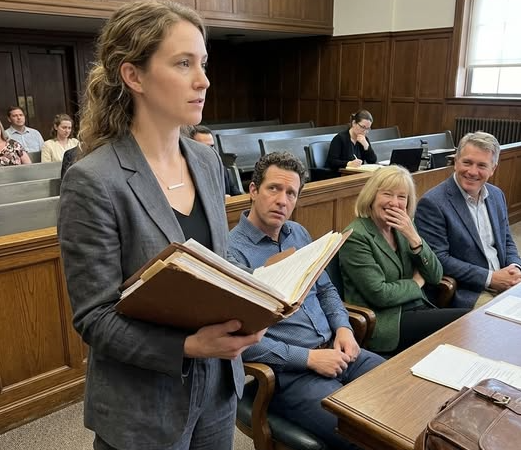
Ruth Ellison laughed out loud when I walked into the courtroom.
She covered her mouth with one hand, like she was trying to be polite about it. Her diamond bracelet caught the light from the tall windows and threw little sparks across the wall. But she didn’t stop laughing. And she made sure the whisper that followed was loud enough for the whole room to hear.
“Well, look who’s here. And without a lawyer. How embarrassing.”
My father-in-law, Frank, leaned toward her on the front bench of the gallery, his hands folded over the silver head of his cane.
“Andrew was right,” he said. “She doesn’t stand a chance.”
I didn’t look at them. I walked down the aisle with my old leather briefcase in one hand and sat down at the empty table on the left side of the room.
Across the aisle, my husband sat at the other table like a man waiting for an award. Andrew Ellison. Navy suit. Silk tie the color of red wine. Three attorneys lined up beside him, all in dark suits, all with matching leather portfolios and the same expensive haircut. Andrew adjusted his tie and exchanged a confident little smile with the lawyer closest to him.
Three lawyers. For a woman he believed had nothing.
Judge Elaine Porter looked down at me over the top of her reading glasses. She was in her sixties, with short gray hair and a face that didn’t give anything away.
“Mrs. Ellison,” she said. “You understand that you have the right to legal representation in this matter?”
“Yes, Your Honor.”
“And you’ve chosen to represent yourself?”
“That’s correct.”
Ruth snorted. Somebody behind her chuckled.
Andrew’s lead attorney stood up immediately and buttoned his jacket. Stephen Calder. I’d looked him up. Twenty-two years in family law, a big corner office downtown, and a reputation for making divorces go exactly the way his clients wanted.
“Your Honor,” Calder said smoothly, “we’re concerned that Mrs. Ellison may complicate what should be a very straightforward divorce settlement.”
Straightforward.
That was the same word Andrew had used three weeks earlier, when he set the divorce papers down beside my breakfast plate on a Tuesday morning.
I remember the exact moment. I was cutting a grapefruit. He walked into the kitchen already dressed for work, laid a thick stack of paper next to my plate, and tapped it twice with one finger.
“Sign these, Mara. It’s straightforward. Don’t make this difficult.”
I put down the knife.
“Seven years, Andrew,” I said. “Seven years of running this house. Planning your business dinners. Booking every one of your flights. Driving your parents to every doctor’s appointment. Reading every contract you were too busy to read. And this says I contributed nothing?”
He picked up his keys.
“You took care of the house, Mara. Don’t exaggerate your importance.”
Then he left. I sat there with half a grapefruit and a document that described seven years of my life as if I’d been a houseguest.
For seven years, his family had treated me like a quiet, obedient housewife whose only purpose was making Andrew’s life easier. They never asked about my past. They never cared what I’d done before I married their son. And Andrew had never understood why I stayed so calm when someone tried to intimidate me.
He never understood because he never asked.
Before I became Mara Ellison, I was Captain Mara Pierce. United States Army. Judge Advocate General’s Corps. I was a military attorney. For years, I examined evidence, cross-examined witnesses, and stood up in courtrooms where a single missed detail could ruin someone’s life.
I walked away from that career because I wanted a peaceful marriage.
“Mrs. Ellison?” Judge Porter said. “You may proceed.”
I opened my briefcase slowly.
From the gallery, Ruth whispered, “Oh, this should be entertaining.”
I took out a slim manila folder. I stood up. And I looked directly at the judge.
“Your Honor, before we discuss their proposed settlement, there’s something this court needs to know.”
Andrew’s smile faltered.
“I never signed that agreement,” I said. “And I never will. Because it’s built on a lie.”
Then I opened the folder.
Stephen Calder was on his feet so fast that his chair banged into the polished railing behind him.
“Objection, Your Honor! We object to the introduction of any private documents that were not properly disclosed.”
Judge Porter raised one hand without even looking at him.
“Mr. Calder, you may make your objection after Mrs. Ellison tells me what the document is. I can’t rule on a piece of paper I haven’t seen.”
Behind him, Ruth leaned forward over the railing and hissed at her son.
“What did she bring?”
Andrew shook his head. “I don’t know.”
“You should know.”
Judge Porter turned back to me. “Mrs. Ellison. Identify the first document.”
I lifted it out of the folder carefully, holding it by the edges. The paper was heavy, cream-colored, slightly yellowed at the corners.
“It’s a letter written to me by Victor Ellison, Andrew’s grandfather,” I said. “It was written eight months before Andrew and I were married.”
A low murmur rolled through the gallery.
Victor Ellison had been dead for almost six years. But in that family, his name still carried weight like a church bell. He started Ellison Manufacturing at thirty-two years old with a borrowed garage and a single machine press, and he built it into the company that paid for every house, every vacation, every charity gala, and every carefully polished photograph the Ellisons had ever posed for.
He was also the only person in that family who ever asked me a question and actually waited for the whole answer.
Andrew shifted in his chair. “Why would my grandfather write you a letter?”
“That’s what I’m about to explain.”
I handed a copy to the clerk. She carried it up to the bench.
Judge Porter read it in silence. It took her almost a full minute. The room was so quiet I could hear the old radiator clicking under the window.
While she read, I watched Ruth’s face change. The amusement drained out of it. Her jaw went tight.
Frank noticed. He leaned toward her. “What is it?”
Ruth didn’t answer him.
Judge Porter looked up.
“Mrs. Ellison, this appears to be a personal letter. But it refers to a financial arrangement that may be relevant to this settlement.”
“Yes, Your Honor.”
“Explain.”
“Victor Ellison created a trust in my name before Andrew and I were married,” I said. “It was funded with investments, property interests, and a separate account managed by an independent trustee outside the family.”
“A trust,” Judge Porter repeated.
Calder stood up again. “Your Honor, this is precisely why we object. This so-called trust has never appeared in any of the financial disclosures exchanged during negotiations.”
“That’s not a reason to keep evidence out, Mr. Calder.”
“It may be irrelevant to the marital estate.”
“It may also be highly relevant,” Judge Porter said. “Sit down.”
He sat down.
I laid a second document on the table.
“The trust was not a gift to Andrew,” I said. “It was created to protect me.”
Ruth made a small sound in the back of her throat.
Judge Porter folded her hands. “Why would Victor Ellison create a trust to protect you before you’d even married his grandson?”
I looked down at the letter.
The first time I read it, I was sitting alone in Victor’s study, three days after his funeral. Andrew was downstairs with his parents, shaking hands with relatives and accepting casseroles. Victor’s study was exactly the way he’d left it. His reading glasses on the blotter. A half-finished crossword. The brass clock on the mantel ticking away like nothing had happened.
The envelope was tucked under the clock, with one word written across the front in his heavy, slanted handwriting.
Mara.
Not Mrs. Andrew Ellison. Not Mara Ellison. Just Mara.
The letter began with an apology. He wrote that he had watched me enter a family that valued obedience more than honesty. He wrote that he’d noticed how often I softened my opinions at dinner just to keep the peace. He wrote that he knew I had given up a legal career because Andrew wanted a quieter life, and because I believed marriage meant sacrifice from both people.
And then he wrote the line I’ve never forgotten.
“You have mistaken silence for peace, Mara. And my family has mistaken your peace for weakness.”
Judge Porter was waiting.
“Victor knew I had been an Army attorney,” I said.
Andrew turned his whole body toward me. “You told him that?”
“I told him before we got married.”
“You never told me much about that.”
“I told you I had worked in military law.”
“You said you’d been in administration.”
“No,” I said gently. “I said I worked in military law. You heard administration.”
The difference had never mattered to Andrew. Back then, I’d told myself it was because he trusted me. Now I understood it was because he’d never been curious.
Victor had been curious. The second time I ever met him, he sat me down on his back porch with two glasses of iced tea and asked me why I’d left the Army. I told him I’d fallen in love, and that loving Andrew mattered more than any courtroom.
Victor studied me for a long time over the rim of his glass.
“Love should add to your life,” he said finally. “It should not require you to disappear from it.”
Judge Porter turned a page. “Mrs. Ellison, does this trust contain any provisions concerning your marriage?”
“Yes. It requires that Andrew honestly disclose all major assets in any legal proceeding involving our marital finances.”
Calder jumped up. “Your Honor, there’s no reason to believe a provision like that is enforceable against my client.”
“It doesn’t need to be,” Judge Porter said flatly. “Your client already has a duty to make complete and honest financial disclosures in this court. That duty comes from the law, not from his grandfather.”
“But the trust isn’t marital property.”
“That question hasn’t been decided yet.”
In the gallery, Ruth had stopped pretending to be amused.
“Your Honor,” I said, “I’ve also brought records showing what the trust contributed during the marriage.”
Andrew finally looked straight at me. “What contributions?”
For a moment I saw him the way he was when we first met. Twenty-nine, restless, working in a corner of his family’s company and desperate to prove he could build something without his parents’ approval. When he told me he wanted to start his own manufacturing technology firm, I sat up with him until two in the morning, night after night, helping him plan.
I built the spreadsheets when his excitement ran ahead of his bookkeeping. I called the vendors when he was too proud to admit he’d missed a deadline. I read every lease and every supplier contract and caught the clauses that would have sunk him.
I didn’t put in my own savings. I didn’t have much after leaving the Army. But I had something. An investment account that I believed existed only to protect me.
Some of that money became the down payment on our first house. Some of it covered the early operating expenses of Andrew’s company, the months when payroll was due and the clients hadn’t paid yet. Some of it paid our mortgage and the electric bill while Andrew poured every dollar he earned back into growth.
The trust never made us rich overnight. It simply made it possible for Andrew to take risks while I quietly absorbed the consequences.
His parents called it “family support.”
“During our marriage,” I said, “the trust paid approximately six hundred and eighty thousand dollars toward property, business expenses, and household obligations.”
Andrew’s face went gray.
“That can’t be right.”
“It is.”
“I would have known.”
“You knew money was available.”
“I knew my grandfather left something for you.”
“You knew enough to use it.”
His mouth opened. Nothing came out.
Judge Porter held up the stack of pages. “Are these bank statements?”
“Yes, Your Honor. Produced by the independent trustee and certified by the bank.”
Calder had gone very still. For the first time all morning, he didn’t look like a lawyer running a case. He looked like a man discovering the case had never been his to run.
And then Ruth leaned over the railing toward him, and she whispered something too loudly. Her voice carried in that silent room.
“Those accounts were supposed to stay private.”
Her eyes went wide the instant she heard herself.
Frank turned and gave her a look that could have stopped a train.
But it was too late. Everyone had heard it.
They knew about the trust. They had always known.
Judge Porter took off her glasses and looked at me.
“Mrs. Ellison, are you suggesting the opposing party knew about this trust and failed to disclose it?”
“I’m suggesting this court should look closely before it approves any agreement that says I made no financial contribution to this marriage.”
Calder tried again. “Your Honor, the proposed settlement was prepared based on information provided by my client.”
“Your client is Mr. Ellison?”
“Yes.”
“Then Mr. Ellison can answer for himself.”
Calder turned and gave Andrew a tiny shake of the head. I’d seen that gesture a hundred times in seven years. Don’t say more than you have to.
Andrew had always hated conflict. He let Ruth talk for him at family dinners. He let his attorneys talk for him in negotiations. And for seven years, whenever anyone asked Andrew what he really wanted, he let me answer.
“Mr. Ellison,” Judge Porter said. “Did you know about the trust?”
Andrew swallowed. “I knew Victor had arranged something for Mara.”
“When did you learn that?”
“After we were married.”
“Did you know the extent of its assets?”
“No.”
“Did you know it had paid for property and business expenses?”
“I knew Mara had access to money.”
“That was not my question.”
His hands tightened around each other on the table.
“I knew she helped us,” he said quietly.
Judge Porter picked up Victor’s letter again. “Mrs. Ellison, what does Victor Ellison say about the purpose of this trust?”
“He wrote that if I ever needed to defend my rights against the family, I should not be intimidated by their money or their reputation.”
“That’s an outrageous interpretation!” Ruth snapped from the gallery.
Judge Porter turned her head slowly toward her.
“Mrs. Ellison. The elder Mrs. Ellison. You will not interrupt this proceeding again.”
Ruth lowered her eyes. But not before I saw something cross her face. Fear.
Victor had never trusted her. I’d spent seven years organizing her charity luncheons, remembering her doctor’s appointments, and listening to her stories about everything she’d sacrificed for her family. I’d always thought she simply didn’t like me. Now I wondered if she had always been afraid of me.
Judge Porter set the letter down.
“Mr. Calder, I will not approve this settlement today.”
“Your Honor—”
“The proposed agreement contains material statements that now appear incomplete, if not false. I’m ordering a full financial investigation. The trust. The marital assets. Mr. Ellison’s business interests. And every transfer of money or property made during this marriage.”
Frank’s cane scraped against the floor. “Your Honor, this is completely unnecessary.”
Judge Porter looked at him over her glasses.
“Sir, unless you’re a party to this case, I suggest you let counsel do the talking.”
Frank’s face turned the color of a ripe tomato.
The judge ordered both sides to preserve every financial record, every email, every text message, every bank statement, every property document, and every business record. Then she banged her gavel, and the hearing was over.
Andrew caught up with me in the hallway outside.
“Mara.”
I stopped.
“Why didn’t you ever tell me about the letter?”
“I tried.”
“When?”
“After Victor died. I told you I found a letter addressed to me.”
“You said it was personal.”
“It was.”
“And you knew about all this before today? And you let me believe we were negotiating normally?”
“You put an agreement next to my breakfast plate that said I contributed nothing to our marriage.”
“I didn’t write that.”
“You signed it.”
“I trusted my attorneys.”
“You trusted everyone except me.”
For a moment, the polished man who’d sat beside three lawyers disappeared. He just looked tired.
“I didn’t think you’d do this,” he said.
“Do what?”
“Turn everything into a fight.”
“I brought documents to court, Andrew, because you brought a lie.”
Over his shoulder, I could see Ruth talking urgently to Calder by the elevators. Frank stood next to her, pale and rigid.
Andrew followed my gaze. Then he looked back at me.
“Did Victor leave anything else?”
“Yes,” I said.
“What?”
“A sealed file. His trustee told me I should only open it if I ever believed the family was hiding assets.”
Andrew went completely still.
Down the hall, Ruth stopped talking mid-sentence.
I hadn’t opened that file yet. But looking at her face, I already knew. Somewhere inside it, Victor had left a truth that could change much more than our divorce.
“Who told you to open it?” Andrew asked.
“The trustee.”
“Which trustee?”
“Eleanor Vance.”
“She still manages Victor’s estate?”
“She manages my trust.”
Ruth had come up behind him without either of us noticing.
“You told me Eleanor retired,” she said to Andrew sharply.
“I said she stopped handling the foundation,” Andrew replied.
That small correction seemed to rattle Ruth more than anything I’d said all morning.
Calder stepped in between us with a practiced smile.
“Mrs. Ellison, I’d strongly advise you not to open or distribute any document without letting counsel review it first.”
“Your counsel or mine?”
“Any document that could affect the marital estate should go through proper legal channels.”
“I agree completely.”
“Then you understand why surprises are a problem.”
“I understand why hidden assets are a problem.”
Andrew flinched. So did Ruth.
That was the first moment I wondered whether Andrew was less sure of his parents’ story than he’d been pretending.
I didn’t go home that night. I checked into a quiet hotel downtown and paid for three nights with my own card. For the first time in weeks, I slept without listening for Andrew’s key in the front door.
When I woke up, pale morning light was coming through the curtains, and the decision I’d been avoiding suddenly felt simple.
I would open Victor’s file.
Not because I wanted to hurt Andrew. Not because I wanted revenge on Ruth or Frank. I would open it because Victor had trusted me with it, and because the agreement in that courtroom had proven that my silence wasn’t protecting anyone anymore.
At nine o’clock, I called Eleanor Vance.
“Mara,” she answered. Her voice had the same calm precision I remembered from Victor’s memorial service.
“Eleanor, I’m sorry to call so early.”
“You are not sorry.”
“No.”
“Then you’re frightened.”
“Yes.”
“That’s more honest. Did they present the agreement in court?”
“Yes.”
“Did you sign it?”
“No.”
“I didn’t think you would. Victor told me you’d never sign anything you hadn’t fully examined.”
“He knew me well.”
“He did.”
“Eleanor, what’s in the file?”
“If I told you, Victor’s instructions would be meaningless.”
“Then tell me what I need to know before I open it.”
She was quiet for a moment. “You need to know it was put together for your protection.”
“From Andrew?”
“Not specifically.”
“From who, then?”
“From anyone who might convince you that protecting the family was the same thing as protecting yourself.”
I sat down on the edge of the hotel bed.
I had spent my whole marriage believing that loyalty meant carrying burdens without asking whether they were mine. Victor had apparently understood that about me before I understood it myself.
“Did Victor know Ruth and Frank were hiding money?” I asked.
“I can’t answer that directly.”
“Can you answer it indirectly?”
“I can tell you that in the last year of his life, Victor became very concerned about the foundation’s records.”
“The Ellison Foundation? The veterans’ foundation?”
“That’s what it was called.”
The Ellison Foundation funded rehabilitation programs, legal help, and housing grants for former service members. I had helped Ruth organize its annual gala four years in a row. I’d rewritten her fundraising speeches, because she always asked me to make them sound “less stiff.” I’d sat at tables with veterans in wheelchairs and listened to them thank her.
“Did Victor think the foundation was misusing money?”
“He thought the accounting needed to be examined.”
“That’s not the same thing.”
“No,” Eleanor said. “It is not. Where are you right now?”
“At a hotel. Alone.”
“Good. Don’t open that file in a house where other people can walk in and out. And don’t photograph anything inside it.”
“Why?”
“Because some of it contains private legal communications. And because the people who fear information rarely see the difference between exposure and truth.”
After we hung up, I sat without moving for almost ten minutes.
The file was sealed with dark green wax pressed with Victor’s initials. The seal hadn’t been touched since the day I found it in his study.
I broke it.
Inside was a handwritten note, a small brass key, and a thick stack of papers bound together with linen thread.
The note was short.
“Mara. If you are reading this, then either my caution was justified, or your heart has finally stopped making excuses for people who benefit from your silence. Begin with the account ledgers. Do not begin with Andrew.”
The first document was a letter from Victor to Eleanor, dated fourteen months before he died.
He wrote that several foundation grants had been approved without proper records. Some payments had gone to organizations with names that sounded like veterans’ charities but had no real history. Others had been routed through a family holding company connected to Ellison Manufacturing.
He’d asked Eleanor to keep copies of every foundation record and to find out whether the transfers were honest mistakes, private loans, or deliberate theft. In the margin, he’d added a note to himself. “Anger can distort evidence. Check twice.”
The second document was a ledger. Three years of foundation payments. Several lines had only initials instead of names. One column was labeled “temporary allocation,” with amounts ranging from twenty thousand to almost two hundred thousand dollars.
All of that money had moved into accounts belonging to a company called Ellison Strategic Holdings.
I knew that name. Andrew had mentioned it once at dinner with his parents. He’d called it a family investment vehicle created to manage “legacy assets.” When I asked if it was connected to his company, Ruth had changed the subject to the dessert.
The third document was a corporate registration from the Secretary of State’s office. Ellison Strategic Holdings had been reorganized six weeks before Andrew filed for divorce. Its managers were listed as Frank Ellison and Ruth Ellison. Its address was a private office downtown.
And one of its very first recorded transactions was a transfer of shares in Andrew’s company. Shares valued at a little over four million dollars.
I looked at the proposed divorce agreement lying on the desk beside the file. Page six, paragraph four. “Husband holds no ownership interest in any business entity other than his technology company.”
I picked up my phone and called Andrew.
He answered on the first ring. “Mara?”
“Where are you?”
“At my office.”
“Do you know about Ellison Strategic Holdings?”
Silence. Then: “Who told you that name?”
“So you do know it.”
“I know my family has investment companies.”
“Did you transfer shares of your company into one of them?”
He didn’t answer.
“Andrew.”
“I didn’t transfer them personally.”
“That wasn’t my question.”
“I signed paperwork.”
“When?”
“Recently. Before the filing.”
I stood up and walked to the window. Down on the street, traffic moved in neat, bright lines.
“Your divorce agreement says you own no interest in any business except your company. You filed it with the court while hiding a four-million-dollar transfer made weeks before.”
“I didn’t prepare the agreement.”
“You signed it.”
“I thought the shares were being held temporarily.”
“Temporarily for what?”
“It was restructuring. My parents’ estate planning.”
“Who told you to sign?”
He took a long breath. “My father said the company needed protection.”
“Protection from what?”
His voice dropped. “From the divorce. He said if the shares stayed in my name, everything could be disrupted.”
“Everything meaning the company? Or your family’s control of it?”
“I don’t know.”
“And you signed anyway.”
“I was under a lot of pressure, Mara.”
“Pressure isn’t the same thing as being forced.”
“I know.”
“Did your mother know?”
“Yes.”
“Did she tell you to hide it from me?”
Another pause. “She said you’d misunderstand.”
“Was foundation money involved in that holding company?”
“What foundation money?”
“Don’t lie to me.”
“I’m not. I signed documents my father’s accountant prepared. That’s all I know.”
“Which accountant?”
“Martin Hale.”
I knew Martin. He’d done the family’s taxes for years. I remembered one charity dinner when he’d tried to correct a number in Ruth’s speech, and she’d waved him off in front of twenty guests like he was a waiter who’d brought the wrong wine.
“Andrew,” I said. “You used money from my trust. And some of it covered debts from your father’s investments. It’s in the ledgers.”
“That’s not possible.”
“It’s documented.”
“Victor would never have allowed that.”
“Victor may not have known in time.”
I heard him breathe in sharply.
“My father made some bad investments,” he said finally. “Real estate. Private loans. Bad enough that he borrowed against company assets. Mom said Victor wanted the company to succeed. Dad said the money would all be repaid.”
“Was it?”
He didn’t answer. He didn’t have to. The ledger showed money going out and nothing coming back.
“Andrew,” I said. “Why did you file for divorce?”
The silence on the line stretched so long I thought the call had dropped.
“My mother gave me an ultimatum,” he said at last, barely above a whisper. “If I wanted to stay part of the family business, I had to divorce you and preserve the assets. She said if I refused, Grandfather’s estate would be reorganized without me. She said I’d lose everything.”
“She told you I was a threat.”
“She said your trust gave you leverage. That you’d take advantage of the family.”
“Your mother spent seven years accepting help from that trust.”
“She said that was different.”
“Of course she did.”
“I should have stopped it.”
“Yes.”
“I know.”
I looked down at Victor’s note. Do not begin with Andrew. Now I understood. Victor had known Andrew would turn out to be both a victim and a participant. And he didn’t want me to lead with my heart.
“You helped them,” I said. “You may have been pressured. But you helped them. And you let me believe I was being thrown away because you’d stopped loving me.”
“I did love you.”
“Love without honesty is just another way of leaving someone.”
Then a different voice came on the line. Sharp. Cold. Ruth must have walked into his office while he was still on the phone.
“Mara. You don’t understand what Victor intended.”
“Then explain it to me, Ruth.”
“He was old. Suspicious. Confused about the business at the end.”
“Was he confused when he documented the transfers? When he copied the foundation ledgers?”
I heard her breathing.
“Those records are not yours.”
“They’re in my possession because Victor gave them to me.”
“Victor trusted no one.”
“He trusted me.”
“You think a letter makes you family?”
“No,” I said. “I thought marriage did.”
Her voice changed. It got soft, almost pleading. “Mara, if those records come out, people who had nothing to do with this will be hurt. Employees. Families. Veterans who depend on those grants.”
“Then tell the truth quickly.”
“You think the truth is simple.”
“No. I think hiding it makes everything worse.”
“You have no idea what Frank has done to keep that company alive.”
“Then tell the investigator.”
“He’ll go to prison!”
In the background, I heard Andrew say quietly, “Mom. Stop.”
Ruth ignored him.
“You were always waiting for a reason to turn on us,” she said.
That sentence hurt more than I expected. Because it told me exactly how she had seen me for seven years. Not as a daughter-in-law. Not as Andrew’s partner. As an enemy waiting for an opening.
“I was waiting for a reason to believe you respected me,” I said, and I hung up.
I spent the rest of the afternoon going through every page.
The evidence wasn’t complete, but it made a clear pattern. Foundation money had moved into accounts tied to family companies. Andrew’s shares had been moved shortly before the divorce filing. Andrew had signed the papers, but his parents had designed the whole structure. And money from my trust had paid debts I never once approved.
At the very bottom of the stack was a sealed envelope addressed to Eleanor. Paper-clipped to it was a short list of names in Victor’s handwriting.
The first name was Martin Hale. Next to it, Victor had written one sentence.
“He knows where the missing records are.”
I called Eleanor again.
“You found Martin’s name,” she said before I could speak.
“How did you know?”
“Because Victor believed that would be the moment you stopped asking whether the family was merely troubled. Martin contacted me yesterday. He says he has something for you. Emails from Ruth and Frank. About the foundation, and about Andrew’s company. He says he helped set up the holding company.”
“Why hasn’t he given them to the investigator?”
“He wants to speak with you first. Because one of the messages is about you.”
“What does it say?”
“I haven’t read it. Victor told me never to read anything meant for you without your permission. But Martin said it proves something important. He said Andrew’s decision to file for divorce was not entirely his own. And he said Ruth knew about your trust years before Victor died.”
Before I could ask her what that meant, someone knocked on my hotel room door.
I looked through the peephole. An older man stood in the hallway, thinner than I remembered, holding a worn brown leather case tight against his chest like a shield.
I opened the door.
“Mrs. Ellison? My name is Martin Hale.” He swallowed hard. “I’m sorry it took me this long.”
He came in only after I stepped aside. He set the leather case on the desk and took out a packet of printed emails, held together with a black binder clip.
“The first message was written six years ago,” he said. “Right after Victor’s funeral. Ruth sent it to me from her private email account.”
“What does it say?”
His face tightened. “It says Victor made a mistake by protecting you. And it says that if Andrew ever tried to leave the family business, Ruth would make sure you paid for it.”
He handed me the packet. I read the email standing up.
Subject: Andrew’s future.
“Martin. Victor made a mistake by protecting Mara. She has already started influencing Andrew against this family. If Andrew leaves the business, that will be his responsibility. But Mara must understand she will not walk away untouched. Do not discuss this with Frank. Ruth.”
I read it twice. Then I set it down on the desk.
“Why would she blame me?”
“Because she believed you were the reason Andrew started questioning his father,” Martin said. “And because she knew the trust gave you independence. To Ruth, independence made you dangerous.”
The next email was from Frank to Martin, more careful in tone but just as troubling.
“The company cannot absorb another withdrawal. If Victor’s fund is accessed again, classify the transfers as advances for Mara’s household expenses. Andrew must not be shown the full ledger.”
“Classify them as my household expenses,” I said slowly. “So if anyone ever looked, it would look like I spent the money.”
Martin nodded and looked at the floor. “I’m not proud of what I did. I kept the books the way they told me to keep them. And I kept copies, because I’m an accountant, and because something in me knew someday someone would ask.”
Then he opened a thinner folder with Victor’s initials on the cover.
“Victor also used a law firm in the city. Harrow and Bell. They have his complete estate file. That brass key in your envelope opens his private archive in their records room. Victor told them not to contact you unless you came to them suspecting wrongdoing.”
“Why did Victor create my trust in the first place, Martin? Really?”
Martin hesitated. “Because of what happened to the women before you.”
“What women?”
“Frank was married twice before Ruth. Both of his first wives walked away with almost nothing. Before each divorce, Frank moved investments into companies controlled by Ruth’s family. The women signed settlements and confidentiality agreements. They never really knew what they’d given up.”
“And Victor found out.”
“After the second divorce. That’s when he started watching Ruth. And when Andrew brought you home, Victor said you reminded him of the kind of person those women might have been, if anyone had protected them.”
He handed me a memo Victor had written before creating the trust. It was in his own blocky print.
“Mara Pierce has shown judgment, discipline, and an unusual resistance to pressure. She has set aside a legal career for marriage, but I do not believe she has set aside her identity. If Ruth tries to isolate Mara financially or emotionally, this fund must remain beyond the family’s control.”
“He knew,” I whispered. “He knew she’d try to isolate me.”
“He feared it.”
The last email in the packet was from Ruth to Frank. It was dated two weeks before Andrew filed for divorce.
“Frank. Andrew is wavering. He says Mara deserves a fair share because she helped build the business. I told him she’s already protected by Victor’s trust, so she has no claim on what belongs to us. He must understand that if he refuses, we will transfer control to the holding company without him. Once the divorce is filed, he’ll sign whatever Calder puts in front of him. Ruth.”
Below it, Frank’s reply. “Don’t threaten him directly. Just remind him what happened to the people who rejected this family.”
I sat down slowly.
Andrew had believed I deserved a fair share. He had said it out loud. And his mother had made sure it didn’t matter.
My phone rang. Andrew’s name lit up the screen.
“I’m downstairs,” he said. “In the hotel lobby.”
“Did Ruth send you?”
“No. Nobody knows I’m here. I found something, Mara. In the company archives. A copy of the full transfer documents. They didn’t just move my shares. They moved my authority over the company. And there’s a second agreement. If the divorce agreement is approved, full control of the holding company passes to my mother. Permanently.”
I closed my eyes. The trust. The false settlement. The pressure on Andrew. It all fit together now.
“She needed the divorce to lock it in,” I said.
“She needed you gone before you found the shares,” he said. “And there’s more. I found a letter Victor wrote to my mother. My father had it in a locked drawer in the archive office. The envelope was already opened.”
“What does it say?”
“I haven’t read all of it. The first page says that if she keeps diverting foundation money, Victor will remove her from every family trust and report her to the authorities.” His voice cracked. “And it mentions you. It says he chose you because you were the only person he trusted to uncover the truth without being corrupted by it.”
Martin was already reaching for his case. “Not here,” he said quietly. “If that letter says what I think it says, it needs to be opened properly. With Eleanor. With the trustee’s attorney. At Harrow and Bell.”
When I came down to the lobby, Andrew was standing alone by the fireplace. He looked like he hadn’t slept in days. He held out the envelope.
“Who opened this?” I asked.
“My father.” He met my eyes. “Mara, there’s one sentence on the second page I did read. Victor didn’t create your trust because he discovered the foundation problems. He created it after my mother came to him with a plan.”
“What plan?”
“A plan to push you out of this family permanently. With nothing.”
The next afternoon, we sat around a long oak table in a private conference room at Harrow and Bell, the old law firm on the twelfth floor of a granite building downtown. Glass paperweights with the firm’s seal held the pages flat. Eleanor stood at the head of the table, silver-haired and straight-backed. Martin sat beside me. Andrew sat across from us. A senior partner named Thomas Bell, a quiet man with a white mustache, unlocked Victor’s archive box with the brass key and handed each document to Eleanor one at a time.
Victor’s letter to Ruth was four pages long.
He wrote that before my wedding, Ruth had come to his study and laid out what she called “a clean correction.” Once Andrew and I were married, she would separate us. Andrew would transfer control of everything into family entities. And I would leave the marriage with no meaningful claim and no idea what had been taken from me. Just like Frank’s first two wives.
Victor had written, in his heavy hand: “You call this estate planning. I call it a betrayal dressed up as estate planning. I have taken steps to make sure it never happens.”
On the last page, there was a paragraph addressed to me.
“If Mara is ever placed in a position where she must choose between protecting Andrew and protecting the truth, she must be reminded that Andrew is responsible for his own choices. Do not ask her to save him from consequences he helped create.”
Andrew lowered his eyes. “I agree with him,” he said.
“You agree now,” I said.
“Yes.”
“That’s different from agreeing when it mattered.”
“I know.”