My name is Michael Harrison, and the day my entire world began to change seemed, at first, like any other Thursday afternoon in Chicago.
At least, that is how I remember it.
I had just walked out of yet another draining executive meeting.
Another afternoon spent in a polished conference room, surrounded by people talking about revenue projections, corporate acquisitions, and ambitious expansion strategies.
Another meeting where everyone shook my hand and reminded me how successful I had become.
Successful.
People used that word whenever they spoke about me.
But at forty-two, I could not remember the last time I had felt genuinely happy.
I had more money than I could reasonably spend.
Beautiful properties in desirable locations.
An impressive investment portfolio.
Luxury sports cars that rarely left the garage.
And a business empire valued in the hundreds of millions.
From the outside, my life looked like something other people dreamed of having.
But every evening, I returned to a beautiful apartment where the silence was almost unbearable.
Sometimes, I could hear the refrigerator running from the other end of the living room.
There was no wife asking how my day had gone.
No children racing toward the door.
Nobody expecting me home.
Just expensive furniture, enormous windows overlooking the city, and a life that felt strangely unfinished.
That afternoon, I stepped through the glass doors of my office building, loosened my necktie, and checked the time.
Three-thirty in the afternoon.
My driver was usually waiting nearby, ready to take me wherever I needed to go next.
But for some reason, I did not call him.
Instead, I started walking.
Perhaps I wanted a few minutes outside.
Or maybe I was simply exhausted from spending every day traveling between luxurious buildings that never felt like home.
I had not even made it to the next intersection when a quiet voice caught my attention.
Excuse me, mister?
I turned around, expecting someone asking for directions.
But the person standing there was a little girl.
She could not have been older than five.
Her blonde hair was tied into two uneven pigtails, and she wore a faded blue dress that looked as though it had been washed countless times.
A small backpack hung from one shoulder, its straps reinforced with patches of mismatched fabric.
But what I noticed most was her footwear.
Her shoes were practically falling apart.
The fabric had split along both sides, the soles were peeling loose, and several tiny toes were visible through the holes near the front.
I could not stop looking atthose little toes.
Exposed to the pavement because the shoes meant to protect them had worn out long ago.
“Hey there,” I said gently. “Is there something you need?”
She hesitated, swallowing before answering.
Then she looked straight at me.
“The kids at school make fun of me.”
Her voice was quiet, but there was something remarkably determined about it.
“I just want some new shoes.”
I waited for her to continue.
There was no rehearsed story, no elaborate explanation, and no attempt to make me feel guilty.
Just a little girl telling a stranger what was troubling her.
She lifted one foot slightly off the sidewalk.
“These ones hurt when I walk.”
Something tightened in my chest.
It was not simply sympathy.
It was a feeling I could not immediately put into words, something I had not allowed myself to experience in a very long time.
I crouched slightly so we could look at each other.
“What is your name, sweetheart?”
“Sophie.”
I gave her a reassuring smile.
“Well, Sophie, I think we can do something about those shoes.”
She blinked.
“You mean it?”
“Of course I do.”
Across the street was a small footwear store.
I took Sophie inside, where a friendly employee helped measure her feet.
She sat quietly on the little fitting bench, her hands folded together in her lap.
Every so often, she glanced at me as though she expected someone to announce that there had been a mistake and she was not actually allowed to choose anything.
The employee brought out three pairs.
Sophie tried the first one, but the shoes squeezed her toes.
The second pair felt too bulky when she walked.
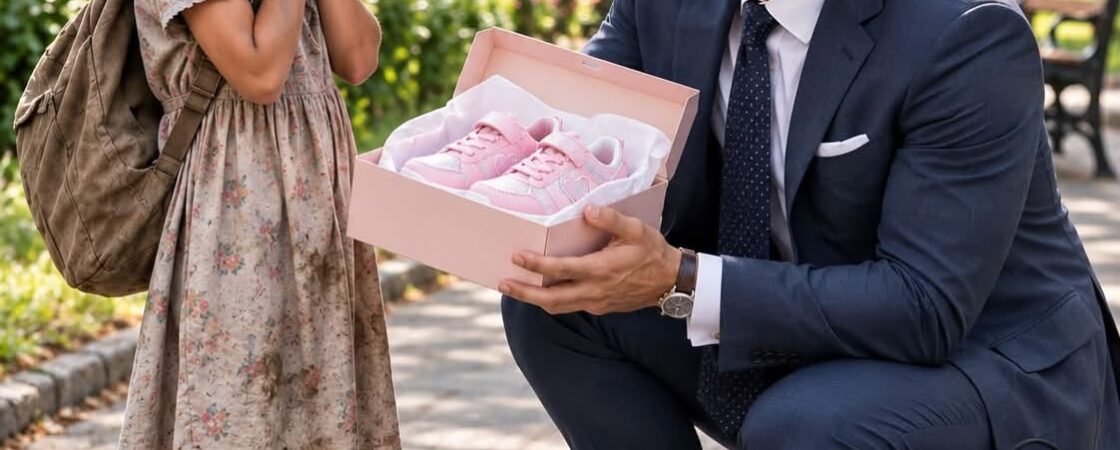
Then she slipped her feet into a pair of white sneakers decorated with soft pink accents.
Her expression changed immediately.
She looked down, wiggled her toes, and whispered something so quietly I almost missed it.
“They do not hurt.”
She carefully stood up.
One step.
Then another.
Soon she was walking back and forth across the store.
And before long, she began trotting around the display shelves, laughing at the unfamiliar feeling of comfortable shoes.
Her laughter filled the little shop.
I stood watching her, surprised by how much that simple sound affected me.
For years, I had been surrounded by conversations about money, achievement, and everything I was supposed to want.
Yet watching a five-year-old discover that walking did not have to hurt brought me more happiness than any business deal I could remember.
I turned toward the employee.
“We will take this pair.”
The shoes cost forty-five dollars.
I paid without a second thought.
Outside, Sophie stood on the sidewalk, admiring her new sneakers as the afternoon sunlight caught their clean white fabric.
“They are so pretty,” she said.
Then she looked up at me, suddenly serious.
“Someday, when I am big, I am going to give you your money back.”
I chuckled.
“You really do not have to do that.”
She shook her head.
“Yes, I do.”
Her chin rose with the stubborn determination only a small child could possess.
“My mommy says if you make a promise, you have to keep it.”
I smiled, but something about the way she said it stayed with me.
For a moment, we simply stood there.
Then, without warning, Sophie stepped forward and threw her little arms around my leg.
She hugged me tightly.
“Thank you, nice man.”
Before I could ask where her mother was, where she lived, or even what her last name might be, she let go.
Then she hurried down the sidewalk.
“Sophie!” I called.
She lifted one hand and waved over her shoulder.
A second later, she turned the corner.
And disappeared.
I stood there for a while, looking in the direction she had gone.
It was strange.
Nothing about Chicago had actually changed.
The same cars moved through the streets. The same impatient pedestrians hurried past. Somewhere nearby, a horn sounded over the noise of traffic.
But suddenly, the city seemed different.
A little brighter.
A little less cold.
Almost welcoming.
I realized I was standing in the middle of the sidewalk with a ridiculous smile on my face.
And for once, I did not particularly care.
Then my phone vibrated.
I pulled it from my pocket.
An unfamiliar number had sent me a message.
There was a photograph attached.
I tapped the screen.
The moment the image appeared, my smile vanished.
It was Sophie.
The same little girl I had met only a short while earlier.
But now she was standing beside a hospital bed.
Her tiny hand was wrapped around the fingers of a woman lying beneath white sheets, with oxygen tubing resting against her face.
I stared at the photograph, confused.
Then I noticed the message underneath.
You were kind to my daughter today. She probably did not explain everything, but she wanted those shoes because she was embarrassed to come visit me wearing her old ones.
I read the words twice.
Before I could respond, another message appeared.
Please do not let Sophie know I have contacted you. She still thinks I am going to recover.
My fingers went cold.
I glanced at the photograph again.
At the woman’s pale face.
At Sophie standing beside the bed.
At the little girl whose greatest wish that afternoon had been a pair of shoes that did not hurt her feet.
Then my phone buzzed for a third time.
I opened the next message.
And what I read made the noise of the entire city seem to disappear.
The doctors have told me I might not have much time left.
I stood still for a second, staring at the small screen.
Then another message blinked onto the display, along with an address.
Saint Jude Memorial Hospital, room 412. Please come. There is something you need to know about Sophie. About us.
I did not call my driver. I hailed a cab right off the curb, my heart hammering against my ribs in a way it never did during a boardroom crisis.
The drive across the city took twenty agonizing minutes.
When I reached the hospital, I hurried through the sliding glass doors, found the elevators, and rode up to the fourth floor.
Room 412 was at the end of a quiet, harshly lit hallway.
The door was ajar.
I pushed it open slowly.
Sophie was not there. A nurse was wheeling her down the corridor toward the playroom, giving me just enough time to step inside.
The woman in the bed turned her head toward the sound.
Her face was thin, drained of color, but as my eyes adjusted to the dim light of the room, recognition hit me like a physical blow.
“Clara?” I whispered.
She managed a weak, tired smile.
“Hello, Michael.”
Thirteen years ago, Clara and I had shared a life before my ambition consumed everything, before I packed a bag and walked away because I believed love and family were secondary to building an empire.
She had never reached out. I had never looked back.
“Why didn’t you tell me?” I asked, my voice cracking.
“You were building your empire,” Clara said softly, her breath shallow. “You told me yourself that distraction was the enemy of success.
And by the time Sophie came along years later, you were a ghost in the financial pages. I wanted her to have a mother who stayed, not a father who bought her presence.”
“She is my daughter,” I said, stepping closer to the bed.
“She is,” Clara whispered, closing her eyes for a moment to gather her strength. “And she has your stubborn chin. She walked all the way downtown today because she wanted to look nice for me, and she ran into you.”
“She told me she would pay me back,” I said, a heavy pressure building in my throat.
Clara opened her eyes, looking at me with a profound, steady gravity. “She keeps her promises. But you need to keep yours to her now. I am not going to be here tomorrow, Michael. You have all the money in the world, but you are going to use it to be a real father to our little girl.”
I reached out and took her frail hand, the same way Sophie had done in the photo.
“I will,” I said, the words finally carrying absolute weight. “I swear it to you, Clara.”
She nodded slowly, the tension finally leaving her shoulders.
When Sophie came back down the hall holding a nurse’s hand, she stopped at the threshold of room 412 and stared up at me in absolute astonishment.
“Nice man?” she whispered. “What are you doing here?”
I knelt down on the linoleum floor, right beside her small pink sneakers, and looked into her eyes.
“Call me Dad, Sophie,” I said softly. “I am not going anywhere.”