PART 3 — THE DINNER THEY PLANNED TO BREAK ME BECAME THE NIGHT THEIR LIES FELL APART
My sister’s boyfriend refused to leave with her after watching my family attack me at dinner. But when he followed me outside, he revealed one final detail about their plan—and what I discovered the next morning made me realize they had been trying to destroy much more than my reputation.
Chapter 1: The Man Who Followed Me Outside
“I’m not going home with you.”
Those six words were the last thing I heard before stepping onto my parents’ front porch.
Behind me, my sister, Vanessa, began screaming.
“Daniel! Are you seriously choosing her over me?”
I heard my mother rush to defend her.
“After everything we’ve done for you, you’re going to humiliate our daughter?”
Daniel didn’t answer immediately.
Then his voice came through the open doorway.
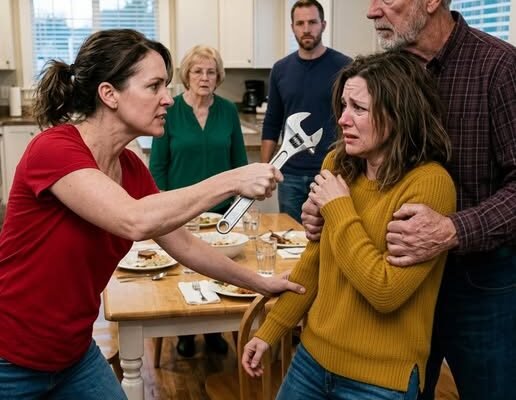
“I just watched you hit someone with a metal wrench. Your husband held her down while your other daughter prepared to hit her again. What exactly am I supposed to defend?”
Silence.
For the first time in my life, someone had described what happened in that house without making excuses for it.
I descended the porch steps, holding one hand against my swollen cheek.
The cold evening air made my face throb.
My car stood at the end of the driveway.
I reached for my keys, but my fingers were shaking so badly that I dropped them.
As I bent down to retrieve them, my vision blurred.
“Don’t drive.”
Daniel’s voice came from behind me.
I turned.
He stood several feet away, keeping his hands visible.
“I’m not going to touch you,” he said. “But you lost consciousness back there. You need medical attention.”
“I just want to go home.”
“I understand.”
He glanced toward the house.
“Your sister told me you lived alone. Is that true?”
I nodded.
“Then let me call an ambulance. You shouldn’t be alone after a head injury.”
I almost refused.
For twenty-eight years, I had been taught that asking for help was weakness, that family problems belonged inside the family, and that outsiders could never understand.
But tonight an outsider had understood more in ten minutes than my parents had acknowledged in a lifetime.
“Okay,” I whispered.
Daniel took out his phone.
And while he spoke to the emergency dispatcher, the front door opened again.
My father stepped onto the porch.
“Emily!” he shouted. “Get back inside.”
I froze automatically.
Even at twenty-eight, that voice could make me feel like a frightened little girl.
Daniel positioned himself between us without approaching my father.
“She needs medical attention,” he said.
My father laughed.
“She’s fine. She always acts like this.”
Then Daniel said something that made my father’s smile disappear.
“I’ve already told the dispatcher what happened. The police are coming too.”
My father stopped moving.
For several seconds, he stared at Daniel.
Then he walked back inside and slammed the door.
I watched the house go dark behind the windows.
And suddenly I understood.
They weren’t afraid that I was hurt.
They were afraid someone else would find out.
Chapter 2: The Evidence My Mother Forgot
At the hospital, a nurse gently cleaned the blood from my cheek while a doctor examined my head.
I had a concussion, significant bruising, and a facial wound that required stitches. Thankfully, the scans showed no acute intracranial bleeding.
The doctor wanted someone to remain with me after discharge and gave me strict instructions about symptoms that would require immediate care.
A police officer arrived while I was waiting for my discharge paperwork.
Her name was Officer Rebecca Hayes.
She sat beside my bed with a small notebook.
“Emily, can you tell me what happened tonight?”
I looked at the floor.
There was a time when I would have called it a misunderstanding.
I would have explained that my mother had a temper, that my sister liked to provoke me, that my father only wanted everyone to calm down.
I would have found a way to make their violence sound smaller.
But my cheek was throbbing.
My wrist bore the outline of my father’s fingers.
And someone had finally witnessed the truth.
“My mother hit me with a wrench,” I said. “My sister wanted to hit me again. My father held my arms so I couldn’t protect myself.”
Officer Hayes wrote everything down.
“Has anything like this happened before?”
I hesitated.
Then I answered.
“Yes.”
That single word opened twenty years of memories.
The childhood punishments nobody questioned.
The birthdays when my sister received presents while I was ordered to clean up.
The accusations whenever something broke or disappeared.
The family gatherings where Vanessa entertained everyone by humiliating me.
And the strange way my parents always insisted I was the reason our family could never be happy.
When I finished, Officer Hayes remained quiet for a moment.
“Do you have any previous documentation?”
I shook my head.
But then I remembered something.
“My mother has security cameras.”
The officer looked up.
“Inside the house?”
“In the dining room, kitchen, and hallway.”
My mother had installed them two years earlier after accusing a housekeeper of stealing jewelry.
She was obsessed with recording everything.
Except, apparently, her own behavior.
“I don’t know whether they were recording tonight,” I added.
Officer Hayes wrote that down.
“That’s important information.”
Before leaving, she explained the next steps, including how investigators could request or seek lawful access to footage and how I could ask about a protective order.
For once, I didn’t feel guilty about telling the truth.
I felt terrified.
But underneath the terror was something unfamiliar.
Relief.
Chapter 3: The Message at 2:17 A.M.
I spent that night at my best friend Rachel’s apartment.
Rachel had been asking me to distance myself from my family for years.
When she saw my face, she cried.
Not because she was surprised by their cruelty.
Because she had feared something like this would eventually happen.
She helped me settle on the couch, placed my medication and water nearby, and promised to follow the doctor’s instructions.
Shortly after two in the morning, my phone vibrated.
A message from an unfamiliar number appeared.
Unknown: Emily, this is Daniel. I’m sorry to contact you so late. There’s something you need to know.
I stared at it.
Another message followed.
Your sister lied to me about why she wanted you at dinner. I think they were trying to make you do something.
I typed slowly.
What do you mean?
His reply came almost immediately.
Vanessa told me your parents needed your signature on some family paperwork. She said you were being difficult about it. She wanted me to see how unreasonable you were before they asked you again.
My heartbeat accelerated.
Family paperwork?
Then another message arrived.
She also said something about your grandmother’s house. Do you know what she meant?
I sat upright.
My grandmother.
The house.
And suddenly, a conversation from three weeks earlier came rushing back.
My mother had called me and asked whether I still had the papers my grandmother had given me before she died.
When I asked why, she said it was nothing important.
“Just old documents, sweetheart. We’re cleaning out some things.”
I had told her they were in my home office.
The next day, Vanessa appeared at my apartment without warning.
She claimed she was in the neighborhood.
While I made coffee, she wandered down the hallway toward my office.
At the time, I thought nothing of it.
Now my stomach tightened.
I called Rachel’s name.
She appeared immediately.
“What’s wrong?”
I showed her Daniel’s messages.
Rachel read them twice.
Then she looked at me.
“Emily, didn’t your grandmother leave you something?”
I nodded.
“She left me her house.”
Rachel’s expression changed.
“Then why does your family need your signature?”
I had no answer.
But for the first time, I began to suspect that dinner had never been about introducing a boyfriend.
Chapter 4: The House My Grandmother Left Behind
My grandmother, Margaret Whitmore, was the only person in my childhood who made me feel loved without conditions.
She lived in a beautiful old house surrounded by maple trees.
Every Sunday, she baked cinnamon rolls and waited for me on the porch.
When my mother criticized my clothes, Grandma told me I looked lovely.
When my sister laughed at my grades, Grandma helped me study.
When my father said I would never amount to anything, Grandma quietly asked what I wanted to become.
She was the reason I eventually became a physical therapist.
She paid for some of my textbooks when my parents refused to help.
She attended my graduation when they claimed to be too busy.
And when she died three years ago, she left me her house through her estate.
My parents were furious.
They believed the property should have gone to my mother.
Vanessa claimed Grandma had always favored me unfairly.
For months, they pressured me to sell the house and divide the money.
But I refused.
Not because I wanted to punish anyone.
Because Grandma had made her wishes clear.
One afternoon, shortly before her death, she had held my hands and said, “Emily, I want you to have a place where nobody can tell you that you don’t belong.”
The house was still mine.
I rented it to a family who cared for it beautifully, while I lived closer to work.
The rental income helped me pay down my student loans.
But I had never considered selling.
That morning, after several hours of restless sleep, Rachel drove me to my attorney’s office.
His name was Michael Turner.
He had handled a small legal matter for me years earlier and knew the history of my grandmother’s estate.
I showed him Daniel’s messages.
Michael listened without interrupting.
Then he opened the property records on his computer.
A few minutes later, his expression grew serious.
“Emily, there’s something you need to see.”
He turned the monitor toward me.
A company called Whitmore Property Holdings LLC had recently filed documents connected to a proposed purchase of my grandmother’s house.
The listed contact was my sister.
Vanessa.
And in the documents Michael had obtained was a copy of what appeared to be my signed authorization.
Except I had never signed it.
I leaned closer.
My signature was there.
My full name.
My handwriting.
Almost.
The final letter curved in the wrong direction.
“That’s not mine,” I whispered.
Michael nodded.
“Then we need to treat this as a suspected forgery.”
I thought about Vanessa visiting my apartment.
My office.
The documents stored in the cabinet.
And then I remembered something even worse.
Three weeks earlier, I had found one of my old bank statements lying on the floor.
I had assumed I dropped it.
Now I wasn’t so sure.
Chapter 5: What My Sister Really Wanted
By afternoon, Michael had contacted the appropriate parties to dispute the authorization and place everyone involved on notice that I had not consented to a sale.
He also advised me to preserve all communications and avoid confronting my family directly.
The proposed transaction had not yet closed, and no ownership had changed hands.
That mattered.
There was still time to stop it.
While Rachel drove me home, Daniel called.
I answered through the car’s speaker.
“Emily, I remembered something else.”
His voice sounded exhausted.
“Go ahead.”
“Vanessa told me she deserved half of your grandmother’s property. She said your parents were finally going to force you to be reasonable.”
Rachel glanced at me.
Daniel continued.
“Yesterday she showed me pictures of a house and said she had a buyer lined up. She claimed you had already agreed to sell.”
My hands turned cold.
“Did she mention a price?”
“Eight hundred and forty thousand dollars.”
I closed my eyes.
That was roughly what Grandma’s property was worth.
Then Daniel added, “She said that once the sale went through, she and I could buy a home together.”
The silence inside Rachel’s car became unbearable.
My sister hadn’t simply wanted to embarrass me.
She had been planning her future with money from a property she didn’t own.
“Daniel,” I asked carefully, “why did she want you at dinner?”
He hesitated.
“Because I’m a mortgage broker. She thought my professional connections could help her find a buyer and arrange the financing.”
That explained why he had seemed uneasy from the moment he arrived.
My sister had tried to turn her own boyfriend into someone who could give legitimacy to her scheme.
But there was still one missing piece.
“If they already forged my signature, why did they need me?”
Daniel exhaled.
“She said there was one last document you had to sign in person.”
I looked out the window.
The evening replayed in my mind.
My mother asking what I did for a living.
The wrench.
My father’s grip.
Vanessa laughing while I struggled.
And the warning that I couldn’t leave until I apologized.
They had intended to frighten me into submission.
Then make me sign.
But something went wrong.
Daniel stopped laughing.
And the entire plan began falling apart.
Chapter 6: The Recording That Changed Everything
Four days later, Officer Hayes called.
Investigators had obtained access to the relevant dining-room footage through the legal process.
The camera had recorded the assault.
But it had also captured part of the conversation before I arrived.
My parents and Vanessa were seated at the table.
The wrench was already lying on a sideboard.
My mother was complaining about the property sale.
According to the investigator’s account, Vanessa told my father that I couldn’t be allowed to leave before they got what they needed.
My father replied that he would make sure I stayed.
Then my mother made a statement that would haunt me for years.
“She’ll cooperate once she remembers who raised her.”
I sat silently while Officer Hayes explained that the video and additional evidence had been preserved.
The investigation was ongoing, and she couldn’t promise how prosecutors would proceed.
But the family story had finally collided with recorded evidence.
That evening, my mother called sixteen times.
I didn’t answer.
Then she sent a message.
MOM: You have ruined this family over one little argument. Your sister is devastated. Your father hasn’t slept. Are you happy now?
I looked at the stitches near my cheekbone.
One little argument.
That’s what she called it.
A moment later, another message appeared.
MOM: If you loved your grandmother, you would do what is right for everyone.
For the first time, I saw her words without hearing the voice of the mother I had spent my life trying to please.
They weren’t words of love.
They were leverage.
I forwarded both messages to Michael.
Then I blocked her number.
Chapter 7: The Visitor Who Came With an Apology
Two weeks passed.
The bruising faded slowly.
I returned to work with a lighter schedule and began attending counseling.
There were difficult mornings when I woke up convinced I had exaggerated everything.
There were nights when I almost called my mother.
Years of conditioning didn’t disappear because one police report had been filed.
Then, one Saturday afternoon, someone knocked on Rachel’s door.
It was Daniel.
He stood outside holding a plain envelope.
Rachel remained in the doorway while I came to speak with him.
“I won’t stay,” he said. “I just wanted to give you something.”
He handed me the envelope.
Inside were printed messages between him and Vanessa.
In one conversation, Vanessa described my grandmother’s property as money that had been unfairly stolen from her.
In another, she told Daniel:
Once Emily signs, everything gets easier. Dad knows how to handle her.
There was also a message from the morning of the dinner.
Tonight she learns she can’t keep embarrassing this family.
I read those words three times.
Then I looked at Daniel.
“Did you know what they were going to do?”
“No.”
His expression tightened.
“If I’d known, I wouldn’t have brought myself anywhere near that house.”
He looked at my healing cheek.
“I should have stepped in sooner.”
I didn’t tell him it was okay.
Because it wasn’t.
But I could see that he understood the difference between regret and an excuse.
“Thank you for helping,” I said.
He nodded.
Then he surprised me.
“Vanessa and I are finished.”
I already suspected as much.
But hearing it still made something loosen inside my chest.
“She keeps telling people you destroyed our relationship,” he continued. “I told her she did that herself.”
He paused.
“There’s one more thing.”
I waited.
“Your grandmother’s house wasn’t the only property they were discussing.”
My stomach dropped.
“What?”
He pointed to one of the documents.
“Your parents’ house. They were planning to use money from your property to clear their debts.”
Everything suddenly fit together.
The urgency.
The forged paperwork.
The desperation to make me cooperate.
This wasn’t merely greed.
They had built a financial plan around taking something that belonged to me.
And they had become violent when their control began slipping.
Chapter 8: The Day My Father Finally Faced Me
Several months later, the criminal case reached a court hearing.
By then, investigators had also forwarded the suspected property fraud to the relevant authorities.
My attorney had successfully challenged the disputed authorization, and the proposed sale had been stopped.
The house remained in my name.
At the hearing, my father sat across the room wearing the same dark suit he had worn to my graduation.
My mother sat beside him.
Vanessa stared at me with open hatred.
For years, they had controlled every family gathering.
Who spoke.
Who stayed quiet.
Who apologized.
Who was blamed.
But inside that courtroom, none of them could simply order me to stop talking.
When I was asked to describe the assault, my voice shook.
I spoke anyway.
I described the wrench striking my face.
My father restraining my arms.
My sister demanding another turn.
The laughter.
And the humiliation of realizing that the people who should have protected me were enjoying my fear.
Then I described what happened after I fell.
Daniel telling my father to release me.
My sister trying to explain away the violence.
My mother calling it discipline.
When I finished, the courtroom was silent.
My father’s attorney questioned parts of my account.
I answered as carefully as I could.
And when the relevant recording was presented, I did not look toward my family.
I watched the judge.
For the first time, their version of events was no longer the only one that mattered.
My mother eventually admitted striking me, although she continued insisting she never intended serious harm.
My father acknowledged restraining me but claimed he had been trying to prevent an argument.
Vanessa denied planning the assault.
The evidence was evaluated through the legal process, and the criminal case ultimately ended with convictions related to the attack. The court imposed sentences, supervision requirements, and no-contact conditions appropriate to each person’s conduct.
The separate financial investigation took longer.
But the disputed property documents were formally invalidated, and the people involved in preparing them faced further scrutiny.
I didn’t celebrate anyone’s punishment.
I only felt an overwhelming relief that I would no longer have to pretend nothing had happened.
Chapter 9: The Letter From My Grandmother
Six months after that terrible dinner, I visited Grandma’s house for the first time in nearly a year.
The tenants had moved out after purchasing a home of their own.
I stood on the familiar porch with the keys in my hand.
The maple trees were beginning to turn red.
Inside, sunlight stretched across the hardwood floors.
The kitchen still smelled faintly of cinnamon whenever the heating system came on.
I walked into the small room Grandma had used as a sewing studio.
Most of her belongings had been packed away after her death.
But in the bottom drawer of an old dresser, I found a wooden box I hadn’t noticed before.
Inside were photographs.
My graduation.
My eighth birthday.
A picture of Grandma helping me ride a bicycle.
And beneath them, an envelope.
My name was written across it in her unmistakable handwriting.
For Emily, when you are ready.
I sat on the floor and opened it.
The letter began:
My darling Emily,
I know you have spent much of your life believing that love must be earned by being quiet, useful, and forgiving.
I have watched you make yourself smaller so other people can feel bigger.
You were never difficult to love, sweetheart.
You were simply born into a home where some people confused control with love.
My eyes filled with tears.
I continued reading.
This house is not a reward for being a good granddaughter.
It is not payment for the kindness you showed me.
It is yours because I want you to have something no one can take away by making you feel guilty.
One day, someone may tell you that choosing yourself means abandoning your family.
Please remember this: protecting your peace is not an act of cruelty.
It is an act of survival.
By the time I reached the final line, I was crying so hard I could barely see the paper.
You have always belonged somewhere, Emily. I hope one day you realize that somewhere can begin with you.
I pressed the letter against my chest.
For twenty-eight years, I had wanted my mother to say something like that.
To tell me I mattered.
That she was proud of me.
That I didn’t have to compete with my sister for the right to be loved.
But the words had been waiting in an old wooden box.
Written by the one person who had never asked me to prove my worth.
Chapter 10: The Family I Finally Chose
One year after the dinner, I moved into Grandma’s house.
Rachel helped me paint the living room.
My coworkers brought plants.
Friends filled the kitchen with food and laughter on the day I moved in.
Nobody criticized the way I arranged the furniture.
Nobody demanded to know how much money I had spent.
Nobody told me I was selfish for being happy.
Daniel stopped by once to return an old photograph of Grandma that Vanessa had kept among her belongings.
We spoke on the porch.
He had moved to another city and begun a new relationship.
Before leaving, he asked whether I was doing better.
I looked at the house behind me.
The flowers growing beside the steps.
The open windows.
The place where I could finally breathe.
“Yes,” I said.
And for once, it was the truth.
My sister sent one final letter several months later.
She said she had lost everything.
Her boyfriend.
Her relationship with our parents.
Her reputation.
She insisted that I had overreacted and could still repair the family if I wanted to.
At the end, she wrote:
I hope you’re happy now that you got what you wanted.
I placed the letter in a folder with the other documents from the case.
I didn’t answer.
Because what I wanted had never been revenge.
I wanted safety.
I wanted freedom.
I wanted to sit at a dinner table without being afraid of what might happen if I spoke.
And slowly, I had built a life where those things were possible.
On the anniversary of that night, Rachel came over for dinner.
We made pasta, opened a bottle of sparkling cider, and sat at Grandma’s old oak table.
Halfway through the meal, Rachel asked me a question.
“Do you ever think about what would have happened if Daniel hadn’t been there?”
I looked down at my plate.
Of course I did.
Sometimes the thought still frightened me.
But then I remembered something.
“Daniel helped me see the truth,” I said. “But he wasn’t the one who walked out of that house.”
Rachel smiled.
“No,” she said. “You were.”
We sat quietly for a moment.
Then I looked toward the window.
Outside, the maple trees swayed gently in the evening wind.
And I remembered my mother’s voice from that terrible dinner.
Then don’t come crawling back tomorrow.
For so long, those words had felt like a threat.
Now they sounded like permission.
Because I never did go crawling back.
And in the end, I learned something my family had spent my entire life trying to keep me from understanding.
The people who hurt you don’t get to decide whether your pain is real. The people who abandon you don’t get to define your worth. And the people who demand your silence don’t get to call that silence love.
That evening, as Rachel helped me clear the dishes, I placed Grandma’s letter back in its envelope.
On the back, I had written a sentence of my own.
“I finally came home—not to the family that broke me, but to the life they could no longer control.”
And for the first time in my life, home was a place where nobody was waiting to hurt me.
THE END.