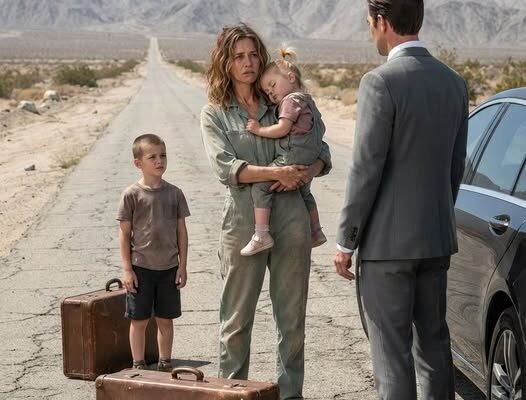
I stared at Daniel Hayes.
“You want me to marry you?”
“Yes.”
“For money.”
“No.”
I almost laughed.
“You just offered me a house, health insurance, and financial security.”
“That isn’t payment for marrying me.”
“What would you call it?”
Daniel hesitated.
“Protection.”
I pulled Ava closer.
“That sounds like payment with better vocabulary.”
For the first time, he looked uncomfortable.
“Fair.”
That answer surprised me.
Men with money usually seemed very practiced at explaining why whatever they wanted was reasonable.
Daniel didn’t argue.
Instead, he reached inside the car, took out a bottle of water, and handed it to Ethan.
Then another to Ava.
He looked at me before offering the third.
“May I?”
I nodded.
“Thank you.”
I drank half of it immediately.
Daniel glanced toward our battered suitcases.
“Before you decide anything, let me get you somewhere safe.”
I stiffened.
“That isn’t a yes.”
“I know.”
“And my children stay with me.”
“Obviously.”
“Nothing happens until I speak to a lawyer who doesn’t work for you.”
A faint smile appeared.
“You should absolutely speak to one.”
That answer bothered me almost as much as the proposal.
I had expected persuasion.
Instead, he kept giving me exits.
Ethan looked up at him.
“Do rich people always ask strangers to marry them?”
Daniel looked at me.
“Apparently only when they’re having a very bad week.”
Ethan considered that.
“That’s weird.”
“It is.”
For the first time that day, I laughed.
Only a little.
Then headlights appeared behind us.
The black SUV came down from the ridge.
Slowly.
Deliberately.
Daniel noticed it before I did.
His entire posture changed.
He stepped between the vehicle and my children.
“Do you know that car?”
“No.”
The SUV stopped twenty yards away.
A woman climbed out.
She looked to be around sixty.
Silver hair pulled into a low knot.
Dark trousers.
White blouse.
No jewelry except a thin gold wedding band.
She held a photograph.
My photograph.
Not of me.
Of Ethan and Ava.
My blood went cold.
I grabbed both children.
“Who are you?”
The woman stopped immediately.
“Sarah Mitchell?”
“How do you know my name?”
Her eyes moved toward Ethan.
Then Ava.
Her face crumpled.
“Oh my God.”
Daniel looked at me.
“You know her?”
“No.”
The woman pressed one hand against her mouth.
Then whispered,
“They look exactly like him.”
Every instinct in my body screamed.
“Like who?”
She looked at me.
“My son.”
The world tilted.
I already knew the name before she said it.
“Matthew.”
My knees weakened.
Matthew Mitchell.
My husband.
My children’s father.
The man who had died three years earlier.
The man whose funeral I had attended with two children clutching my hands.
I stepped backward.
“No.”
“My name is Helen Mitchell.”
I shook my head.
“Matthew’s mother was dead.”
Pain crossed her face.
“That is what he told you.”
Daniel turned toward her sharply.
Helen’s eyes never left mine.
“And I deserve whatever you think of me after you hear why.”
I couldn’t process it.
Matthew had told me both of his parents were gone.
He never showed me childhood photographs.
Never took me to meet relatives.
He said there was nobody left.
For nine years, I believed him.
“Why do you have pictures of my children?”
Helen looked down at the photograph.
“They were sent to me three weeks ago.”
“By who?”
“A private investigator.”
My stomach turned.
“I’ve been looking for them.”
“For us?”
“For Matthew’s children.”
I pulled Ethan closer.
“You don’t get to call them that.”
Helen stopped.
Then nodded.
“You’re right.”
Again.
Another stranger accepting a boundary.
I didn’t understand what kind of evening I had stumbled into.
Daniel spoke quietly.
“Sarah, we should move off the roadside.”
That much was undeniable.
The light was fading.
Trucks were still passing.
My children were exhausted.
And I suddenly had a billionaire proposing marriage and a supposedly dead mother-in-law holding their photograph.
I looked at both adults.
“If either of you lies to me, I walk.”
Daniel nodded.
Helen did too.
We drove to a small hotel outside Tucson.
Not Daniel’s mansion.
Not some private estate.
A normal hotel.
Daniel booked two rooms under my name.
One for me and the children.
One for himself down the hall.
Helen took another room on a different floor after I made it clear she would not be alone with my children.
Nobody argued.
That unsettled me too.
People had been arguing with my needs for so long that simple respect felt suspicious.
The first thing Daniel did was order food.
Ava ate macaroni and cheese so quickly I had to tell her to slow down.
Ethan ate two hamburgers.
Then half my fries.
I didn’t care.
I watched them eat until my chest hurt.
After they showered and fell asleep, I met Daniel and Helen in the little conference room downstairs.
I sat closest to the door.
Daniel noticed.
He moved farther away.
Helen placed the photograph on the table.
It had been taken six months earlier.
Ava at school pickup.
Ethan beside her.
I recognized the location immediately.
“Why was someone photographing my children?”
“The investigator was confirming identities.”
“That doesn’t make it better.”
“No.”
Helen folded her hands.
Then she told me the truth.
Or what she said was the truth.
Matthew hadn’t lost his family.
He’d left them.
His father had been controlling.
Wealthy.
Cruel in the particular way some powerful men become cruel when everyone around them depends on them.
Matthew wanted nothing to do with the family business.
At twenty-one, he disappeared.
Changed his phone number.
Stopped answering letters.
Eventually, he told everyone his family was dead.
Including me.
“What business?”
Helen hesitated.
“Mitchell Agricultural Systems.”
I stared at her.
Even I knew the name.
They manufactured irrigation systems and farm equipment across the Southwest.
Not Daniel-Hayes money.
But certainly not poor.
“You’re rich.”
Helen almost smiled.
“Technically.”
I leaned back.
This was becoming absurd.
“Then why was your son working as a diesel mechanic when I met him?”
“Because that was what he wanted.”
That sounded like Matthew.
He loved engines.
Hated suits.
Thought every tie looked like a noose.
“What happened after he died?”
“I didn’t know.”
My anger sharpened.
“How could you not know your son died?”
“He had been gone for fourteen years.”
Her eyes filled.
“I searched.”
“His father didn’t.”
“I did.”
Matthew had built his entire adult life around disappearing.
No public social media.
Few records.
We had married at a courthouse.
Moved several times for work.
When he died in a construction accident, his death notice listed only me and the children.
Helen did not see it.
“How did you find us now?”
“His father died four months ago.”
Apparently, while settling the estate, Helen found an old letter Matthew had written years earlier.
He never sent it.
Inside, he mentioned me.
Sarah.
And two children.
Ethan and Ava.
That was all.
Helen hired someone.
Three weeks ago, the investigator found us.
By then, we were already gone from our apartment.
“Why?”
Daniel asked quietly.
I looked at him.
He hadn’t asked before.
I almost didn’t answer.
Then I realized there was no dignity left in hiding something simply because poverty embarrassed me.
“Our landlord sold the building.”
I looked down.
“I was behind already.”
Matthew’s medical debt had consumed most of what little savings we had.
Then Ava got sick twice that winter.
I missed work.
Then the restaurant where I worked reduced hours.
The eviction wasn’t dramatic.
No sheriff throwing our furniture onto the street.
Just notices.
Fees.
Promises I couldn’t keep.
Eventually, there was nowhere to go.
We were heading toward Phoenix because a former coworker said a hotel there might hire housekeepers.
But I had spent the last of our money on bus tickets for a route that wasn’t running.
Helen stared at me.
“You’ve been homeless?”
I hated the word.
“We’ve been between places.”
Her eyes closed.
“My grandchildren were sleeping wherever you could find somewhere safe while I was sitting in a house with seven empty bedrooms.”
I stiffened.
“That is not my fault.”
“No.”
She looked at me immediately.
“It is absolutely not.”
Good.
Because I wasn’t going to carry her guilt too.
Then Daniel asked something that changed everything.
“What did Matthew’s father leave the grandchildren?”
Helen looked at him.
My stomach tightened.
“What?”
She opened her handbag.
“That’s why I needed to find you.”
Her late husband had written Matthew out of the will years earlier.
But he hadn’t written out any grandchildren.
A trust existed.
Not enormous by Daniel’s standards.
Enormous by mine.
Each grandchild was entitled to educational funding and a share of family assets when they became adults.
My mouth went dry.
“How much?”
Helen gave me a number.
I thought I’d misheard.
Combined, Ethan and Ava’s future trust was worth slightly more than six million dollars.
I laughed.
Not because anything was funny.
Because twelve hours earlier, Ava had been opening an empty lunch container hoping food might appear.
And somewhere, paperwork said my children were millionaires.
Ethan was asleep upstairs wearing socks with a hole in one heel.
Life had apparently developed a cruel sense of humor.
I looked at Helen.
“Can I access it?”
“For their necessities, with trustee approval.”
“Who is trustee?”
“I am.”
Of course.
I stood.
“I need air.”
Daniel started to rise.
I glared at him.
He sat back down.
Good.
I walked outside.
The desert night had cooled.
Cars moved along the interstate in the distance.
I wrapped my arms around myself.
A minute later, the hotel door opened.
Helen stepped outside.
She stayed several feet away.
“I won’t ask you to trust me.”
“Good.”
“But I need you to know something.”
I looked at her.
“I did not search for Matthew because of money.”
“I searched because he was my son.”
Her voice broke.
“And now I have two grandchildren who don’t know me.”
“That isn’t their fault.”
“No.”
“Or mine.”
“No.”
I looked at her.
“Then don’t arrive with money and expect it to make you family.”
Her eyes filled.
“I won’t.”
For some reason, that answer hurt more than if she’d argued.
I was so tired of people turning help into ownership.
Landlords.
Employers.
Relatives.
Men who offered rescue and expected obedience.
I suddenly remembered Daniel sitting inside.
Waiting to hear whether I would marry him.
I laughed bitterly.
Helen frowned.
“What?”
“Apparently this is the night everyone discovers I come with financial paperwork.”
She didn’t understand.
I didn’t explain.
When I returned to the conference room, Daniel was standing by the window.
I sat down.
“I’m not marrying you.”
He nodded.
“Okay.”
That was it.
No persuasion.
No reminder of the highway.
No mention of the children.
I stared at him.
“That’s all?”
“You said no.”
“You told me you needed a wife.”
“I do.”
“Then why aren’t you trying to convince me?”
He turned toward me.
“Because if your answer only becomes yes because you’re afraid your children will go hungry, then it isn’t really a choice.”
For several seconds, I couldn’t speak.
That was when I first began to believe he might actually be safe.
“Then why did you offer?”
He looked embarrassed.
“Because I saw a problem I thought money could solve.”
Helen gave him a look.
I almost smiled.
Daniel continued.
“And because I’m desperate.”
“Why?”
He finally explained the situation properly.
His grandfather had created a family trust controlling a large block of Hayes Industries shares.
Daniel had spent fifteen years modernizing the company after taking over.
His uncle Victor wanted him removed.
Under the trust structure, one contested block of voting shares would transfer permanently to Daniel at forty-five only if he had established a legal household before the deadline.
A ridiculous old-fashioned clause.
Daniel turned forty-five in eleven days.
“So you planned to marry the first woman you found beside a highway?”
“When you say it like that, it sounds bad.”
“It is bad.”
“Yes.”
I almost laughed again.
“Why me?”
He became serious.
“Because you asked me for a job.”
“So?”
“Not money.”
I looked at him.
“You had forty-seven cents.”
My face burned.
“And you asked for work.”
He shrugged.
“I respected that.”
“That isn’t a reason to marry someone.”
“No.”
He smiled faintly.
“I wasn’t exactly operating at my best.”
That night, I slept twelve hours.
When I woke, Ava was sitting beside me eating a banana.
“Where did that come from?”
“Mr. Daniel.”
I sat up.
“What?”
“He left breakfast outside.”
On the floor beyond the door sat a paper bag.
Bagels.
Fruit.
Milk.
Coffee.
And a note.
No marriage required.
I laughed despite myself.
For the next three days, everything changed.
Helen’s attorneys confirmed the trust.
A lawyer I chose independently reviewed it.
Daniel paid her retainer.
When I objected, he said,
“Consider it roadside assistance.”
I told him rich people were strange.
He agreed.
The children’s trust could immediately cover housing, medical care, schooling, and reasonable living expenses.
But I refused to let Helen put us into one of her houses.
Instead, I rented a modest two-bedroom apartment.
My name went on the lease.
The trust paid only what the attorney confirmed belonged to the children.
I found work too.
Not housekeeping.
Daniel learned I had spent six years doing inventory and bookkeeping before Matthew died.
Hayes Industries had an opening in procurement administration.
I refused to work directly for Daniel.
So he arranged an interview with someone who did not know how we’d met.
I got the job.
On my own.
That mattered.
By the time Daniel’s forty-fifth birthday approached, I knew more about his board problem than I intended.
Victor Hayes was not simply trying to remove him.
He was trying to sell the company in pieces.
Factories.
Patents.
Land.
Thousands of employees would lose jobs.
Daniel’s grandfather’s absurd trust clause had given Victor the opening he needed.
One evening, Daniel came to my apartment.
He brought pizza.
Ethan had decided Daniel was fascinating because he knew how helicopters worked.
Ava liked him because he always carried peppermints.
After the children went to bed, Daniel sat across from me.
“I found another solution.”
“To the marriage problem?”
“Yes.”
“What?”
“I can challenge the clause.”
“How long?”
“Maybe two years.”
“And the board meeting?”
“I may lose control before then.”
I looked at him.
“You’re telling me this because?”
“Because I don’t want you hearing later that I was secretly hoping you’d change your mind.”
I studied him.
“Were you?”
He smiled slightly.
“Yes.”
At least he was honest.
“But I won’t ask again.”
Something shifted inside me.
Not romance.
Not yet.
Respect.
Then Helen complicated everything.
She had been slowly entering the children’s lives.
Slowly meant exactly that.
An hour at the park.
Lunch with all of us.
A birthday gift that I approved before she gave it.
No surprise trust funds.
No trying to make Ethan call her Grandma.
She simply showed up.
One afternoon, Ethan asked her,
“Did my dad hate you?”
Helen went completely still.
Then she answered honestly.
“I think he hated some things I failed to protect him from.”
“Did you love him?”
“Yes.”
“Then why didn’t he come back?”
Her eyes filled.
“I don’t know.”
Ethan thought about that.
Then said,
“Sometimes I get mad at Mom.”
I raised an eyebrow.
“Excuse me?”
“But I still come back.”
Helen laughed through her tears.
“So you do.”
Children have a way of making complicated adults sound foolish.
Months earlier, I thought wealth would be the biggest change in our lives.
It wasn’t.
Safety was.
Food in the refrigerator.
A lease nobody could suddenly take away.
A pediatrician for Ava.
Glasses for Ethan.
Shoes that fit.
And the strange luxury of buying groceries without adding the total in my head after every item.
Then came Daniel’s board meeting.
I had no intention of attending.
Until the night before.
I was sitting at my kitchen table reviewing invoices for work when I thought about the highway.
A stranger had stopped.
He had offered something absurd.
But before I agreed to anything, he fed my children.
He gave me a room.
He accepted no.
And afterward, when I no longer needed him financially, he had never once used his help to demand anything from me.
I called him.
He answered on the first ring.
“Everything okay?”
“Yes.”
There was a pause.
“Then why are you calling at eleven?”
I looked at the papers in front of me.
“Does the trust clause say you need a wife?”
“Yes.”
“Or does it say you need to establish a legal household?”
Silence.
“Sarah.”
“I read contracts for procurement all day.”
“I noticed something in the copy you showed me.”
The language was old.
Awkward.
But specific.
The shares vested if Daniel entered into a legally recognized marital or domestic household before forty-five.
Arizona did not provide the exact status contemplated when the trust was drafted.
But the company was incorporated elsewhere.
His attorneys had focused exclusively on marriage because everyone assumed that was what his grandfather meant.
“What if the clause can be satisfied through a domestic partnership recognized in another jurisdiction?”
Daniel went silent.
Then,
“I need to call my lawyer.”
The next twelve hours were chaos.
His legal team confirmed there was a possible argument.
Not guaranteed.
But enough to stop Victor’s immediate takeover while the trust interpretation was litigated.
Daniel did not need a wife.
He needed lawyers who read the entire sentence.
At the board meeting, Victor’s motion stalled.
Then something unexpected happened.
Several independent directors sided with Daniel once they learned Victor’s sale plan.
Daniel kept control.
Not because he married me.
Because the board finally understood what they were choosing between.
When Daniel called afterward, he was laughing.
“You saved my company.”
“No.”
“I found a comma.”
“That was a very expensive comma.”
“I’m putting your name on it.”
“Don’t.”
Six months passed.
Then a year.
Daniel became part of our lives anyway.
Not through a contract.
Through ordinary things.
He came to Ethan’s school science fair.
Ava made him sit through a tea party where he was assigned the role of “sick princess.”
He did it without complaint.
Mostly.
Helen became Grandma Helen after Ava decided that was her name.
Nobody asked her permission.
She cried for fifteen minutes.
I found myself crying too.
My own life changed.
I earned a promotion.
Then another.
The children’s trust remained theirs.
I refused to use it to create a life I could not maintain myself.
Helen respected that.
Daniel respected it too.
One evening, nearly two years after the highway, he took me to dinner.
No children.
No board crisis.
No contracts.
We were halfway through dessert when he looked unusually nervous.
That amused me.
I had seen him negotiate with men worth hundreds of millions without blinking.
“What?”
He put down his fork.
“I need to ask you something.”
I immediately pointed at him.
“If this involves a corporate trust, I’m leaving.”
He laughed.
“No.”
“If you mention voting shares, I’m taking the cheesecake.”
“Fair.”
Then he reached into his jacket.
I stopped smiling.
“Daniel.”
He placed a small ring box on the table.
But he didn’t open it.
“I asked you once when you had almost no choices.”
I stared at him.
“I hate that I did that.”
“You also accepted no.”
“I did.”
He took a breath.
“So I’m asking again now.”
He looked around.
“At your apartment you chose.”
“At your job you earned.”
“With money in your own bank account.”
“With two children who are safe whether you marry me or never speak to me again.”
My eyes filled.
“Sarah Mitchell, now that you absolutely do not need me…”
He opened the box.
“Would you choose me?”
That question was completely different from the first one.
On the highway, marriage had sounded like rescue.
Now it sounded like partnership.
I looked at him for a long time.
Then asked,
“Do I still get my own lawyer?”
He smiled.
“Two, if you want.”
“And my children’s trust stays separate.”
“Obviously.”
“I keep working.”
“I’d be afraid to suggest otherwise.”
“And if you ever tell me I’m lucky you saved me—”
“You can leave me beside the same highway.”
I laughed through my tears.
Then I said yes.
We married six months later.
Small ceremony.
No magazines.
No business press.
Ethan was Daniel’s best man.
Ava scattered approximately three times more flower petals than anyone requested.
Helen sat in the front row holding a photograph of Matthew.
That had been my idea.
Daniel’s too.
Because marrying again did not erase the man I had loved before him.
Matthew had given me my children.
Daniel never tried to compete with a dead man.
That may have been one of the reasons I loved him.
Before the ceremony, Helen gave me something.
A sealed envelope.
“Matthew wrote this twenty years ago.”
My hands shook.
“He never mailed it to me.”
“No.”
“What does it say?”
“I don’t know.”
That surprised me.
“I never opened it.”
I waited until the night after the wedding.
Daniel was asleep beside me.
I sat near the hotel window and opened the letter.
Most of it was angry.
Matthew wrote about his father.
About leaving.
About never wanting the family money.
Then near the end, he wrote:
Mom, someday I hope I become the kind of father who makes his children feel safe enough that they never have to disappear from me.
I cried quietly.
Matthew had done that.
He had been a good father.
Not perfect.
But good.
He had hidden too much about his past.
Yet Ethan and Ava had never doubted he loved them.
I folded the letter and kept it for them.
Years later, Ethan asked me something.
He was thirteen by then.
Tall.
Serious.
Still worrying too much.
“Mom?”
“Yes?”
“Would you have married Daniel that first day?”
I laughed.
“Absolutely not.”
Daniel yelled from the kitchen,
“I heard that!”
Ethan smiled.
“Then why did you marry him later?”
I thought about it.
“Because the first time he asked, I needed what he had.”
“And the second?”
“The second time, I didn’t.”
Ethan frowned.
“That makes you want to marry someone?”
“It made me know I was free to choose.”
He seemed to understand.
Ava, who was drawing at the table, looked up.
“I would’ve married him for the peppermints.”
Daniel pointed at her.
“Finally, someone appreciates me.”
Our life was not perfect after that.
Money didn’t make children stop arguing.
It didn’t make grief disappear.
It didn’t make Helen’s lost years with Matthew less painful.
And it didn’t turn Daniel into a man who remembered where he left his keys.
But we became a family.
Not because a billionaire offered to rescue a poor woman.
I hate when people tell the story that way.
Daniel did stop his car.
He did feed my children.
He did give us somewhere safe to sleep.
I will always be grateful for that.
But he did not rescue me.
Helen’s money didn’t rescue me either.
The children’s trust gave them security.
My job gave me stability.
People helped.
There is no shame in saying that.
But I made the decisions.
I signed my own lease.
Earned my own paycheck.
Protected my children’s money.
Said no when something didn’t feel right.
And later, when my life was finally steady enough that fear was no longer making decisions for me, I said yes.
That is the difference I want my children to remember.
Years after that night, we drove the same highway outside Tucson.
Ava spotted the shoulder where we’d been stranded.
“Was it there?”
I looked.
The desert looked exactly the same.
Dry grass.
Telephone poles.
Mountains fading purple in the distance.
“Yes.”
Daniel slowed the car.
Ethan leaned forward.
“That’s where we met him?”
“Yes.”
Ava smiled.
“That’s lucky.”
I thought about the forty-seven cents.
The empty lunch container.
My son’s offer to carry a suitcase that was too heavy for him.
The fear I’d hidden behind a smile.
Then I looked at my family.
Helen was meeting us for dinner.
Ethan had just made the soccer team.
Ava had two loose teeth and talked constantly.
Daniel was beside me.
But I shook my head.
“No, sweetheart.”
Ava frowned.
“No?”
“Meeting Daniel was lucky.”
I reached back and squeezed her hand.
“But surviving long enough to get there?”
“That was us.”
And that is the part nobody sees when they hear the story.
They hear:
Billionaire.
Marriage proposal.
Trust fund.
Big house.
They imagine my life changed because rich people appeared.
But the most important thing I received beside that highway wasn’t money.
It wasn’t even a home.
It was the first chance I’d had in months to stop being afraid long enough to make a choice.
Years later, Daniel still jokes that I rejected his first proposal faster than anyone had ever rejected him.
I remind him that his first proposal was terrible.
He agrees.
The ring from his second proposal is still on my hand.
Not because it represents security.
I already had security when I accepted it.
It represents something far more precious.
Choice.
The first time Daniel Hayes asked me to become his wife, I had forty-seven cents and two hungry children.
I said no.
The second time, I had a home, a career, savings, and children who were safe with or without him.
And that time, when I said yes, we both knew exactly what the word meant.
Not rescue.
Not debt.
Not survival.
Love.