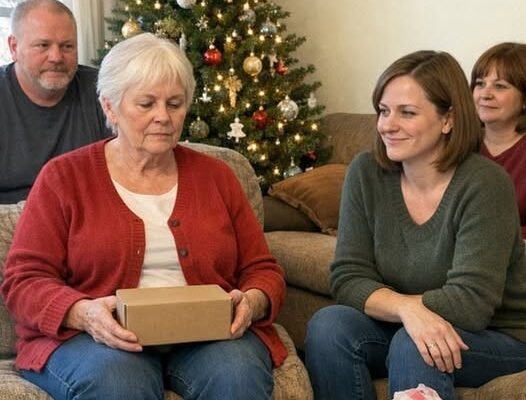
Emma’s fingers found the edge of the tape.
She peeled the velvet back carefully.
Underneath were two things.
A folded piece of yellow notebook paper.
And a receipt.
Emma picked up the receipt first.
“Twenty-two dollars?”
Shay frowned.
“What?”
Emma read it aloud.
“Cedar Chest Restoration. Hinge replacement, wood oil, felt adhesive. Twenty-two dollars.”
Nobody said anything.
Shay looked at me.
I kept my hands folded in my lap.
Emma lifted the second piece of paper.
The moment I saw my husband’s handwriting, my throat closed.
She recognized it too.
“Grandpa wrote this.”
That was when Brett came out of the kitchen.
He was still holding a carving knife in one hand and a dish towel in the other.
“What did Grandpa write?”
Emma unfolded the paper.
I had read it so many times that I knew every word.
She began.
“Emma—
If Grandma gives you this box someday, it means she finally decided you’re old enough not to fill it with crayons.”
A few people laughed.
Emma covered her mouth.
That was exactly how he talked.
She continued.
“This box sat beside my bed for most of my married life.
Your grandmother gave it to me during our first Christmas after we got married.
We didn’t have much money.
She bought it at a church sale for three dollars.”
My sister-in-law looked at me.
I nodded.
Three dollars.
December of 1977.
We had been married eight months.
I had wanted to buy him a proper watch box.
We couldn’t afford one.
So I found that little cedar box at a church basement sale.
One hinge was already crooked.
My husband loved it anyway.
For forty-six years, he kept everything important inside.
His wedding cuff links.
His father’s pocketknife.
Our children’s baby hospital bracelets.
A photograph of Brett missing both front teeth.
And, for reasons I never understood, a 1986 grocery receipt.
Emma kept reading.
“Someday I want you to have it.
Not because it is valuable.
It isn’t.
But because the best things your grandmother and I owned were never the expensive things.
They were the things that stayed.”
The room became completely still.
Brett slowly set the carving knife on the side table.
Emma’s voice began to tremble.
“Your grandma stayed.
Our family stayed.
And this silly little box stayed.
So if it reaches you, keep something inside that reminds you where you came from.
Then one day, if you have somebody you love enough, give it away again.
Love,
Grandpa.”
Emma stopped.
Nobody moved.
Then she looked at me.
“Grandma.”
That one word nearly undid me.
I nodded.
“He wrote that?”
“About two years ago.”
“Why?”
I looked down at my wedding ring.
“Your grandfather knew his heart wasn’t very good.”
Brett’s face changed.
Dad hadn’t told him how worried he had become during those last months.
He didn’t want anyone hovering.
That was my husband.
Stubborn until the end.
“He started leaving little notes,” I continued. “Instructions mostly.”
My sister-in-law laughed softly.
“That sounds like him.”
“Oh, there were instructions.”
I smiled despite myself.
“One for the tractor. One for the water heater. Three pages about which socket wrenches Brett was allowed to borrow.”
Brett shook his head.
“Allowed?”
“He had opinions.”
That earned a few quiet laughs.
Then I looked back at Emma.
“But that note was for you.”
Her eyes filled.
“Why didn’t you give me the note before?”
“Because he asked me to wait until I gave you the box.”
She looked at it again.
Then Shay spoke.
Her voice was much quieter than before.
“I didn’t know.”
I looked at her.
“No.”
She stared at the twenty-two-dollar receipt in Emma’s hand.
Then at the little wooden box.
The certainty had disappeared from her face.
“I thought you bought an expensive antique.”
“I know.”
“It looks expensive.”
“That would have made Harold very happy.”
Brett smiled.
“Dad spent forty-six years telling everyone Mom overpaid at three dollars.”
“I did overpay. The hinge was broken.”
Emma laughed through her tears.
Shay didn’t.
She sat down slowly.
Then she looked directly at me.
“Why didn’t you just say something?”
I could have answered sharply.
Part of me wanted to.
I could have reminded her that she hadn’t asked.
That she had taken the box from Emma’s hands and announced my supposed wrongdoing before fourteen people.
That she’d decided what I had done before I was given a chance to say anything.
But Christmas wasn’t going to become another thing our family remembered for the wrong reason.
So I told her the truth.
“Because if I had tried to explain while you were holding that box over your head, I would have started crying.”
Her expression changed.
“And I didn’t want my first story about Harold this Christmas to sound like a defense.”
Shay’s eyes dropped.
That landed.
For fourteen months, I had learned that grief could arrive from anything.
A work glove behind the washing machine.
A grocery item I no longer needed to buy.
His coffee mug in the wrong cupboard.
Someone saying, “your husband” before remembering there was no husband anymore.
Christmas had been the hardest.
I had decorated alone.
Wrapped presents alone.
Driven to Brett’s house with an empty passenger seat.
And through all of that, I had been carrying one of the last things Harold had asked me to give away.
Shay took a breath.
“I embarrassed you.”
Nobody rescued her from the sentence.
I appreciated that.
“Yes.”
She nodded.
“I did.”
Then she looked at Emma.
“And I took your gift out of your hands.”
Emma nodded.
“Yes.”
“I shouldn’t have.”
“No.”
Shay swallowed.
Then she looked back at me.
“I am sorry.”
There was no excuse afterward.
No “I was only trying to be fair.”
No “you have to understand.”
Just:
“I am sorry.”
That mattered.
I nodded.
“Thank you.”
She hesitated.
“Can I ask one thing?”
“Yes.”
“Did you really spend only twenty-two dollars?”
I smiled.
“Twenty-two dollars and four evenings.”
Aunt Carol spoke from across the room.
“Then she has eighteen dollars left.”
Everyone laughed.
Even Shay.
Emma reached beneath the lining again.
Her fingers stopped.
“Wait.”
She pulled out an envelope I had almost forgotten.
On the front I had written:
BALANCE: $18.
Brett started laughing before she even opened it.
Inside were three five-dollar bills and three ones.
Emma stared at me.
“You didn’t.”
“I told you I followed the rule.”
The room broke apart.
People laughed.
My sister-in-law slapped her knee.
Brett leaned against the wall.
Even Shay covered her face.
“Oh my God.”
I finally laughed too.
It felt good.
Really good.
Emma held up the money.
“So Grandpa’s box was twenty-two dollars and you gave me the remaining eighteen?”
“Technically the box cost three dollars in 1977.”
“That puts you over budget with inflation,” Brett said.
I pointed at him.
“Go check your ham.”
He went back to the kitchen laughing.
The tension disappeared almost as quickly as it had arrived.
But something between Shay and me remained unfinished.
A few minutes later, while everyone else returned to opening presents, she sat down beside me.
For a while, we watched Emma.
She had the cedar box on her lap.
She kept running her thumb over the hinge.
Exactly the way Harold used to.
Shay spoke quietly.
“I’ve been difficult about Christmas.”
I looked at her.
“I didn’t say that.”
“No. I’m saying it.”
She folded her hands.
“When I was growing up, Christmas was miserable.”
I knew pieces of the story.
Her parents had divorced badly.
Her mother tried to outspend her father.
Her father tried to outdo her mother.
Every present came with a message attached.
Who loved more.
Who spent more.
Who deserved gratitude.
Shay continued.
“I made the forty-dollar rule because I didn’t want our kids growing up thinking the biggest present meant the most love.”
I nodded.
“And that’s a good rule.”
She looked surprised.
“You still think that?”
“I told you. I never had a problem with the rule.”
She glanced toward Emma.
“I think somewhere along the way I got so focused on enforcing it that I forgot why I made it.”
I understood that better than she probably realized.
Rules meant to protect people can become weapons if we’re not careful.
“I should have asked you privately,” she said.
“Yes.”
“I shouldn’t have assumed.”
“No.”
“And I definitely should not have held your gift over my head like evidence in a criminal trial.”
I smiled.
“That was a little dramatic.”
She groaned.
“I am never going to live this down.”
“Probably not.”
That finally made her laugh.
Then her expression softened.
“I loved your husband.”
“I know.”
“I wish I’d asked before I opened my mouth.”
I looked toward the Christmas tree.
One of Harold’s old wooden ornaments hung near the bottom.
A crooked little snowman he had made with Emma when she was five.
“You can’t unsay something,” I told her.
Her face fell.
“But you can decide what you say next.”
She looked at me.
Then she reached over and took my hand.
“I’m sorry, Mom.”
She had called me Mom before.
Plenty of times.
But that time felt different.
I squeezed her hand.
“I know.”
When Brett called everyone to dinner, Emma carried the box with her.
She refused to leave it underneath the tree.
She set it beside her plate.
Halfway through dinner, she suddenly asked,
“Grandma, what did Grandpa keep in it?”
That opened the floodgates.
I told her about the cuff links.
Brett remembered the pocketknife.
My sister-in-law remembered Harold hiding candy in it during Lent.
“He did not.”
“He absolutely did.”
Brett nearly choked on his potatoes.
Then I remembered something else.
“The hospital bracelets.”
Brett stopped chewing.
“What hospital bracelets?”
“Yours and your sister’s.”
Dad had saved both.
Brett stared at me.
“Dad kept those?”
“For forty-six years.”
He looked down at his plate.
My son is fifty-one years old.
That night, for just a moment, he looked eight.
“He never told me.”
“No.”
“That would’ve been nice to know.”
I reached across the table.
“Your father wasn’t very good at saying things while he was here.”
Brett smiled sadly.
“He was better with wood.”
“Yes.”
“He fixed things.”
“Yes.”
“He showed up.”
“Yes.”
Emma touched the cedar box.
“So this was kind of like Grandpa’s memory box?”
I thought about it.
“Yes.”
Then she asked the question I hadn’t prepared for.
“What should I put in it first?”
I looked around the table.
At Brett.
At Shay.
At the grandchildren.
At relatives Harold had known for decades.
At one empty chair nobody had mentioned but everyone had noticed.
“I think that’s your decision.”
Emma considered it.
Then she took the eighteen-dollar envelope.
She removed the money.
She handed it back to me.
“You keep this.”
“Why?”
“I know what I’m putting in first.”
She folded the envelope carefully.
Then she wrote something on the back.
She slipped it into the cedar box.
Later, when she went to help clear dishes, curiosity got the better of me.
I opened it.
On the envelope she had written:
CHRISTMAS AT DAD AND MOM’S.
THE YEAR GRANDMA GAVE ME GRANDPA’S BOX.
WE ALMOST FOUGHT ABOUT $40.
THEN EVERYONE TOLD STORIES ABOUT GRANDPA.
BEST PRESENT I GOT.
I closed the lid.
That was when I finally cried.
Not the kind of crying I had feared earlier.
Not humiliated tears.
Not angry ones.
These were the tears that had been waiting fourteen months for somewhere safe to go.
Brett found me standing alone beside the tree.
He didn’t ask what was wrong.
He just wrapped his arms around me.
And for a while, I let my son hold me.
“I miss him,” I whispered.
“I know.”
“Christmas feels wrong.”
“I know.”
“He would’ve loved tonight.”
Brett laughed softly.
“Dad would’ve loved watching Shay accuse you of violating the forty-dollar rule.”
I laughed against his shoulder.
“He would’ve waited until dinner to tell her.”
“No. He would’ve waited until next Christmas.”
“That too.”
I pulled back and wiped my face.
Brett looked toward the cedar box.
“I’m glad you gave it to Emma.”
“So am I.”
“Were you sure?”
“No.”
That surprised him.
I looked around the room.
“For months after your father died, I didn’t want anyone touching his things.”
His coat hung in our mudroom until April.
His boots remained beside the barn door.
His half-used carpenter pencils stayed in an old coffee can.
Sometimes grief convinces you that objects are holding someone in place.
As though moving their jacket means moving them farther away.
“I nearly put that box back on his dresser,” I admitted.
“What changed?”
I looked at Emma.
She was laughing with her brother.
“Your father didn’t ask me to preserve it.”
“He asked me to pass it on.”
That realization had taken me nearly a year.
Harold had spent his entire life using things.
Tools were supposed to get scratched.
Tables were supposed to get stained.
Trucks were supposed to accumulate miles.
And apparently, little cedar boxes were supposed to pass from one pair of hands to another.
The following Christmas, we kept the forty-dollar rule.
Nobody objected.
Shay added one sentence to the family text:
$40 LIMIT.
HEIRLOOMS DO NOT COUNT.
ASK BEFORE PUBLICLY PROSECUTING YOUR MOTHER-IN-LAW.
I laughed so hard when I read it that I called her.
“You wrote that?”
“I’m trying to get ahead of Brett.”
“You’re twenty years too late.”
Over the next year, something changed between us.
Not because of the box alone.
Because Shay did what people rarely do after a bad moment.
She changed her behavior.
If something bothered her, she asked me privately.
I did the same.
We stopped interpreting before asking.
We got better at giving each other the benefit of information we didn’t yet have.
That’s a much more useful gift than the benefit of the doubt.
And Emma?
She kept the box.
She didn’t place it somewhere precious where nobody could touch it.
She used it.
Exactly as her grandfather would have wanted.
Inside went the envelope from that Christmas.
A dried flower from her high school graduation.
A movie ticket from her first date.
A photograph of Harold teaching her to hold a fishing pole.
Her brother’s hospital bracelet after he broke his wrist.
Later, her college acceptance letter.
Years passed.
Then one afternoon, Emma came to my house carrying that cedar box.
I was sitting at the same kitchen table where I had restored it.
The hinge had developed another squeak.
“Grandma?”
“Yes?”
“I need you to help me with something.”
She placed it in front of me.
Inside was a photograph.
Emma and a young man named Daniel.
He was kneeling.
She was crying.
And on her hand was a ring.
I covered my mouth.
“When?”
“Saturday.”
I hugged her so hard she laughed.
Afterward, she opened the box again.
“I want this at the wedding.”
I stared at her.
“For what?”
“We’re going to have a table with photographs of people who aren’t there.”
My throat tightened.
She touched the lid.
“I want Grandpa’s box there.”
I couldn’t speak.
Emma reached across the table.
“He’ll be there anyway, Grandma.”
I looked at her.
“I know.”
“But this way everybody gets to hear the story.”
“What story?”
She smiled.
“The Christmas you broke the forty-dollar limit.”
“I did not break that rule.”
She laughed.
“I know.”
Then she became serious.
“The story about why Grandpa said the best things aren’t the expensive things.”
I ran my hand across the cedar.
The wood had more scratches now.
One corner had a little water stain.
The new hinge I had installed years earlier was beginning to discolor.
It was no longer the perfectly restored box I had given her.
And somehow that made me happier.
It meant it had continued living.
At Emma’s wedding, the box sat beside Harold’s photograph.
Inside was his note.
People stopped to read it.
Some laughed.
Some cried.
Shay stood beside me during the reception.
“You know,” she said, “I still feel terrible every time I see that thing.”
I smiled.
“You should.”
She stared at me.
Then I laughed.
She elbowed me.
“Mean.”
I took her hand.
“You gave the story a memorable beginning.”
“I could’ve done without that.”
“Probably.”
We watched Emma dance with her husband.
Then Shay rested her head briefly against my shoulder.
“I’m glad you let me finish that day.”
I thought about it.
“So am I.”
Not because I wanted her embarrassed.
Not because I wanted to prove her wrong.
But because if I had interrupted, defended myself, raised my voice, and fought to win the room, we might all remember that Christmas as an argument.
Instead, we remember Harold’s note.
We remember the eighteen dollars.
We remember Brett laughing in the kitchen.
We remember telling stories around the dinner table.
And I learned something that Christmas too.
There is a difference between price and value.
The restoration cost twenty-two dollars.
The original box cost three.
The paper beneath the lining cost nothing.
But that box carried forty-six years of marriage.
A grandfather’s handwriting.
A granddaughter’s memories.
A mother’s apology.
A family’s laughter.
You could never fit those things under a forty-dollar limit.
Fortunately, you don’t have to.
Because the things that matter most in a family were never meant to be measured by what someone paid for them.
They’re measured by how long we carry them.
And whether, when the time comes, we love someone enough to pass them on.