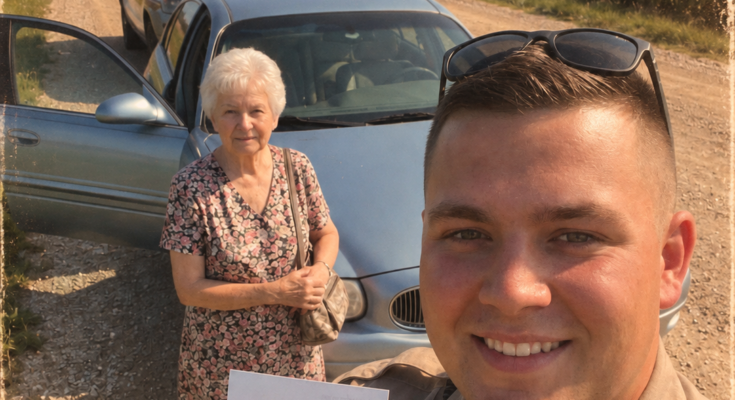
Part Two — The Voice Everyone Remembered
The deputy’s hand stopped halfway to his radio.
Then the woman’s voice came through again.
“Fourteen, confirm the name. Shirley Hagen?”
His smile was gone now.
“Affirmative.”
Another voice broke in before the dispatcher could answer.
Older. Male. Firm.
“Unit Fourteen, this is Sheriff Dalton. What is the status of Mrs. Hagen?”
The deputy glanced at Mom.
“Possible fraudulent temporary license.”
“Did you verify the document number?”
“I ran her information.”
“That isn’t what I asked.”
The road suddenly seemed very quiet.
Sheriff Dalton continued.
“Her temporary credential is valid. Dispatch can walk you through the verification. In the meantime, why is a seventy-one-year-old woman standing beside a highway in ninety-one-degree heat?”
The deputy looked toward his cruiser.
I saw something change in his face.
Not fear exactly.
Recognition.
He was beginning to understand that the woman he’d spent forty minutes treating like a joke was known by the voices coming through his radio.
“Put Mrs. Hagen somewhere cool,” Dalton ordered. “Your supervisor is en route.”
Mom finally climbed back into our car.
I handed her a bottle of water.
Her fingers shook slightly as she opened it.
That bothered me more than anything.
Mom had looked completely calm standing beside the road.
Only now did I understand how hard she’d been working to stay that way.
Ten minutes later, Captain Miguel Ruiz arrived.
The moment he saw Mom, he stopped.
“Miss Shirley?”
Mom looked at him.
“Miguel?”
He laughed once in disbelief.
Then his expression changed when he looked at the deputy.
Ruiz had started in county communications at twenty-two.
Mom had trained him.
So had Sheriff Dalton.
Over the next few minutes, I learned what “answering phones” had actually meant.
For thirty-four years, Mom had worked nights in emergency communications.
She had talked frightened teenagers through crashes.
Sent ambulances to farms without street addresses.
Tracked deputies during storms when radio signals failed.
Stayed on the line with domestic violence victims hiding in closets.
Once, during a tornado outbreak, she’d remained at her console seventeen hours because replacements couldn’t reach the courthouse.
She knew half the county’s retired deputies by voice.
And many of the current supervisors had started their careers hearing Shirley Hagen calmly tell them where help was coming from.
Captain Ruiz asked what happened.
Mom told him exactly.
No exaggeration.
No demand for revenge.
When she finished, Ruiz turned to the deputy.
“Body camera running?”
“Yes, sir.”
“Good.”
He looked back at Mom.
“We’ll preserve everything.”
The deputy finally spoke to her.
“Ma’am, I didn’t know who you were.”
Mom stared at him for a moment.
Then she said the sentence I’ve remembered ever since.
“You shouldn’t have needed to.”
━━━━━━━━━━━━━━━━━━━━
Part Three — What My Mother Actually Did
Mom filed a formal complaint the following Monday.
She didn’t call Sheriff Dalton privately.
She didn’t ask Captain Ruiz to “take care of it.”
She filled out the same paperwork anyone else would have been required to complete.
The department reviewed the body-camera footage, radio traffic, computer checks and the length of the stop.
The temporary license had been valid.
The deputy had apparently entered information from the document incorrectly and, instead of resolving the discrepancy promptly, decided the paper itself must be suspicious.
What troubled the department more was everything after that.
The mocking.
The unnecessary delay.
Mom’s request to sit somewhere cooler.
The fact that he’d already decided she was foolish before he’d finished determining whether she’d done anything wrong.
There were consequences.
He was removed from road duty temporarily while the complaint was investigated, received discipline, and underwent additional training.
Mom never celebrated.
When I asked whether she thought he should lose his job, she shook her head.
“That’s not my decision.”
“But after what he did?”
“He needs consequences, Jeffrey. He also needs somebody to teach him.”
Then she looked at me.
“Humiliating him won’t undo him humiliating me.”
That was my mother.
Two weeks later, she asked me to drive her to the courthouse.
She had another pan of lemon bars balanced on her knees.
“Who are those for?”
“Dispatch.”
I laughed.
“You almost got heatstroke and you’re bringing them dessert?”
“They didn’t leave me standing outside.”
Fair enough.
The communications center was nothing like I remembered from childhood.
The old radios had been replaced by computer screens and digital maps.
But something hadn’t changed.
The moment Mom walked through the door, people recognized her.
“Shirley!”
A woman hurried around the console and hugged her.
Another dispatcher called toward the back:
“Somebody tell Dalton Miss Shirley brought lemon bars.”
Mom rolled her eyes.
“Apparently retirement means nobody thinks I have a last name anymore.”
They laughed.
I stood near the doorway watching people come over.
Some were old coworkers.
Others had never worked beside her but knew stories about her.
Captain Ruiz appeared carrying coffee.
He pointed at the lemon bars.
“Are those the famous ones?”
“They’re only famous because deputies will eat anything that’s free.”
Then a young dispatcher asked Mom something.
“Is it true you stayed on a call with a boy during the tornado in ’98?”
Mom thought about it.
“The farmhouse outside Whitaker?”
The dispatcher nodded.
“He was nine.”
Mom corrected her.
“Ten.”
“What happened?”
“His mother was trapped downstairs. He and his sister were in the bathtub.”
“And you stayed with them?”
“Until firefighters arrived.”
“How long?”
“Hour and seventeen minutes.”
Something turned over inside me.
I remembered that night.
I had been sixteen.
Mom missed my basketball game.
I had been furious.
When she came home the following morning, exhausted, I barely spoke to her.
She never told me she’d spent the night helping two terrified children survive a tornado.
On the drive home, I finally said it.
“Mom?”
“Hmm?”
“I used to be embarrassed when people asked what you did.”
She looked out the window.
“I know.”
That answer hurt.
“You knew?”
“Children notice what adults respect.”
“I told people you just answered phones.”
“Well, technically, there were phones.”
“Mom.”
She smiled.
I didn’t.
“I’m sorry.”
She reached over and squeezed my wrist.
“You don’t owe me an apology for being sixteen.”
“It wasn’t only when I was sixteen.”
She became quiet.
“I spent years making what you did sound small.”
Mom watched the cornfields passing outside.
Then she said:
“The work wasn’t important because people knew my name, Jeffrey.”
I waited.
“It was important because when frightened people called, somebody had to answer.”
A month later, we drove County Road 6 again.
The corn was beginning to turn brown.
Mom’s permanent license had finally arrived.
She pulled it from her purse at a stop sign and held it toward me.
“Look. Made professionally this time.”
I laughed so hard I nearly spilled my coffee.
She tucked it away.
And I thought about what she’d told that deputy.
I don’t think I’m somebody.
For weeks, that sentence bothered me.
Because she was somebody.
But eventually I understood what she’d meant.
The deputy wasn’t wrong because he’d accidentally humiliated a woman who knew the sheriff.
He was wrong because he’d humiliated a woman.
Her job history didn’t create her dignity.
Her connections didn’t create it.
Her age didn’t create it.
And recognizing her name shouldn’t have been necessary before somebody decided she deserved water, shade, patience and basic respect.
That afternoon, we stopped at the courthouse again.
Mom carried lemon bars inside.
The security officer smiled when he saw her.
“Morning, Shirley.”
“Morning, Carl.”
Nothing dramatic happened.
Nobody saluted.
Nobody rushed over.
She was simply an old woman walking into a building where she’d once worked nights while most of the county slept.
As we headed downstairs, someone asked me whether Mom had worked there.
For most of my life, I would have answered:
“She answered phones.”
This time I looked at her.
Then I said:
“My mother spent thirty-four years helping people get home.”
Mom stopped walking.
She didn’t say anything.
She just smiled.
And that was when I finally understood why she’d asked the deputy to press that button and say her name.
She wasn’t asking the radio to prove she was important.
She was asking it to bear witness.