
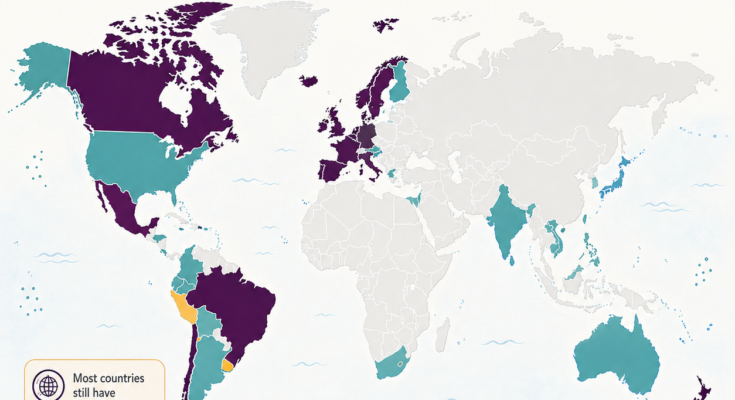
A world map of “conversion therapy” laws reveals a striking legal divide.
Across parts of Europe, North America, Latin America and Oceania, governments have introduced laws restricting practices intended to change or suppress a person’s sexual orientation or gender identity.
Elsewhere, restrictions are indirect—often operating through rules governing doctors, psychologists or other licensed professionals.
Some countries have protections only in particular states, provinces or regions.
And across most of the world, there is still no nationwide restriction of the kind tracked by ILGA World.
The result is a complicated global patchwork rather than a simple division between “legal” and “illegal.”
What Does “Conversion Therapy” Mean?
The phrase generally refers to practices intended to change, suppress or redirect a person’s sexual orientation, gender identity or gender expression.
ILGA World prefers the wording “so-called conversion therapies” because the word therapy can imply a legitimate medical treatment.
Major medical organizations reject that implication.
The American Psychiatric Association states that conversion practices intended to change sexual orientation or gender identity lack supporting evidence and can carry significant risks of harm. (American Psychiatric Association)
The Pan American Health Organization, part of the WHO system, has similarly stated that efforts to “cure” a non-heterosexual orientation lack medical justification and can threaten health and well-being. (PAHO)
So another increasingly common term is:
“conversion practices.”
That wording avoids suggesting that these interventions are recognized medical therapies.
The Map Has Four Very Different Categories
The infographic separates countries into four broad groups.
Restrictions in Place
Purple represents countries with direct nationwide legal restrictions.
According to ILGA World, 17 UN member states had implemented nationwide bans or restrictions by May 2026. (ILGA World)
These countries are concentrated especially in:
Western Europe,
parts of the Americas,
and Oceania.
But purple does not mean every country’s law is identical.
One law might ban the practice for everyone.
Another may protect only minors.
Another may apply specifically to medical or psychological professionals.
Another might prohibit paid services but have exceptions for certain non-commercial contexts.
Those differences are important.
Canada Is One of the Stronger National Examples
Canada stands out prominently on the map.
The country moved from a patchwork of provincial and local rules to nationwide criminal-law restrictions.
Its inclusion illustrates a broader trend seen in several countries:
legal change often begins locally.
A city acts first.
Then a province or state.
Eventually, a national legislature follows.
This is one reason older versions of global conversion-practice maps can become outdated surprisingly quickly.
Europe Contains the Largest Cluster of National Restrictions
Western Europe is the most visually obvious concentration of purple.
Countries including France, Germany and several neighboring states have adopted restrictions of different scopes.
This regional concentration reflects years of:
professional medical guidance,
national legislation,
court decisions,
and broader European human-rights debates.
But Europe is far from uniform.
Large parts of Central and Eastern Europe remain gray on the current map, meaning ILGA does not classify them as having the same type of restriction.
Even within the European Union, national laws can therefore differ substantially.
Latin America Has Been Important in the Legal History
Latin America was an early region for legal and professional action.
Brazil and Ecuador were already among the small number of countries with national restrictions when ILGA World published its first major global survey in 2020. (ILGA World)
Several other countries developed what ILGA calls indirect restrictions.
These may operate through healthcare law rather than a dedicated “conversion therapy ban.”
That distinction explains the teal color on the map.
What Is an “Indirect Restriction”?
Indirect restrictions can be harder to understand than straightforward bans.
Imagine that a country does not have a statute saying:
“Conversion therapy is prohibited.”
Instead, its medical regulations might say that doctors cannot diagnose or treat someone as mentally ill solely because of their sexual orientation.
Or professional licensing rules may prevent psychologists from offering services designed to “cure” homosexuality.
The result can substantially restrict conversion practices within healthcare even without a dedicated criminal ban.
ILGA has historically identified examples of this type of regulatory approach in countries including Argentina and Uruguay, as well as several Pacific jurisdictions. (ILGA World)
That is why teal should not be interpreted as:
“Conversion practices are completely legal.”
It means the restriction works indirectly.
The United States Is Particularly Complicated
The United States is a perfect example of why national maps can oversimplify law.
For years, regulation primarily developed state by state.
Different states adopted different rules, particularly concerning licensed professionals working with minors.
Other states had no equivalent restrictions.
That means someone’s legal protections could change simply by crossing a state border.
And the legal landscape continues to evolve.
In March 2026, the American Psychiatric Association responded to the U.S. Supreme Court’s decision in Chiles v. Salazar, warning that the ruling could affect state protections against conversion practices for minors. (American Psychiatric Association)
So for countries such as the United States, a global map should always be accompanied by the warning:
“Rules vary by state or jurisdiction and may change through litigation.”
“Varies by Region” Is More Important Than It Looks
The orange category means there is no single rule covering the entire country.
Instead, restrictions exist only in certain states, provinces or regions.
This creates a very different legal situation from a national ban.
For example, one region may prohibit licensed therapists from offering conversion practices to minors.
The neighboring region may have no comparable law.
A person seeing only a country-level map could easily miss that distinction.
This is why ILGA’s database separates:
national restrictions,
subnational restrictions,
and indirect regulation.
Most Countries Still Have No Restrictions
The gray areas dominate much of:
Africa,
Asia,
the Middle East,
and parts of Eastern Europe.
ILGA’s map therefore makes a striking point:
although legal restrictions have expanded quickly, most countries still do not have a nationwide prohibition or comparable restriction in place.
But “no restriction” must be interpreted carefully.
It does not necessarily mean:
- the practice is common;
- the government endorses it;
- doctors consider it legitimate;
- every form of abuse associated with it is lawful.
Other laws can still apply.
For example, conduct involving:
physical assault,
unlawful confinement,
fraud,
sexual abuse,
or practicing medicine without a license
may violate completely separate laws.
The map tracks regulation specifically directed toward conversion practices.
Why Medical Organizations Reject the Practice
One of the strongest reasons governments began regulating conversion practices came from the medical profession itself.
PAHO/WHO has stated that homosexuality is not a disease and therefore does not require a “cure.” It found no rigorous evidence showing that efforts to change sexual orientation are effective and cited reports of depression, anxiety, shame and other harms associated with such practices. (PAHO)
The American Psychiatric Association reaffirmed its position in 2024.
It opposes conversion practices based on the assumption that diverse sexual orientations or gender identities are mental illnesses and instead supports therapies that do not treat those identities as pathology. (American Psychiatric Association)
The United Nations Independent Expert has also described “conversion therapy” as an umbrella term covering many different interventions based on the idea that sexual orientation or gender identity can and should be changed. (OHCHR)
The Practices Can Be Very Different
One reason regulation is difficult is that “conversion therapy” does not describe one single procedure.
Historically, practices have included forms of:
psychotherapy,
behavioral conditioning,
religious counseling,
institutional programs,
and more coercive interventions.
Some historical interventions were extremely severe.
Modern practices can be much less visibly medical and may take place outside licensed healthcare systems altogether.
That creates an important loophole.
A government may prohibit licensed psychologists from conducting conversion practices while leaving:
religious organizations,
unlicensed counselors,
family-directed programs,
or informal interventions
outside the law.
So two countries shown in the same color can provide very different levels of practical protection.
Protecting Minors Is Often the First Step
Many legal restrictions focus first on children and adolescents.
The reasoning is that minors have less ability to:
refuse treatment,
leave a program,
choose another provider,
or resist pressure from parents or guardians.
As a result, some jurisdictions prohibit conversion practices only when the client is below a specified age.
Adults may remain legally able to seek the same services voluntarily.
Other jurisdictions go further and prohibit providers from offering them regardless of the person’s age.
That distinction is one of the most important things a simple four-color world map cannot display.
Professional Ban vs. Criminal Ban
Another major difference is who can be punished.
Suppose a psychologist offers prohibited conversion therapy.
Depending on the country, consequences might include:
a professional warning,
license suspension,
loss of the right to practice,
a fine,
civil liability,
or criminal penalties.
Those are very different legal systems.
A medical licensing restriction may be highly effective against licensed professionals but irrelevant to unlicensed organizations.
A criminal prohibition can reach more people but may require a higher legal burden of proof.
There is therefore no universal model.
The Number of Countries With Restrictions Has Grown Quickly
The change since 2020 is striking.
When ILGA World published Curbing Deception in February 2020, it identified only three UN member states—Brazil, Ecuador and Malta—with nationwide legal restrictions. (ILGA World)
By 2024, ILGA reported:
16 countries with nationwide bans. (ILGA World)
By May 2026:
17 UN member states
had nationwide bans or restrictions. (ILGA World)
That means the global legal landscape changed dramatically in only six years.
But Laws Alone Do Not End the Practice
ILGA itself stresses that legal bans are only part of the response.
Its policy toolbox argues that effective restrictions can also require:
public awareness,
professional education,
implementation,
survivor support,
and enforcement. (ILGA World)
A law that exists only on paper may have little effect if:
people do not know it exists,
professional regulators do not investigate,
victims cannot report violations,
or practices simply move underground.
This is a recurring problem in almost every area of law.
Legal status tells us what governments have written into legislation.
It does not automatically tell us what happens in real life.
Why Comparing Countries Is Difficult
There is another reason this map should be treated as a broad overview rather than a legal guide.
Definitions differ.
One jurisdiction might define conversion practices as attempts to change:
sexual orientation only.
Another covers:
sexual orientation and gender identity.
A third may explicitly include:
gender expression.
Some laws exempt certain conversations or counseling.
Others regulate only activities claiming a therapeutic purpose.
Different definitions can substantially change the scope of a restriction.
Therefore, saying simply:
“Country X banned conversion therapy”
can conceal a lot of legal detail.
What the World Map Really Shows
The most interesting feature is not simply which countries are purple.
It is how fast an entirely new area of law has emerged.
In 2020, national restrictions were rare.
Six years later, they stretch across multiple continents.
Meanwhile, most of the world still has no specific nationwide restriction.
And between those two extremes are countries using:
professional regulations,
healthcare laws,
state or provincial bans,
or mixed systems.
The result is a legal geography that is still actively changing.
Final Thought
This map is ultimately less about four colors and more about four different approaches to regulation.
Some governments directly prohibit conversion practices.
Others restrict them through professional healthcare rules.
Some leave decisions to states and provinces.
Most still have no specific national restriction.
At the same time, major health organizations have reached a much clearer position: attempts to change sexual orientation lack a medical basis, while major psychiatric organizations also oppose efforts built on treating diverse sexual orientations and gender identities as mental disorders. (PAHO)
As legislation continues to change, the map will almost certainly look different again in a few years.
Accuracy Note for Your Infographic
The overall concept is good, but I would update:
“ILGA World data (April 2026)”
to:
“ILGA World Database — updated July 2026.”
The live database currently gives July 2026 as its update date. (ILGA Database)
I would also consider changing the title to:
“Where So-Called ‘Conversion Therapies’ Are Legally Restricted”
because the map includes both direct and indirect restrictions rather than only outright bans.
Finally, add a small note:
“Restrictions vary in scope. Some apply only to minors, licensed professionals, particular practices, or specific regions.”
That will prevent readers from assuming every purple or teal country has identical legislation.