Part 1: The Mocking
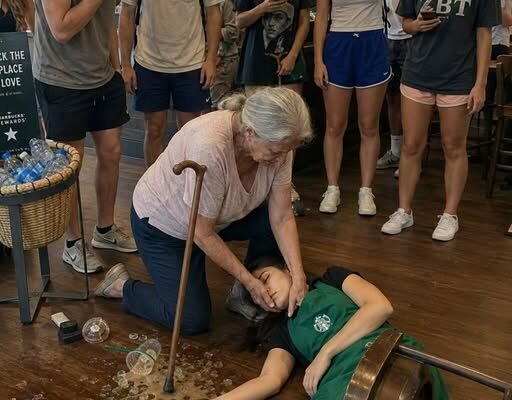
The tray of iced lattes hit the hardwood floor with a sound like a shotgun blast. Shards of plastic and crushed ice exploded across the room, but nobody was looking at the mess. They were looking at Chloe, the bright-eyed, twenty-something barista. She was on the ground, her body thrashing violently against the bottom of the counter.
Panic erupted. It was a packed Tuesday afternoon in the trendy downtown coffee shop. Dozens of college students were suddenly on their feet, screaming, gasping, or covering their mouths in horror. But not a single one stepped forward. Instead, the modern instinct kicked in. A sea of smartphones went up. People froze, paralyzed by the sudden trauma, recording the nightmare instead of stopping it.
Then came a sound that cut through the chaos. It was the sharp, heavy clatter of a wooden cane hitting the floor.
Eleanor was moving.
At 71 years old, Eleanor was a fixture at the cafe, and not a popular one. She had a severe limp, a deeply lined face, and a permanent scowl. The students usually steered clear of her corner table. They whispered about her, rolling their eyes when she glared at them for playing their videos too loud. To the young, vibrant crowd, she was just a bitter, broken woman who had outlived her joy.
They couldn’t have been more wrong.
Eleanor pushed through the crowd with a speed that defied her crippled leg. She shoved a terrified young man out of her path. “Move!” she roared. Her voice didn’t shake. It wasn’t the frail rasp of an elderly woman. It was a voice used to commanding chaos. It echoed off the exposed brick walls, instantly silencing the panicked whispers of the crowd.
Eleanor dropped to her knees beside the thrashing barista. She didn’t hesitate for a fraction of a second. She grabbed a thick canvas jacket off the back of a nearby chair, deftly rolled it up, and wedged it gently under Chloe’s head to stop it from slamming against the floorboards.
“Clear the area! Move those chairs back, now!” Eleanor barked, her eyes darting around the circle of frozen faces. She pointed a crooked, arthritic finger directly at a boy holding his phone up. “You. Put that away and call 911. Tell them we have an active grand mal seizure. Patient is in her twenties. Breathing is currently uncompromised.”
The boy blinked, stunned into submission, fumbled his phone, and immediately dialed the number.
Part 2: The Hero
Eleanor gently rolled Chloe onto her side, placing her in the recovery position. She checked the young woman’s airway, her movements precise, practiced, and entirely devoid of panic. She glanced at her wristwatch, noting the exact time the convulsing began.
The entire coffee shop watched in absolute, stunned silence. The “grumpy old gargoyle” they had dismissed and ignored for months was completely in her element. She was an island of absolute calm in a sea of hysteria.
For three excruciating minutes, the seizure continued. Eleanor stayed kneeling on the hard, wet floor, her hand resting gently on Chloe’s shoulder, murmuring quiet, soothing words that only the barista could hear.
Finally, the thrashing began to subside. Chloe’s muscles relaxed, and she let out a long, ragged breath, slipping into the deep sleep that follows a severe episode.
“She’s stabilizing,” Eleanor announced to the room, though she never took her eyes off the girl. “Keep the space clear. Give her air.”
Sirens wailed in the distance, growing louder until they stopped right outside the large glass windows. Two paramedics rushed through the doors, carrying their heavy medical bags. They looked at the scene, expecting the usual frantic, unhelpful crowd.
Instead, Eleanor looked up and delivered a flawless clinical report. “Female, mid-twenties. Grand mal seizure lasting approximately three minutes and forty seconds. Placed in the left lateral recumbent position. Airway is clear. Pulse is strong but rapid. She has not regained consciousness, currently in the postictal state. No signs of head trauma prior to my securing her.”
The lead paramedic blinked, clearly taken aback by the precise medical terminology. “Copy that,” he said with immediate respect. “We’ve got it from here. Excellent work, ma’am.”
It took two strong students to help Eleanor back to her feet. Her bad leg was shaking violently from the strain of kneeling on the hard floor, and her face was pale with exhaustion. She retrieved her heavy wooden cane and leaned heavily against a table, catching her breath.
The ambulance crew carefully loaded Chloe onto a stretcher and wheeled her out the door. The cafe was completely silent. Nobody was looking at their phones anymore. They were all looking at Eleanor.
Part 3: The Reckoning
A girl from a nearby table, one who had previously complained to her friends about Eleanor’s “bad vibes,” stepped forward hesitantly. “Ma’am?” the young student asked, her voice trembling slightly. “How… how did you know exactly what to do? You were amazing.”
Eleanor looked at the girl. The permanent scowl was gone, replaced by a deep, weary kindness that transformed her entire face. She adjusted her grip on her cane and let out a soft, gravelly chuckle. “I spent forty years as a triage nurse in an inner-city emergency room,” Eleanor said quietly. “I’ve seen gunshot wounds, multi-car pileups, and cardiac arrests before my morning coffee. A seizure in a coffee shop is just a Tuesday.”
The words hung in the air, heavy and profound. The students realized in that moment how incredibly blind they had been. They had looked at the wrinkles, the limp, and the gruff exterior, and they had seen a nuisance. They didn’t see the thousands of lives those crooked hands had saved. They didn’t see the decades of trauma, exhaustion, and unwavering dedication that had put the limp in her walk and the severe look on her face.
They had judged a book by its worn, battered cover, completely ignoring the incredible story written on the pages inside.
Before Eleanor could turn to leave, the cafe manager walked out from behind the counter. He wiped his eyes, handed her a fresh, steaming cup of black coffee, and quietly said, “This one is on us. And every one after this, for as long as you want to come here.”
Eleanor took the cup, nodded gracefully, and slowly made her way out the door, her cane clicking rhythmically against the floorboards.
The next day, when Eleanor arrived at her usual time, the corner table wasn’t empty. There was a small vase of fresh flowers sitting in the center of it, and a handwritten note taped to the wood. It was signed by every single student who had been there the day before.
The message was simple: “Thank you for showing us what a real hero looks like. We’re honored to share this space with you.”
Eleanor read the note, and for the first time in months, a real smile crossed her face. She sat down, sipped her coffee, and looked out the window at the busy street. She had been coming to that cafe for years, but she had never felt welcome. Now, she did.
Over the following weeks, things changed. Students started greeting her by name. They offered to carry her coffee to her table. They asked her questions about her nursing career. They listened to her stories. They learned that the “grumpy old woman” had a wealth of knowledge and experience.
One student even asked her to speak at a campus event about emergency preparedness. Eleanor agreed. She stood on a stage in front of hundreds of young people and told them the truth: that heroes don’t always wear capes. Sometimes they’re just ordinary people who have seen too much and learned how to stay calm when others panic.
She told them that every one of them had the potential to be a hero. It just took training, courage, and the willingness to step forward when everyone else steps back.
The applause was deafening. Eleanor didn’t cry. She wasn’t the type. But she felt something she hadn’t felt in a long time: hope.
Chloe, the barista, recovered fully. She came back to work a few weeks later, her first stop Eleanor’s table. She handed her a thank-you card and a homemade pastry. “You saved my life,” she said. Eleanor waved her hand. “I just kept your head from hitting the floor.” “No,” Chloe said. “You saved my life.”
Eleanor didn’t argue. She just took the pastry and smiled.
The cafe became Eleanor’s second home. She still sat in the corner. She still drank black coffee. But now, she was surrounded by friends. The students who had once mocked her now respected her. The staff who had tolerated her now welcomed her.
And every once in a while, someone would approach her table and ask, “Is it true you delivered a baby in an elevator?” Eleanor would chuckle. “I delivered two,” she’d say. “And one of them was a dog.”
They never knew if she was joking. They never wanted to ask.
Society tells us that value belongs to the young, the beautiful, and the loudly visible. But the truth is, the most extraordinary people are often sitting quietly in the corner, carrying histories of unimaginable strength.
The next time you see someone who looks a little rough around the edges, or moves a little slower than the rest of the world, take a second before you judge them. You might just be standing in the presence of a hero who is simply resting their legs.
Eleanor lived another ten years. She never stopped going to the cafe. She never stopped being grumpy. But she also never stopped being the hero.
And when she died, the cafe held a memorial service in her honor. The students who had once laughed at her now spoke about her with reverence. They told stories about her kindness, her wisdom, and her unwavering strength.
They placed a small plaque on her corner table: “Reserved for Eleanor. The hero who sat among us.”
Because sometimes, the people who seem the least likely to be heroes are the ones who have been saving lives all along—and we were just too busy looking at the outside to see what was truly inside. ❤️