Part 1: The Invasion
I inherited my grandfather’s ranch at 9:12 on a Saturday morning. By 10:03, more than a hundred strangers were fishing on it.
Six weeks after my grandfather Walter died, the estate had finally closed. His attorney handed me the keys, the certified deed, the survey records, and a battered leather folder Grandpa had kept updated for decades. I drove straight to the ranch because I wanted silence.
Instead, pickup trucks lined the ranch road almost to the county highway. Bass boats sat on trailers. Men carried tackle boxes toward the water. A registration tent stood beside Grandpa’s equipment shed, and a banner stretched between two posts announcing the CEDAR GLEN COMMUNITY FISHING TOURNAMENT. Someone was already launching a boat into Pond Two.
I parked near the registration tent. A woman in a pink blazer marched toward me. “Sir, you can’t park there.” I looked past her. “That’s my barn.” She stopped. “My name is Ethan Walker.” Recognition crossed her face. “You’re Walter’s grandson.”
“Yes.” She introduced herself as Karen Whitmore, president of the Cedar Glen Residential Association, the gated subdivision bordering the eastern side of the ranch. I pointed toward the water. “What exactly is happening?” “Our annual community tournament.” “On my ponds?” Karen folded her arms. “The community has used these ponds for years. Walter always understood the arrangement.” “What arrangement?” “Recreational access.” “Can I see it?”
She laughed. Actually laughed. “You inherited the ranch an hour ago and already want to renegotiate community traditions?” “I’m not renegotiating anything. I’m asking whether you have permission to run a paid tournament on private land.”
Her expression hardened. More than a hundred competitors had paid entry fees, she told me, and the event wasn’t stopping because I had suddenly decided to make ownership an issue. Ownership. As though I’d invented the word that morning.
I went back to my truck and brought her the leather folder. The certified deed was on top, followed by recorded surveys, parcel maps, and tax records. Karen barely glanced at the first page. “The HOA has recreational rights.” “Where?” “It’s longstanding.” “That isn’t a document.” “Tradition matters.” “Not more than a deed.”
Part 2: The Investigation
Instead of arguing, I walked the shoreline. Grandpa had shown me the property markers when I was a teenager, and near Pond Two I found one beneath the weeds. I scraped dirt from the stamped cap with my boot and compared the survey number with the plat in my folder. It matched. Pond One. Pond Two. Pond Three. The shorelines, boat ramps, and access roads were all shown inside Walker Ranch.
So I called Grandpa’s attorney, Samuel Price. “Did Grandpa ever grant Cedar Glen an easement or recreational agreement?” “No,” Samuel said. “Ever?” “I reviewed the chain of title during probate. There is no recorded recreational easement.” He warned me not to assume that ended the question. Ask the HOA to produce whatever document they believed gave them access, he said.
Fair enough. I found the tournament director, Brian Foster. Unlike Karen, Brian actually studied the deed and compared the parcel map with his event paperwork. His forehead tightened. “We were told the HOA had permission.” “Did you ever see anything signed by my grandfather?” “No.” “An easement?” “No.” “A lease?” “No.”
An angler nearby overheard us. “Wait, this isn’t HOA property?” Karen appeared almost immediately. “Nothing has changed,” she said. Brian turned to her. “Karen, where’s the access agreement?” “We’ve been doing this for years.” “That’s not what I asked.”
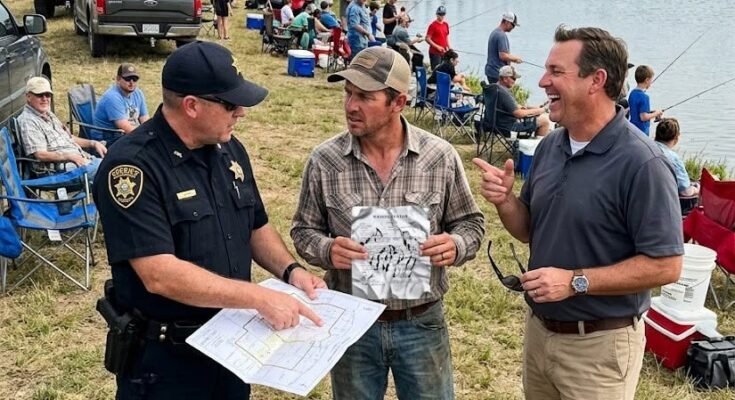
Now people were watching. Then a sheriff’s SUV rolled through the gate. Karen smiled as if the cavalry had arrived and reached Deputy Mark Collins before I did. “This man is interfering with a permitted community event,” she told him.
Collins looked past her at me. “You the property owner?” “As of this morning.” Karen immediately started talking again—annual tournaments, community use, years of tradition, Grandpa never objecting.
I didn’t argue with her. I opened the battered leather folder, pulled out the certified deed, and placed it directly into Deputy Collins’s hand.
Part 3: The Reckoning
Deputy Collins studied the deed carefully. Then he looked at Karen. “Ma’am, do you have any documentation showing the HOA has permission to be here?”
Karen’s confidence faltered. “We’ve had an arrangement for years. Walter knew about it.”
“Did he sign anything?”
“He never objected.”
“Ma’am, that’s not the same thing as permission.”
The crowd had grown quiet. Anglers were setting down their rods. Some had already started packing their gear. Brian Foster stepped forward. “Deputy, if we don’t have permission, we’ll leave. I’m not going to cause trouble.”
Karen tried to argue, but Brian was already walking toward the registration tent. “People, pack it up. The tournament is canceled.”
The HOA president turned to me, her face red with fury. “This isn’t over. The HOA will take this to court. We have legal rights.”
“Then produce the document,” I said. “Show me the signed agreement. Show me the easement. Show me a single piece of paper that proves my grandfather gave you permission to use his land.”
She couldn’t. Because it didn’t exist.
Deputy Collins handed the deed back to me. “Mr. Walker, if they return without permission, call us. We’ll handle it.”
I thanked him and watched as the crowd of anglers packed up their boats. Some approached me to apologize. Others looked angry—not at me, but at Karen for misleading them.
Brian Foster was the last to leave. “I’m sorry about this,” he said. “We were told we had permission. I should have checked.”
“You weren’t the one who misled everyone,” I said. “She was.”
He nodded, then drove away.
Karen stood alone near the registration tent, her pink blazer now looking more ridiculous than authoritative. “You’ll regret this,” she said.
“No,” I said. “I won’t.”
Over the following weeks, the HOA tried to fight. They hired a lawyer. They threatened to sue. But without any documentation, they had no case. The county confirmed the boundaries. The property lines were clear. Karen was forced to resign from the HOA board after the other members realized she had put the entire community at legal risk.
I kept the ranch. I fished the ponds whenever I wanted. And I posted signs at every entrance: “Private Property. No Trespassing.”
But I also did something unexpected. I sent a letter to every participant in that tournament, apologizing for the confusion and inviting them to fish the ponds for free—on one condition. They had to sign a liability waiver and agree to respect the property. Most of them did.
I didn’t want to be the villain. I just wanted my land to be respected.
Grandpa had trusted me with everything he built. I wasn’t going to let anyone take it away simply because they had “tradition” on their side. Tradition without permission is just trespassing. And trespassing without consequence is just entitlement.
I still think about that morning. The boats. The banners. Karen’s laugh when I asked for proof. But I also remember the moment the crowd realized they had been misled. The anger wasn’t aimed at me. It was aimed at the person who had lied to them.
I never saw Karen again. But I heard she moved out of Cedar Glen not long after. The HOA elected a new board. They reached out to me, offering an apology and an easement request—properly documented, properly signed.
I declined. But I told them I was open to discussing a lease arrangement for future tournaments.
That’s the difference between taking and asking. One creates conflict. The other builds community.
I think Grandpa would have been proud. He always said land was only as valuable as the people who respected it. I finally understood what he meant. ❤️