Part One: The Officers on My Porch
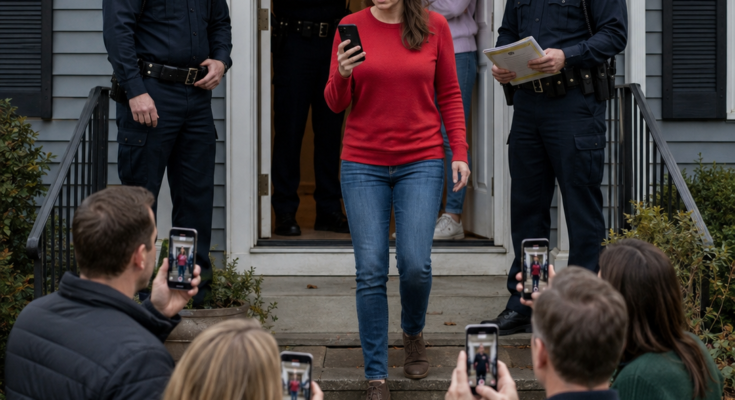
“Ma’am,” the taller officer said again, when I didn’t answer right away. “Can you confirm — you got a call around one a.m. asking for twenty thousand dollars?”
“Yes,” I said. “From my parents. Why? Is Travis okay?”
The two officers exchanged a look I couldn’t read yet.
“Your brother’s fine,” the shorter one said. “Physically, anyway. He was picked up last night on a DUI, second offense, and there was an outstanding warrant tied to it from a missed court date back in the spring. He’s being held until his arraignment.”
I felt something in my chest loosen, just slightly, at he’s fine. Whatever else was true, he wasn’t hurt.
“So why are you at my door?” I asked. “I didn’t send any money.”
“That’s actually why we’re here,” the taller officer said, and for the first time his voice softened into something almost apologetic. “We got a call early this morning from a woman identifying herself as your mother, reporting a large cash withdrawal made under your name — twenty thousand dollars, from an account she said was jointly held. She said it hadn’t shown up yet and she was worried something had happened to the transfer, or that you might’ve been scammed out of it.”
I stood in my doorway in my sweatpants, blinking at him.
“I don’t have a joint account with my parents,” I said slowly. “I haven’t since I was nineteen.”
He nodded like that answer didn’t surprise him nearly as much as it should have. “That’s what we’re finding out. We just needed to confirm, directly from you, whether you’d actually made a withdrawal or a wire transfer last night. For the report.”
“I didn’t send anything,” I said. “I told them to call my sister and I went back to sleep.”
The shorter officer wrote something down, and I caught the faintest twitch at the corner of his mouth — not quite a smile, but close to one, like a man who’d heard a hundred versions of family financial chaos and recognized the shape of this one instantly.
“That’s consistent with what we’re seeing,” he said. “We’ll be in touch if we need anything else. Sorry to wake you up over it.”
“You didn’t wake me up,” I said. “I slept fine.”
They left, and I stood in the doorway for a long moment after the patrol car pulled away, feeling the cold morning air on my bare feet, trying to understand what I’d just heard. My mother hadn’t just wanted the money. She’d told the police it had already been sent — that twenty thousand dollars of mine was somewhere out in the world, missing, and she was worried on my behalf.
She’d built a story where I was the one in trouble, using money I’d never given.
Part Two: What the Report Actually Said
I called Allison before I called my parents. She picked up on the second ring, sounding exactly as tired as I felt.
“Did they call you too?” I asked.
“At one-fifteen,” she said. “I told them I don’t have that kind of money lying around, and Mom got upset and hung up on me. Diana, what is going on? Is Travis okay?”
I told her what the officers had said — the DUI, the missed court date, the warrant, and then the part that actually mattered, the part about the “joint account” and the “missing transfer.” Allison went quiet for a long moment.
“She told the police you’d sent it,” Allison finally said. “Why would she say that?”
I thought about it while I made coffee I didn’t really want, phone wedged against my shoulder. “I think,” I said slowly, “she panicked when I hung up, and needed the story to still work. If I sent the money and it just hadn’t arrived yet, then Travis still gets bailed out eventually, and I’m still the good daughter who came through, and nobody has to explain to a bail bondsman why the money isn’t there.”
“That’s insane,” Allison said.
“It’s not insane,” I said. “It’s just what happens when the story’s been running for thirty years without anyone checking whether it’s true.”
I called my mother back around ten. She answered on the first ring, breathless, the same tone she’d used at 1 a.m.
“Diana, thank God — did you get my messages? Where’s the money, honey, the bondsman needs—”
“Mom,” I said, calm the way I’d been calm at 1:03 a.m., “I never sent any money. There’s no joint account. The police were at my door an hour ago because you told them there was.”
Silence. The same silence from the phone call, except this time I recognized it immediately for what it was — not shock, not grief. Recalculation.
“I was scared,” she said finally, her voice shifting registers, softer now, aimed at persuasion instead of panic. “I didn’t know what else to say. I thought if I told them it was already handled, they’d let him go faster, and then you’d send it and everything would just — work out, the way it always does.”
“The way it always does,” I repeated, “because I always make it work out.”
“Diana, please. He’s your brother.”
“I know,” I said. “And you used my name with the police this morning without asking me. That’s not being scared, Mom. That’s a plan. You had a plan, and it required me to say yes without ever actually being asked.”
She didn’t have an answer for that. For the first time in as long as I could remember, my mother had nothing to say at all.
Part Three: The First Peaceful Morning
Travis was arraigned two days later. I didn’t post anything, and neither did Allison. According to my father, a public defender got him released on his own recognizance pending trial, which — I looked it up, afterward, mostly out of curiosity — is what happens to a lot of people whose families don’t come running with cash at one in the morning. The system, it turned out, didn’t actually require twenty thousand dollars from me. It only ever seemed to.
My parents didn’t call for two weeks after that. When my mother finally did, it wasn’t with an apology, not really — it was a smaller, quieter voice, asking if I could just come to dinner. No mention of money. No mention of Travis, at first, until near the end, when she said, almost like an afterthought, that he’d started seeing a counselor as a condition of his release, and that maybe it would actually stick this time, since there wasn’t a rescue coming to interrupt it.
I went to that dinner. Luke came with me, which he’d never done before — he’d always given me space to handle my family alone, the way I’d always insisted I wanted it. This time I asked him to come, and he didn’t ask why, just laced his fingers through mine in the car and said he’d be there the whole time.
My father didn’t apologize either. Some things about him, I suspected, weren’t going to change on any timeline I controlled. But he didn’t ask me for anything that night, and for my family, that was close enough to progress that I let myself notice it.
Allison and I talk most weeks now, the way we probably should have been talking all along, instead of only finding each other in the wreckage of Travis’s latest emergency. She told me once that she used to think I was the strong one, the one who could handle anything, and that was exactly why nobody ever thought to ask if I was okay. I told her I used to think the same thing about myself, right up until the night I asked one simple question and nobody in my family could answer it.
Travis still calls sometimes, mostly to talk, not to ask. It’s slower than I expected, and smaller than the dramatic turnaround I might have hoped for a year ago. But it’s real, in a way the midnight phone calls never were, and these days, when my phone buzzes late at night, I no longer brace for the worst before I even pick it up.
Mostly, now, it’s just Allison, checking in before bed.
I always answer those.