The Locked Gate
The first thing my mother said was not hello.
“Open the gate, Paige. We’ve been driving for three hours, and the children are tired.”
Her voice came through the intercom beside my desk while I was reviewing payroll for twelve employees.
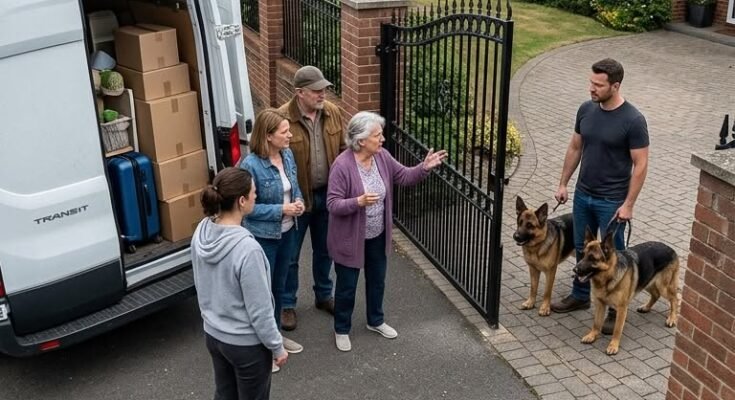
On the security monitor, Diane Whitaker stood under the camera wearing a beige coat and the same impatient expression I remembered from childhood. My twin sister, Mallory, waited beside her husband and three children. A rented moving truck blocked half of the gravel entrance.
Boxes were stacked beside the gate.
Every single one had been taped shut before anyone had asked if they were welcome.
Mallory leaned toward the intercom.
“The downstairs suite will be perfect for us. The kids can use the rooms across the hall.”
Her husband, Grant, looked past the bars toward my detached workshop.
“Does that building have heat? I could set up a furniture business in there.”
I watched them calmly discuss my property as if I had already agreed.
My mother glanced toward the neighboring driveway.
“Don’t embarrass me by making everyone stand outside.”
For twelve years, I had imagined what I might say if they ever came back needing something from me.
In those imagined conversations, I was always eloquent.
Standing behind a locked gate, I realized I needed very few words.
Mallory and I were born seven minutes apart, but our mother treated those minutes like proof that my sister had arrived first in every way that mattered.
Mallory got the bedroom with the window. The new winter coat. Dance lessons. Birthday parties planned around her friends.
I got her old clothes and constant reminders that I was easier.
“You’re independent,” Mom would say whenever Mallory needed something I had.
It sounded like praise until I understood that independent meant no one planned to show up for me.
The only person who noticed was our grandmother Elaine.
She took me to estate sales on Saturday mornings and taught me how to inspect repaired furniture.
“Never be ashamed of a crack,” she once told me. “Just pay attention to what caused it.”
At her kitchen table, I was allowed to speak without being told I was making things difficult.
When Grandma passed during my senior year, the balance inside our home changed almost immediately.
Mallory stopped pretending to share.
Mom stopped pretending to be fair.
A few months after graduation, Mallory announced she was expecting a baby. Her boyfriend, Grant, moved into our rented duplex with two laundry baskets, an oversized television, and no steady paycheck.
Mom decided my bedroom was the only room big enough for a crib.
I asked if I could sleep on the couch until community college started.
“Grant has back trouble,” she said. “He may need the living room.”
“What about the basement?”
“We need it for baby supplies.”
Then Mom folded her arms and said the sentence that separated my old life from everything that came after it.
“You’re nineteen, Paige. At some point, you have to stop being my responsibility.”
Mallory stood behind her with one hand resting on her stomach.
“You’ve always acted like you don’t need us,” she said. “This should be easy for you.”
I packed two trash bags while they watched television in the next room.
Mom handed me canned soup and crackers before I left.
“Tell people you chose to move out,” she said. “It sounds more mature.”
For several weeks, I slept on friends’ floors.
When those arrangements ended, I bought a discount tent and hid it behind the storage sheds of a roadside flea market outside Ridge Hollow.
I washed in gas-station bathrooms before work. I kept my clean shirt sealed inside a grocery bag so it would not smell like wet grass.
One rainy afternoon, Mom saw me collecting shopping carts outside the grocery store.
Our eyes met through her windshield.
Mallory sat beside her, laughing at something on her phone.
Mom did not stop.
She drove away slowly enough for me to understand that she had recognized me and chosen not to turn around.
That night, I held my prepaid phone for nearly an hour without calling her.
Instead, I made myself a promise.
I would build something so solid that no one could ever again decide, on my behalf, that I didn’t count.
It took twelve years, but it was never one dramatic leap. It was a hundred small, unglamorous ones.
The flea market owner, a widower named Hollis who ran the space more out of habit than ambition, noticed I showed up early and stayed late without being asked. He let me sleep in the back office once the weather turned, in exchange for keeping the books straight — something Grandma Elaine had taught me without either of us realizing it would matter this much. I learned to spot a chair worth restoring versus a chair worth walking past. I learned which vendors were drowning in inventory and which ones needed cash more than they needed a fair price. By twenty-two, I had saved enough to buy out two failing furniture booths at auction. By twenty-five, I had a small storefront. By twenty-eight, a workshop behind it, restoring and reselling what other people had decided was worthless.
I never called it luck when people asked. Luck implies something arrived when you weren’t looking. I had been looking the entire time — at every crack, every hinge, every piece of furniture and every version of myself that people said couldn’t be repaired.
By thirty-one, I owned four acres outside Ridge Hollow, a restoration business with twelve employees, a house with a gate that locked, and a life that answered to no one who hadn’t earned the right to ask.
My mother and sister never knew any of this. I made sure of it. Old friends who tried to pass along updates got the same answer: I appreciate it, but I’d rather they not know where I am. It wasn’t spite. It was architecture. You cannot build a foundation on ground people believe they’re entitled to stand on.
So when Diane’s voice came through that intercom twelve years later, the strangest part wasn’t the nerve of it. It was how quickly, how automatically, they’d already begun assigning rooms.
“Open the gate, Paige.”
I looked at the monitor. At the taped boxes. At Grant eyeing my workshop like a man measuring square footage he hadn’t earned. At three children who had never done anything to me, standing in the cold because the adults around them had built a plan on the assumption that I still didn’t count enough to be asked.
I pressed the intercom button.
“How did you find this address?”
Mom’s face flickered with something like relief — she thought I was finally being reasonable.
“Your cousin Renee mentioned the business. It wasn’t hard after that.”
“And the plan was to just arrive.”
“We’re family, Paige. Grant lost his job in March. Mallory’s been under so much stress with the kids. We knew you’d understand, since you’ve always been the strong one.”
There it was again. Strong. Independent. The word they’d always used instead of unclaimed.
“I want to be very clear,” I said, “so there’s no confusion later. This gate is staying locked. Not today, and not next week if you come back with a different story.”
Mallory stepped closer to the camera, her old performance of hurt sliding into place easily, like she’d never stopped practicing it. “After everything we’ve been through as a family, you’re going to leave us standing outside in the cold with your nieces and nephew?”
“I was standing outside in the rain once,” I said. “Mom drove past me pushing shopping carts and didn’t stop. You were in the passenger seat laughing at your phone. So don’t talk to me about family standing outside in the cold. You taught me exactly how that’s supposed to go.”
Silence came through the speaker for the first time since they’d arrived.
“I can give you the number for a shelter in the county,” I continued. “I can give you the number for a family services office that helps with emergency housing for kids. Those are real resources, and I mean that sincerely, for the children’s sake. What I won’t give you is a room in this house or a foothold in this business, because both of those were built by someone you decided, twelve years ago, didn’t need to be thought about.”
“You’d really do this to your own sister,” Mallory said. “Your own mother.”
“You did it to me first,” I said. “I just had further to fall, and no one to catch me. I built my own net. I’m not obligated to hand you a piece of it.”
I watched them a moment longer on the monitor — Grant already turning toward the truck, calculating, the way people do when a plan collapses and they start looking for the next one. My mother’s mouth opening to say something else, then closing, because for the first time in either of our lives, she didn’t have a version of the story where I was supposed to give in.
I gave the children a longer look before I ended the call — not because I owed anyone at that gate anything, but because none of what happened in that driveway had been their doing. I made a note to quietly get that shelter information to Renee, the cousin who’d given up my address, so it could find its way to them without ever needing to come through me directly.
Then I turned off the monitor, went back to the payroll spreadsheet open on my desk, and made sure every one of my twelve employees got paid on time that Friday — the same as every Friday since I’d learned that showing up for people, reliably, without being asked twice, was the whole difference between a family and a landlord you never chose.
The gate stayed locked. It still does.