Part I: The Stop
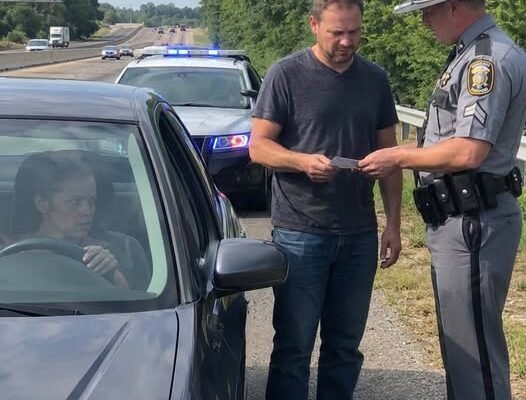
My wife got pulled over for speeding, and after the officer checked her license, his expression changed. He looked at me, then back at her, before asking me to step out of the car.
Red and blue lights washed across the windshield. My wife, Rebecca, eased our car onto the shoulder of Route 35 and sighed. “Great,” she muttered. “Your mother’s never going to let me forget this.”
I laughed. Normally she’d have laughed too. This time she just stared straight ahead, her knuckles pale on the wheel.
The trooper took her license and registration and walked back to his cruiser. He sat there a long time — checking his screen, checking our car, checking it again. Beside me, Rebecca had gone very still.
“You okay?” I asked.
“Fine.”
She was not fine. Thirteen years of marriage had taught me the difference.
When the trooper came back, he didn’t speak to Rebecca. He tapped on my window instead. “Sir, could you step out for a moment?”
My stomach tightened. I caught Rebecca’s eyes for a second, and in them was something I’d never seen before — real fear, gone as fast as it appeared.
I got out. The trooper walked me a few paces behind the car, out of earshot.
“You’re Nathan?” he asked.
“Yes.”
He hesitated, like he was deciding how much trouble he was about to cause himself. “This isn’t official. I could be wrong, and if I am, forget I said anything.”
“Said what?”
“Your wife’s plate came back registered to a name that isn’t hers. Rebecca Ann Voss. Nine years ago there was a missing-persons case out of Ashland County — a woman matching her description, same date of birth. Case went cold. Never closed.” He glanced past me at the car. “I’m not accusing anyone of anything. But whatever’s going on, I don’t think you should go home tonight. Find somewhere safe. Call this man in the morning.”
He pressed a card into my hand — a detective’s name and number scrawled on the back — and walked off before I could ask another question. A minute later he gave Rebecca a warning and let us go.
She was quiet the whole drive to her mother’s house, checking the mirrors twice, glancing behind us three times. At dinner she laughed at the right moments, cleared the dishes, told her usual stories. Too normal. The card sat in my pocket like a stone.
Around nine, she said she’d stay over to help her mother sort old photographs. I told her I had work in the morning and needed to get home. She studied me a beat too long, then nodded. “Drive safe.”
I didn’t go home. I sat in a motel parking lot an hour later, staring at the card, before I finally dialed the number.
A man answered on the second ring. “Detective Mercer.”
“My name is Nathan Brooks.”
A long pause. “I wondered if you’d call.”
Part II: The File
Mercer wouldn’t talk on the phone. Just: *come to Ashland tomorrow, come alone.*
I didn’t sleep. By nine I was in a small station office, watching a tired man set a thin folder on the desk between us.
“Nine years ago,” he said, “a woman named Rebecca Voss vanished from a house two miles from here. Her fiancé said she just never came home from her shift. We searched for months. Found her car. Never found her.”
He turned a photograph toward me — younger, thinner, but unmistakably my wife.
“I’m not telling you this to frighten you,” Mercer said. “I’m telling you because the fiancé, Daniel Voss, was never cleared. And three weeks ago, he made parole.”
My hands went cold.
“I don’t think your wife ran from nothing, Nathan. I think she ran *from* something, and built a whole life on the other side of it. And I think if Daniel Voss finds out where she is, he’s not going to knock politely.”
He slid a second photo across — a recent one, grainy, taken outside a gas station forty miles from our house.
“He’s already looking.”
Part III: What She Never Told Me
I drove home in silence, Mercer’s file on the passenger seat like a passenger of its own. Every mile, I rehearsed a hundred ways to ask my wife who she really was, and none of them survived contact with the truth I now knew: whoever answered the door tonight, I loved her. That much hadn’t changed.
Rebecca was waiting on the porch when I pulled in, arms crossed against the evening chill, and the moment she saw my face, she knew.
“You talked to someone,” she said. Not a question.
“A detective. Ashland County.” I held up the folder. “Rebecca Voss.”
She didn’t flinch, didn’t deny it. She just sat down heavily on the porch steps, and after thirteen years of marriage, I finally watched the last wall come down.
“His name was Daniel,” she said. “We were engaged. He told everyone I was gentle, that I needed protecting. What he meant was I needed controlling. The night I left, he’d broken two of my ribs the week before and told me the next time, he’d make sure I couldn’t leave at all.” Her voice didn’t shake. It had clearly been rehearsed for this moment for nine years. “I didn’t run to hurt anyone. I ran because it was the only way I was going to survive to thirty.”
“Why didn’t you go to the police?”
“I did. Twice. Both times, nothing happened — no charges, no protection, just a report in a drawer. So I found a woman who helped people disappear. New name. New city. New life.” She looked at me, eyes wet but steady. “And then I met you, and I never found the right moment to hand you a version of myself that came with a body count of almost-mine.”
I sat down beside her. “He’s out. He’s looking for you.”
For the first time, real fear crossed her face — not for herself, I realized, but for the life we’d built, the one she’d been so careful never to let him find.
“Then we go to Mercer together,” I said. “Tonight. Not to hide anymore. To finish this the way you should have gotten to nine years ago.”
She looked at me for a long moment, like she was waiting for the anger, the questions about every anniversary and holiday spent as someone else’s daughter-in-law under a stolen name. When it didn’t come, something in her shoulders finally loosened.
“You’re not angry?”
“I’m angry,” I said, “that you had to run at all. Not that you did.”
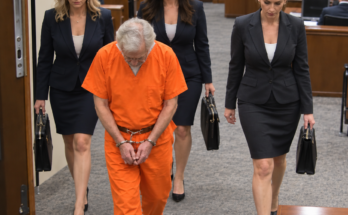
Three weeks later, Daniel Voss was arrested a mile from our old house, a burner phone full of surveillance photos of Rebecca in his pocket. Mercer’s decade-old case finally closed — not with a body, but with the woman everyone had assumed was one, sitting in a courtroom under her own two names, telling the truth for the first time since she was twenty-four.
Rebecca kept both names in the end. Voss on the paperwork that mattered, Brooks on everything else. “Proof,” she told me, “that a person can survive being erased and still choose who they get to be.”
The trooper who pulled her over that day never learned how the story ended. But some nights, I think about mailing him the last page — just so he knows that stepping out of that car, and taking a folded note from a stranger, was the moment my wife finally stopped running.