Part 1 — Twenty-Seven Messages
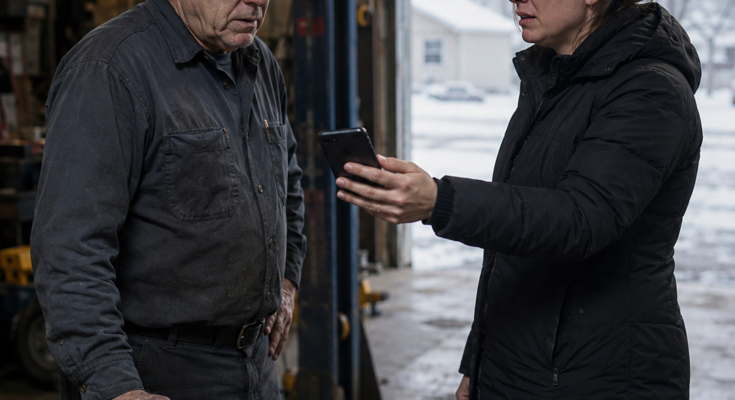
Three days after I buried my son, his wife walked into my auto shop and placed his phone on my workbench.
“There are twenty-seven recordings on this,” Grace said. “Every one of them is for you.”
Outside, February snow was turning gray along the Pennsylvania highway. Inside, the shop smelled like motor oil, cold metal, and the coffee I had forgotten to drink.
I stared at the phone.
“Ethan and I weren’t speaking,” I said.
“I know.”
Grace’s voice held no anger. Anger would have been easier. She looked exhausted, as if grief had kept her awake and then followed her into the morning.
“He recorded things when he wanted to call you,” she continued. “Then he always found a reason not to send them.”
I wiped my hands on a rag, although they were already clean.
“Why bring them now?”
Her eyes filled with tears.
“Because the last one was recorded the night he died.”
Then she left me alone with the phone.
My son had been thirty-six when an eighteen-wheel truck lost control on an icy stretch of Interstate 76. The police officer said Ethan probably never saw it coming.
People say that as if it is a kindness.
At the funeral, I stood in the back while teachers, neighbors, and former students filled every pew. Grace sat in front beside her mother. I had not known where I belonged, so I chose the place farthest from the family.
That was the punishment I believed I deserved.
Ethan and I had not spoken in four years, two months, and eleven days.
I knew the exact number because I had counted every one of them.
After my wife, Linda, died from cancer, Ethan came home from Philadelphia to help me run Hale Automotive. For eight months, he handled invoices before sunrise, taught high-school math during the day, and returned at night to close the shop.
I told myself he was learning the family business.
In truth, he was keeping his father alive.
One evening, he sat across from me in the office and said Grace had been offered a nursing position in Philadelphia. He wanted to move there permanently. He had been accepted into a program that would let him teach students with learning disabilities.
“I’m not a mechanic, Dad,” he said. “I love teaching.”
All I heard was that he was leaving, just like his mother had left me—though Linda had not chosen to die.
Grief can turn fear into cruelty before a man recognizes his own voice.
“Your grandfather built this shop,” I said. “I spent thirty-five years keeping it alive for you.”
“I never asked you to.”
That sentence struck exactly where he did not intend it to.
I stood and pointed toward the door.
“If you walk out now, don’t bother coming back.”
Ethan stared at me.
I expected him to argue. I wanted him to argue.
Instead, he picked up his coat.
“I hope you don’t mean that,” he said.
I did not answer.
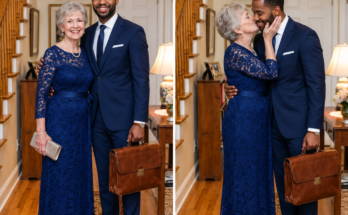
He mailed me an invitation to his wedding six months later. I mailed it back unopened.
Pride makes a man feel powerful for five minutes and lonely for years.
Now his phone lay on my workbench, offering me twenty-seven chances to hear the words I had refused while he was alive.
My finger hovered over the first recording.
The date was four days after his wedding.
I pressed play.
For several seconds, there was only breathing.
Then my dead son spoke.
“Hey, Dad. It’s Ethan.” He gave a nervous little laugh. “Obviously. You know my voice.”
I gripped the edge of the workbench.
“Grace wore Mom’s earrings at the wedding,” he continued. “I think you would’ve liked that. I kept looking at the church doors, even after the ceremony started. I know that was stupid.”
His voice became quieter.
“Anyway, I just wanted you to know there was a seat for you.”
The recording ended.
I played it again.
And again.
Then I opened the second message.
Part 2 — The Call He Never Made
I listened to all twenty-seven recordings in the order Ethan had made them.
They covered four years of a life I had missed.
In one, he told me about his first day teaching a class of students everyone else had labeled “difficult.” In another, he described buying a house with a basement that flooded during the first storm.
“You would’ve known how to fix it,” he said. “I watched six videos and somehow made it worse.”
Sometimes he sounded angry.
“You don’t get to punish me forever because I wanted a different life.”
Sometimes he sounded ashamed.
“I keep telling myself you should call first. Grace says that’s just pride wearing a nicer shirt.”
Once, there was nearly a minute of silence before he whispered, “I miss Mom.”
I lowered my head onto my arms and wept until the steel workbench was wet beneath my face.
The eighteenth recording had been made on my sixty-second birthday.
“I drove past the shop today,” Ethan said. “Your truck was outside. I parked across the road for twenty minutes. I almost came in.”
I remembered that day.
A dark sedan had been parked near the old pharmacy. I had noticed it because the driver never got out. For one foolish moment, I had wondered whether it was Ethan.
Then the car drove away, and I told myself I was relieved.
In the twenty-third message, I heard voices behind him—teenagers laughing, chairs scraping, a school bell ringing.
“One of my students fixed a lawn-mower engine today,” he said. “The shop teacher had given up on it. I showed the kid how you taught me: fuel, air, spark—start with what the machine needs, not with what you assume is broken.”
He paused.
“I talk about you more than you probably deserve.”
There was affection beneath the insult.
That hurt most of all.
Around midnight, Grace returned. Snow covered the shoulders of her black coat. She placed a paper bag of sandwiches on the desk but did not ask whether I had eaten.
“Did you know about these?” I asked.
“Some of them.”
“Why didn’t you make him call me?”
For the first time, anger flashed across her face.
“I tried.”
I looked away.
“Every Christmas, every birthday, every time we drove near Pittsburgh, I told him to walk through that door. But he remembered what you said.”
“I didn’t mean it.”
“He didn’t know that.”
The truth landed without mercy.
Grace sat in the battered chair beside my desk. She looked around at the old racing calendars, Linda’s photograph, and the wooden sign Ethan had painted for the shop when he was twelve.
“He loved you,” she said. “He was also furious with you. Both things were true.”
“Did he hate me when he died?”
“No.” Her voice softened. “But he was tired of being the only one who might have to risk rejection.”
I nodded because I had no defense.
Only one recording remained.
It had been made at 7:42 on the night of the accident.
The crash happened at 9:16.
I could not press play.
Grace reached across the desk, but she did not touch the phone. She simply rested her hand beside mine.
Together, we listened.
Road noise hummed beneath Ethan’s voice.
“Hey, Dad. I’m doing it. I’m coming to the shop tomorrow morning.”
He laughed, and for a moment he sounded seventeen again.
“The weather’s getting ugly, so I’m stopping at a motel soon. Grace thinks I should wait until next week, but I’ve waited four years already.”
There was a long pause.
“I don’t want the shop, Dad. I never did. But I want you. I think those became the same thing in your mind after Mom died.”
I covered my mouth.
“And I’m sorry too,” he continued. “I kept waiting for you to become less stubborn while practicing being just as stubborn myself.”
His turn signal clicked in the background.
“If you throw me out tomorrow, at least I’ll know I knocked. But I don’t think you will.”
Another pause.
“I love you, Dad. I’ll see you in the morning.”
The message ended.
Something inside me broke open.
“He was coming here,” I said.
Grace began to cry.
“Yes.”
“If I had called him—if I had apologized sooner—he wouldn’t have been on that road.”
“No.” Her voice became firm. “Do not turn his last act of hope into another weapon against yourself.”
I stared at her.
“He wasn’t driving here to die, Walter. He was driving here to live. Don’t make the accident mean something it didn’t.”
I wanted to argue, but she was right.
I had already wasted four years treating pain as proof that I had been wronged. I would not spend the rest of my life treating pain as proof that I deserved to disappear.
Grace slid a small brass key across the desk.
“He had this in his pocket.”
I recognized it immediately.
It was the key to Hale Automotive—the one I had given Ethan when he was sixteen.
He had carried it for twenty years.
Even after I told him never to come back.
Part 3 — The Door I Left Open
The following Monday, I closed the shop and drove to Philadelphia with Grace.
Ethan’s school had created a memorial in the hallway. Photographs, handwritten notes, and folded paper airplanes covered an entire wall.
One message read, Mr. Hale was the first teacher who didn’t act like I was stupid.
Another said, He told me being slow at something isn’t the same as being unable to do it.
A young man named Marcus waited beside Ethan’s classroom. He wore work boots and held a rusted wrench.
“Mr. Hale gave me this,” he said. “He said it belonged to his dad.”
I recognized the wrench. Nine-sixteenths, with blue paint on the handle. Ethan had stolen it from my toolbox when he was fourteen and denied it for months.
“He told us you could hear what was wrong with an engine before anybody else,” Marcus continued. “He was proud of you.”
I looked through the classroom window.
On the whiteboard, in Ethan’s handwriting, were six words:
BROKEN IS NOT THE SAME AS USELESS.
It was something I used to tell him in the shop.
I had been talking about machines.
He had understood it better than I did.
I returned home and took down the sign that said EMPLOYEES ONLY from the side door of Hale Automotive.
For the next month, I called Ethan’s school, the local community college, and every youth program that would answer. I was not good on the telephone. I sounded angry even when I was asking for help.
Grace handled the paperwork.
That spring, we started the Ethan Hale Saturday Shop—a free morning program for teenagers who wanted to learn basic auto repair but could not afford classes or tools.
The first Saturday, three students came.
By June, there were fourteen.
I taught them how to change oil, test a battery, replace brake pads, and admit when they did not know something.
The last lesson was the hardest for me.
Marcus began working part-time at the shop. He asked too many questions, played terrible music, and returned every tool to the wrong drawer.
I loved having him there.
Grace visited most Saturdays with coffee. For months, we spoke only about Ethan. Then, slowly, we began speaking about ourselves.
She told me about the nursing degree she still wanted to finish. I told her I had been attending a grief group at the church even though I hated every minute of it.
“That means it’s probably helping,” she said.
“You sound like Ethan.”
“He learned it from me.”
For the first time since the funeral, we laughed without immediately feeling guilty.
I did not become the father-in-law Grace had deserved overnight. She did not become a replacement for the son I had lost.
We were two wounded people connected by someone neither of us could bring back.
But we chose not to lose each other too.
On the first anniversary of Ethan’s death, Grace and I met at the shop before sunrise. Snow had begun falling again, soft and clean against the parking lot.
She handed me his phone.
“Are you ready?” she asked.
I nodded.
We played the final recording one more time.
I love you, Dad. I’ll see you in the morning.
When it ended, I unlocked the side door with the brass key that had been in Ethan’s pocket.
Then I placed it beneath his photograph on the wall.
At eight o’clock, the students began arriving. Boots stomped snow from the floor. Someone turned on the radio. Marcus shouted that the coffee tasted like transmission fluid.
The shop filled with the kind of noise I had once believed only a son could inherit.
Before joining them, I stood beneath Ethan’s photograph.
“You knocked,” I whispered. “I’m sorry it took me so long to open the door.”
I no longer listened to the recordings every night. I had learned that grief could preserve a voice, but it could not become the only place I lived.
So each Saturday, I opened the shop.
I taught somebody’s son or daughter how to repair what could be repaired, how to replace what could not, and how to tell the difference.
Above the workbench, I painted Ethan’s words in large white letters:
BROKEN IS NOT THE SAME AS USELESS.
And beneath them, the door remained open.