Part 1: The Name He Chose
I was the one holding my father’s hand when he died.
But the last word he spoke was my brother’s name.
“Danny.”
It came out as little more than breath.
Then Dad’s fingers loosened around mine, the oxygen machine continued its soft mechanical sigh, and the room became unbearably still.
For eighteen months, I had been the one who stayed.
I drove Dad from our small Kentucky town to every oncology appointment in Louisville. I learned how to flush his port, crush pills into applesauce, and change the sheets without moving him more than necessary.
I used all my vacation days, then took unpaid leave from the elementary school where I worked.
My husband handled dinners and homework for our two teenagers. My friends left casseroles on the porch. I slept in a recliner beside Dad’s bed because he panicked whenever he woke alone.
My brother Daniel lived six hours away in Chicago.
He did not visit once.
So when Dad used his final breath to say Daniel’s name, I felt something ugly beneath my grief.
Jealousy.
I hated myself for it immediately.
The hospice nurse, Marlene, switched off the oxygen machine and covered Dad’s hands.
“He knew you were here,” she said gently.
“Then why didn’t he say my name?”
She looked at me for a long moment.
“Sometimes people use their last strength on what remains unfinished.”
Daniel and Dad had not spoken in twelve years.
The break happened when Daniel was twenty-eight and brought his partner, Marcus, home for Thanksgiving.
Our mother had died the previous spring. It was the first holiday without her, and all of us were raw in ways we did not understand.
Daniel had told me about Marcus months earlier. Dad knew only that our brother was bringing “a friend.”
When Daniel reached for Marcus’s hand at the table, Dad stopped carving the turkey.
He stared at their joined hands and said, “Not in my house.”
Daniel quietly asked whether Dad meant the hand-holding or their relationship.
Dad replied, “Both.”
Marcus stood first.
Daniel followed.
At the door, Dad said, “If you walk out now, don’t expect to come back when you decide family matters again.”
Daniel looked at him with tears in his eyes.
“I’m leaving because family matters.”
Then he walked away.
For years, I blamed them both.
I told myself Daniel was stubborn and Dad was from another generation. I sent birthday texts, safe Christmas cards, and photographs of the children. Daniel always replied politely, but he stopped asking about home.
When Dad became sick, I called him.
“He has stage-four pancreatic cancer,” I said. “You should come.”
There was a long silence.
“Does he want me there?” Daniel asked.
“He’s your father.”
“That wasn’t my question.”
I asked Dad that evening.
He stared at the television and said, “I don’t need anyone coming out of guilt.”
I gave Daniel the softened version.
“He isn’t ready.”
Daniel sent money for a home-health aide. Dad returned it.
He mailed a card. Dad left it unopened on the counter for three weeks before throwing it into a drawer.
After that, Daniel stopped trying.
At least, that was what I believed.
The morning after Dad died, I began sorting the medications for disposal.
Marlene returned to collect the hospice equipment. Before leaving, she placed Dad’s old cellphone on the kitchen table.
“Your father asked me to help him record something last Tuesday,” she said.
I stared at the phone.
“For whom?”
“He said you would know after you heard it.”
There was one audio file on the screen.
It was labeled FOR MY CHILDREN.
Part 2: The Call I Never Knew About
Dad’s voice sounded weaker on the recording than it had in my memory.
“Sarah,” he began, “if you’re hearing this, then you did what you always do. You stayed until the work was finished.”
I covered my mouth.
“You changed your life to care for me. I noticed every mile you drove, every meal you reheated, and every night you thought I was sleeping while you cried in that chair.”
The jealousy I had felt beside his bed dissolved into shame.
Then Dad spoke about Daniel.
“Your brother did not abandon me. I need you to know that before the family turns my pride into his punishment.”
Six months earlier, Dad had called Daniel without telling me.
The conversation lasted eleven minutes.
Dad said he wanted to see his son before he died.
Daniel offered to drive down the following weekend with Marcus.
Dad told him to come alone.
“Just this once,” Dad had said. “Don’t bring that part of your life into my final days.”
Daniel answered, “Marcus is not a part of my life. He is my husband. I will not ask him to disappear so you can pretend to accept me.”
Dad hung up.
He told Marlene about the call weeks later, after she noticed him staring at a photograph of Daniel as a boy.
On the recording, Dad took several difficult breaths.
“I spent twelve years calling my son stubborn because it sounded better than calling myself cruel.”
He admitted that Daniel had written every Christmas.
He admitted that Daniel paid half the cost of my unpaid leave by sending money through my husband, who had promised not to reveal it.
He admitted that the home-health aide came anyway, paid anonymously by Daniel after Dad rejected the first offer.
“Danny stayed away because I made love conditional,” Dad said. “He would not teach me that cruelty works if you wait long enough.”
Then his voice softened.
“Sarah, do not think his absence means your presence mattered less. You gave me peace. He carried the wound I gave him. Neither of you owed me what I asked.”
The final part was addressed to Daniel.
“Son, Marcus is your family. I should have welcomed him when your mother would have. I was afraid that accepting you meant admitting I had been wrong about things I built my whole life around.”
Dad began to cry.
I had seen my father cry only once before—at my mother’s funeral.
“I know saying this now is cheap. Dying does not make me brave. It only leaves me no more time to be a coward.”
The recording ended with one request.
“Sarah, if Daniel will listen, tell him my last lesson came too late for me. Maybe it won’t come too late for the rest of you.”
I sat alone at the kitchen table until the screen went dark.
Then I called my husband.
“How long have you known Daniel was helping us?”
He was silent.
“He made me promise,” he finally said. “He didn’t want you caught between them.”
“I thought I was doing this alone.”
“You were doing the caregiving alone. But you were never carrying the cost alone.”
I wanted to be angry with him.
Instead, I thought of every time I had looked at Daniel’s name on my phone and decided he had chosen not to care.
I had mistaken distance for indifference because that version asked less of me.
Dad’s funeral was two days later.
Daniel’s chair in the front row remained empty.
After the service, Uncle Ray shook his head and said, “Your brother should be ashamed. Whatever happened, a son comes home when his father dies.”
For twelve years, I would have stayed quiet.
This time, I looked at the relatives surrounding us.
“No,” I said. “A father should make home a place his son is allowed to bring his whole life.”
Then I took out Dad’s phone.
Part 3: The Son Who Finally Came Home
I did not play the recording at the funeral.
Part of me wanted to.
I wanted every relative who had blamed Daniel to hear Dad confess. I wanted the truth to embarrass them as deeply as their whispers had embarrassed my brother.
But the recording was not mine to use as a weapon.
It belonged to Daniel.
That evening, I drove to Chicago.
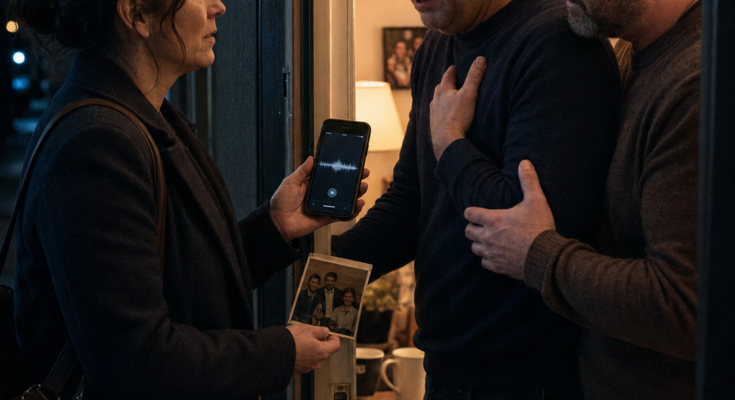
I arrived after midnight with Dad’s cellphone, a small overnight bag, and no idea whether my brother would open the door.
Marcus answered.
He was older than the man I remembered from Thanksgiving. There was gray in his beard, and he wore reading glasses pushed onto his head.
When he recognized me, his expression became guarded.
“Is Daniel okay?” I asked.
Marcus looked behind him.
“He hasn’t been okay since you called about the cancer.”
Daniel appeared in the hallway.
For a moment, we simply stared at each other.
He had our mother’s eyes.
I had forgotten that.
“Dad died Tuesday,” I said.
Daniel nodded.
“I saw the obituary.”
“His last word was your name.”
My brother’s face collapsed.
Marcus caught his arm before his knees gave way.
We sat together in their living room while Dad’s voice filled the space between us.
Daniel listened without interrupting. When Dad apologized to Marcus, Marcus removed his glasses and wiped his eyes.
When the recording ended, Daniel asked me to play it again.
Then a third time.
“Do you forgive him?” I asked.
Daniel stared at the dark phone.
“I don’t know.”
“That’s fair.”
“Do you?”
I thought about the man who taught me to ride a bicycle, sat beside my hospital bed when I had appendicitis, and later let pride cost him twelve years with his son.
“I love him,” I said. “I’m still deciding what else is true.”
Daniel reached for my hand.
“You were there for him, Sarah. Don’t let this make you believe that didn’t matter.”
“I was angry that he said your name.”
“You’re allowed to be.”
“I’m sorry I blamed you.”
He squeezed my fingers.
“You were trying to survive him too.”
I stayed for three days.
Marcus made coffee in the mornings. Daniel showed me photographs of the life I had missed—their small courthouse wedding, vacations, a terrible kitchen renovation, and twelve Christmas trees decorating apartments that slowly became a home.
Dad had called it “that part” of Daniel’s life.
Sitting there, I saw what it really was.
It was a marriage.
It was ordinary, complicated, loyal love.
One year after Dad’s death, Daniel and Marcus came back to Kentucky.
Some relatives were awkward. Uncle Ray avoided Marcus until Daniel directly introduced him as his husband.
I watched my uncle make a choice.
He could repeat Dad’s mistake or learn from it.
Ray held out his hand.
“I’m sorry it took us this long,” he said.
It was not enough to repair twelve years.
But it was a beginning.
We visited Dad’s grave near sunset.
Daniel placed a photograph beneath the flowers. It showed him and Marcus on their wedding day, both laughing as rain soaked through their shirts.
“He would have complained about the weather,” I said.
Daniel smiled.
“He would have complained about the courthouse.”
“He would have secretly liked Marcus’s tie.”
Marcus laughed.
For the first time, Dad’s grave did not feel like the center of our family.
The living people standing around it did.
I still have his cellphone.
Daniel has the original recording, but I keep a copy.
I no longer hear Dad’s final word as a rejection of the daughter who stayed.
I hear it as the name of the son he should never have sent away.
Some apologies arrive too late to restore what was lost.
But if the truth reaches the people still living, it may keep the loss from becoming an inheritance.