Part 1: The Empty Workbench
My children sold their father’s red toolbox for twenty-five dollars while I was at a cardiology appointment.
Tom had been dead for fourteen months.
To Michael, Erin, and Lucas, that apparently meant I had grieved long enough.
They arrived at my house outside Cleveland on a Saturday morning with coffee, trash bags, and a rented pickup truck.
“We’re just going to clear the attic,” Erin promised. “Nothing sentimental.”
For weeks, they had been urging me to sell the house.
Michael said the stairs were dangerous. Erin wanted me closer to her family in Arizona. Lucas kept sending me links to senior communities with swimming pools and cheerful names like Willow Haven.
I was sixty-seven, not ninety-seven.
I still drove, volunteered at the library, mowed my lawn, and knew perfectly well where I wanted to live.
But grief made every disagreement look like evidence that I needed help.
That morning, I agreed they could sort old clothes, broken Christmas decorations, and anything in the attic marked for donation.
“Do not touch the garage,” I said.
All three heard me.
When I returned two hours later, there was a handwritten sign at the end of my driveway.
GARAGE SALE—EVERYTHING MUST GO.
The folding tables were nearly empty. Strangers were carrying away boxes while Michael counted bills beside the garage door.
I walked past him.
Tom’s workshop looked as if someone had removed its bones.
The drill press was gone. So were the clamps, two hand planes, the socket set his father had given him, and the small bench vise he used to hold birdhouse pieces for our grandchildren.
Then I saw the empty space in the center of his workbench.
“Where is the red toolbox?”
Lucas looked toward Michael.
Michael sighed.
“A guy bought it.”
“What guy?”
“I don’t know. A guy.”
“How much?”
No one answered.
I picked up the strip of masking tape where Michael had written the price.
METAL TOOLBOX—$25.
Tom had carried that box to work every weekday for thirty-two years. I bought it for our tenth anniversary when we could barely afford groceries. His initials were scratched beneath the handle. Inside the lid were three crooked crayon hearts our children had drawn when they were small.
It was not expensive.
It was irreplaceable.
“I told you not to touch the garage.”
“Mom, they’re tools,” Michael said. “Dad isn’t coming back to use them.”
The sentence struck harder than he intended.
Erin stepped between us.
“We’re worried about you. You’ve turned this house into a museum.”
“It is my house.”
“That’s not the point.”
“It is exactly the point.”
Lucas tried to hand me the money from the sale.
I looked at the thin stack of bills.
“You sold forty-two years of your father’s life for less than the cost of taking your families to dinner.”
Michael’s face hardened.
“You can’t keep everything forever because Dad touched it.”
“And you cannot sell my belongings because my grief makes you uncomfortable.”
I told them to leave.
That night, I sat alone at Tom’s workbench.
The pale rectangle where the toolbox had rested was the only clean place on the dusty surface.
I remembered Tom standing there after his cancer diagnosis, pretending to organize screws because neither of us knew how to discuss dying.
“People think a workshop is where a man fixes things,” he had said. “Mostly, it’s where he goes until he can face what he can’t fix.”
The next morning, an old pickup stopped outside my house.
A man in his late thirties climbed out carrying the red toolbox.
He set it carefully on my porch.
His eyes were wet.
“Are you Mrs. Parker?” he asked.
I nodded.
He placed one hand on the lid.
“My name is Marcus Green. I bought this yesterday.”
I reached for my purse.
“I’ll give you whatever you want.”
He shook his head.
“I’m not here for money.”
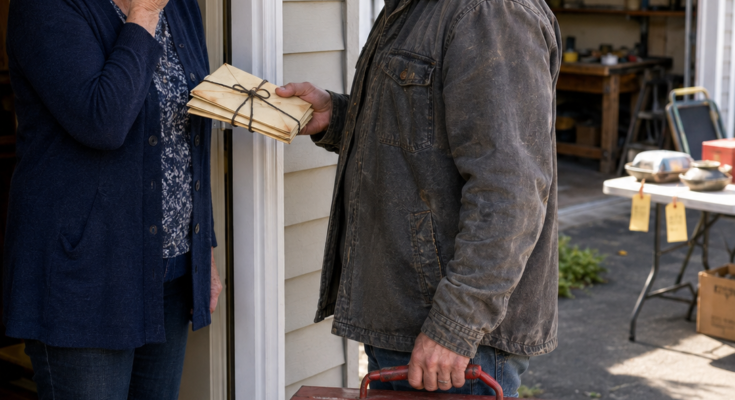
Then he opened the bottom drawer and removed four sealed envelopes tied together with a shoelace.
My husband’s handwriting was on each one.
Part 2: What Tom Hid Inside
Marcus stood in my kitchen holding the toolbox as though it contained something alive.
He explained that the bottom drawer had jammed when he tried to open it. After removing the sliding tray, he discovered a thin wooden panel beneath the sockets.
Under that panel were four letters.
One for each of our children.
One for me.
“I didn’t read them,” Marcus said. “But I saw the name Thomas Parker engraved on the box.”
“You knew my husband?”
His mouth tightened.
“Mr. Parker was my high school shop teacher.”
Marcus had been sixteen when his mother entered treatment and his father went to prison. He slept in his uncle’s basement, missed classes, and was weeks away from dropping out.
Tom began leaving an extra sandwich on the corner of his desk every morning.
He never called it charity.
He called it a mistake in his lunch packing.
Later, Tom helped Marcus apply for an apprenticeship and drove him to the interview when his uncle refused.
“I own a cabinet shop now,” Marcus said. “Eleven employees. A wife. Two daughters. None of that happens if your husband decides I’m someone else’s problem.”
He looked at the empty workshop through the kitchen doorway.
“Your kids said they were selling everything because the owner died. Then I saw his initials.”
My hands trembled as I called Michael, Erin, and Lucas.
They arrived an hour later, defensive until they saw Marcus and the returned toolbox.
I placed the letters on the kitchen table.
The envelopes were dated three weeks before Tom died.
Michael opened his first.
Tom apologized for being harder on our oldest son than on the others. He wrote that he had mistaken criticism for preparation and had spent years pointing out Michael’s mistakes because he was afraid praise would make him weak.
You did not need a tougher father. You needed one who told you he was proud before it was too late. I was proud every day.
Michael stopped reading aloud.
He covered his face with both hands.
Erin’s letter said Tom knew she was unhappy in her marriage.
Do not stay merely because your mother and I stayed. We stayed because we kept choosing each other. Endurance without kindness is not loyalty. It is loneliness with witnesses.
Erin began crying before she reached the second page.
Lucas’s envelope contained a photograph of him at eleven, holding the first wooden boat he built with Tom.
You think I was disappointed when you lost your job. I was frightened because you sounded like me at thirty-four—too ashamed to ask for help. The money that arrived without a name came from me. It was never a debt.
Lucas stared at the photograph.
“He knew?”
“Your father always knew more than he said,” I whispered.
My letter was last.
Tom wrote that he had watched me spend our entire marriage taking care of everyone else.
He knew the children would eventually urge me to leave the house. He understood why. The roof was aging, the winters were hard, and every room carried his absence.
But then he wrote:
Do not let them move you before you are ready just because watching you grieve makes them feel helpless. Stay until the house becomes a home again—or leave when it becomes only work. Make either choice because it is yours.
At the bottom, he had added one sentence for the children.
Ask your mother what she wants. Then love her enough to believe the answer.
Nobody spoke.
Marcus quietly placed the red toolbox back on the workbench.
Michael looked toward the empty shelves where his father’s tools had been.
“Mom,” he whispered, “what have we done?”
Part 3: What We Managed to Bring Home
I did not forgive my children immediately.
The letters explained their father’s heart. They did not excuse what they had done to mine.
I gave Michael the notebook where he had recorded every sale.
“Find what you can,” I said. “Pay whatever it costs. Some people may say no, and you will respect that. But you will try.”
For six weekends, my children drove across three counties retrieving pieces of Tom’s workshop.
They bought back the drill press for twice what they had sold it for. Erin found the old clamps at a flea market after the original buyer resold them. Lucas recovered the bench vise from a retired mechanic who returned it without taking a dollar.
Some things were gone.
The hand planes had been shipped to another state. The socket set could not be traced. A wooden mallet Tom made during his first year of teaching had disappeared with a box of scrap lumber.
We recovered eleven of eighteen items.
The empty spaces mattered too.
They reminded my children that an apology does not always restore what a careless decision removes.
Marcus returned the following Saturday with his two daughters and a tray of cinnamon rolls.
He cleaned the red toolbox, repaired the bent bottom drawer, and showed us how Tom had built the false compartment.
“He must have known someone would find those letters eventually,” Erin said.
Marcus smiled.
“Your dad trusted tools more than people. Tools usually stay where you put them.”
We all laughed.
It was the first laughter that had entered the workshop since Tom died.
After that, my children stopped sending me listings for retirement communities.
Instead, Michael asked whether I wanted help replacing the roof.
Erin asked whether I wanted company—not whether I was lonely.
Lucas came every Thursday evening and sat with me at the kitchen table. Sometimes we discussed his father. Sometimes we discussed baseball or grocery prices. Sometimes neither of us had anything important to say.
He came anyway.
I stayed in the house for another year.
Then one February morning, I spent forty minutes shoveling the driveway and realized I was tired of maintaining a building simply to prove I could.
I called my children.
“I think I’m ready to sell.”
No one celebrated.
No one sent me a brochure.
Michael asked, “Are you sure?”
Erin asked, “Where would you like to go?”
Lucas asked, “How can we help?”
This time, they listened to the answers.
I chose a small condo fifteen minutes away, near the library and the park where Tom and I used to walk.
Before the sale, we invited Marcus to the workshop.
I gave him Tom’s restored drill press and most of the recovered tools for his cabinet shop. The high school received the rest, along with a modest scholarship for students entering the trades.
I kept the red toolbox.
On our final evening in the house, the four of us sat on the garage floor eating pizza from the box.
The workshop was empty again, but this time it did not feel violated.
It felt finished.
Michael traced the pale rectangle on the workbench where the toolbox had rested.
“I thought getting rid of Dad’s things would help you move on,” he said.
“You wanted to fix my grief.”
“I guess I did.”
“Your father would have told you some things cannot be fixed. They can only be carried differently.”
In my new condo, the red toolbox sits beneath the living-room window.
It still smells faintly of sawdust and machine oil.
The top drawer holds Tom’s measuring tape, three crayons, and the four letters.
People sometimes assume I kept it because I could not let go.
They are wrong.
I kept it because grief is not about holding on to everything.
It is about learning which pieces still hold you.