Part 1: The Bill
My sister handed me the bill before our father’s funeral flowers had begun to wilt.
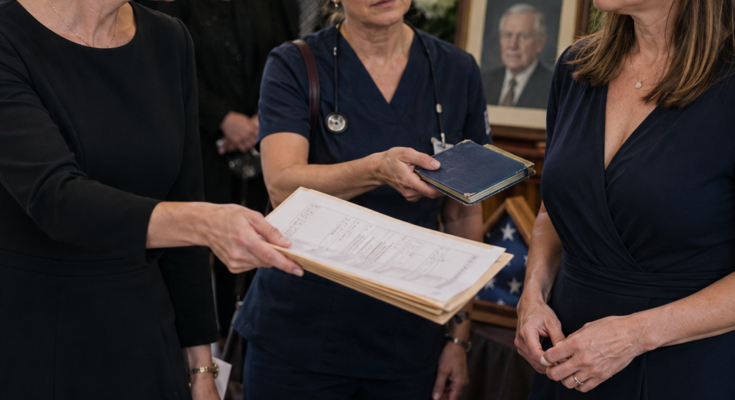
We were in the church reception hall outside Pittsburgh. Dad’s photograph stood beside a folded American flag, smiling in the brown jacket he wore every Thanksgiving. Relatives were eating baked ham from paper plates when Denise pulled me into the empty coatroom.
She closed the door and handed me a manila folder.
On top was a typed invoice for $12,438.52.
“What is this?” I asked.
“Your half of Dad’s care.”
I thought she was joking.
For the final nine months of Dad’s life, I had transferred Denise $1,500 every month. I paid for his hospital bed, the bathroom safety rails, and three emergency flights from Seattle. Every time I offered to take family leave and stay with him, Denise told me not to come.
“He needs consistency,” she would say. “You’ll only upset his routine.”
She lived twelve minutes away. I lived across the country. So I believed her when she said she was cooking his meals, managing his medication, and sleeping on his couch whenever he had a bad night.
Now her invoice charged me for 418 hours of “private caregiving,” plus groceries, gasoline, cleaning, and something called emotional labor.
“I already sent you thirteen thousand five hundred dollars,” I said.
“That covered supplies. It didn’t cover my time.”
“You were billing Dad to visit him?”
Her eyes narrowed. “I put my life on hold while you stayed comfortably in Seattle.”
The coatroom door opened. Aunt Carol stood there holding two cups of coffee.
Denise immediately raised her voice.
“I knew you’d refuse. I just hoped, for once, you’d do the decent thing.”
Several relatives turned toward us.
That was Denise’s gift. She could turn a private accusation into a public verdict before you understood the charge.
“Your sister did everything for Raymond,” Aunt Carol said quietly.
I looked around the reception hall. People avoided my eyes.
They had already heard Denise’s version: the devoted daughter who sacrificed everything and the selfish daughter who sent money instead of love.
I placed the invoice back inside the folder.
“Send me the receipts.”
“I don’t need to prove what I did.”
“Then I don’t need to pay you.”
Denise’s face hardened.
“Dad knew which daughter cared about him.”
Before I could answer, someone touched my elbow.
It was Maria, Dad’s hospice nurse.
She had attended the service alone and stayed near the back. Now she held a worn blue notebook against her chest.
“Laura,” she whispered, “your father asked me to give you this—but only if Denise mentioned money after his funeral.”
Denise went completely still.
“That’s Dad’s private property,” she said.
Maria handed it to me anyway.
“No,” she replied. “He was very clear. It belongs to Laura now.”
Part 2: The Notebook
I opened Dad’s notebook in the restroom.
Every page contained dates, receipts, and observations.
“March 4—Denise came for twenty minutes. Asked me to sign a blank check.”
“April 12—Laura’s transfer arrived. Denise moved it to her account.”
“May 8—Credit card charged $2,840 at Lakeview Resort. I have never been there.”
Dad had paid for groceries, utilities, medication, and copays. The money I sent for his care had gone to Denise.
Inside the back cover was a credit-union letter rejecting a home-equity loan. The application carried Dad’s name and a signature that looked almost right.
Almost.
Maria waited outside. When I emerged, she said, “Your father knew what she was doing.”
“Why didn’t he stop her?”
“He did.”
She explained that six weeks before his death, Dad revoked Denise’s power of attorney. He met with his lawyer and changed several documents.
Then I read the final page.
“Laura, I am not confused. Your sister thinks illness made me helpless. Let her think that until Mr. Wallace has everything secured. If she asks you for money after my funeral, give him this notebook.”
Below that was an appointment time for the following morning.
When I returned, Denise was telling our relatives that Dad’s house was already under contract.
She saw the notebook beneath my arm.
Her smile vanished.
“I hope,” she said, approaching me, “you aren’t going through things that don’t belong to you.”
I slipped the notebook into my purse.
“Actually, Denise, tomorrow we’re finding out exactly what belongs to whom.”
Part 3: What Dad Left Behind
Mr. Wallace’s office overlooked the Monongahela River.
Denise arrived fifteen minutes late wearing sunglasses and carrying the same manila folder. She placed the invoice on the conference table as though it were evidence against me.
“Before we discuss the estate,” she said, “Laura owes me money.”
Mr. Wallace did not touch the folder.
“Before we discuss your invoice,” he replied, “we need to discuss the money you took from your father.”
He opened a thick binder.
Dad had contacted him after noticing withdrawals he could not explain. Together, they reviewed eighteen months of bank and credit-card statements.
There was the resort charge.
There were payments for new kitchen cabinets at Denise’s house.
There was a $6,200 down payment on the SUV she had driven to the funeral.
Altogether, Denise had taken $46,780 from Dad’s accounts, including nearly every dollar I had sent for his care.
“Dad gave me permission,” she said.
“Then you may provide written proof to the estate.”
“He was my father. We didn’t put everything in writing.”
Mr. Wallace looked at the blue notebook.
“Raymond did.”
Denise turned toward me.
“You planned this.”
“I learned about it yesterday.”
“You always wanted the house.”
The house was a three-bedroom brick ranch where Dad had lived for forty-one years. It was worth about $310,000 and had no mortgage.
Denise had already signed a sales agreement with a local investor for $225,000. She planned to use the same power of attorney Dad had revoked.
Mr. Wallace had notified the title company that morning. The sale was stopped.
Then he read the amended trust.
Dad had not cut Denise out of his will. That would have been simpler—and perhaps kinder.
Instead, he ordered a full accounting.
The estate would reimburse me for the money I had sent. The remaining property would be divided equally, but every unauthorized dollar Denise had taken would be deducted from her share.
If she challenged the accounting or tried to use the revoked power of attorney, the executor was instructed to refer the forged loan application and bank records to the county’s elder-abuse unit.
Denise removed her sunglasses.
“He would never threaten me with police.”
Mr. Wallace unfolded a letter written in Dad’s hand.
“He asked me to read this aloud.”
The letter was short.
Denise, I loved you before you knew what money was, and I love you now. But love cannot mean pretending you did not steal from a sick man. Care is what you give when no one is watching—not what you invoice after the funeral.
My sister began to cry.
For one dangerous second, I wanted to comfort her. Then I remembered Dad recording a resort charge while sitting alone in his house.
I slid her invoice across the table.
“Submit it to the executor,” I said. “With receipts.”
She never did.
Denise eventually signed a settlement. She sold her SUV and repaid part of the missing money. The rest came from her inheritance. No criminal complaint was filed because Dad’s instructions allowed repayment first.
The house was sold properly six months later to a young couple expecting their first child.
Before closing, I walked through it one final time.
In Dad’s bedroom, the outline of his hospital bed remained pressed into the carpet. On the nightstand was a photograph of Denise and me as children, both sitting on his shoulders at the county fair.
He had never stopped loving either of us.
He had simply refused to let love become permission.
I kept the photograph, his blue notebook, and the old porch swing.
Denise and I do not speak often now. When we do, she says I chose money over family.
I no longer argue.
Dad’s notebook taught me that truth does not need to shout. It only needs dates, receipts, and the courage to be opened.